Studies indicate *Suaeda salsa* communities contribute to soil organic carbon (SOC) storage, though the extent can vary. In some salt marsh environments dominated by *Suaeda salsa*, invasive *Spartina alterniflora* has been observed to increase SOC in the top 30 cm. Furthermore, *Suaeda salsa* habitats are associated with specific salt-tolerant microbial taxa that may play a role in short-term carbon storage. Compared to other wetland vegetation like *Phragmites australis*, *Suaeda salsa* ecosystems show substantial, though not the highest, SOC sequestration. The knowledge base does not detail specific uses like cover cropping or nitrogen fixation, nor does it provide direct farmer experiences with its integration into practices such as rotational grazing or no-till farming. Further research is needed to fully understand its potential as a primary regenerative agriculture component. While coverage in our knowledge base is limited, the above represents documented uses in regenerative systems.

Regenerative Quick Profile

All recommendations assume integrated, regenerative practices—not conventional inputs.

Climate & Soil Fit

Climate: Tropical Rainforest, Tropical Monsoon, Tropical Savanna, Hot Semi-Arid (Steppe), Cold Semi-Arid (Steppe), Hot Desert, Cold Desert, Humid Subtropical, Oceanic (Maritime Temperate), Hot-Summer Mediterranean, Warm-Summer Mediterranean, Monsoon-Influenced Humid Subtropical, Subtropical Highland, Hot-Summer Continental, Warm-Summer Continental, Subarctic, Monsoon-Influenced Hot-Summer Continental

Zones: USDA 7-11, Australian Zones 3-14

Optimal Soil: Saline Soil, Sandy Soil

System Role & Functions

Primary: Soil Remediation

Secondary: Cover Crop System, Specialty

Key Benefits: Easy establishment, Low maintenance

Management Level

Experience: Beginner-Friendly

Maintenance: Very low maintenance - This halophyte is self-sufficient, thriving in saline soils and drought conditions without requiring supplemental water management or fertility enhancements.

Value Streams
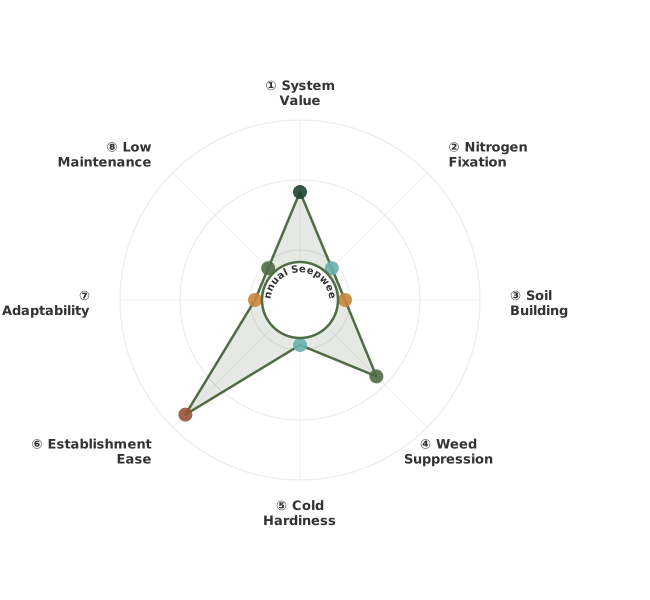
1

Climate Suitability Assessment

Will this plant thrive in your climate?

IDEALLY SUITED

Köppen Zone: Aw (Tropical Savanna), BSh (Hot Semi-Arid (Steppe)), BWh (Hot Desert), Cfa (Humid Subtropical), Csa (Hot-Summer Mediterranean), Csb (Warm-Summer Mediterranean), Cwa (Monsoon-Influenced Humid Subtropical)
USDA Zone: 6a, 7a, 8a, 9a, 10a, 11a, 12a
Australian Zone: temperate, subtropical
EU Climate Region: atlantic

Annual Seepweed thrives in climates with mild winters and long, warm growing seasons, characterized by consistent moisture. This includes humid subtropical (Köppen Cfa), temperate (Australian), and Atlantic (EU) regions, as well as USDA zones 8a through 12, and Australian subtropical and temperate zones. These areas typically receive 30-50 inches (750-1250 mm) of annual rainfall, with temperatures conducive to growth without extreme heat stress. The plant establishes readily, performs its soil remediation functions effectively, and has a high likelihood of overwintering, allowing for multi-year establishment and sustained benefits. Its inherent salt tolerance is a significant advantage in coastal areas within these zones. Minimal supplemental irrigation is usually required, making it a cost-effective option for regenerative agriculture practices, contributing to soil health and nutrient cycling without excessive management inputs.

ADEQUATE

Köppen Zone: Af (Tropical Rainforest), Am (Tropical Monsoon), BSk (Cold Semi-Arid (Steppe)), BWk (Cold Desert), Cfb (Oceanic (Maritime Temperate)), Cwb (Subtropical Highland), Dfa (Hot-Summer Continental), Dfb (Warm-Summer Continental)
USDA Zone: 5a, 5b
Australian Zone: grassland

Annual Seepweed can perform adequately in climates with moderate temperatures and sufficient, though not always abundant, moisture. This includes oceanic (Köppen Cfb) and some grassland (Australian) zones, as well as USDA zones 6a through 7b. These regions generally have growing seasons long enough for the plant to establish and provide some soil remediation benefits, particularly when managed as an annual. However, its performance may be limited by cooler summers, shorter frost-free periods, or occasional dry spells that necessitate supplemental irrigation. While perennial survival is less certain than in ideal zones, it can still contribute to soil health and cover cropping. Management might involve careful timing of planting and potentially some water management to ensure successful establishment and growth, making it a viable but not optimal choice.

NOT RECOMMENDED

Köppen Zone: ET (Tundra), Dfc (Subarctic), Dwa (Monsoon-Influenced Hot-Summer Continental)
USDA Zone: 2a, 3a, 3b, 4a
Australian Zone: arid
EU Climate Region: mediterranean

Annual Seepweed is not recommended for climates with extreme heat and aridity, or those with very short growing seasons and severe winters. This includes hot desert (Köppen BWh), hot semi-arid (Köppen BSh), Mediterranean (Köppen Csa, Csb, EU Mediterranean), and very cold USDA zones (6a, 6b). In hot, dry regions, the lack of consistent moisture and high temperatures prevent establishment and survival, requiring unsustainable irrigation and intensive management. Its effectiveness for soil remediation and cover cropping is severely compromised. In cold regions, winter kill is highly probable, limiting its utility to a risky annual at best, with short growing seasons hindering full development. The economic and practical viability for regenerative agriculture is extremely low in these zones, making alternative species a far better choice.

Better alternatives for these "not recommended" zones: Atriplex spp. (Saltbush) (highly drought-tolerant and salt-tolerant native Australian plants for arid/semi-arid regions), Salsola tragus (Russian Thistle) (opportunistic, drought-tolerant annual that can tolerate saline soils, though can be weedy), Hairy Vetch (cold-hardy annual legume for nitrogen fixation in cold zones), Winter Rye (extremely cold-hardy cover crop for biomass and soil protection)

Note: Zones listed above represent climates where this plant can produce reliably with reasonable management. Climate zones not mentioned would require intensive climate modification (greenhouses, extensive infrastructure) and are not economically viable for regenerative agriculture purposes.

2

Soil Suitability Assessment

Which soil types work best for this plant?

IDEALLY SUITED

Saline Soil, Sandy Soil

This plant thrives in these soil types without requiring amendments or remediation. Natural soil conditions support optimal growth and productivity.

ADEQUATE

Alkaline Soil, Clay Soil, Loam Soil, Rocky Soil

This plant performs acceptably in these soil types with moderate, manageable remediation such as pH adjustment, compost addition, or drainage improvement. The required amendments are practical and cost-effective for regenerative agriculture.

NOT RECOMMENDED

Acidic Soil, Desert Soil, Rich Soil, Wet Soil

Growing this plant in these soil types would require impractical remediation such as complete soil replacement, extensive amendments, or cost-prohibitive infrastructure. These conditions are not economically viable for regenerative agriculture.

Note: Soil suitability assessments focus on remediation requirements. "Ideally Suited" means the plant generally thrives without the need for substantial amendments, "Adequate" means manageable remediation (lime, compost, mulch), and "Not Recommended" means impractical soil changes would be required. Climate factors like rainfall and temperature also influence success.

3

Seasonal Considerations

Planting timing, growth duration, and harvest windows

Suaeda salsa offers flexible cover cropping opportunities across a range of climates. For spring planting, sow after the danger of hard frost has passed and soil temperatures consistently reach above 50°F (10°C). It establishes quickly, typically within 2-3 weeks, providing a vibrant summer cover. If a summer planting is desired, into warm, moist soils after a cash crop harvest, Suaeda salsa can thrive.

Fall planting is most effective when sown at least 4-6 weeks before the first expected frost, allowing for robust establishment before winter dormancy. In warmer zones (Cfa, Csa, BWh, BSh), it may overwinter and resume growth in early spring. In cooler climates (Cfb, Csb), it will likely winter-kill, leaving behind valuable organic matter. Termination should occur well before planting your next cash crop, ideally when biomass is at its peak but before seed set to manage volunteer potential. This allows ample time for decomposition and soil preparation. Consider it a valuable warm-season cover for summer drought resilience or a quick-growing option for late-season soil improvement.

4

System Role & Multi-Benefit Value

Functional roles, integration strategies, and stacked benefits

Functional Role

Total System Value

Seepweed offers significant system value beyond direct harvest, primarily through its soil remediation capabilities. It excels in coastal and saline environments, where it can tolerate high salt concentrations, making it ideal for reclaiming marginal lands. This contributes to risk diversification by enabling the productive use of otherwise unproductive areas. While direct harvest value might be limited to specific niche markets (e.g., salt-tolerant forage), its ecosystem services are substantial. Excerpts suggest its role in coastal wetland carbon sequestration (though sometimes influenced by invasive species like Spartina alterniflora). By improving soil physicochemical properties over time (e.g., pH, salinity), it creates a more favorable environment for other agricultural components. It acts as a foundational plant in a regenerative system, paving the way for more diverse and productive vegetation, enhancing overall farm resilience.

Integration Characteristics

Multi-Benefit Value: Not Recommended - Within its specialized saline niche, Suaeda salsa offers ecosystem services by contributing to soil health and providing a food source.

5

Management & Care Requirements

Integration guidance, maintenance needs, and care practices

How to Integrate This Plant

Seepweed (Suaeda salsa) is a halophytic plant well-suited for soil remediation in coastal or saline agricultural systems. Its primary role is to tolerate and potentially extract salt and other contaminants from marginal lands, making them more suitable for other crops over time. Integrate seepweed into systems where soil salinity is a challenge, such as buffer zones along coastlines or areas impacted by salinization. It can be part of a phased reclamation strategy. In Year 1-2, it establishes and begins initial salt tolerance. By Year 3-5, it can contribute to soil organic carbon accumulation and provide habitat. Its value is in reclaiming unproductive land for future use, acting as a pioneer species. It can also be grazed by salt-tolerant livestock. Its contribution is primarily ecological, improving soil health and creating a more stable environment for subsequent agricultural activities, thus diversifying risk by utilizing otherwise unusable land.

Integration Practices & Management

The provided knowledge base offers limited direct insights into the specific regenerative agriculture practices employed by farmers for integrating *Suaeda salsa*. The available sources primarily focus on ecological studies of *Suaeda salsa* in its native or invaded habitats, rather than on its deliberate cultivation within regenerative farming systems. For instance, studies detail its role in salt marshes and its interaction with invasive species like *Spartina alterniflora*, noting its impact on soil organic carbon (SOC) in certain contexts. Research also examines soil-vegetation co-evolution in reclaimed areas where *Suaeda salsa* may be present, observing improvements in soil physicochemical properties over time. However, information regarding establishment methods such as seeding rates or tillage practices, integration with grazing systems, termination strategies, or its use in cash crop rotations is not present within these sources. Consequently, practical farmer experiences and detailed management considerations for regenerative agriculture are not documented in this specific collection of texts.

Management Profile

Maintenance Intensity: Ideally Suited - This halophyte is self-sufficient, thriving in saline soils and drought conditions without requiring supplemental water management or fertility enhancements.

6

Economics & Value Streams

Direct harvest, system benefits, ecosystem services, and risk diversification

Comprehensive economic analysis including direct harvest value, system enhancement contributions, ecosystem services, value timeline, and risk diversification strategies.

Cover Crop Investment

Metric Value
Seed Cost $15-30/acre $37-74/ha
Termination Cost 20-50 49-124
Biomass Production 2-5 4-11
N Fixation Value N/A N/A
Weed Control Savings 10-30 25-74

Cover crops are soil investments, not cash crops. Economics measured in soil health gains, input reduction, and subsequent crop performance. Values show direct costs and estimated benefits.

System Enhancement Value

Beyond harvest: soil healing, contamination removal, and land restoration

Soil Remediation & Building

Annual seepweed (Suaeda salsa) offers significant soil remediation value, particularly in saline and reclaimed estuarine environments. Knowledge base excerpts highlight its role as a salt-tolerant pioneer species that thrives in challenging conditions, contributing to the stabilization and improvement of degraded soils. As soil conditions improve over time, seepweed can facilitate the transition to more diverse vegetation communities, as observed in the Hengsha Island chronosequence study where its presence was associated with declining pH, electrical conductivity, and salinity, alongside accumulating nitrogen, phosphorus, and potassium. This process of soil amelioration is critical for restoring functionality to land impacted by salinization or reclamation, making it suitable for a wider range of agricultural or ecological purposes. Furthermore, seepweed contributes to soil organic carbon (SOC) accumulation, as indicated by studies comparing it with invasive species like *Spartina alterniflora*. While its direct impact on SOC may vary, its role in native wetland ecosystems suggests a contribution to soil health and structure, which underpins broader ecosystem functions.

Ecosystem Service Contributions

Environmental contributions: carbon, pollinators, wildlife, and water

  • Carbon Sequestration: Annual seepweed contributes to carbon sequestration through its biomass production and incorporation into soil organic matter. Studies suggest its presence in native wetland ecosystems can lead to SOC accumulation, though the rate and long-term stability may be influenced by other factors and competing species. Its role in soil remediation also indirectly supports carbon storage by improving soil health.
  • Pollinator Support: Low. While it's a pioneer species in salt marshes, there is no specific mention of its value to pollinators in the provided knowledge base excerpts. Its primary role is ecological stabilization and soil improvement.
  • Wildlife Habitat: Provides habitat for salt-tolerant pioneer species, contributing to the initial stages of ecological succession in reclaimed areas. Its presence can support a specific niche of invertebrate and microbial communities adapted to saline conditions. Limited information is available on its direct value for larger wildlife.
  • Water Quality: Not applicable

Value Timeline: Soil Healing Process

When you'll see results: remediation timeline varies by contamination type

Years 1-2

Initial soil remediation, stabilization of saline/reclaimed soils, and establishment of pioneer vegetation. Contribution to early stages of soil organic matter development.

Years 3-5

Continued soil improvement, including reductions in salinity and pH. Potential for increased vegetation cover and biodiversity as soil conditions become more favorable for other species. May begin to outcompete invasive species in some contexts.

Years 10-20

Established soil health and structure, facilitating a shift to more diverse plant communities. Long-term contribution to soil organic carbon content and overall ecosystem resilience in formerly degraded areas.

20+ Years

Sustained soil remediation benefits, acting as a foundational species in restored coastal or saline ecosystems. Ongoing contribution to soil carbon storage and support for a mature, stable ecosystem.

Farm Risk Reduction

How this reduces farm risk: future land value and production potential

  • Multiple Revenue Streams: Specialty crop potential (if markets exist), soil remediation services (potential for contracts with land managers), ecological restoration projects, potential for biomass for bioenergy or other uses.
  • Temporal Income Spread: Ongoing soil remediation and ecological service provision throughout its lifecycle. Potential for discrete harvestable products if cultivated for specialty markets. Value is primarily linked to its ecological function rather than annual harvest.
  • Market Risk Hedge: Reduces reliance on conventional agricultural inputs by improving soil health naturally. Offers a solution for challenging land types (saline, reclaimed) that might otherwise be unproductive. Its ecological function provides resilience against soil degradation and salinization.
7

Regenerative Suitability Details

Comprehensive trait ratings for system integration assessment

Comparative ratings for this plant across key regenerative agriculture traits.

Trait Suitability Explanation
Cold Hardiness Not Recommended As an annual, Suaeda salsa thrives during warmer seasons, contributing to soil building and ground cover when conditions are favorable, and does not provide winter protection.
Weed Suppression Adequate In saline or coastal areas, Suaeda salsa can form a dense canopy, contributing to natural weed suppression and enhancing soil surface protection.
Nitrogen Fixation Not Recommended Suaeda salsa, a non-legume, does not contribute to nitrogen fixation; its role is in nutrient cycling within its specific saline niche.
Root System Depth Not Recommended This species has shallow roots, primarily residing in the topsoil, which contributes to surface soil structure and nutrient cycling.
Biomass Production Not Recommended Adapted to saline environments, Suaeda salsa provides valuable biomass for soil organic matter in its niche, rather than for broad cover cropping purposes.
Establishment Ease Ideally Suited Highly salt-tolerant, Suaeda salsa establishes rapidly in challenging alkaline soils, quickly providing ground cover and contributing to soil surface stability.
Multi Benefit Value Not Recommended Within its specialized saline niche, Suaeda salsa offers ecosystem services by contributing to soil health and providing a food source.
Climate Adaptability Not Recommended As a halophyte, Suaeda salsa thrives in saline and warm conditions (zones 7-10), demonstrating resilience within its specific ecological niche.
Maintenance Intensity Ideally Suited This halophyte is self-sufficient, thriving in saline soils and drought conditions without requiring supplemental water management or fertility enhancements.

Comparative System: Ratings compare plants within their economic category (e.g., cover crop nitrogen fixation compared to other cover crops, not to all plants). Individual farm conditions and management practices significantly influence actual performance.

8

Learn More

Why farmers use this plant and additional resources

Why Regenerative Farmers Use This Plant

Suaeda salsa, commonly known as alkali sea-purslane, annual seepweed, alkali-grass, or sea blite, offers significant regenerative benefits, particularly in saline or marginal lands that are often underutilized. While not a nitrogen-fixing legume, it excels at scavenging available nutrients, especially sodium and other salts, from the soil profile and converting them into valuable biomass. This process helps to remediate saline soils, making them more amenable to other crops over time. In systems where salinity is a challenge, Suaeda salsa can be a critical component for building soil health and productivity, acting as a bio-accumulator that reduces the negative impacts of salt on subsequent cash crops. Its dense growth habit also contributes to improved soil structure and water infiltration, especially in arid and semi-arid regions where soil health is paramount.

Integrating Suaeda salsa into regenerative systems can provide substantial benefits beyond soil remediation. As a cover crop, it produces significant above-ground biomass, typically ranging from 2-5 tons per acre (4,500-11,200 kg/ha) under favorable conditions. This biomass, when decomposed, adds organic matter to the soil, enhancing its fertility and water-holding capacity. Furthermore, its ability to thrive in saline environments means it can be used in areas where many other cover crops fail, offering a unique solution for weed suppression and erosion control in challenging landscapes. Its presence can also support beneficial insect populations by providing habitat and forage, contributing to a more resilient farm ecosystem.

The quantitative ecosystem benefits of Suaeda salsa are most pronounced in its ability to remediate saline soils and improve soil structure. By actively growing in these challenging conditions, it prevents wind erosion and dust generation, improving air quality. Its extensive root system, reaching depths of 12-24 inches (30-60 cm), helps to break up compacted soil layers and improve water infiltration, even in soils with high salt content. Over a 3-5 year rotation, consistent use of Suaeda salsa on marginal lands can lead to a measurable increase in soil organic matter (SOM) content, typically adding 0.5-1.5% SOM over a 3-5 year rotation when managed effectively, or improving SOM by 0.1-0.3% annually. This enhanced SOM improves soil structure, aeration, microbial activity, water retention, and reduces runoff, thereby mitigating soil erosion. Its resilience in saline conditions also means it can be a valuable component in crop rotations, breaking disease cycles and improving the overall health of the soil.

Regional success stories highlight Suaeda salsa's adaptability. In the coastal regions of China, it has long been cultivated in saline-alkali soils for both its edible qualities and its soil-improving properties, often rotated with rice or other grains. Farmers in the Mediterranean basin are exploring its use in marginal, salt-affected lands to improve soil structure and reduce the need for costly soil amendments. In parts of Australia, where salinity is a widespread issue, Suaeda salsa is being trialed as a cover crop to reclaim salt-affected paddies and improve the sustainability of dryland farming systems. In the salt-affected plains of Western Australia, farmers utilize it in rotation with wheat to improve soil structure and scavenge excess salts, reporting improved yields in subsequent cash crops. In the brackish marshes of the US Atlantic coast, it is used in buffer zones to filter runoff and stabilize shorelines. In parts of India, where saline soils are prevalent, it is grazed by livestock, providing a critical source of nutrition during dry seasons and helping to improve the health of degraded pastures. In the arid and semi-arid regions of the western United States, its salt tolerance makes it a candidate for improving degraded soils or for use in areas with limited water resources. In the UK, it can be incorporated into rotations on coastal farms susceptible to soil salinization, providing ground cover and improving soil structure. Australian dryland farmers might consider it for marginal lands where other cover crops fail, establishing it with autumn rains to build soil organic matter and provide grazing potential. In Brazilian coffee plantations, its resilience could allow it to serve as a groundcover in inter-rows, contributing to soil health and erosion control without competing excessively with the coffee trees. In the corn and soybean belt of the United States, it can be used as a summer cover crop on marginal, salt-affected fields that are not suitable for cash crops, improving soil health before the main season. In Brazilian coffee plantations, it can be interseeded into the understory to help manage soil salinity and improve soil structure in areas prone to waterlogging, contributing to the overall health of the coffee agroecosystem. In the rice paddies of Southeast Asia, it can be grown on bunds or in rotation to improve soil health and provide supplemental forage. In the coastal agricultural areas of the UK, it is planted in saline intrusion zones to stabilize soil and improve its structure, often grazed by sheep before spring planting. In Brazilian semi-arid regions, it can be integrated into pasture systems to provide drought-tolerant forage and improve soil salinity. In the arid regions of the US Southwest, it is used in fallow periods to prevent wind erosion and scavenge any available moisture and nutrients.

9

How to Integrate This Plant

Practical guidance for regenerative systems

Establishing Suaeda salsa is relatively straightforward, making it accessible for a wide range of regenerative farmers. For broadcast seeding, rates typically range from 3-7 lbs/acre (3.4-7.8 kg/ha) for dense ground cover. When drilled, a slightly lower rate of 2-4 lbs/acre (2.2-4.5 kg/ha) is recommended, ensuring optimal seed-to-soil contact. Seeding rates generally range from 5-15 lbs/acre (5.6-16.8 kg/ha) for dense cover, depending on the desired outcome and seedbed preparation. For drilled seed, rows can be 6-12 inches (15-30 cm) apart, and if row-planted for biomass or specific management, rows can be spaced 12-24 inches (30-60 cm) apart. The ideal planting depth is shallow, between 0.125-0.25 inches (0.3-0.6 cm), as the seeds require light for germination. Optimal planting depth is shallow, around 0.25-0.5 inches (0.6-1.3 cm), to ensure good seed-to-soil contact. For optimal establishment, planting is best timed with the onset of consistent moisture.

Suaeda salsa can be sown from early spring through mid-summer in temperate regions, and throughout the warmer months in hotter climates. For instance, in the Northern Hemisphere, planting can occur from April to July, or in late August to early September for a fall cover. In the Southern Hemisphere, this would translate to planting from October to January, or February to March. The plant establishes relatively quickly, usually within 14-21 days (or 15-30 days, or 20-30 days), provided adequate moisture is available.

Once established, Suaeda salsa is remarkably drought and heat tolerant, requiring minimal supplemental water beyond natural rainfall, typically around 0.5-1 inch (1.3-2.5 cm) of moisture per week during its initial establishment phase. It requires adequate moisture, approximately 1 inch (2.5 cm) per week, during its initial growth phase for vigorous development. Fertility management should prioritize biological approaches; its ability to scavenge nutrients means it often requires little external input. In systems with existing organic matter, such as areas recently amended with compost or manure, it will thrive. Incorporating compost, utilizing residue from previous cover crops, or integrating animal manure are ideal. Its nutrient scavenging capabilities mean it performs well in soils with moderate to high nutrient levels, often utilizing residual nutrients from previous crops or manure applications. It requires minimal supplemental fertility, and synthetic inputs should be avoided unless transitioning from highly degraded soils.

The plant typically reaches maturity in 45-60 days (or 60-90 days for full biomass), growing to a height of 1-3 feet (0.3-0.9 m) (or 2-4 feet (0.6-1.2 m)). Pest and disease management is generally minimal due to its resilience and ability to outcompete many weeds, with a focus on maintaining healthy soil biology to prevent issues. Focus on maintaining healthy soil biology and crop rotation to prevent any potential issues. Encouraging beneficial insects through habitat and diverse planting, and ensuring good soil health will naturally suppress most issues.

For category-specific integration as a cover crop, termination and residue management are key. Suaeda salsa can be terminated through natural processes where winters are sufficiently cold to cause winterkill, typically below 15°F (-9°C) (or below 0°F / -18°C). In milder climates, grazing with livestock is an effective and beneficial method, providing nutrition for animals while reducing biomass. Mowing or crimping can also be employed, ideally at the flowering stage to maximize biomass and nutrient return. Roller-crimping is a viable option at the 50% bloom stage, creating a dense mulch mat. If mechanical or biological termination methods are exhausted or impractical during a transition phase, herbicide can be used as a last resort, applied when the plant is actively growing. Termination should ideally occur 2-3 weeks before planting the subsequent cash crop to allow for residue decomposition. The residue breaks down relatively quickly, typically within 30-45 days (or 30-60 days), releasing scavenged nutrients back into the soil for the following crop. While Suaeda salsa does not fix atmospheric nitrogen, its biomass contributes valuable organic matter. Farmers can choose to allow for reseeding in subsequent years if volunteer stands are desired, or manage termination to prevent excessive spread.

View Full Document (Printable single-page version)