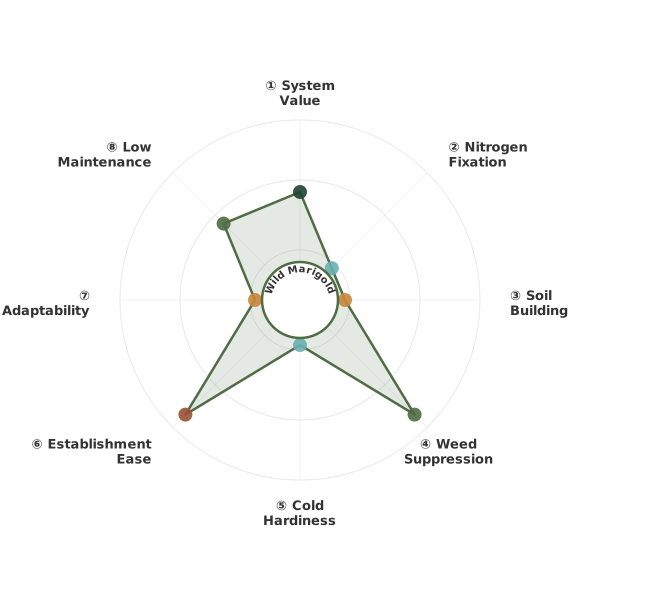
Available excerpts suggest several applications within regenerative agriculture. Primarily, it functions as a beneficial interplanting species, notably with tomatoes, to deter pests like root-knot nematodes and tomato hornworms. This aligns with polyculture strategies aimed at maximizing space and reducing pest pressure. Tagetes minuta also exhibits allopathic properties, capable of suppressing weeds, and is nematocidal, offering potential benefits for soil health by managing nematode populations. Furthermore, its essential oils have demonstrated insecticidal activity against aphids. While not explicitly detailed as a cover crop or forage in these excerpts, its pest-deterring and weed-suppressing qualities suggest potential roles in enhancing biodiversity and soil health within integrated farming systems. Farmer experience highlights its efficacy in pest management, though caution is advised regarding potential dermatitis from its oils. While coverage in our knowledge base is limited, the above represents documented uses in regenerative systems.

Regenerative Quick Profile

All recommendations assume integrated, regenerative practices—not conventional inputs.

Climate & Soil Fit

Climate: Tropical Rainforest, Tropical Monsoon, Tropical Savanna, Hot Semi-Arid (Steppe), Cold Semi-Arid (Steppe), Hot Desert, Cold Desert, Humid Subtropical, Oceanic (Maritime Temperate), Hot-Summer Mediterranean, Warm-Summer Mediterranean, Monsoon-Influenced Humid Subtropical, Subtropical Highland, Hot-Summer Continental, Warm-Summer Continental, Subarctic, Monsoon-Influenced Hot-Summer Continental, Tundra

Zones: USDA 8-11, Australian Zones 12-14, EU Mediterranean, Subtropical

Optimal Soil: Loam Soil

System Role & Functions

Primary: Cash Crop With Services

Secondary: Cover Crop System, Specialty

Key Benefits: Easy establishment, Weed Suppression

Management Level

Experience: Beginner-Friendly

Maintenance: Moderate maintenance - This vigorous plant thrives with balanced fertility management and can be integrated into a system where its pest-repellent qualities are leveraged, with attention to managing its spread.

Value Streams

  • Cash crop production
1

Climate Suitability Assessment

Will this plant thrive in your climate?

IDEALLY SUITED

Köppen Zone: Af (Tropical Rainforest), Am (Tropical Monsoon), Aw (Tropical Savanna), Cfa (Humid Subtropical), Cwa (Monsoon-Influenced Humid Subtropical)
USDA Zone: 6a, 7a, 8a, 9a, 10a, 11a, 12a
Australian Zone: tropical, subtropical

Wild Marigold thrives in climates characterized by long, warm to hot growing seasons with minimal frost risk and adequate moisture. These conditions are met in Köppen Cfa, Aw, As zones and extensively across USDA zones 8a through 13a, Australian subtropical and tropical zones, and parts of the grassland and temperate zones. Optimal temperatures for flowering are consistently maintained, promoting abundant and continuous bloom production. Rainfall patterns are generally sufficient, though supplemental irrigation can further enhance yields in areas with distinct dry periods. Establishment is highly reliable, and minimal management is required beyond standard cultivation practices. These zones allow Wild Marigold to fully express its potential as a cash crop, providing consistent yields for its primary and secondary functions, with high establishment success rates and minimal risk of crop failure due to climatic factors. The extended warm periods ensure a prolonged harvest season, maximizing economic viability and ecological services.

ADEQUATE

Köppen Zone: BSh (Hot Semi-Arid (Steppe)), Cfb (Oceanic (Maritime Temperate)), Csa (Hot-Summer Mediterranean), Csb (Warm-Summer Mediterranean), Cwb (Subtropical Highland), Dfa (Hot-Summer Continental), Dfb (Warm-Summer Continental)
USDA Zone: 5a, 5b
Australian Zone: grassland, temperate
EU Climate Region: atlantic, mediterranean

Wild Marigold can be successfully cultivated in climates with moderate growing seasons and temperatures, though some management considerations are necessary. This includes Köppen Cfa, Cwa, Aw, and As zones, as well as USDA zones 7a and 7b, Australian grassland and temperate zones, and EU Atlantic and Mediterranean regions. While these zones generally provide sufficient warmth and moisture, they may experience periods of heat stress, insufficient rainfall during dry spells, or cooler summers that can reduce flowering intensity. Supplemental irrigation is often beneficial, particularly during dry periods in Mediterranean and grassland climates, to ensure consistent bloom production and plant health. Establishment is generally good with proper timing, but yields might be slightly lower or the harvest season shorter compared to 'ideally suited' zones. These areas offer a good balance of feasibility and productivity, making Wild Marigold a viable option with standard agricultural practices and some attention to water management.

NOT RECOMMENDED

Köppen Zone: ET (Tundra), BSk (Cold Semi-Arid (Steppe)), BWh (Hot Desert), BWk (Cold Desert), Dfc (Subarctic), Dwa (Monsoon-Influenced Hot-Summer Continental)
USDA Zone: 2a, 3a, 3b, 4a
Australian Zone: arid

Wild Marigold is not recommended for climates with extreme heat, low humidity, and very low precipitation, such as Köppen BSh and BWh zones, and Australian arid zones. These environments present severe challenges due to intense solar radiation, rapid desiccation, and insufficient natural moisture, leading to poor germination, stunted growth, and minimal to no flowering. Survival and bloom production would require extensive and costly irrigation infrastructure, making cultivation economically unfeasible. The plant's requirements for consistent moisture and moderate temperatures are fundamentally unmet in these harsh conditions. While technically possible to grow with extreme intervention, the high input costs, low probability of success, and minimal yield make it a poor choice for regenerative agriculture in these regions. Alternative, more drought and heat-tolerant species are significantly better suited to these challenging arid and semi-arid environments.

Better alternatives for these "not recommended" zones: Desert Marigold (Baileya multiradiata) (native to arid regions, highly drought and heat tolerant), Cosmos (Cosmos bipinnatus) (tolerates heat and drought better than marigolds, can reseed), Zinnia (Zinnia elegans) (heat-loving annual that performs well in dry conditions with minimal water), Portulaca (Portulaca grandiflora) (succulent annual that thrives in hot, dry, sunny conditions)

Note: Zones listed above represent climates where this plant can produce reliably with reasonable management. Climate zones not mentioned would require intensive climate modification (greenhouses, extensive infrastructure) and are not economically viable for regenerative agriculture purposes.

2

Soil Suitability Assessment

Which soil types work best for this plant?

IDEALLY SUITED

Loam Soil

This plant thrives in these soil types without requiring amendments or remediation. Natural soil conditions support optimal growth and productivity.

ADEQUATE

Clay Soil, Rich Soil, Rocky Soil, Sandy Soil

This plant performs acceptably in these soil types with moderate, manageable remediation such as pH adjustment, compost addition, or drainage improvement. The required amendments are practical and cost-effective for regenerative agriculture.

NOT RECOMMENDED

Acidic Soil, Alkaline Soil, Desert Soil, Saline Soil, Wet Soil

Growing this plant in these soil types would require impractical remediation such as complete soil replacement, extensive amendments, or cost-prohibitive infrastructure. These conditions are not economically viable for regenerative agriculture.

Note: Soil suitability assessments focus on remediation requirements. "Ideally Suited" means the plant generally thrives without the need for substantial amendments, "Adequate" means manageable remediation (lime, compost, mulch), and "Not Recommended" means impractical soil changes would be required. Climate factors like rainfall and temperature also influence success.

3

Seasonal Considerations

Planting timing, growth duration, and harvest windows

Tagetes minuta thrives in warmer conditions, making it adaptable for various cover cropping strategies. For spring planting, sow after the last expected frost when soil temperatures consistently reach 50°F (10°C) and rising. It establishes quickly, often within two to three weeks, and can provide significant biomass before late spring cash crop planting. In regions with mild winters, a late summer or early fall planting, at least six to eight weeks before the first expected frost, can allow for substantial growth and potentially overwintering, especially in zones Cfa and Cwa.

Termination is key to integrating Tagetes minuta effectively. Aim to terminate the cover crop when it reaches peak biomass, typically four to six weeks after establishment for maximum organic matter contribution, and always several weeks before planting your next cash crop to allow for decomposition. While not a true winter hardy cover, it can offer some protection in milder climates. In warmer zones (BSh, BWh, Aw, As), it can be used as a summer cover crop between cash crops, planted after harvest and terminated before the next planting cycle. Frost seeding is generally not recommended due to its warm-season germination requirements.

4

System Role & Multi-Benefit Value

Functional roles, integration strategies, and stacked benefits

Functional Role

Total System Value

Tagetes minuta offers multifaceted benefits within a regenerative agricultural system. Its primary value stems from its role as a cash crop, with potential for culinary use as 'black mint' (excerpts,). Beyond direct harvest, it provides significant ecological services, notably as a bio-fumigant and nematicide, helping to manage soil-borne pests and reduce disease pressure on companion crops like tomatoes (excerpt). This directly enhances system resilience by improving soil health and reducing the need for external inputs. Its allopathic properties contribute to weed suppression, aligning with reduced tillage practices. Furthermore, research indicates insecticidal activity against pests such as the cotton aphid (excerpt), adding another layer to its pest management capabilities. While not a primary nitrogen fixer or structural component like trees, its contribution to a healthy soil biome and its role in integrated pest management significantly enhance overall farm resilience by diversifying pest control strategies and improving crop health. The potential for dermatitis due to its oils (excerpt) requires careful handling but does not negate its systemic benefits.

Integration Characteristics

Multi-Benefit Value: Not Recommended - Its primary value lies in its essential oils and potential pest-repellent properties, contributing to a more biodiverse and robust integrated farming system.

5

Management & Care Requirements

Integration guidance, maintenance needs, and care practices

How to Integrate This Plant

Wild marigold (Tagetes minuta) can be integrated into regenerative systems primarily as a cash crop with significant ecological services. Its nematocidal properties make it valuable for interplanting with susceptible crops like tomatoes, as mentioned in excerpt, helping to manage root-knot nematodes and deter pests such as tomato hornworms. This practice directly supports soil health and reduces reliance on synthetic pesticides. Additionally, its allopathic effects can suppress weeds, contributing to reduced tillage systems. Tagetes minuta can also be incorporated into alley cropping systems or as a border crop to protect more sensitive plantings. Its rapid growth and potential height (up to 8-9 feet, per excerpt) mean it can offer some temporary shading or act as a living mulch in its first year. The plant's oils have evaluated insecticidal activities against aphids, suggesting its use in integrated pest management strategies (excerpt). Overall, its value lies in direct harvest, pest and disease management, and weed suppression, contributing to a more resilient and biodiverse farm ecosystem. It is not typically associated with nitrogen fixation, windbreaks, or significant erosion control.

Integration Practices & Management

The provided knowledge base offers limited insight into the specific establishment, integration, and termination strategies regenerative farmers employ with Tagetes minuta. However, it highlights its potential as a beneficial cover crop and interplant. Source suggests interplanting Tagetes minuta with vegetables, such as tomatoes, to deter pests like root-knot nematodes and tomato hornworms, indicating a role in integrated pest management within crop systems. Source notes its allopathic effects, capable of suppressing weeds, and its nematocidal properties, suggesting it could be valuable in no-till or minimal tillage systems for soil health improvement. Source mentions its use in Andean cuisine, implying cultivation for food or condiment purposes, though it also cautions about potential dermatitis from its oils. The knowledge base does not detail specific seeding rates, timing, grazing integration, or termination methods. Consequently, practical farmer experiences regarding its management, fertility needs, competition management, succession planning, or specific integration into cash crop rotations like relay cropping or rotation sequences are not available within these mentions.

Management Profile

Maintenance Intensity: Adequate - This vigorous plant thrives with balanced fertility management and can be integrated into a system where its pest-repellent qualities are leveraged, with attention to managing its spread.

6

Economics & Value Streams

Direct harvest, system benefits, ecosystem services, and risk diversification

Comprehensive economic analysis including direct harvest value, system enhancement contributions, ecosystem services, value timeline, and risk diversification strategies.

Cover Crop Investment

Metric Value
Seed Cost $15-30/acre $37-74/ha
Termination Cost 20-50 49-124
Biomass Production 2-5 4-11
N Fixation Value N/A N/A
Weed Control Savings 10-30 25-74

Cover crops are soil investments, not cash crops. Economics measured in soil health gains, input reduction, and subsequent crop performance. Values show direct costs and estimated benefits.

System Enhancement Value

Beyond harvest: ecosystem services from regenerative cash crop practices

Ecological Service Contributions

Tagetes minuta, also known as Mexican marigold or black mint, offers significant pest management services within integrated farm systems. Its nematocidal properties are highlighted in the knowledge base excerpts, indicating its potential to suppress nematode populations in the soil. This directly contributes to improved plant health and reduced crop losses, particularly for susceptible crops like tomatoes. Furthermore, the plant exhibits allopathic effects, capable of suppressing unwanted weeds, thus reducing the need for mechanical or chemical weed control and conserving soil moisture. The knowledge base also mentions its inclusion in fruit tree guilds to attract beneficial insects, suggesting it can play a role in supporting a more diverse and resilient agroecosystem by providing habitat and food sources for predators that control fruit pests. Its use as an interplant with vegetables demonstrates its ability to maximize space utilization and provide multiple benefits concurrently, enhancing overall farm productivity and sustainability.

Ecosystem Service Contributions

Environmental contributions: carbon, pollinators, wildlife, and water

  • Carbon Sequestration: As a fast-growing annual or short-lived perennial, Tagetes minuta contributes to soil organic matter through biomass decomposition, thus sequestering carbon in the short to medium term. Its dense growth can also help protect bare soil from erosion, further aiding carbon retention.
  • Pollinator Support: Medium. While not explicitly listed as a primary pollinator attractant, its flowers can provide a nectar and pollen source for various small insects, including those that are beneficial predators. Its role in pest management may indirectly support broader pollinator health by reducing pesticide use.
  • Wildlife Habitat: Limited. Tagetes minuta is not typically grown for wildlife habitat in terms of providing significant food or shelter resources for larger animals or birds. Its primary ecological role is in pest and weed management.
  • Water Quality: Not applicable

Value Timeline: Production & Services

When you'll see results: varies by crop (annual harvest vs. perennial establishment)

Years 1-2

Initial pest suppression (nematodes, weeds), support for beneficial insects, and improved soil health through biomass incorporation. Potential for initial cash crop harvest if established as a specialty item.

Years 3-5

Established pest management services, continued weed suppression, and enhanced beneficial insect populations. Increased soil organic matter and improved soil structure. Potential for more consistent specialty crop revenue.

Years 10-20

Long-term contributions to soil health and resilience, with ongoing pest and weed management benefits. May contribute to a more stable and diverse agroecosystem.

20+ Years

Sustained ecosystem services contributing to farm-level resilience and reduced reliance on external inputs. Potential for self-seeding and continued naturalized presence if managed appropriately.

Farm Risk Reduction

How this reduces farm risk: backup income, weather protection, market hedges

  • Multiple Revenue Streams: Specialty cash crop (e.g., for 'black mint' condiment), pest control services (nematode suppression, weed inhibition), potential for seed sales (niche markets), and intercropping income from companion crops benefiting from its presence.
  • Temporal Income Spread: Provides immediate benefits in pest and weed management from its first growing season, with ongoing ecological services developing over time. Harvest of specialty product can be timed based on market demand.
  • Market Risk Hedge: Reduces reliance on synthetic pesticides and herbicides, thus lowering input costs and market price volatility associated with these inputs. Its pest control functions can protect yields of other more sensitive cash crops, acting as a form of crop insurance. Diversifies farm revenue beyond primary commodities.
7

Regenerative Suitability Details

Comprehensive trait ratings for system integration assessment

Comparative ratings for this plant across key regenerative agriculture traits.

Trait Suitability Explanation
Cold Hardiness Not Recommended As an annual, it thrives during warmer seasons, contributing to living mulches and weed suppression but does not offer winter ground cover for soil protection.
Weed Suppression Ideally Suited Its rapid, dense growth and natural allelopathic compounds effectively suppress a broad spectrum of weeds, fostering a more resilient soil ecosystem.
Nitrogen Fixation Not Recommended Tagetes minuta is not a legume and does not contribute to nitrogen cycling; its primary role is in ecological pest management rather than nutrient enhancement.
Root System Depth Not Recommended With a relatively shallow root system, it primarily influences the topsoil, contributing to surface structure and nutrient cycling without significant deep soil disturbance.
Biomass Production Not Recommended While not a primary biomass producer, its essential oils offer valuable pest deterrence, and its presence supports overall ecosystem health in integrated systems.
Establishment Ease Ideally Suited This species establishes quickly with minimal intervention, naturally outcompeting early weeds and requiring little external support for vigorous growth.
Multi Benefit Value Not Recommended Its primary value lies in its essential oils and potential pest-repellent properties, contributing to a more biodiverse and robust integrated farming system.
Climate Adaptability Adequate Native to warmer regions, it thrives in heat and tolerates some moisture stress, offering valuable pest management during its active growing season.
Maintenance Intensity Adequate This vigorous plant thrives with balanced fertility management and can be integrated into a system where its pest-repellent qualities are leveraged, with attention to managing its spread.

Comparative System: Ratings compare plants within their economic category (e.g., cover crop nitrogen fixation compared to other cover crops, not to all plants). Individual farm conditions and management practices significantly influence actual performance.

8

Learn More

Why farmers use this plant and additional resources

Why Regenerative Farmers Use This Plant

Tagetes minuta, commonly known as Mexican marigold or African marigold, offers significant regenerative benefits as a cover crop and intercropping component. Its rapid growth and dense foliage are instrumental in suppressing weeds, often outcompeting annual weeds by 70-90% within its first few weeks of establishment, thereby reducing the need for costly and soil-disrupting mechanical or chemical weed control.

Soil Health and Structure: The plant's extensive root system, reaching depths of 12-24 inches (30-60 cm), helps to improve soil structure, enhance water infiltration, and scavenge nutrients from deeper soil profiles, making them available to subsequent cash crops. Its fibrous root system also helps to bind soil particles, reducing erosion, especially on sloping land. While not a legume, its biomass decomposition contributes valuable organic matter, typically adding 2-6 tons per acre (4,500-13,500 kg/ha) of dry matter to the soil surface within a 60-90 day growth cycle, which gradually builds soil organic matter over 3-5 year rotations. This increased microbial biomass can enhance nutrient cycling and improve the soil's water-holding capacity, leading to greater resilience against drought. Water infiltration rates can increase by 20-40% in soils that have hosted Tagetes minuta due to improved soil aggregation and reduced surface crusting.

Pest and Disease Management (Biofumigation): Tagetes minuta is primarily recognized for its potent biofumigant properties and its role in integrated pest management. Its aromatic foliage and the presence of thiophenes in its tissues act as natural deterrents to a range of soil-borne pests and nematodes, including root-knot nematodes (Meloidogyne spp.) and certain fungal pathogens. This biofumigant action can reduce the need for synthetic nematicides and fungicides, leading to cost savings and a healthier soil ecosystem. Farmers in regions like California have reported a noticeable reduction in soil-borne disease pressure and a subsequent increase in marketable yield for vegetables such as tomatoes and potatoes. In vegetable rotations, planting Tagetes minuta prior to susceptible crops can significantly reduce nematode pressure, potentially increasing cash crop yields by 10-25% and reducing the need for chemical treatments.

Ecosystem Services: Integrating Tagetes minuta into diverse farming systems provides a cascade of ecological advantages. As a cover crop, it offers excellent erosion control, particularly on sloped land, by holding soil in place with its fibrous root network and protective canopy. Its aromatic foliage also acts as a natural pest deterrent, repelling certain nematodes and insects. In intercropping scenarios, such as with maize or beans, it can enhance biodiversity and create a more resilient agroecosystem. The decomposition of its substantial biomass releases essential nutrients, with approximately 10-20% of its dry weight being readily available nitrogen, thus contributing to nutrient cycling. Studies have shown that its presence can support populations of predatory insects, such as ladybugs and lacewings, by providing habitat and pollen sources.

Regional Adaptations:

  • South Africa: Farmers in the Western Cape have successfully used Tagetes minuta as a fallow crop in vineyards, noting a significant reduction in nematode populations and improved soil health before replanting.
  • Brazil: In coffee plantations, it is often intercropped to suppress weeds and deter pests, contributing to a more sustainable and biodiverse plantation system. It is also used in coffee and soybean systems to suppress soil pests and improve soil structure between rows.
  • Australia: Farmers in dryland cropping regions utilize it as a fast-growing cover crop to protect soil from wind and water erosion during fallow periods, with biomass contributions improving soil moisture retention. It is also explored for its potential to manage root-knot nematodes in horticultural systems and finds application in grain and horticultural rotations to combat soil-borne issues.
  • Europe (Mediterranean): Valued for its nematode-suppressing qualities in vegetable rotations, helping to reduce the need for soil fumigation. Farmers utilize it in rotations with olives and grapes to manage soil-borne diseases and nematodes.
  • United States (Corn Belt): Can be planted as a late-season cover crop after small grains or early vegetables, terminated by frost or crimping before planting the next cash crop in spring. In the Central Valley of California, farmers often plant it after the harvest of summer vegetables, terminating it 2-3 weeks before planting their next cool-season crop, significantly reducing nematode populations.
  • United Kingdom: Sown in early summer to provide weed suppression and biomass before being terminated by mowing or crimping in autumn for winter cereals. In temperate climates, it can be sown in spring or early summer and terminated in the fall, providing soil health benefits before winter wheat.
  • India: Often intercropped with sugarcane or vegetables to improve soil health and deter pests naturally.
9

How to Integrate This Plant

Practical guidance for regenerative systems

Establishing Tagetes minuta is straightforward, with seeding rates typically ranging from 2-15 lbs/acre (2.2-16.8 kg/ha) when drilled and 5-20 lbs/acre (5.6-22.4 kg/ha) when broadcast. The optimal planting depth is shallow, between 0.25-0.5 inches (0.6-1.3 cm), ensuring good seed-to-soil contact. For dense cover, broadcast seeding is effective, while for intercropping or row planting, spacing of 6-12 inches (15-30 cm) between plants is common.

Planting Timeline:

  • Northern Hemisphere: Planting typically occurs from late spring through early summer, from April to July, depending on local frost dates and desired growth period. In some regions, planting can extend through late summer (August-September) for specific termination times.
  • Southern Hemisphere: Sowing occurs from September to December, with late summer planting possible from February to March.

Growth and Management:

  • Establishment: It establishes rapidly, often showing significant ground cover within 14-45 days under favorable conditions.
  • Moisture: Adequate moisture is key, requiring approximately 1 inch (2.5 cm) of water per week during establishment, either from rainfall or irrigation. Established plants exhibit some drought tolerance.
  • Fertility: Fertility needs are moderate; it performs well in a range of soil types and can scavenge nutrients from deeper soil layers. Supplemental fertility can be provided through compost application or incorporation of manure prior to planting to support robust biomass production.
  • Maturity: The plant typically reaches a mature height of 3-5 feet (0.9-1.5 m) within 60-90 days, reaching peak biofumigant potential at this stage.
  • Pest and Disease Management: Management is largely preventative through its natural repellent properties. Biological controls such as introducing predatory insects or companion planting with pest-repelling species are prioritized over chemical interventions.

Termination and Residue Management: Termination and residue management for Tagetes minuta should follow the regenerative hierarchy.

  • Natural Winterkill: An option in regions where temperatures consistently drop below 20°F (-7°C) or below 14°F (-10°C).
  • Grazing: Livestock, such as sheep or cattle, can effectively reduce biomass while providing valuable forage, followed by mowing.
  • Mechanical Termination:
  • Mowing: Can be used in conjunction with other methods.
  • Crimping/Roller-Crimping: An excellent mechanical method, especially at the 50% bloom stage or onset of flowering (approximately 60-75 days after planting), that creates a dense mulch mat. This suppresses weeds for 4-6 weeks, conserves soil moisture, and initiates residue decomposition.
  • Residue Decomposition: Typically takes 30-60 days, releasing beneficial compounds and contributing to soil organic matter.
  • Nutrient Credit: Expect a nitrogen credit of approximately 20-40 lbs/acre (22-45 kg/ha) for the following crop from its residue.
  • Herbicide Use: Considered a last resort, ideally during a transitional phase, and always after exploring biological and mechanical termination methods.
  • Seed Management: If volunteer plants are undesirable, termination before seed set is crucial. In some systems, allowing volunteer establishment for a second season can be a cost-effective strategy if managed carefully.
  • Relay/Intercropping: Tagetes minuta can be sown into standing crops like corn at the V4-V6 stage, allowing it to establish as the cash crop matures.