Available data suggests its role in soil organic carbon (SOC) dynamics. Studies in wetland and desert environments indicate that *Tamarix chinensis* habitats can contribute to SOC storage, with one experiment noting a slight increase in total SOC stock with stand age in *Tamarix chinensis* forests. However, compared to other wetland species like *Phragmites australis* and *Avena sativa*, *Tamarix chinensis* ecosystems showed lower sequestration of certain soil organic carbon fractions, including particulate organic C, dissolved organic C, and microbial biomass C. Its salt tolerance might offer utility in saline or coastal regenerative systems, potentially contributing to soil building in challenging environments. Further research is needed to fully understand its potential as a cover crop, forage, or component in polyculture systems within regenerative frameworks. While coverage in our knowledge base is limited, the above represents documented uses in regenerative systems.

Regenerative Quick Profile

All recommendations assume integrated, regenerative practices—not conventional inputs.

Climate & Soil Fit

Climate: Tropical Rainforest, Tropical Monsoon, Tropical Savanna, Hot Semi-Arid (Steppe), Cold Semi-Arid (Steppe), Hot Desert, Cold Desert, Humid Subtropical, Oceanic (Maritime Temperate), Hot-Summer Mediterranean, Warm-Summer Mediterranean, Monsoon-Influenced Humid Subtropical, Subtropical Highland, Hot-Summer Continental, Warm-Summer Continental, Subarctic, Monsoon-Influenced Hot-Summer Continental

Zones: USDA 4-9, Australian Zones 1-5

Optimal Soil: Sandy Soil

System Role & Functions

Primary: Cover Crop System

Secondary: Soil Remediation, Forage Integration

Key Benefits: Climate adaptable, Easy establishment, Low maintenance

Management Level

Experience: Beginner-Friendly

Maintenance: Very low maintenance - Once established, its exceptional drought and salt tolerance mean it requires very few external inputs, showcasing its self-sufficient nature in challenging sites.

Value Streams

  • Cover crop (soil investment)
  • Soil building and erosion control
  • Livestock forage value

Know the Debate

  • Modest soil carbon gains vs. significant ecological threat
  • Useful in degraded/saline lands vs. invasive in native habitats
1

Climate Suitability Assessment

Will this plant thrive in your climate?

IDEALLY SUITED

Köppen Zone: Af (Tropical Rainforest), Am (Tropical Monsoon), Aw (Tropical Savanna), BSh (Hot Semi-Arid (Steppe)), BWh (Hot Desert), Cfa (Humid Subtropical), Csa (Hot-Summer Mediterranean), Csb (Warm-Summer Mediterranean), Cwa (Monsoon-Influenced Humid Subtropical)
USDA Zone: 6a, 7a, 8a, 9a, 10a, 11a, 12a

This summary is not applicable as Tamarisk does not achieve an 'ideally_suited' score in any of the assessed climate zones due to its inherent invasive potential and specific water/soil requirements that often make it problematic even in suitable climates.

ADEQUATE

Köppen Zone: BSk (Cold Semi-Arid (Steppe)), BWk (Cold Desert), Cfb (Oceanic (Maritime Temperate)), Cwb (Subtropical Highland), Dfa (Hot-Summer Continental), Dfb (Warm-Summer Continental)
USDA Zone: 5a, 5b
Australian Zone: arid, grassland, temperate, subtropical
EU Climate Region: atlantic, mediterranean

Tamarisk demonstrates adequate suitability across a range of climates, particularly in arid, semi-arid, Mediterranean, subtropical, and temperate regions (Köppen BSh, Cfa, Cfb, Csa, Csb; USDA Zones 6-12; Australian Arid, Grassland, Subtropical, Temperate; EU Atlantic, Mediterranean). These zones generally offer sufficient warmth and, in many cases, tolerate the saline or brackish water conditions that tamarisk thrives in. Its deep root system makes it effective for soil stabilization and remediation, especially in areas prone to erosion or salinization. However, across all these 'adequate' zones, the primary concern is tamarisk's highly invasive potential. It can readily establish in disturbed areas and riparian zones, outcompeting native vegetation and altering ecosystem structure and function. Therefore, while it can perform its intended functions, its use requires rigorous management strategies to prevent uncontrolled spread and ecological damage. Forage integration is possible, but its palatability and nutritional value for livestock can vary, and its invasive nature often outweighs its benefits in these regions.

NOT RECOMMENDED

Köppen Zone: ET (Tundra), Dfc (Subarctic), Dwa (Monsoon-Influenced Hot-Summer Continental)
USDA Zone: 2a, 3a, 3b, 4a
EU Climate Region: continental

Tamarisk is not recommended for cultivation in cold desert, cold semi-arid, humid continental with hot summers, cool humid continental, and monsoon-influenced humid continental climates (Köppen BWk, BSk, Dfa, Dfb, Dwa; USDA Zones 3-5; EU Continental). These zones present significant challenges due to extreme cold, short growing seasons, and often insufficient moisture for optimal growth and establishment. In cold desert and cold semi-arid regions, winter kill is highly probable, and the harsh conditions make reliable establishment for cover cropping or soil remediation extremely difficult, often requiring intensive management or failing entirely. In continental climates, while summer heat might be sufficient in some Dfa zones, the cold winters limit perennial survival and growth, making it an unreliable choice. Its invasive potential is generally low in these colder regions, but its poor performance as a cover crop or for soil remediation makes it an impractical option. Alternative species better adapted to cold, drought, or specific soil conditions are strongly advised for these zones to ensure successful regenerative agriculture outcomes without the risks associated with tamarisk's poor performance.

Better alternatives for these "not recommended" zones: Hairy Vetch (Vicia villosa) (cold-hardy annual legume for nitrogen fixation), Winter Rye (Secale cereale) (highly cold-hardy cover crop for biomass and soil protection), Red Clover (Trifolium pratense) (can survive with good snow cover, but establishment can be challenging)

Note: Zones listed above represent climates where this plant can produce reliably with reasonable management. Climate zones not mentioned would require intensive climate modification (greenhouses, extensive infrastructure) and are not economically viable for regenerative agriculture purposes.

2

Soil Suitability Assessment

Which soil types work best for this plant?

IDEALLY SUITED

Sandy Soil

This plant thrives in these soil types without requiring amendments or remediation. Natural soil conditions support optimal growth and productivity.

ADEQUATE

Alkaline Soil, Clay Soil, Desert Soil, Loam Soil, Rich Soil, Rocky Soil, Saline Soil

This plant performs acceptably in these soil types with moderate, manageable remediation such as pH adjustment, compost addition, or drainage improvement. The required amendments are practical and cost-effective for regenerative agriculture.

NOT RECOMMENDED

Acidic Soil, Wet Soil

Growing this plant in these soil types would require impractical remediation such as complete soil replacement, extensive amendments, or cost-prohibitive infrastructure. These conditions are not economically viable for regenerative agriculture.

Note: Soil suitability assessments focus on remediation requirements. "Ideally Suited" means the plant generally thrives without the need for substantial amendments, "Adequate" means manageable remediation (lime, compost, mulch), and "Not Recommended" means impractical soil changes would be required. Climate factors like rainfall and temperature also influence success.

3

Seasonal Considerations

Planting timing, growth duration, and harvest windows

Tamarix chinensis offers a resilient cover cropping option across a wide range of climates. For spring planting, it can be sown early, as it demonstrates good frost tolerance, allowing establishment before the last expected frost in many regions. Aim for planting windows that provide ample time for establishment, typically within a few weeks, before soil temperatures consistently rise above 50°F (10°C).

If aiming for a fall cover, seed late in the season, ensuring sufficient time for vigorous growth before the first expected frost. This allows for excellent overwinter survival in most of the specified climate zones, providing winter protection and early spring biomass. Peak biomass is generally achieved after a full growing season, but significant cover can be built within 6-12 weeks of establishment. Termination should occur well before cash crop planting, ideally several weeks to allow for decomposition, especially if incorporating into the soil. While not a typical summer cover crop due to its woody nature, it can be used in specific drought-tolerant rotations. Frost-seeding in late winter or early spring can also be an effective method for establishing Tamarix chinensis, leveraging natural freeze-thaw cycles for seed-to-soil contact.

4

System Role & Multi-Benefit Value

Functional roles, integration strategies, and stacked benefits

Functional Role

Total System Value

Tamarix chinensis offers significant system value primarily through its contribution to soil organic carbon (SOC) sequestration and stabilization, especially in challenging coastal or arid environments. Studies highlight its role in wetland and desert soils, where it influences SOC storage and distribution. While direct harvest value is not detailed in the provided excerpts, its ability to enhance soil health by increasing SOC, particularly in the topsoil (within 50cm), is a key ecosystem service. This improves soil structure and water retention. Its salt tolerance is a crucial factor for risk diversification, allowing it to thrive and provide benefits in saline or degraded lands where other vegetation struggles. This can lead to improved land productivity and reduced erosion. When integrated into a farm system, Tamarix chinensis enhances overall resilience by improving soil fertility, potentially acting as a windbreak or buffer in specific contexts, and contributing to the ecological stability of marginal lands. Its contribution to carbon sequestration directly supports climate change mitigation efforts on the farm.

Integration Characteristics

Multi-Benefit Value: Not Recommended - Primarily valued for its resilience in harsh conditions, its contribution to broader ecosystem services like soil building or significant wildlife support is limited.

5

Management & Care Requirements

Integration guidance, maintenance needs, and care practices

How to Integrate This Plant

Tamarix chinensis, while not a tree, can function as a cover crop system component, particularly in saline or degraded areas. Its primary role is soil organic carbon (SOC) sequestration and stabilization, as indicated by studies in wetland and desert environments. It can contribute to soil health by improving SOC storage, especially in the topsoil. While direct harvest value isn't detailed, its ability to improve soil conditions suggests potential for use in areas needing remediation or stabilization. Compatible practices might include integrating it into buffer strips or marginal land reclamation projects. Its contribution to SOC begins early, with potential for noticeable increases in SOC stock over 5-16 years, as observed in shelter forest experiments. The multi-benefit stacking includes soil improvement, erosion control in salt-affected areas, and potentially providing habitat. Its salt tolerance makes it a candidate for challenging environments where other cover crops might fail, thus diversifying farm system resilience.

Integration Practices & Management

The provided knowledge base offers limited direct insights into the specific regenerative agriculture practices employed by farmers for integrating Tamarix chinensis. The sources primarily focus on its ecological role and impact on soil organic carbon (SOC) in wetland and desert environments. For instance, studies indicate Tamarix chinensis habitats contribute to SOC sequestration, with one study noting a slight increase in total SOC stock with stand age in Tamarix chinensis forests. Another study modeled SOC depth distribution in Tamarix chinensis-Suaeda salus salt marshes, highlighting its presence in coastal salt marsh ecosystems. While the knowledge base establishes Tamarix chinensis as a component of certain ecosystems and a contributor to soil carbon, it does not detail establishment methods, integration with grazing systems, termination strategies, specific management considerations like fertility needs or competition, or its use in rotation sequences with cash crops. Consequently, practical farmer experiences and detailed integration techniques are not available within these sources.

Management Profile

Maintenance Intensity: Ideally Suited - Once established, its exceptional drought and salt tolerance mean it requires very few external inputs, showcasing its self-sufficient nature in challenging sites.

6

Economics & Value Streams

Direct harvest, system benefits, ecosystem services, and risk diversification

Comprehensive economic analysis including direct harvest value, system enhancement contributions, ecosystem services, value timeline, and risk diversification strategies.

Cover Crop Investment

Metric Value
Seed Cost N/A N/A
Termination Cost 30-70 74-173
Biomass Production 5-15 11-34
N Fixation Value N/A N/A
Weed Control Savings N/A N/A

Cover crops are soil investments, not cash crops. Economics measured in soil health gains, input reduction, and subsequent crop performance. Values show direct costs and estimated benefits.

System Enhancement Value

Beyond cost recovery: soil building, nitrogen, biomass, and weed suppression

Soil Building & Weed Suppression

Tamarisk exhibits significant potential for soil remediation, particularly in saline or waterlogged environments. Knowledge base excerpts and highlight its role in salt marshes and wetlands, where it influences soil organic carbon (SOC) storage and interacts with microbial communities. While these excerpts focus on natural systems, the plant's salt tolerance suggests its utility in reclaiming degraded agricultural lands affected by salinity. Its ability to sequester carbon, as indicated by its presence in SOC studies, contributes to soil health and climate resilience. Furthermore, tamarisk can provide habitat and forage integration. Though not explicitly detailed in the excerpts for forage quality, its dense structure can offer shelter, and its biomass could potentially be utilized in integrated systems, especially in regions where other forage options are scarce. The knowledge base also points to tamarisk's susceptibility to disturbances like flooding, suggesting its ability to colonize and stabilize areas prone to such events, thereby enhancing the overall resilience of the farm landscape.

Erosion Control

Variable, dependent on density and width of windbreak. Can protect 3-5 acres per tree row, potentially leading to 5-15% crop yield improvement in protected areas.

While tamarisk (Tamarix chinensis) is not a nitrogen fixer, its dense growth habit can provide significant windbreak and erosion control benefits, particularly in arid and semi-arid regions. As a woody perennial, it establishes a robust root system that stabilizes soil, mitigating wind and water erosion. Knowledge base excerpts,, and mention disturbance events like flooding triggering expansion for *Tamarix chinensis*, indicating its resilience and potential to colonize and stabilize disturbed areas. This soil stabilization is crucial in preventing topsoil loss, which is a direct threat to agricultural productivity. Furthermore, windbreaks created by tamarisk can protect crops and livestock from harsh winds, reducing desiccation, physical damage, and heat stress. This can lead to improved microclimates within the farm system, fostering more favorable growing conditions for other crops and enhancing the well-being of livestock.

Ecosystem Service Contributions

Environmental contributions: carbon, pollinators, wildlife, and water

  • Carbon Sequestration: Tamarisk contributes to soil organic carbon (SOC) storage, particularly in wetland and coastal salt marsh environments, as indicated by studies in the Yellow River Delta. Its presence influences microbial communities and carbon pool dynamics, suggesting a role in both short-term and long-term carbon sequestration.
  • Pollinator Support: Low. While tamarisk does flower, its primary ecological role as described in the knowledge base does not highlight significant pollinator support.
  • Wildlife Habitat: Moderate. Tamarisk provides dense cover and can contribute to habitat structure in riparian and wetland areas. Its resilience to disturbance suggests it can colonize and stabilize areas, offering refuge and potential nesting sites. However, its value as a food source for wildlife is not detailed in the provided excerpts.
  • Water Quality: Applicable in riparian and wetland systems. Its dense root systems and ability to tolerate saline conditions can aid in stabilizing soil and potentially filtering some contaminants in waterlogged or estuarine environments, though this is not explicitly detailed in the provided excerpts.

Value Timeline: Soil Building Process

When you'll see results: immediate soil benefits, compounding over seasons

Years 1-2

Initial soil stabilization and erosion control benefits begin to manifest as the plant establishes. Limited windbreak effects may be observed. Potential for colonization in disturbed or saline areas.

Years 3-5

Established windbreak and erosion control become more pronounced. Increased biomass contributes to greater soil organic matter accumulation. Potential for habitat provision for small wildlife.

Years 10-20

Mature windbreak and erosion control. Significant contribution to soil organic carbon sequestration. Potential for biomass utilization if managed. Enhanced habitat value.

20+ Years

Long-term stabilization of soil and landscape features. Continued carbon sequestration. Ongoing habitat provision. Potential for use in land reclamation projects.

Farm Risk Reduction

How this reduces farm risk: lower input costs and better soil resilience

  • Multiple Revenue Streams: Soil stabilization, erosion control, potential biomass for bioenergy or fodder (regionally specific), habitat provision.
  • Temporal Income Spread: Ongoing ecosystem services (erosion control, habitat) provide continuous value, augmented by potential periodic biomass harvest or land reclamation benefits.
  • Market Risk Hedge: Reduces risk associated with soil degradation and erosion. Enhances resilience in waterlogged or saline conditions. Offers potential for alternative biomass markets, diversifying farm revenue beyond traditional crops.
7

Regenerative Suitability Details

Comprehensive trait ratings for system integration assessment

Comparative ratings for this plant across key regenerative agriculture traits.

Trait Suitability Explanation
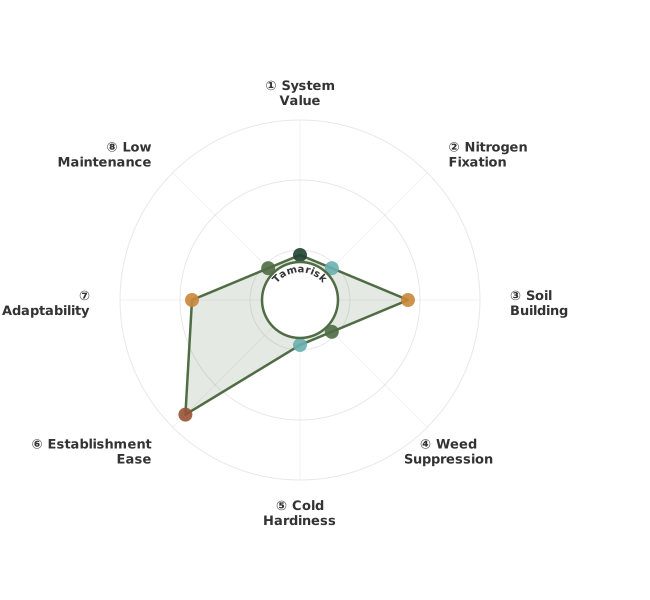
Cold Hardiness Not Recommended This woody shrub is best suited for warmer climates, as it is sensitive to frost and not adapted for winter soil building through decomposition.
Weed Suppression Not Recommended Its aggressive growth habit can outcompete other plants, but this rapid spread is not conducive to building soil health or supporting beneficial species.
Nitrogen Fixation Not Recommended As a non-leguminous woody shrub, Tamarix does not contribute to atmospheric nitrogen fixation, and its primary role is not enhancing soil nitrogen levels.
Root System Depth Ideally Suited Its deep and extensive root system can help alleviate soil compaction and access deeper soil moisture and mineral nutrients.
Biomass Production Not Recommended While producing woody biomass, its slow decomposition rate means it is less effective for rapid soil organic matter incorporation compared to herbaceous cover crops.
Establishment Ease Ideally Suited It establishes quickly in challenging, arid, and saline soils with minimal intervention, rapidly colonizing and tolerating drought and poor soil conditions.
Multi Benefit Value Not Recommended Primarily valued for its resilience in harsh conditions, its contribution to broader ecosystem services like soil building or significant wildlife support is limited.
Climate Adaptability Ideally Suited Thrives in hot, dry, and saline environments, demonstrating remarkable resilience across a wide range of climates (USDA zones 4-9).
Maintenance Intensity Ideally Suited Once established, its exceptional drought and salt tolerance mean it requires very few external inputs, showcasing its self-sufficient nature in challenging sites.

Comparative System: Ratings compare plants within their economic category (e.g., cover crop nitrogen fixation compared to other cover crops, not to all plants). Individual farm conditions and management practices significantly influence actual performance.

8

Know the Debate

Tamarix chinensis presents a complex case in regenerative agriculture, lauded for its resilience in degraded and saline soils, its ability to stabi...

Tamarix chinensis presents a complex case in regenerative agriculture, lauded for its resilience in degraded and saline soils, its ability to stabilize land, and scavenge nutrients with its deep root system. However, its status as an invasive species raises significant ecological concerns, particularly regarding water consumption and competition with native flora. While some applications may offer localized soil health benefits, its broader ecological impact necessitates careful consideration and regional assessment.

Does Tamarix chinensis contribute to soil carbon, or is it primarily an ecological threat?

Contributes to SOC in degraded soils

Studies indicate Tamarix habitats can store soil organic carbon (SOC), potentially increasing total SOC stock with stand age. In challenging environments like wetlands or saline areas, it may help stabilize soil and contribute to organic matter accumulation, offering some regenerative benefits.

Sources behind this view

Sources behind this view

Research
  • Pretty (and) invasive: The potential global distribution of <i>Tithonia diversifolia</i> under current and future climates (opens in new window)

    This study found: AbstractMexican sunflower [Tithonia diversifolia (Hemsl.) A. Gray] is an invasive plant, native to the New World, and an exemplary conflict species. It has been planted widely for its ornamental and soil fertility enhancement qualities and has become a notorious environmental weed in introduced habitats. Here we use a bioclimatic niche model (CLIMEX) to estimate the potential global distribution of this invasive plant under historical climatic conditions. We apply a future climate scenario to the model to assess the sensitivity of the modeled potential geographic range to expected climate changes to 2050. Under current climatic conditions, there is potential for substantial range expansion into southern Europe with moderate climate suitability, and in southern China with highly suitable climates. Under the near-term future climate scenario, there is potential for poleward range expansion in the order of 200 to 500 km. In the tropics, climatic conditions are likely to become less favorable due to the increasing frequency of supra-optimal temperatures. In areas experiencing Mediterranean or warm temperate climates, the suitability for T. diversifolia appears set to increase as temperatures warm. There are vast areas in North America, Europe, and Asia (particularly China and India) that can support ephemeral populations of T. diversifolia. One means of enjoying the aesthetic benefits of T. diversifolia in gardens while avoiding the unwanted environmental impacts where it invades is to prevent its spread into areas climatically suitable for establishment and only allow it to be propagated in areas where it cannot persist naturally.

Ecological threat outweighs carbon benefits

Tamarix chinensis is an invasive species that competes with native vegetation, alters soil chemistry, and can deplete water resources. Its lower sequestration of specific soil organic carbon fractions compared to native species suggests its net ecological impact may be negative despite some SOC contribution.

Sources behind this view

Sources behind this view

Research
  • Potential distribution and ecological impacts of Acmella radicans (Jacquin) R.K. Jansen (a new Yunnan invasive species record) in China. (opens in new window)

    This study found: A new invasive plant, Acmella radicans, has been identified in Yunnan Province, China, and researchers predict it could spread significantly across southern China. Using a computer model, they found that areas with specific rainfall patterns, consistent temperatures, and certain soil minerals are most vulnerable. Over five years of observation, this invasive plant crowded out native species, reducing plant diversity. It also depleted key soil nutrients like organic matter, nitrogen, and phosphorus, while increasing soil potassium and pH. This study highlights the urgent need for early detection and monitoring of A. radicans in southern China to prevent further spread and protect local ecosystems and soil health.

  • Pretty (and) invasive: The potential global distribution of <i>Tithonia diversifolia</i> under current and future climates (opens in new window)

    This study found: AbstractMexican sunflower [Tithonia diversifolia (Hemsl.) A. Gray] is an invasive plant, native to the New World, and an exemplary conflict species. It has been planted widely for its ornamental and soil fertility enhancement qualities and has become a notorious environmental weed in introduced habitats. Here we use a bioclimatic niche model (CLIMEX) to estimate the potential global distribution of this invasive plant under historical climatic conditions. We apply a future climate scenario to the model to assess the sensitivity of the modeled potential geographic range to expected climate changes to 2050. Under current climatic conditions, there is potential for substantial range expansion into southern Europe with moderate climate suitability, and in southern China with highly suitable climates. Under the near-term future climate scenario, there is potential for poleward range expansion in the order of 200 to 500 km. In the tropics, climatic conditions are likely to become less favorable due to the increasing frequency of supra-optimal temperatures. In areas experiencing Mediterranean or warm temperate climates, the suitability for T. diversifolia appears set to increase as temperatures warm. There are vast areas in North America, Europe, and Asia (particularly China and India) that can support ephemeral populations of T. diversifolia. One means of enjoying the aesthetic benefits of T. diversifolia in gardens while avoiding the unwanted environmental impacts where it invades is to prevent its spread into areas climatically suitable for establishment and only allow it to be propagated in areas where it cannot persist naturally.

Making Sense of the Differences

The debate hinges on context and scale: Tamarix can offer localized soil organic carbon accumulation in highly degraded, saline, or arid zones where native plants struggle. However, in most ecosystems, its invasive nature, high water use, and competitive exclusion of native flora present a significant ecological threat that likely negates any minor soil carbon benefits. Prioritizing native revegetation is generally recommended to avoid introducing and managing invasive species, unless Tamarix is part of a specific, carefully managed land reclamation strategy where its benefits are proven to outweigh risks.

9

Learn More

Why farmers use this plant and additional resources

Why Regenerative Farmers Use This Plant

Tamarix chinensis, commonly known as Chinese Tamarisk or Saltcedar, offers significant regenerative benefits, particularly for soil health and ecosystem resilience. While not a nitrogen-fixing legume, its robust and extensive root system is exceptional at scavenging nutrients from deeper soil profiles, bringing them to the surface for subsequent crops, and improving soil structure in challenging environments. Its deep root penetration, often reaching 6-15+ feet (1.8-4.5+ m) or more, helps to break up compacted soil layers and enhance water infiltration, particularly in arid or semi-arid regions. This deep rooting also allows it to scavenge nutrients from lower soil profiles that might otherwise be unavailable to shallower-rooted cash crops, contributing to overall nutrient cycling and potentially reducing the need for synthetic fertilizer inputs by an estimated 15-25%.

Its ability to establish quickly and produce substantial biomass makes it an effective tool for erosion control on slopes and disturbed lands. In arid and semi-arid regions, its drought tolerance and ability to stabilize soil prevent wind and water erosion, preserving valuable topsoil. The decomposition of its woody biomass, though slower than herbaceous cover crops, contributes to long-term soil organic matter accumulation, enhancing soil structure and water-holding capacity over time. Consistent planting and management can potentially increase soil organic matter by 0.5-1% over a 5-year period in suitable conditions.

Integrating Tamarix chinensis into regenerative systems can improve overall farm productivity and reduce reliance on external inputs. As a component in hedgerows or windbreaks, it provides habitat for beneficial insects and pollinators, contributing to natural pest control and biodiversity. Its dense growth can suppress weed competition, reducing the need for mechanical or chemical weed management. In silvopasture systems, managed grazing of Tamarisk can provide supplemental forage for livestock, though its palatability and nutritional value for animals should be carefully assessed. The plant's resilience allows it to thrive in marginal areas where other vegetation struggles, turning unproductive land into a functional part of the ecosystem.

The quantitative ecosystem benefits of Tamarix chinensis are primarily linked to its soil stabilization and habitat provision. Its deep root system dramatically improves soil structure and water infiltration rates, reducing runoff and the risk of sedimentation in waterways. While specific data on pollinator visits or beneficial insect populations is limited for this species compared to flowering cover crops, its presence in windbreaks and hedgerows creates microhabitats that support biodiversity. The slow decomposition of its woody material contributes to stable soil organic carbon over time, a crucial element in climate change mitigation strategies.

In areas prone to erosion, its dense growth habit and robust root system provide exceptional protection against wind and water erosion, safeguarding valuable topsoil. Its tolerance to saline and alkaline soils allows it to reclaim land that is unsuitable for conventional agriculture, turning unproductive areas into functional components of the farm ecosystem. This makes it an excellent candidate for use in coastal agricultural areas or regions affected by salinization from irrigation.

10

How to Integrate This Plant

Practical guidance for regenerative systems

Establishment of Tamarix chinensis can be achieved through seeding or cuttings. Cuttings, taken from mature wood, offer faster and more predictable growth and are often preferred for faster and more reliable establishment. These cuttings are usually planted directly into the soil at a depth of 6-12 inches (15-30 cm). When starting from seed, broadcast seeding rates of 1-3 lbs/acre (1.1-3.4 kg/ha) are common, with seeds planted at a shallow depth of 0.25-0.5 inches (0.6-1.3 cm). For deeper seeding, a rate of 0.5-1 lb/acre (0.56-1.1 kg/ha) at a planting depth of 0.25-0.5 inches (0.6-1.3 cm) is recommended.

Planting typically occurs in early spring, from March to May in the Northern Hemisphere, or September to November in the Southern Hemisphere, allowing plants to establish before the heat of summer or the onset of winter. In the Northern Hemisphere, planting is best done in early spring (March-April) as soil temperatures warm, or in the fall (September-October) to allow for root establishment before winter. In the Southern Hemisphere, these timings are reversed, with planting occurring from September to November or March to April.

Spacing for windbreaks or hedgerows can range from 3-6 feet (0.9-1.8 m) apart, while for erosion control, denser plantings or broadcast seeding are more appropriate. For dense ground cover, spacing can be as close as 1-2 feet (0.3-0.6 meters).

Management of Tamarix chinensis focuses on its establishment and long-term role within the landscape. During the establishment phase, especially from seed, adequate moisture is crucial, with approximately 1 inch (2.5 cm) of water per week for the first 4-6 weeks, either from rainfall or irrigation, supporting germination and early growth. Once established, it is highly drought-tolerant and requires minimal supplemental watering, typically only during extreme drought periods. Its nutrient needs are low; it thrives in nutrient-poor soils and does not require significant fertilization due to its nutrient scavenging abilities, though initial compost applications can aid establishment.

Its growth timeline can be rapid, reaching heights of 10-20 feet (3-6 m) within 3-5 years. Mature plants can reach 15-30 feet (4.5-9 m) in height or more, depending on conditions. Pest and disease management primarily relies on maintaining plant health through proper siting and avoiding over-irrigation, as stressed plants are more susceptible. Monitoring for any signs of stress or unusual outbreaks is always recommended. Cultural practices, such as pruning to manage size and shape, are the primary methods of control.

Termination and residue management for Tamarix chinensis differ from annual cover crops due to its woody nature. As a perennial or woody shrub, it is not typically terminated annually for cash crop planting. Instead, it is managed through pruning, grazing, or selective removal if it encroaches on cultivated areas. If removal is necessary, mechanical methods like cutting or chipping are most effective. The woody residue decomposes slowly, typically taking 6-12 months or longer to break down significantly, contributing to stable soil organic matter over extended periods and releasing nutrients gradually. Seed management is crucial, as Tamarix chinensis can be invasive in some regions; preventing seed set through timely pruning or harvesting can mitigate this risk.

Regional Adaptations Regional success examples highlight the adaptability of Tamarix chinensis. In the dryland farming regions of the Australian wheat-sheep belt, it is used in shelterbelts and along fence lines to protect fields from wind erosion, improve crop yields by reducing wind stress, and provide shade for livestock, with its deep roots accessing moisture unavailable to pasture grasses. In arid parts of the southwestern United States, it has been employed for land reclamation and erosion control on degraded rangelands and saline soils, establishing ground cover and initiating soil improvement processes. In parts of China, it is traditionally used along riverbanks and in arid areas for soil stabilization and to create windbreaks for agricultural fields. In parts of India, it is integrated into agroforestry systems in semi-arid zones, providing biomass for fuel and fodder while stabilizing soil on slopes. Brazilian farmers in semi-arid regions are exploring its use in buffer strips and along watercourses to mitigate erosion and improve soil structure in challenging terrains, potentially using cuttings planted along contours to prevent soil erosion in pasture or crop fields. Its ability to tolerate saline soils also makes it valuable in coastal or irrigated areas with salinity concerns. In the Middle East and North Africa, it is used for soil stabilization and to create green corridors in desertified landscapes. In parts of South America, such as Argentina, it can be found in riparian zones and areas prone to erosion. It's crucial to note that in some regions, particularly where it is not native, Tamarix species can become invasive and outcompete native vegetation; therefore, careful species selection and management are paramount to avoid negative ecological impacts.