While coverage of *Ulmus pumila* in our regenerative agriculture knowledge base is limited, existing excerpts suggest its potential role in soil improvement and land restoration. One study in Inner Mongolia explicitly examines *Ulmus pumila* land in relation to soil organic carbon (SOC) and other physicochemical indices, indicating its presence in land use patterns aimed at understanding soil health. This implies its use in systems focused on building soil structure and fertility, potentially through its contribution to organic matter. Although not explicitly detailed as a cover crop, forage, or nitrogen fixer within these specific excerpts, its inclusion in land management studies suggests it can be integrated into agroforestry or silvopasture systems. The primary regenerative benefit observed or implied is related to soil building and carbon sequestration, as indicated by its association with SOC. Further research is needed to fully understand its specific applications and benefits within diverse regenerative farming practices.

Regenerative Quick Profile

All recommendations assume integrated, regenerative practices—not conventional inputs.

Climate & Soil Fit

Climate: Tropical Rainforest, Tropical Monsoon, Tropical Savanna, Hot Semi-Arid (Steppe), Cold Semi-Arid (Steppe), Hot Desert, Cold Desert, Humid Subtropical, Oceanic (Maritime Temperate), Hot-Summer Mediterranean, Warm-Summer Mediterranean, Monsoon-Influenced Humid Subtropical, Subtropical Highland, Hot-Summer Continental, Warm-Summer Continental, Subarctic, Monsoon-Influenced Hot-Summer Continental, Tundra

Zones: USDA 2-9, Australian Zones 1-8

Optimal Soil: Loam Soil

System Role & Functions

Primary: Silvopasture

Secondary: Soil Remediation, Windbreak

Key Benefits: Climate adaptable, Low maintenance

Management Level

Experience: Beginner-Friendly

Maintenance: Very low maintenance - Once established, Siberian elm requires minimal attention due to its inherent hardiness and drought tolerance, integrating seamlessly into the landscape with its resilient growth habit.

Value Streams
1

Climate Suitability Assessment

Will this plant thrive in your climate?

IDEALLY SUITED

Köppen Zone: Dfa (Hot-Summer Continental), Dfb (Warm-Summer Continental), Dfc (Subarctic), Dwa (Monsoon-Influenced Hot-Summer Continental)
USDA Zone: 3b, 4a, 5a, 5b, 6a
Australian Zone: temperate, subtropical
EU Climate Region: atlantic, continental

Siberian Elm performs optimally in climates characterized by warm to hot summers and cold to mild winters, with sufficient precipitation. This includes Köppen zones Dfa, Dfb, Cfa, and Cfb, USDA zones 5b through 8b, Australian subtropical and temperate regions, and EU Atlantic and continental climates. These zones provide a growing season of 150-240 frost-free days with average temperatures conducive to rapid growth (65-85°F / 18-29°C). Establishment is highly successful, with minimal need for supplemental irrigation beyond initial establishment, as rainfall typically meets its needs (30-50 inches/75-125 cm annually). The species exhibits vigorous growth, making it excellent for silvopasture (providing biomass and forage), effective windbreaks due to its dense foliage and rapid growth, and robust soil remediation capabilities. Its cold hardiness ensures survival through winters, and its adaptability to various soil types further enhances its suitability. Productivity for silvopasture is high, and its role as a windbreak is established quickly, contributing significantly to farm resilience and productivity with low management input.

ADEQUATE

Köppen Zone: BSk (Cold Semi-Arid (Steppe)), BWk (Cold Desert), Cfa (Humid Subtropical), Cfb (Oceanic (Maritime Temperate))
USDA Zone: 3a, 7a

Siberian Elm is adequately suited to climates with longer growing seasons and milder winters, but where summer heat or dryness can become limiting factors. This includes Köppen zones Csb, Dfc, USDA zones 4a-4b, 9a-10b, and EU Mediterranean-influenced regions. These zones typically offer 100-180 frost-free days, but may experience dry spells or temperatures that can stress the plant, particularly during establishment or peak summer. While it can establish and grow, performance might be slower, and yields for silvopasture could be reduced by 10-20% compared to ideal zones. Supplemental irrigation may be necessary during prolonged dry periods, especially in USDA zones 9-10, increasing management costs. Windbreak establishment might take slightly longer, and soil remediation could proceed at a reduced pace. However, its inherent cold hardiness and drought tolerance once established still allow it to fulfill its functions, making it a viable, though not optimal, choice with appropriate site selection and management practices.

NOT RECOMMENDED

Köppen Zone: Af (Tropical Rainforest), Am (Tropical Monsoon), Aw (Tropical Savanna), ET (Tundra), BSh (Hot Semi-Arid (Steppe)), BWh (Hot Desert), Csa (Hot-Summer Mediterranean), Csb (Warm-Summer Mediterranean), Cwa (Monsoon-Influenced Humid Subtropical), Cwb (Subtropical Highland)
USDA Zone: 2a, 8a, 9a, 10a, 11a, 12a

Siberian Elm is not recommended for climates with extreme cold, very short growing seasons, or prolonged, intense summer heat and drought. This includes Köppen zones Bsk, Dfd, Csa, USDA zones 1a-3b, and specific EU regions with harsh continental extremes. In extremely cold zones (USDA 1-3, Köppen Dfd), winter temperatures (-40°F/-40°C and below) and very short growing seasons (under 90 days) lead to high mortality rates and severely limit growth, making silvopasture, windbreaks, and soil remediation impractical and economically unviable. In hot, dry climates (Köppen Bsk, Csa), prolonged summer heat (often exceeding 90°F/32°C) and severe drought stress the plant, hindering establishment and growth, and requiring intensive irrigation that is often not economically feasible. While Siberian Elm is hardy, these conditions push its limits, resulting in unreliable establishment (success rates below 60%), reduced productivity, and high management costs. Alternative species specifically adapted to these extreme conditions are far more suitable for regenerative agriculture functions.

Better alternatives for these "not recommended" zones: Caragana arborescens (Siberian Peashrub) (Extremely cold-hardy, drought-tolerant legume adapted to arid conditions, excellent for silvopasture and soil stabilization.), Populus tremuloides (Quaking Aspen) (Native to cold climates, fast-growing, adaptable to various soils, provides biomass and windbreak.), Elaeagnus angustifolia (Russian Olive) (Drought-tolerant, nitrogen-fixing shrub/small tree, provides windbreak and can tolerate saline soils.), Quercus ilex (Holm Oak) (Drought-tolerant, evergreen oak well-adapted to Mediterranean climates, provides shade and biomass.)

Note: Zones listed above represent climates where this plant can produce reliably with reasonable management. Climate zones not mentioned would require intensive climate modification (greenhouses, extensive infrastructure) and are not economically viable for regenerative agriculture purposes.

2

Soil Suitability Assessment

Which soil types work best for this plant?

IDEALLY SUITED

Loam Soil

This plant thrives in these soil types without requiring amendments or remediation. Natural soil conditions support optimal growth and productivity.

ADEQUATE

Clay Soil, Rich Soil, Rocky Soil, Sandy Soil

This plant performs acceptably in these soil types with moderate, manageable remediation such as pH adjustment, compost addition, or drainage improvement. The required amendments are practical and cost-effective for regenerative agriculture.

NOT RECOMMENDED

Acidic Soil, Alkaline Soil, Desert Soil, Saline Soil, Wet Soil

Growing this plant in these soil types would require impractical remediation such as complete soil replacement, extensive amendments, or cost-prohibitive infrastructure. These conditions are not economically viable for regenerative agriculture.

Note: Soil suitability assessments focus on remediation requirements. "Ideally Suited" means the plant generally thrives without the need for substantial amendments, "Adequate" means manageable remediation (lime, compost, mulch), and "Not Recommended" means impractical soil changes would be required. Climate factors like rainfall and temperature also influence success.

3

Seasonal Considerations

Planting timing, growth duration, and harvest windows

Establishing Siberian elm requires careful timing to ensure vigorous growth. Nursery trees, whether bare-root or containerized, are best planted in early spring, as soon as the soil can be worked and after the threat of hard frost has passed. This allows the root system to establish before the heat of summer.

Siberian elm is a resilient species and can reach a state of establishment within two to three years. While not typically grown for fruit, if managed for biomass or other uses, initial harvests might be feasible within five to seven years. Full production, depending on your management goals, can be expected by year ten, with trees capable of productive lifespans extending for decades.

Seasonal management focuses on optimizing growth and health. Pruning is most effective during the dormant season, either in late fall after leaf drop or in early spring before bud break. This minimizes sap loss and stress. Summer growth is a period of active development and requires monitoring for pests or diseases. Winter dormancy is crucial for the tree's rest cycle, preparing it for the following year's growth. Bloom typically occurs in early spring, preceding leaf-out.

4

System Role & Multi-Benefit Value

Functional roles, integration strategies, and stacked benefits

Functional Role

Total System Value

Siberian elm offers substantial system value by stacking multiple benefits. While direct harvest value might be limited to browse for livestock or potential timber in the long term, its primary contribution lies in system enhancement. As a key component in silvopasture, it provides crucial shade, mitigating heat stress for animals and improving their well-being and productivity. Its root system aids in erosion control, particularly on slopes, and its woody structure can serve as a windbreak, protecting pastures and crops. Ecosystem services include carbon sequestration in its biomass and soil, habitat provision for beneficial insects and wildlife, and contributing to a more biodiverse farm landscape. This diversification of functions and services enhances the farm's resilience against climatic variations and market fluctuations, reducing reliance on single income streams or external inputs.

Integration Characteristics

Multi-Benefit Value: Adequate - This fast-growing tree offers valuable shade and windbreak functions, provides wildlife habitat, and contributes to gradual soil improvement over time as part of an integrated system.

5

Management & Care Requirements

Integration guidance, maintenance needs, and care practices

How to Integrate This Plant

Siberian elm (Ulmus pumila) is a valuable tree for regenerative systems, primarily functioning within silvopasture settings due to its resilience and potential for browse. Its primary role is providing structural diversity and shade for livestock, contributing to animal comfort and reducing heat stress, which can improve productivity. Compatible practices include silvopasture, where it can be integrated with grazing animals, and potentially as a component in windbreaks or hedgerows for erosion control. It can also serve as a nurse tree in more complex agroforestry designs. Timeline to contribution: Year 1-2: Establishment, minimal browse value. Year 5: Provides significant shade and browse potential. Year 20+: Mature shade, windbreak, and potential timber value. Multi-benefit stacking includes shade, browse, windbreak, erosion control, and habitat for wildlife, enhancing overall farm ecosystem health and resilience beyond direct harvest.

Integration Practices & Management

The provided knowledge base offers limited insight into the specific regenerative agriculture integration methods for *Ulmus pumila*. While *Ulmus pumila* is mentioned as a land use type in a study on soil organic carbon in Inner Mongolia, details on its establishment, integration with grazing or cash crops, or termination strategies are not present. The sources do not elaborate on seeding rates, timing, companion planting, or tillage practices for its introduction. Similarly, information regarding its use in mob grazing, rotational systems, or specific grazing timings and rest periods is absent. Termination methods such as natural winterkill, grazing down, crimping, mowing, or herbicide application are not discussed. Management considerations like fertility needs, competition management, or succession planning in a regenerative context are also not detailed. Consequently, the knowledge base does not provide practical farmer experiences or specific insights into how regenerative farmers actively integrate *Ulmus pumila* into their farming systems beyond its presence as a land cover type.

Management Profile

Maintenance Intensity: Ideally Suited - Once established, Siberian elm requires minimal attention due to its inherent hardiness and drought tolerance, integrating seamlessly into the landscape with its resilient growth habit.

6

Economics & Value Streams

Direct harvest, system benefits, ecosystem services, and risk diversification

Comprehensive economic analysis including direct harvest value, system enhancement contributions, ecosystem services, value timeline, and risk diversification strategies.

Cover Crop Investment

Metric Value
Seed Cost $15-30/acre $37-74/ha
Termination Cost 20-50 49-124
Biomass Production 2-5 4-11
N Fixation Value N/A N/A
Weed Control Savings 10-30 25-74

Cover crops are soil investments, not cash crops. Economics measured in soil health gains, input reduction, and subsequent crop performance. Values show direct costs and estimated benefits.

System Enhancement Value

Beyond harvest: shade for livestock, soil building, and system benefits

Shade Value for Livestock

$50-150/head/year for cattle in silvopasture (variable by climate, livestock density, and canopy characteristics)

Siberian Elm (Ulmus pumila) can provide valuable shade in silvopasture systems, offering a significant benefit to livestock by mitigating heat stress, particularly during warmer months. This shade not only improves animal welfare and reduces the risk of heat-related illnesses but also indirectly boosts productivity by encouraging more consistent grazing and reducing the need for animals to seek shade in less desirable or potentially overgrazed areas. The quantitative value of this shade is highly variable, depending on factors such as the density of the tree stand, the age and size of the trees, the climate, and the specific livestock being managed. Well-established Siberian Elms can create substantial canopy cover, leading to cooler microclimates on the pasture. This cooling effect can be critical for maintaining milk production in dairy cows, weight gain in beef cattle, and overall health for all types of livestock.

Windbreak & Erosion Control

Protects 200-600 ft downwind (2-14 acres per 100ft row) per row. Value varies by wind exposure, crop types, and windbreak design.

As a species known for its rapid growth and dense foliage, Siberian Elm is well-suited for use as a windbreak. Planted in rows, these trees can significantly reduce wind speed across agricultural fields, offering protection to crops and livestock. The extent of this protection can be substantial, with wind speed reduction extending many times the height of the trees downwind. This buffering effect minimizes wind erosion of valuable topsoil, reducing the loss of organic matter and nutrients. For crops, reduced wind exposure can lead to improved growth rates, reduced lodging, and potentially increased yields by minimizing desiccation and physical damage. Livestock sheltered by a windbreak experience reduced stress, conserve energy that would otherwise be used to stay warm, and can graze more comfortably and consistently during windy periods. The effectiveness of the windbreak is directly related to its height, density, and design.

Other System Contributions

Beyond its primary functions, Siberian Elm exhibits notable soil remediation capabilities. Knowledge base excerpt highlights its role as a pioneer species that thrives on degraded soils, acting as a 'natural repair mechanism.' Its aggressive root systems, though challenging in some contexts (excerpt), can help stabilize soil and prevent erosion. Furthermore, Siberian Elm contributes organic matter to the soil as it grows and sheds leaves, which can improve soil structure and fertility over time, potentially paving the way for other species to establish. Excerpt mentions the edible samaras and seeds, offering a potential for human consumption, which is a direct system benefit that can add to farm diversification and resilience. The allelopathic effects mentioned in excerpt are a double-edged sword; while they can inhibit other desirable species in the short term, they may also play a role in managing competition in certain restoration contexts.

Ecosystem Service Contributions

Environmental contributions: carbon, pollinators, wildlife, and water

  • Carbon Sequestration: Siberian Elm is a woody perennial with a capacity for significant carbon sequestration in its biomass and soil organic matter, particularly given its potential for rapid growth and ability to establish on degraded lands.
  • Pollinator Support: Medium; While not a primary nectar or pollen producer in the same vein as some other species, its early spring flowering can provide a food source for pollinators when other options may be scarce. Specific data on its pollinator value is not detailed in the provided excerpts.
  • Wildlife Habitat: Provides nesting sites and potential browse for some wildlife. The seeds from its samaras could offer a food source for small mammals and birds, though this is not explicitly detailed in the provided knowledge base.
  • Water Quality: Not applicable

Value Timeline: When Benefits Begin

When you'll see results: shade in years 1-5, fruit/nut harvest 3-10, timber 20+

Years 1-2

Initial windbreak establishment and soil stabilization. Early stages of soil organic matter contribution. Potential for minor shade. Edible samaras may be available.

Years 3-5

Established windbreak providing significant protection. More substantial shade provision for livestock. Increased soil organic matter and improved soil structure. Edible seed harvest becomes more reliable.

Years 10-20

Mature windbreak offering maximum protection. Full shade canopy for livestock. Significant contribution to soil health and remediation. Reliable source of edible seeds.

20+ Years

Long-term established windbreak and shade source. Continued soil improvement. Potential for timber value if managed for that purpose, though not a primary function.

Farm Risk Reduction

How this reduces farm risk: backup income, weather protection, market hedges

  • Multiple Revenue Streams: Livestock shade value, windbreak protection (indirect yield improvement), potential for edible seed harvest, soil remediation services.
  • Temporal Income Spread: Ongoing ecosystem services (shade, windbreak, soil improvement) coupled with periodic product availability (seeds).
  • Market Risk Hedge: Reduces reliance on external inputs (fertilizers, shade structures) and provides resilience against extreme weather (heat, wind). Diversifies farm output beyond traditional crops or livestock.
7

Regenerative Suitability Details

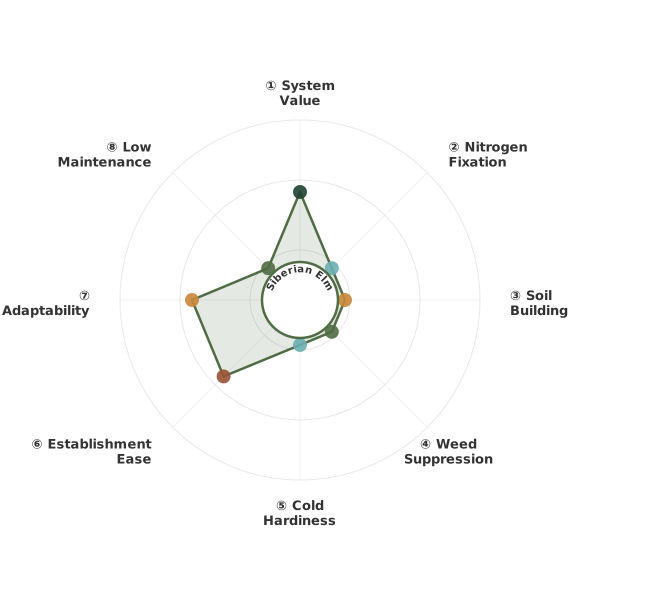
Comprehensive trait ratings for system integration assessment

Comparative ratings for this plant across key regenerative agriculture traits.

Trait Suitability Explanation
Cold Hardiness Not Recommended This tree species, while not a ground-covering cover crop, exhibits resilience in cold climates. Its primary contribution is in agroforestry systems, supporting the broader ecological functions of the landscape.
Weed Suppression Not Recommended As a woody tree species, its growth habit and establishment speed are not optimized for direct weed suppression or immediate soil building in an agricultural context. Focus is on its role within a diversified landscape.
Nitrogen Fixation Not Recommended Siberian elm, being a tree and not a legume, does not contribute to atmospheric nitrogen fixation. Its value lies in its hardiness and efficient growth within the system.
Root System Depth Adequate Its moderately deep and fibrous root system actively enhances soil structure and facilitates nutrient cycling throughout the soil profile, contributing to overall soil health.
Biomass Production Not Recommended The woody biomass produced by Siberian elm decomposes slowly, gradually contributing to long-term soil organic matter accumulation within a regenerative system.
Establishment Ease Adequate This tree establishes readily from seed or transplants, benefiting from good moisture retention and initial mulching to support vigorous growth and integration into the landscape.
Multi Benefit Value Adequate This fast-growing tree offers valuable shade and windbreak functions, provides wildlife habitat, and contributes to gradual soil improvement over time as part of an integrated system.
Climate Adaptability Ideally Suited Extremely adaptable across a wide range of challenging climates, this tree thrives in diverse conditions, demonstrating its robustness and resilience within varied landscape designs.
Maintenance Intensity Ideally Suited Once established, Siberian elm requires minimal attention due to its inherent hardiness and drought tolerance, integrating seamlessly into the landscape with its resilient growth habit.

Comparative System: Ratings compare plants within their economic category (e.g., cover crop nitrogen fixation compared to other cover crops, not to all plants). Individual farm conditions and management practices significantly influence actual performance.

8

Learn More

Why farmers use this plant and additional resources

Why Regenerative Farmers Use This Plant

Ulmus pumila, commonly known as Siberian Elm, offers significant regenerative benefits when integrated into agricultural systems, primarily as a hardy, fast-growing tree for windbreaks, erosion control, shelterbelts, and agroforestry applications. While not a nitrogen-fixing legume, its dense and deep root system is exceptionally effective at stabilizing soil and preventing erosion, particularly on sloping land or in areas prone to wind damage. Its taproot can reach depths of 6-25+ feet (1.8-7.5+ m) over time, improving soil structure and water infiltration by breaking up compacted layers. This extensive root network also contributes to significant carbon sequestration, with mature trees sequestering an estimated 40-60 lbs (18-27 kg) of carbon annually per tree, depending on age and growing conditions.

Beyond soil health, Siberian Elm serves as a robust component in agroforestry and silvopasture systems. In windbreak applications, it significantly reduces wind velocity across fields, thereby minimizing soil erosion from wind, preventing crop desiccation, and protecting delicate seedlings. Studies show windbreaks can increase yields by 5-15% within their sheltered zone. In silvopasture systems, its dense foliage provides valuable shade and shelter for livestock, reducing heat stress and improving animal welfare, which can translate to increased weight gain and reduced veterinary costs. The woody biomass it produces can also serve as habitat for beneficial insects and birds.

Siberian Elm contributes to soil organic matter through leaf litter decomposition, which typically occurs within 6-12 months, releasing valuable nutrients back into the soil ecosystem. Over time, the accumulation of leaf litter and woody debris enhances soil structure, improves water infiltration and retention, and fosters a thriving soil microbial community. Its hardy nature also makes it an excellent choice for reclaiming degraded land, where its vigorous growth can outcompete invasive weeds and initiate ecological restoration. Its resilience allows it to thrive in marginal soils where other trees might struggle, making it a valuable option for land reclamation and improving overall ecosystem health.

The ecosystem services provided by Siberian Elm extend to supporting biodiversity. Its flowers, though inconspicuous, can provide a nectar and pollen source for early-season pollinators. More significantly, its dense structure offers critical habitat and nesting sites for various bird species and beneficial insects, contributing to a more resilient and balanced farm ecosystem.

Regional success stories highlight the adaptability of Siberian Elm. In the dryland farming regions of Australia, it is often utilized in shelterbelts to protect cereal crops from wind erosion and reduce evapotranspiration. Farmers in the Great Plains of North America have long used Siberian Elm in windbreaks to protect crops and livestock from harsh prairie winds, with stands established in the mid-20th century still providing significant benefits today. In parts of South America, it is being explored for its potential in agroforestry systems to provide shade for crops like coffee and cocoa, while also contributing to soil stability on sloped terrain. In the UK, it can be incorporated into mixed hedgerows to provide structural diversity and habitat. In the Brazilian Cerrado, its drought tolerance makes it a candidate for agroforestry systems on degraded pastureland. In the US Southwest, it is valued for its ability to establish on marginal lands and provide shade and wind protection with minimal irrigation once mature. Farmers in Argentina have utilized it in silvopasture systems for cattle. In parts of India, it is integrated into farm boundaries and as a component of fodder systems. In New Zealand, it has been integrated into riparian zones to stabilize stream banks and filter runoff. In China, it has a long history of use in reforestation and soil conservation projects.

Sources behind this view

Community
  • Siberian elm offers edible seeds (complete protein), medicinal properties, hardwood, animal forage (goats love it), and is a fast-growing, drought-hardy shade tree suitable for arid regions like north

9

How to Integrate This Plant

Practical guidance for regenerative systems

Establishment of Siberian Elm is typically achieved through seed or sapling planting. For direct seeding, rates can range from 0.5-4 lbs/acre (0.56-4.5 kg/ha), with seeds ideally sown at a depth of 0.25-0.5 inches (0.6-1.3 cm) below the soil surface. For dense windbreaks or erosion control plantings, seed can be broadcast at rates of 2-4 lbs/acre (2.2-4.5 kg/ha), or drilled at 1-2 lbs/acre (1.1-2.2 kg/ha). If planting as individual trees or saplings for hedgerows or silvopasture, spacing can vary significantly, from 6-12 feet (1.8-3.6 meters) apart for dense hedgerows to 20-40 feet (6-12 meters) for larger windbreaks or agroforestry components. For windbreaks, spacing can range from 10-20 feet (3-6 m) apart for individual trees, or closer for dense plantings. In the Canadian Prairies, it is planted in double or triple rows with spacing of 6-8 feet (1.8-2.4 m). Rows are often spaced 10-20 feet (3-6 m) apart depending on the desired density and function.

Optimal planting times are early spring (March-May in the Northern Hemisphere) after the last frost, or late autumn (September-October in the Southern Hemisphere), coinciding with periods of adequate soil moisture for germination. In the Northern Hemisphere, seeds can also be sown from October to April, allowing for natural stratification or sowing as soon as the ground is workable.

Once established, Siberian Elm is exceptionally low-maintenance. Its primary management involves shaping and thinning as needed for windbreak effectiveness or timber production, usually starting 5-10 years after planting. While it can tolerate infertile soils, applying compost or well-rotted manure around the base in the first few years can accelerate growth. While it requires minimal supplemental water once established, young trees benefit from consistent moisture, approximately 1 inch (2.5 cm) per week, during their first growing season. Established trees require about 1 inch (2.5 cm) of rainfall or irrigation per week during dry periods, though they are drought-tolerant once mature.

Its growth timeline is rapid, reaching heights of 15-25 feet (4.5-7.5 m) within 5-7 years and a mature height of 40-60 feet (12-18 m) over 20-30 years. Saplings can reach 6-10 feet (1.8-3 meters) in height within 2-3 years and mature into substantial trees over 5-10 years. Siberian Elm typically establishes quickly, with noticeable growth within the first year, and can reach heights of 30-50 feet (9-15 m) within 10-15 years, with a mature height of up to 60 feet (18 m).

Pest and disease management is generally minimal due to its inherent hardiness, with biological controls and good air circulation being the primary preventative measures. In cases of aphid infestations, biological controls such as ladybugs and lacewings are encouraged, alongside maintaining plant vigor through good soil health practices.

As a woody perennial, Siberian Elm is not typically managed as a cover crop in the traditional sense of termination for annual crop planting. Instead, its integration focuses on its long-term benefits. For windbreaks or hedgerows, management involves occasional pruning to maintain desired shape and density, typically conducted during the dormant season. In silvopasture systems, grazing animals can help manage understory vegetation and prune lower branches, while the trees themselves provide shade and forage. If Siberian Elm is used in a system where its woody biomass is periodically harvested for bioenergy or mulch, this would occur after several years of growth, with the residue then being incorporated into the soil or used as surface mulch, contributing organic matter. Seed management is generally not a concern for preventing reseeding, as its natural spread is manageable within agricultural contexts, and it is not considered an aggressive invasive species in most temperate regions. However, farmers may choose to manage stands to prevent unwanted spread into cropping areas through timely mowing or grazing before seed set if necessary.

View Full Document (Printable single-page version)