Vinca Major, also known as Big Periwinkle, has limited mention within our regenerative agriculture knowledge base. Despite this, existing references suggest potential roles within diversified farming systems. While not explicitly a cover crop or nitrogen fixer in the texts, its dense groundcover habit could contribute to soil building by suppressing weeds and increasing organic matter when managed appropriately. Its evergreen nature may offer year-round soil protection, aiding in erosion control and potentially supporting soil microbial communities. The plant's value for pollinator support is not detailed in the provided excerpts. There are no direct mentions of its integration with practices like rotational grazing, no-till, or agroforestry, nor are there specific farmer experiences documented. Further research and observation within regenerative contexts would be needed to fully understand Vinca Major's practical applications and benefits for soil health and ecosystem services in these systems.

Regenerative Quick Profile

All recommendations assume integrated, regenerative practices—not conventional inputs.

Climate & Soil Fit

Climate: Tropical Rainforest, Tropical Monsoon, Tropical Savanna, Hot Semi-Arid (Steppe), Cold Semi-Arid (Steppe), Humid Subtropical, Oceanic (Maritime Temperate), Hot-Summer Mediterranean, Warm-Summer Mediterranean, Monsoon-Influenced Humid Subtropical, Subtropical Highland, Hot-Summer Continental, Warm-Summer Continental, Subarctic, Monsoon-Influenced Hot-Summer Continental

Zones: USDA 7-10, Australian Zones 3-6, EU Atlantic, Oceanic, Mediterranean

Optimal Soil: Loam Soil

System Role & Functions

Primary: Cover Crop System

Secondary: Pollinator Support, Specialty

Key Benefits: Low maintenance

Management Level

Experience: Advanced

Maintenance: Very low maintenance - Once established, this vigorous groundcover thrives in shade and poor soils with minimal intervention, naturally managing its own moisture and fertility needs without external inputs.

Value Streams

  • Cover crop (soil investment)
  • Soil building and erosion control
  • Pollinator habitat and support
1

Climate Suitability Assessment

Will this plant thrive in your climate?

IDEALLY SUITED

Köppen Zone: Af (Tropical Rainforest), Am (Tropical Monsoon), Aw (Tropical Savanna), Cfa (Humid Subtropical), Cfb (Oceanic (Maritime Temperate)), Cwa (Monsoon-Influenced Humid Subtropical)
USDA Zone: 6a, 7a, 8a, 9a, 10a, 11a, 12a

Greater Periwinkle demonstrates ideal suitability in climates that offer mild winters and warm, humid summers, with consistent moisture. This includes USDA Zones 8a through 10b, where winter lows rarely drop below 10°F (-12°C), allowing for robust perennial establishment and spread. The extended growing season and favorable temperatures (typically 60-80°F or 15-27°C) promote vigorous vegetative growth, enabling it to effectively function as a dense groundcover for soil protection and erosion control. Its secondary functions, such as pollinator support and specialty uses, are also well-served in these regions due to consistent flowering and foliage. Minimal management is required, as the plant is well-adapted to these conditions and can thrive with natural rainfall or minimal supplemental irrigation. Its ability to establish quickly and cover the soil surface efficiently makes it a highly reliable choice for regenerative agriculture practices aimed at improving soil health and reducing weed pressure.

ADEQUATE

Köppen Zone: BSh (Hot Semi-Arid (Steppe)), Csa (Hot-Summer Mediterranean), Csb (Warm-Summer Mediterranean), Cwb (Subtropical Highland), Dfa (Hot-Summer Continental), Dfb (Warm-Summer Continental)
USDA Zone: 5a, 5b
Australian Zone: temperate, subtropical
EU Climate Region: atlantic

Greater Periwinkle is adequately suited to climates with moderate temperatures and consistent rainfall, such as Köppen Cfa, Cfb, and Csb zones, and Australian subtropical and temperate regions, along with the EU Atlantic climate. These regions generally experience mild winters (above 0°F or -18°C) and warm summers, allowing for establishment and persistence. While it can provide groundcover and some soil protection, its performance as a cover crop may be less vigorous compared to ideal zones. Growth can be moderated by cooler spring temperatures, potential summer dryness in Csb and Atlantic regions, or periods of intense heat and humidity in Cfa and subtropical areas. Supplemental irrigation might be necessary during dry spells to maintain optimal growth and soil coverage. Its secondary functions are generally supported, but flowering and foliage density might be less consistent than in more favorable climates. Overall, it offers a viable, though not optimal, solution for cover cropping in these transitional zones.

NOT RECOMMENDED

Köppen Zone: ET (Tundra), BSk (Cold Semi-Arid (Steppe)), BWh (Hot Desert), BWk (Cold Desert), Dfc (Subarctic), Dwa (Monsoon-Influenced Hot-Summer Continental)
USDA Zone: 2a, 3a, 3b, 4a

Greater Periwinkle is not recommended for climates with extreme winter cold or prolonged hot, dry summers, specifically Köppen Csa zones and USDA Zones 6a and 6b. In Csa (Mediterranean) climates, hot, dry summers inhibit growth and establishment, making it unreliable for cover cropping. In USDA Zones 6a and 6b, severe winter temperatures (-10 to 0°F or -23 to -18°C) lead to significant winter kill, compromising its perennial nature and effectiveness as a cover crop. Establishment success is low (<70%) due to these harsh conditions, requiring intensive management and supplemental irrigation that is often economically unviable. While it might survive in these zones, its primary function as a cover crop is severely compromised, offering minimal soil protection and potentially spreading poorly. Alternative plants better adapted to these specific climatic challenges are recommended for reliable cover cropping and soil health benefits.

Better alternatives for these "not recommended" zones: Hairy Vetch (Cold-hardy annual legume for nitrogen fixation and soil cover in cold zones.), Winter Rye (Extremely cold-hardy cover crop for biomass and soil protection in cold zones.), Crimson Clover (Can establish in fall and provide some winter cover in milder parts of Zone 6, though less hardy than rye or vetch.), Thyme (various species) (Drought-tolerant groundcover that can provide soil protection in dry Mediterranean conditions.), Creeping Rosemary (Drought-tolerant, low-growing shrub that offers good groundcover and soil stabilization in dry conditions.), Native drought-tolerant groundcovers (Species adapted to local Mediterranean conditions will perform best and require less intervention.)

Note: Zones listed above represent climates where this plant can produce reliably with reasonable management. Climate zones not mentioned would require intensive climate modification (greenhouses, extensive infrastructure) and are not economically viable for regenerative agriculture purposes.

2

Soil Suitability Assessment

Which soil types work best for this plant?

IDEALLY SUITED

Loam Soil

This plant thrives in these soil types without requiring amendments or remediation. Natural soil conditions support optimal growth and productivity.

ADEQUATE

Clay Soil, Rich Soil, Rocky Soil, Sandy Soil

This plant performs acceptably in these soil types with moderate, manageable remediation such as pH adjustment, compost addition, or drainage improvement. The required amendments are practical and cost-effective for regenerative agriculture.

NOT RECOMMENDED

Acidic Soil, Alkaline Soil, Desert Soil, Saline Soil, Wet Soil

Growing this plant in these soil types would require impractical remediation such as complete soil replacement, extensive amendments, or cost-prohibitive infrastructure. These conditions are not economically viable for regenerative agriculture.

Note: Soil suitability assessments focus on remediation requirements. "Ideally Suited" means the plant generally thrives without the need for substantial amendments, "Adequate" means manageable remediation (lime, compost, mulch), and "Not Recommended" means impractical soil changes would be required. Climate factors like rainfall and temperature also influence success.

3

Seasonal Considerations

Planting timing, growth duration, and harvest windows

Vinca Major offers flexible timing for regenerative systems. For a spring planting, sow after the last expected frost when soil temperatures consistently reach around 50°F (10°C). It establishes relatively quickly, typically within 3-4 weeks, and can serve as a vigorous summer cover, suppressing weeds and building organic matter. Termination should occur at least 2-3 weeks before planting your main cash crop to allow for decomposition.

In many Cfa and Cfb climate zones, Vinca Major exhibits good overwintering capabilities, making it a viable late fall planting option. Aim to seed in late fall, well before the first expected frost, allowing it to establish a root system before severe cold sets in. This winter cover will resume growth in early spring, providing early season soil protection. Termination in spring should be planned to precede your main crop's planting window. While not ideal for frost-seeding due to its specific germination requirements, its resilience in milder winter climates allows for strategic use as a persistent ground cover. Its peak biomass is generally achieved during the warmer months.

4

System Role & Multi-Benefit Value

Functional roles, integration strategies, and stacked benefits

Functional Role

Total System Value

Greater periwinkle's value in regenerative systems lies in its robust ground cover capabilities, contributing significantly to soil health and stability. Its primary benefit is exceptional erosion control, protecting valuable topsoil from wind and water displacement, particularly on vulnerable slopes. It also excels at weed suppression, reducing the need for mechanical or chemical interventions and conserving soil moisture. While it doesn't offer direct harvest value in a typical agricultural sense, its role as a living mulch in food forests, silvopastures, or alley cropping systems enhances the productivity and resilience of other components. By preventing soil loss and reducing weed competition, it indirectly supports crop yields and the establishment of woody perennials. Furthermore, its dense mat provides habitat for beneficial insects and small ground-dwelling wildlife, contributing to on-farm biodiversity and ecosystem services. Its perennial nature ensures these benefits are consistent year after year, contributing to long-term farm resilience and reducing reliance on external inputs.

Integration Characteristics

Multi-Benefit Value: Not Recommended - Primarily an ornamental groundcover with invasive potential, offering limited ecosystem services beyond superficial erosion control and minimal support for wildlife or pollinators.

5

Management & Care Requirements

Integration guidance, maintenance needs, and care practices

How to Integrate This Plant

Greater periwinkle, a non-tree groundcover, primarily functions as a cover crop system, offering significant erosion control and weed suppression. Its dense foliage can also provide habitat for beneficial insects and small wildlife, contributing to on-farm biodiversity. While not a nitrogen fixer or a primary pollinator attractant, its ground cover role is crucial in preventing soil loss, especially on slopes or newly established areas. It can be integrated into silvopasture systems or food forests as a living mulch, helping to retain soil moisture and suppress competing weeds around trees and shrubs. In alley cropping, it can be used in the inter-row spaces to protect soil. Its contribution to soil health and erosion control begins in Year 1, providing immediate ground cover. By Year 3-5, its established root system will further enhance soil structure and water infiltration, while continuing to suppress weeds. The perennial nature of periwinkle means its benefits of erosion control and habitat provision are sustained over the long term.

Integration Practices & Management

While the provided sources offer limited direct insights into the specific integration methods of Vinca Major (Vinca Major) within regenerative agriculture systems, general principles can be inferred. Establishment would likely involve considerations for its invasive potential, suggesting careful seed or cutting placement rather than broadcast seeding. Companion planting might be explored to manage its vigor, though no specific examples are given. In grazing systems, Vinca Major's palatability and potential toxicity to livestock would be a primary concern. If integrated, timing of grazing and adequate rest periods would be crucial, likely after livestock have consumed more desirable forage, to prevent overgrazing or accidental ingestion. Termination strategies are not detailed, but natural winterkill, mowing, or crimping might be considered to manage its spread, especially if it's not a desired component. Management would necessitate understanding its fertility needs and competitive interactions with other species. Without direct farmer experiences from the knowledge base, specific details on its use in relay cropping, intercropping, or rotation sequences with cash crops remain unaddressed. Further research or direct farmer accounts would be needed to elucidate practical applications.

Management Profile

Maintenance Intensity: Ideally Suited - Once established, this vigorous groundcover thrives in shade and poor soils with minimal intervention, naturally managing its own moisture and fertility needs without external inputs.

6

Economics & Value Streams

Direct harvest, system benefits, ecosystem services, and risk diversification

Comprehensive economic analysis including direct harvest value, system enhancement contributions, ecosystem services, value timeline, and risk diversification strategies.

Cover Crop Investment

Metric Value
Seed Cost $25-50/acre $62-124/ha
Termination Cost 15-40 37-99
Biomass Production 2-5 4-11
N Fixation Value N/A N/A
Weed Control Savings 10-30 25-74

Cover crops are soil investments, not cash crops. Economics measured in soil health gains, input reduction, and subsequent crop performance. Values show direct costs and estimated benefits.

System Enhancement Value

Beyond cost recovery: soil building, nitrogen, biomass, and weed suppression

Soil Building & Weed Suppression

Greater Periwinkle (*Vinca major*) offers limited but notable system benefits beyond direct harvest, primarily in its secondary functions. As a cover crop, it can suppress weeds and prevent soil erosion due to its dense foliage and spreading root system. Its role in pollinator support, while not extensively detailed in the provided excerpts, is a generally recognized benefit of many flowering groundcovers. The plant produces flowers that can attract and provide nectar or pollen for various insects. Furthermore, its designation as a 'Specialty' plant suggests potential for niche markets or ornamental value within the farm landscape, contributing to aesthetic appeal and potentially attracting customers interested in unique or naturalistic plantings. However, it is crucial to acknowledge the significant caveat presented in the knowledge base: *Vinca major* is identified as an invasive species in California (,,). Its aggressive growth and tendency to smother native plants mean that any integration must be extremely cautious, focusing on contained areas or utilizing its cover crop function with rigorous management to prevent escape and negative ecological impacts. The value it provides must be weighed against its invasive risks.

Erosion Control

Variable; incidental soil stabilization benefits, but not a primary function.

While Greater Periwinkle (*Vinca major*) is not typically planted for windbreak or erosion control purposes, its dense, spreading groundcover habit can offer some soil stabilization benefits in areas where it is established. Its root system can help bind soil particles, reducing the impact of surface runoff and wind erosion, particularly on slopes or disturbed areas. However, its invasive potential, as highlighted in the knowledge base excerpts (,), means that its use for these purposes would need to be carefully managed to prevent unintended spread into natural habitats. The primary concern with *Vinca major* is its aggressive growth and smothering of native vegetation, rather than its beneficial role in structural farm elements like windbreaks. Therefore, while some incidental erosion control may occur, it is not a primary or recommended function for this species in an integrated farm system.

Ecosystem Service Contributions

Environmental contributions: carbon, pollinators, wildlife, and water

  • Carbon Sequestration: As a fast-growing groundcover, Greater Periwinkle (*Vinca major*) would sequester carbon in its biomass and soil organic matter. However, its invasive nature and the potential for its removal or mismanagement could negate long-term carbon storage benefits.
  • Pollinator Support: Medium; produces flowers that can attract pollinators, contributing to local biodiversity and supporting beneficial insect populations within the farm ecosystem.
  • Wildlife Habitat: Low; primarily provides ground cover and potential nesting sites for small invertebrates. Its dense growth can suppress other vegetation, limiting habitat diversity for larger wildlife.
  • Water Quality: Not applicable

Value Timeline: Soil Building Process

When you'll see results: immediate soil benefits, compounding over seasons

Years 1-2

Initial soil stabilization and erosion control as the groundcover establishes. Some early pollinator attraction as flowers begin to bloom. Potential for weed suppression.

Years 3-5

Established dense groundcover providing significant weed suppression and erosion control. Consistent pollinator support. Potential for specialty ornamental value if managed within defined areas.

Years 10-20

Mature groundcover offering sustained soil health benefits. Continued pollinator support. However, the risk of invasive spread becomes a more significant concern, potentially requiring management efforts that offset other benefits.

20+ Years

Long-term groundcover benefits if contained. If unmanaged, the invasive nature could lead to significant ecological disruption, diminishing any positive system value and incurring management costs.

Farm Risk Reduction

How this reduces farm risk: lower input costs and better soil resilience

  • Multiple Revenue Streams: Specialty ornamental sales (if managed and marketed), potential niche groundcover sales for specific applications (with extreme caution due to invasiveness).
  • Temporal Income Spread: Ongoing groundcover and pollinator support services provide continuous, albeit often unmonetized, value. Any direct income streams would likely be periodic, depending on market demand for specialty plants.
  • Market Risk Hedge: Limited. As an invasive species, its integration into a farm system introduces ecological and management risks that could outweigh potential market hedging benefits. Its value as a cover crop is overshadowed by its potential to escape cultivation. Therefore, it does not offer significant market hedging benefits in the traditional sense.
7

Regenerative Suitability Details

Comprehensive trait ratings for system integration assessment

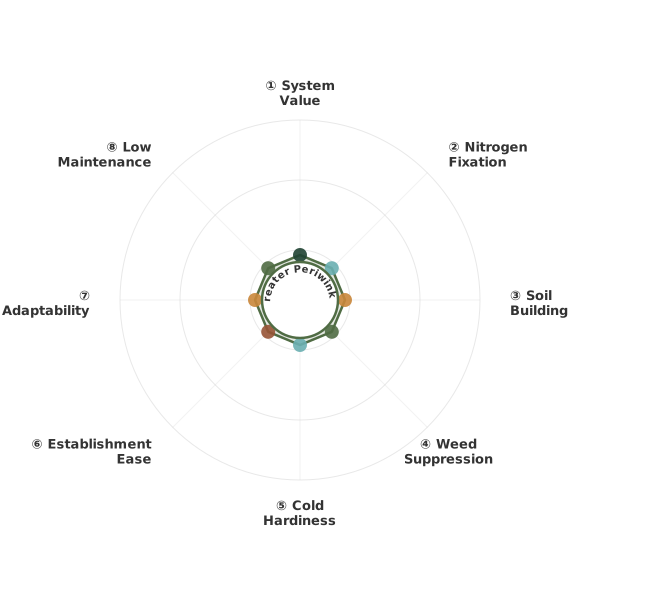
Comparative ratings for this plant across key regenerative agriculture traits.

Trait Suitability Explanation
Cold Hardiness Not Recommended This ornamental groundcover is sensitive to frost and does not contribute to soil building or biomass generation within a regenerative system.
Weed Suppression Not Recommended While it can aggressively cover ground, its growth habit is not designed for agricultural weed suppression or soil health improvement as a cover crop.
Nitrogen Fixation Not Recommended As an ornamental groundcover rather than a legume, Periwinkle does not contribute to nitrogen fixation within the soil ecosystem.
Root System Depth Not Recommended Periwinkle possesses a shallow, spreading root system that anchors surface soil but offers limited potential for subsoil aeration or nutrient cycling.
Biomass Production Not Recommended This ornamental groundcover produces limited biomass, and its slow-decomposing woody stems contribute minimally to soil organic matter regeneration.
Establishment Ease Not Recommended Slow to establish from seed, requiring division or cuttings, and exhibits poor early vigor, making it susceptible to competition and slow to form a beneficial ground cover.
Multi Benefit Value Not Recommended Primarily an ornamental groundcover with invasive potential, offering limited ecosystem services beyond superficial erosion control and minimal support for wildlife or pollinators.
Climate Adaptability Adequate Hardy in zones 7-10, it thrives in moderate conditions and prefers consistent moisture, but can be stressed by extreme drought or waterlogging, impacting its role in moisture retention.
Maintenance Intensity Ideally Suited Once established, this vigorous groundcover thrives in shade and poor soils with minimal intervention, naturally managing its own moisture and fertility needs without external inputs.

Comparative System: Ratings compare plants within their economic category (e.g., cover crop nitrogen fixation compared to other cover crops, not to all plants). Individual farm conditions and management practices significantly influence actual performance.

8

Learn More

Why farmers use this plant and additional resources

Why Regenerative Farmers Use This Plant

Vinca major, or Big Periwinkle, is a robust evergreen perennial that excels as a groundcover in regenerative agriculture systems, primarily for its exceptional soil stabilization and weed suppression capabilities. Its vigorous, sprawling growth habit, with trailing stems that readily root at nodes, forms a dense, impenetrable mat. This characteristic is crucial for preventing soil erosion on slopes and disturbed areas, effectively minimizing overland flow and sediment loss. This physical barrier can reduce soil loss by an estimated 70-90% compared to bare ground, preventing the degradation of valuable topsoil and the sedimentation of waterways.

While not a nitrogen-fixing legume, its dense foliage contributes to soil organic matter accumulation through leaf litter decomposition, enhancing soil structure and water infiltration over time. Its dense foliage and extensive root system effectively scavenge nutrients from the soil, preventing their leaching into groundwater, particularly in areas with high rainfall or sandy soils. The continuous ground cover also moderates soil temperature and moisture, creating a more stable environment for soil microbial communities, which are the foundation of a healthy, productive soil ecosystem.

The integration of Vinca major offers significant indirect economic benefits through input cost reduction and enhanced system resilience. Its dense canopy actively outcompetes a wide spectrum of annual and biennial weeds, potentially leading to a 15-30% decrease in herbicide expenditures in managed areas, a saving typically realized within 1-3 years of establishment. In areas where dense ground cover is critical for soil stability, this translates to annual savings of $40/acre or more from reduced inputs. Furthermore, improved soil structure from its root system and organic matter contribution can enhance water retention, potentially reducing irrigation needs by 5-10% once well-established, translating to savings on water and pumping costs. While initial establishment costs can range from $500-$1,500 per acre, its lifespan exceeding 5-10 years, coupled with these ongoing savings, positions it as a cost-effective, long-term solution for groundcover management, especially in perennial cropping systems like orchards and vineyards, or in buffer zones.

Environmentally, Vinca major provides essential ecosystem services by creating a stable, living mulch that moderates soil temperature fluctuations, fostering a more hospitable environment for beneficial soil microorganisms. This continuous ground cover supports a more biologically active soil surface, leading to increased organic matter and improved nutrient cycling. Its dense foliage offers low-level habitat for beneficial insects and small ground-dwelling organisms, contributing to local biodiversity and natural pest control. By reducing the need for mechanical cultivation or chemical interventions for weed control, Vinca major supports a more balanced and less disturbed farm ecosystem. Its ability to thrive in less-than-ideal conditions also makes it a valuable tool for ecological restoration projects and for increasing the overall resilience of agricultural landscapes against environmental stressors.

Vinca major has demonstrated success in various agricultural settings globally. In the Mediterranean basin, its native region, it is used on vineyard slopes to prevent erosion and reduce weed pressure. In the southeastern United States, it is employed in orchards, on disturbed land, and along irrigation ditches for its persistent groundcover and soil-binding properties. Australian farmers in temperate zones utilize it in buffer strips, on embankments, and in non-arable areas to combat soil erosion, particularly in areas with moderate rainfall. Its adaptability allows for integration into diverse systems, from established perennial crops to areas requiring long-term ground stabilization where minimal intervention is desired. In agroforestry systems, its adaptability to partial shade makes it suitable for understory planting in regions like Brazil, where it can help maintain soil cover and suppress competing vegetation without significant competition with the primary crop.

9

How to Integrate This Plant

Practical guidance for regenerative systems

Establishing Vinca major requires careful planning to leverage its vigorous growth habit effectively and achieve desired coverage speed. Propagation can be achieved through cuttings, plugs, or seed, with cuttings and plugs generally offering faster groundcover establishment. For optimal coverage, planting density typically ranges from 1-2 feet (30-60 cm) apart, depending on the desired speed of establishment; closer spacing will result in quicker coverage.

For seed, broadcast seeding rates can range from 50-100 lbs/acre (56-112 kg/ha), while drilling can be done at slightly lower rates. If using smaller quantities, seeding rates typically range from 1-2 ounces (28-56 grams) per 100 square feet, or approximately 2-4 lbs/acre (2.2-4.5 kg/ha). Planting depth should be shallow, around 0.25-0.5 inches (0.6-1.3 cm). The ideal planting time varies by hemisphere, with late spring to early summer (April-June in the Northern Hemisphere, October-December in the Southern Hemisphere) being optimal for establishment in many regions, allowing plants to develop before extreme temperatures. In the UK and other temperate European countries, early autumn (September-October) can also be suitable for establishing permanent groundcover.

Initial watering is critical after planting to ensure consistent moisture and encourage adventitious rooting of stems, a process that typically leads to establishment within 30-45 days. Consistent moisture is crucial during the initial establishment phase to encourage root development and stem rooting. The initial investment for establishment, including plant material and labor, can range from $500 to $1,500 per acre.

Once established, Vinca major requires minimal management, fitting well into low-input regenerative systems. While moderately drought-tolerant once its root system is developed, supplemental watering may be beneficial during prolonged dry spells, especially in full sun locations, to maintain vigorous growth. Initial manual or targeted weeding may be necessary until the canopy is fully formed, after which its vigorous growth will suppress most competing vegetation. In areas where its spread needs to be contained, occasional trimming of trailing stems can be performed; these pruned stems can often be replanted to further establish cover or fill gaps. The plant typically reaches a height of 1-2 feet (0.3-0.6 m) in its dense mat form, with stems extending several feet. Fertility needs are generally met by decomposing leaf litter and improved soil biology; if supplemental nutrients are deemed necessary during a transition phase, compost or well-rotted manure are preferred over synthetic inputs.

As a groundcover, Vinca major is typically not terminated in the same manner as annual cover crops; its primary role is as a persistent living mulch. If management is required, such as for replanting or transitioning the area, physical removal of sections of the mat can be undertaken. In situations where its spread needs to be restricted, mowing or trimming back the edges of the growth can be effective. If complete removal is necessary, it can involve mechanical methods like tilling or, as a last resort during a transition phase, carefully targeted herbicide application, always prioritizing biological and mechanical methods first.

For cover crop applications where termination is considered, regenerative methods should be prioritized. In regions with sufficiently cold winters, natural winterkill can eliminate the need for intervention. Where winterkill is not reliable, mowing or grazing can be employed to reduce biomass before planting a subsequent cash crop. Roller-crimping at the appropriate growth stage, typically when flowering begins, is an effective mechanical termination method that creates a beneficial mulch layer. If herbicide use is considered, it should be as a last resort during a transition phase, applied only when regenerative termination methods have been exhausted, and timed to allow for sufficient residue breakdown before cash crop planting. The biomass produced by Vinca major contributes organic matter to the soil, and its decomposition timeline will vary, but it typically releases nutrients gradually over several months, supporting soil health. Expect nitrogen credits to be minimal as Vinca major is not a legume, but its contribution to soil structure and weed suppression is substantial.

View Full Document (Printable single-page version)