
Asparagus
Available data points to its potential role in soil health. Excerpt highlights its use in field trials investigating soil amendments like mushroom substrate and microbial inoculants, suggesting asparagus can be part of systems aimed at improving productivity in challenging replant soils. Furthermore, excerpt demonstrates asparagus's beneficial relationship with arbuscular mycorrhizal fungi (AMF), showing enhanced nutrient uptake (ergothioneine) when inoculated. This suggests asparagus could be integrated into systems that foster beneficial soil microbial communities, contributing to a more resilient soil biome. While not explicitly detailed as a cover crop, forage, or nitrogen fixer, its interaction with soil microbes and response to amendments indicate potential for soil building and improved nutrient cycling. Further research is needed to fully understand its primary uses and benefits in diverse regenerative systems. While coverage in our knowledge base is limited, the above represents documented uses in regenerative systems.
For a full botanical description see: Plants For A Future(opens in new window) (external link)
Regenerative Quick Profile
All recommendations assume integrated, regenerative practices—not conventional inputs.
Climate & Soil Fit
Climate: Tropical Rainforest, Tropical Monsoon, Tropical Savanna, Hot Semi-Arid (Steppe), Cold Semi-Arid (Steppe), Hot Desert, Cold Desert, Humid Subtropical, Oceanic (Maritime Temperate), Hot-Summer Mediterranean, Warm-Summer Mediterranean, Monsoon-Influenced Humid Subtropical, Subtropical Highland, Hot-Summer Continental, Warm-Summer Continental, Subarctic, Monsoon-Influenced Hot-Summer Continental, Tundra
Zones: USDA 4-9, Australian Zones 3-11
Optimal Soil: Loam Soil
System Role & Functions
Primary: Cash Crop With Services
Secondary: Cover Crop System, Soil Remediation
Key Benefits: Low maintenance, Yield Reliability
Management Level
Experience: Advanced
Maintenance: Very low maintenance - Once established, asparagus fit seamlessly into a regenerative system, requiring minimal intervention due to its inherent resilience and natural fertility management.
Value Streams
- Vegetable/specialty crop harvest
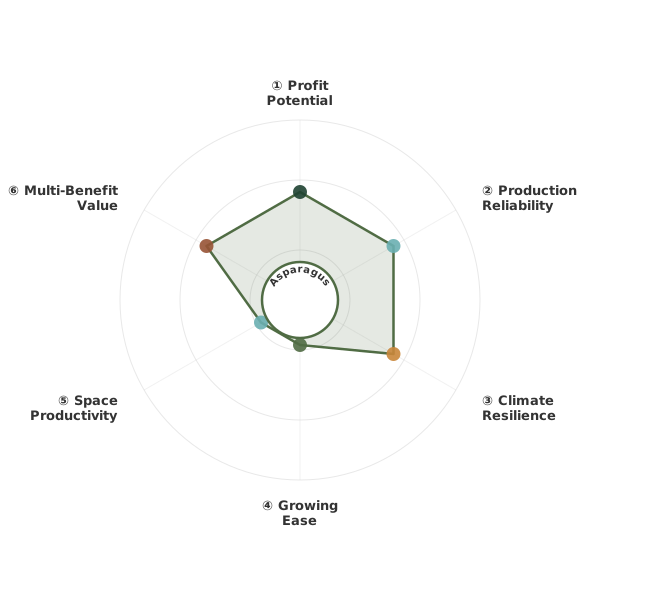
How These Traits Are Calculated
Trait dimensions are ordered clockwise starting from the top of the chart (12 o'clock position):
1. Profit Potential
Net returns per acre from yield, pricing, input costs, and labor efficiency
WHAT: Synthesizes gross revenue potential, input costs, labor requirements, and storage/marketing advantages into net profitability per acre. Captures the complete economic picture from planting to sale.
WHY: Not all vegetables are equally profitable. High-value crops with efficient production can return $10,000-30,000/acre versus $2,000-5,000/acre for lower-value options. Profit potential guides crop selection for maximum return on limited land and determines viable scale for farm businesses.
HOW: Scored via LLM synthesis of economics data (yields, prices, costs), storage advantages (season extension, value-added potential), and labor intensity. Exceptional (3.0): High yields × premium prices with moderate inputs and good storage (garlic, high-value salad greens). Typical (2.0): Moderate returns (tomatoes, squash). Limited (1.0): Low yields, commodity pricing, or intensive labor requirements (low-value greens).
2. Production Reliability
Weighted: yield consistency (60%) + disease/pest resistance (40%)
WHAT: Combines yield reliability (harvest consistency year-to-year) with disease and pest resistance to measure predictable production. Reliable vegetables deliver consistent harvests without catastrophic failures from pests or weather.
WHY: Market commitments and CSA subscriptions require dependable production. Unreliable crops that fail in bad years or require intensive pest management create cash flow gaps and customer dissatisfaction. Reliable producers allow confident planning and reduce input costs from emergency pest interventions.
HOW: Weighted formula prioritizes yield reliability (60% weight) for overall consistency, with disease/pest resistance (40% weight) to prevent total failures. Exceptional (3.0): Consistent yields across variable seasons with strong natural pest resistance. Typical (2.0): Generally reliable with some pest/weather sensitivity. Limited (1.0): Highly variable yields or severe pest vulnerability requiring intensive management.
3. Climate Resilience
Temperature and rainfall tolerance across diverse growing conditions
WHAT: Measures the breadth of climatic conditions where the vegetable produces successfully—temperature extremes, humidity ranges, and rainfall variability. Climate-resilient crops work across diverse regions and weather patterns.
WHY: Climate variability is increasing—unexpected heat waves, cold snaps, or drought periods can wipe out entire vegetable harvests. Resilient crops provide insurance against weather uncertainty and allow geographic expansion for market growth. This is especially critical for direct-market farmers who can't easily substitute crops mid-season.
HOW: Ratings based on the climate_adaptability trait documenting temperature tolerance and geographic range. Exceptional (3.0): Grows successfully in diverse climates (cold to hot, humid to dry) with wide hardiness zone range. Typical (2.0): Moderate climate flexibility. Limited (1.0): Narrow climate requirements (tropical-only, cool-season-only, humidity-sensitive).
4. Growing Ease
Weighted: establishment ease (50%) + low maintenance requirements (50%)
WHAT: Combines establishment difficulty (germination, transplanting) with ongoing maintenance needs (watering, fertilizing, pest management) to measure total labor requirements. Easy crops grow reliably with minimal intervention.
WHY: Labor is the primary cost for small-scale vegetable production. Easy-care crops allow farmers to manage more production area with the same labor, improving profitability. Difficult crops requiring constant attention, precise timing, or specialized skills reduce overall farm productivity and increase risk.
HOW: Weighted formula balances establishment ease (50% weight) for reliable startup and inverted maintenance intensity (50% weight) for ongoing care. Exceptional (3.0): Direct-seeded or easy transplants with minimal water/fertility/pest needs. Typical (2.0): Moderate care requirements. Limited (1.0): Difficult establishment or intensive ongoing management (daily watering, heavy feeding, constant pest monitoring).
5. Space Productivity
Weighted: yield per square foot (60%) + season extension potential (40%)
WHAT: Combines spatial productivity (yield per square foot) with temporal productivity (extended harvest windows from succession planting or season extension). Maximizes production from limited growing area.
WHY: Land is the primary constraint for vegetable farmers—especially those near urban markets. Space-efficient crops delivering high yields in small areas improve per-acre profitability dramatically. Season extension (spring tunnels, fall protection) adds bonus production windows when competing supply is limited and prices are higher.
HOW: Weighted formula prioritizes space efficiency (60% weight) for core yield per area, with season extension potential (40% weight) for bonus production opportunities. Exceptional (3.0): High yields per square foot (10,000+ lbs/acre equivalents) with season extension options. Typical (2.0): Moderate yields and extension potential. Limited (1.0): Low yields or crops unsuitable for season extension.
6. Multi-Benefit Value
Ecosystem services beyond harvest—pollinator support, nitrogen fixing, pest habitat
WHAT: Measures ecosystem services provided beyond harvestable yield. Multi-benefit vegetables contribute to farm ecology through nitrogen fixation (legumes), pollinator support (flowering crops), beneficial insect habitat, soil building, or erosion control.
WHY: Cash crops can either extract from farm ecosystems or contribute to them. Vegetables with strong multi-benefit value build soil fertility, support pollinators needed for fruit/vine crops, and create habitat for pest predators—reducing external input needs. Nitrogen-fixing vegetables (beans, peas) provide $40-80/acre worth of fertility for following crops.
HOW: Ratings based on the multi_benefit_value trait documenting service contributions. Exceptional (3.0): Significant ecosystem services (nitrogen fixation, heavy pollinator support, soil building, pest habitat). Typical (2.0): Some ecosystem contributions. Limited (1.0): Single-purpose cash crops with minimal farm ecology benefits.
Ratings are based on documented performance in regenerative systems, not conventional high-input scenarios. All traits assume integrated management practices focused on soil health and ecosystem services.
5
Management & Care Requirements
Integration guidance, maintenance needs, and care practices
Management & Care Requirements
Integration guidance, maintenance needs, and care practices
How to Integrate This Plant
Asparagus (Asparagus officinalis) can be integrated into regenerative systems primarily as a long-term cash crop with complementary ecosystem services. Its primary function is cash crop with services, contributing to farm income while enhancing soil health and biodiversity. Compatible practices include alley cropping, where asparagus can be planted in the alleys between rows of trees, or as a component in a food forest system, benefiting from the microclimate provided by taller species. It can also function as a living mulch or groundcover in certain perennial systems. Asparagus begins providing value from Year 1 with establishment, with marketable yields typically starting around Year 3 and increasing significantly by Year 5. Its multi-benefit stacking includes direct harvest value, significant soil building potential through its extensive root system, and support for beneficial soil microbes, particularly arbuscular mycorrhizal fungi (AMF), as indicated by research on ergothioneine uptake. This microbial support enhances nutrient cycling and plant resilience, contributing to overall farm ecosystem health beyond its direct economic return.
Integration Practices & Management
Source touches on improving asparagus productivity in replant soils through amendments like mushroom substrate, clay mineral, mustard meal, and microbial inoculants, suggesting potential fertility and soil health management approaches. Source highlights the positive role of arbuscular mycorrhizal fungi (AMF) in asparagus's uptake of ergothioneine, indicating that microbial inoculants could be a consideration for enhancing plant health and nutrient acquisition, a common regenerative strategy. However, details on establishment methods, integration with grazing, termination strategies, or specific management considerations for asparagus within a regenerative rotation are not present. The available information does not detail practical farmer experiences or specific integration techniques with other cash crops or livestock systems. While coverage in our knowledge base is limited, the above represents documented uses in regenerative systems. While coverage in our knowledge base is limited, the above represents documented uses in regenerative systems.
Management Profile
Maintenance Intensity: Ideally Suited - Once established, asparagus fit seamlessly into a regenerative system, requiring minimal intervention due to its inherent resilience and natural fertility management.
Sources behind this view
 Community
-
Protect young asparagus in food forests with defined wood chip paths to deter animals and manage grass competition. Asparagus is resilient and water-loving, thriving even in unwatered areas with good
Read more (opens in new window) permies.com
 Research
-
Regenerative Agriculture: Restoring Ecosystems¢ Resilience and Productivity: A Review (opens in new window)
Regenerative agriculture builds soil health and ecosystem services through practices like no-till, cover crops, and diverse rotations. It increases soil organic matter, improves water infiltration, bo
6
Economics & Value Streams
Direct harvest, system benefits, ecosystem services, and risk diversification
Economics & Value Streams
Direct harvest, system benefits, ecosystem services, and risk diversification
Comprehensive economic analysis including direct harvest value, system enhancement contributions, ecosystem services, value timeline, and risk diversification strategies.
Vegetable & Specialty Economics
| Metric | Value |
|---|---|
| Seed/Transplant Cost | 800-1600 $/acre 1976-3953 $/ha |
| Expected Yield | 2000-5000 lbs/acre 2241-5604 kg/ha |
| Market Price | 2.00-4.00 $/lb 4-8 $/kg |
| Harvest/Handling Cost | 1000-2000 $/acre 2471-4942 $/ha |
| Marketing/Distribution Cost | 500-1000 $/acre 1235-2471 $/ha |
| Net Annual Return* | $-600 to $17700/acre/year |
Economics highly variable by market channel (direct vs wholesale), scale, and management. Direct marketing commands premiums but requires labor. Values shown for mid-scale market garden operations.
* Net Annual Return = (Yield × Market Price) − (Amortized Establishment Cost + Annual Maintenance). This return is realized only at/after first harvest; early years have costs but no revenue. Range shows worst case to best case scenarios.
System Enhancement Value
Beyond harvest: ecosystem services from regenerative cash crop practices
Ecological Service Contributions
Asparagus's perennial nature and deep root systems contribute significantly to soil health and remediation, particularly in 'replant soils' where microbial complexes can reduce yields. The incorporation of ample compost and well-rotted manure during establishment further enhances soil structure and fertility. The study by highlights the crucial role of arbuscular mycorrhizal fungi (AMF) in asparagus uptake of ergothioneine (ERGO), an antioxidant. Promoting AMF populations, which are often reduced by tillage, can be achieved by integrating asparagus into farming systems. This suggests asparagus can act as a bio-accumulator, potentially improving soil microbial health and plant nutrient uptake. Furthermore, asparagus attracts pollinators like honey bees, which are vital for the pollination of other crops within an integrated farm system. Its perennial growth habit also provides consistent ground cover, reducing soil erosion and improving water infiltration over time, especially when managed with minimal tillage post-establishment.
Ecosystem Service Contributions
Environmental contributions: carbon, pollinators, wildlife, and water
- Carbon Sequestration: Asparagus, as a perennial vegetable with a long lifespan (over 15 years), has the potential for significant carbon sequestration in its root biomass and the surrounding soil, especially when established in no-till or reduced tillage systems. Its deep root structure contributes to soil organic matter accumulation over time.
- Pollinator Support: High. Asparagus is visited by honey bees and other pollinators, which are essential for the reproduction of many agricultural crops. Its perennial nature provides a consistent and extended source of nectar and pollen.
- Wildlife Habitat: Asparagus provides ground cover, which can offer some habitat for small ground-dwelling invertebrates and potentially nesting sites for certain ground birds. Its foliage can also serve as browse for some wildlife, though it's not a primary food source for most larger animals.
- Water Quality: Not applicable
Value Timeline: Production & Services
When you'll see results: varies by crop (annual harvest vs. perennial establishment)
Years 1-2
Initial soil preparation and establishment of perennial root systems begin to improve soil structure and reduce erosion. Minimal harvest is recommended in year 1, with light harvesting in year 2, providing a small but early income stream. AMF colonization can begin, contributing to soil health.
Years 3-5
Full harvest potential is reached from the third year onwards, providing consistent cash crop revenue for eight weeks annually. Established root systems offer significant soil remediation benefits and contribute to ongoing soil organic matter accumulation. Pollinator support becomes more pronounced with mature plants.
Years 10-20
Mature asparagus beds continue to provide consistent annual harvests and contribute significantly to soil health and carbon sequestration. The deep perennial root system maximizes soil remediation and water infiltration benefits. Potential for increased AMF activity and associated nutrient cycling benefits.
20+ Years
Long-term, established asparagus beds offer sustained economic returns alongside persistent and significant ecosystem services, including robust soil health, carbon storage, and continued pollinator support. The perennial nature ensures ongoing benefits without the need for annual replanting, reducing farm labor and resource inputs.
Farm Risk Reduction
How this reduces farm risk: backup income, weather protection, market hedges
- Multiple Revenue Streams: Primary income from cash crop harvest (asparagus spears). Secondary benefits include improved soil health, reduced need for synthetic fertilizers and soil amendments due to soil remediation and potential nutrient cycling assistance from AMF, and enhanced pollinator populations supporting other crops.
- Temporal Income Spread: Value is spread temporally through a perennial harvest cycle (8-week harvest window annually from year 3 onwards) and ongoing, cumulative ecosystem services (soil remediation, carbon sequestration, pollinator support) that build over the long lifespan of the plant (15+ years).
- Market Risk Hedge: As a perennial crop, asparagus reduces the risk and cost associated with annual planting. Its long lifespan provides a stable, recurring income stream. Its role in soil remediation and support for beneficial microbes can reduce reliance on external inputs, buffering against price volatility of fertilizers and soil amendments. The attraction of pollinators can indirectly support yields of other crops in an integrated system.
Sources behind this view
Community
-
Focusing on high-value perennials like asparagus and building a perennial polyculture with free/cheap native species (black locust, elderberry, hazelnut) while using microgreens as a short-term profit
Read more (opens in new window) permies.com
8
Learn More
Why farmers use this plant and additional resources
Learn More
Why farmers use this plant and additional resources
Why Regenerative Farmers Use This Plant
Asparagus officinalis stands out as a high-value specialty cash crop within regenerative agriculture, offering significant revenue potential per acre and contributing to long-term soil health and farm resilience. Its perennial nature means that once established, it can provide a harvest for 15-25 years, amortizing initial establishment costs over a long period and drastically reducing annual establishment costs and labor compared to annual crops.
Economic Potential: From seed, it typically takes 3-4 years to reach full harvest potential, yielding an impressive 2,000-6,000 lbs/acre (2,240-6,720 kg/ha) annually in mature beds. Depending on market demand and farm management, wholesale prices can range from $3-$8 per pound ($6.60-$17.60 per kg), with direct-to-consumer prices significantly higher. This translates to potential gross revenues of $6,000-$28,000 per acre ($14,800-$69,000/ha). This productivity makes it an attractive option for direct-to-consumer sales via farmers' markets and CSA programs, as well as for specialty wholesale markets seeking premium produce. The ability to plant successive beds or manage different age groups of asparagus allows for a staggered harvest, extending the selling season and providing a consistent income stream throughout late spring and early summer.
Ecological Benefits: Integrating asparagus into a diversified farm system offers significant ecological benefits. As a deep-rooted perennial, it significantly contributes to building soil organic matter and improving soil structure over time, with root systems extending 6-10 feet (1.8-3 meters) deep. This extensive root network enhances water infiltration, reduces soil erosion, breaks up compaction, and scavenges nutrients from deeper soil profiles, making them available to shallower-rooted companion plants or preventing nutrient leaching. Its perennial habit means less soil disturbance annually, a key tenet of regenerative agriculture, leading to improved soil biology and reduced erosion potential.
The dense ferny foliage acts as a living mulch, suppressing weeds and providing habitat for beneficial insects during its active growth phase. Mature ferny growth provides overwintering habitat for various beneficial insects, including ladybugs and lacewings, which can then move into adjacent crops in the spring. Its deep root system also plays a crucial role in improving soil aeration and water-holding capacity, leading to more resilient cropping systems. By reducing the need for annual tillage and synthetic inputs, asparagus cultivation aligns perfectly with regenerative principles, fostering a more biodiverse and self-sustaining agricultural ecosystem. Furthermore, its deep root system acts as a carbon sink, sequestering carbon below ground.
Regional Adaptations: Asparagus has demonstrated success in various regional farming systems:
- Pacific Northwest, USA: Growers have established profitable operations in USDA Zones 7-9, benefiting from mild winters and adequate rainfall. Cultivation is well-suited to mild, wet winters and warm, dry summers, often with irrigation.
- Europe (France, Netherlands): Asparagus cultivation has a long history, with farmers leveraging its potential for early-season markets. It is integrated into mixed vegetable farms and specialty crop operations. In the UK, it is commonly grown in USDA Zones 7-8, often on well-drained soils, and benefits from mulching. Growers utilize its tolerance for cooler, wetter conditions, often planting in raised beds to improve drainage.
- Australia: Growers in cooler, temperate regions (Australian Zones 2-3) have found success with specific varieties adapted to their climate, integrating it into mixed horticultural operations. Farmers in regions like South Australia and Victoria have found success with varieties adapted to Mediterranean climates, where hot, dry summers are managed with irrigation and mulching.
- Canada: Growers in areas like southern Ontario (Canadian Zone 6b) successfully cultivate asparagus, selecting varieties known for their cold tolerance. In regions with shorter growing seasons, focusing on early-maturing varieties and ensuring adequate winter protection for the crowns is key.
- Southeastern US (Humid Subtropical): Selecting varieties with good disease resistance and ensuring adequate air circulation are key to managing fungal issues.
- Dryland regions of Australia: Careful irrigation management and the use of drought-tolerant varieties are crucial for successful cultivation where water is a limiting factor.
Sources behind this view
Research
-
Regenerative Agriculture: Restoring Ecosystems¢ Resilience and Productivity: A Review (opens in new window)
Regenerative agriculture builds soil health and ecosystem services through practices like no-till, cover crops, and diverse rotations. It increases soil organic matter, improves water infiltration, bo
-
Effect of Organic and Mineral Soil Additives on Asparagus Growth and Productivity in Replant Soils (opens in new window)
In replant asparagus fields, mushroom compost and mustard meal (biofumigation) significantly boosted marketable yields by up to 16% over 5 years, addressing soil sickness issues.