Regenerative Quick Profile

All recommendations assume integrated, regenerative practices—not conventional inputs.

Climate & Soil Fit

Climate: Tropical Rainforest, Tropical Monsoon, Tropical Savanna, Hot Semi-Arid (Steppe), Cold Semi-Arid (Steppe), Hot Desert, Cold Desert, Humid Subtropical, Oceanic (Maritime Temperate), Hot-Summer Mediterranean, Warm-Summer Mediterranean, Monsoon-Influenced Humid Subtropical, Subtropical Highland, Hot-Summer Continental, Warm-Summer Continental, Subarctic, Monsoon-Influenced Hot-Summer Continental

Zones: USDA 6-11, Australian Zones 10-24

Optimal Soil: Loam Soil

System Role & Functions

Primary: Cover Crop System

Secondary: Nitrogen Fixer, Cash Crop With Services

Key Benefits: Nitrogen Fixation

Management Level

Experience: Beginner-Friendly

Maintenance: Moderate maintenance - As a key nitrogen-fixing component of the rotation, soybeans benefit from healthy soil organic matter and balanced nutrient cycling through compost and cover cropping, integrating pest and disease management within the broader farm ecosystem.

Value Streams

  • Cover crop (soil investment)
  • Soil building and erosion control
1

Climate Suitability Assessment

Will this plant thrive in your climate?

IDEALLY SUITED

Köppen Zone: Aw (Tropical Savanna), Cfa (Humid Subtropical), Cwa (Monsoon-Influenced Humid Subtropical)
USDA Zone: 6a, 7a, 8a, 9a, 10a
Australian Zone: subtropical
EU Climate Region: atlantic

Black soybean performs optimally in regions with long growing seasons (150-240+ frost-free days) and warm temperatures, ideally between 70-85°F (21-29°C) during its growth cycle. These conditions are met in Köppen Cfa and Cwa zones, USDA zones 7a through 10b, Australian subtropical regions, and EU Atlantic climate regions. Ample rainfall (30-50 inches/75-125 cm annually) or reliable irrigation is beneficial, though the plant exhibits moderate drought tolerance once established. Spring establishment is reliable when soil temperatures reach 60°F (15°C). In these zones, black soybean excels as a cover crop, fixing significant amounts of nitrogen and producing substantial biomass. It can also readily overwinter and reseed in the warmer USDA zones and subtropical Australian regions, acting as a valuable component in regenerative systems with minimal management inputs beyond initial planting.

ADEQUATE

Köppen Zone: Af (Tropical Rainforest), Am (Tropical Monsoon), BSh (Hot Semi-Arid (Steppe)), Cfb (Oceanic (Maritime Temperate)), Csa (Hot-Summer Mediterranean), Csb (Warm-Summer Mediterranean), Cwb (Subtropical Highland), Dfa (Hot-Summer Continental), Dfb (Warm-Summer Continental)
USDA Zone: 5a, 5b, 11a, 12a
Australian Zone: temperate
EU Climate Region: continental

Black soybean is adequately suited to climates with moderate growing seasons (120-150 frost-free days) and temperatures that are warm during summer but may have cooler springs or autumns. This includes Köppen Csa, Cfb, Dfa, Dwa, and Dfb zones, USDA zones 5b through 6b, Australian temperate regions, and EU continental climate regions. While it can be grown successfully, it is typically managed as an annual crop due to unreliable winter survival in colder zones. Summer heat is generally sufficient for good growth and nitrogen fixation, but cooler temperatures may slightly reduce rates. Adequate rainfall is important, and supplemental irrigation might be beneficial during dry spells, particularly in Csa and temperate Australian zones. Yields and nitrogen fixation are good but may be slightly lower than in ideal climates. Careful planting and harvesting timing are crucial to avoid frost damage.

NOT RECOMMENDED

Köppen Zone: ET (Tundra), BSk (Cold Semi-Arid (Steppe)), BWh (Hot Desert), BWk (Cold Desert), Dfc (Subarctic), Dwa (Monsoon-Influenced Hot-Summer Continental)
USDA Zone: 2a, 3a, 3b, 4a

Black soybean is not recommended in climates with very short growing seasons (less than 120 frost-free days) and extreme cold, or in regions with prolonged periods of extreme heat and drought that exceed its tolerance. This includes Köppen Dwb zones, USDA zones 3a through 5a, and any regions with similar marginal conditions. In these zones, winter survival is highly unlikely, and the short growing season, coupled with the risk of frost damage, severely limits biomass production and nitrogen fixation. The economic viability and practical success of growing black soybean are questionable, requiring intensive management and yielding minimal benefits. Alternative nitrogen-fixing cover crops or biomass producers that are specifically adapted to these harsh conditions are a far more suitable choice for regenerative agriculture practices.

Better alternatives for these "not recommended" zones: Hairy Vetch (cold-hardy annual legume for nitrogen fixation), Winter Rye (extremely cold-hardy cover crop for biomass and soil protection), Cowpea (heat-tolerant nitrogen fixer for hot, dry conditions (where applicable)), Sunn Hemp (tropical nitrogen fixer adapted to hot, dry conditions (where applicable))

Note: Zones listed above represent climates where this plant can produce reliably with reasonable management. Climate zones not mentioned would require intensive climate modification (greenhouses, extensive infrastructure) and are not economically viable for regenerative agriculture purposes.

2

Soil Suitability Assessment

Which soil types work best for this plant?

IDEALLY SUITED

Loam Soil

This plant thrives in these soil types without requiring amendments or remediation. Natural soil conditions support optimal growth and productivity.

ADEQUATE

Acidic Soil, Alkaline Soil, Clay Soil, Desert Soil, Rich Soil, Rocky Soil, Sandy Soil

This plant performs acceptably in these soil types with moderate, manageable remediation such as pH adjustment, compost addition, or drainage improvement. The required amendments are practical and cost-effective for regenerative agriculture.

NOT RECOMMENDED

Saline Soil, Wet Soil

Growing this plant in these soil types would require impractical remediation such as complete soil replacement, extensive amendments, or cost-prohibitive infrastructure. These conditions are not economically viable for regenerative agriculture.

Note: Soil suitability assessments focus on remediation requirements. "Ideally Suited" means the plant generally thrives without the need for substantial amendments, "Adequate" means manageable remediation (lime, compost, mulch), and "Not Recommended" means impractical soil changes would be required. Climate factors like rainfall and temperature also influence success.

3

Seasonal Considerations

Planting timing, growth duration, and harvest windows

Soybeans, as a cover crop, are a versatile warm-season annual best suited for planting after the last expected frost in spring. This allows ample time for establishment and growth before cooler temperatures arrive. Aim for planting when soil temperatures consistently reach 60°F (15°C) to ensure rapid germination and vigorous early growth, typically taking 1-3 weeks to establish a good stand.

For a fall cover crop, soybeans must be planted well before the first expected frost to allow for sufficient biomass accumulation. However, they are not reliably winter-hardy in most climates, meaning they will likely winter-kill in colder regions, leaving the soil surface clear for early spring cash crop planting. In milder climates, they may survive as a green manure crop.

Peak biomass is usually achieved in late summer to early fall. Termination should occur several weeks before planting your next cash crop, allowing for decomposition and nutrient release. While not typically frost-seeded, soybeans can be incorporated into summer-fallow systems or planted as a relay crop with shorter-season cash crops if managed carefully. Their nitrogen-fixing capabilities make them valuable in building soil health.

4

System Role & Multi-Benefit Value

Functional roles, integration strategies, and stacked benefits

Functional Role

Integration Characteristics

Multi-Benefit Value: Adequate - A valuable legume for soil fertility, soybeans also provide significant biomass for soil health and can offer moderate support for beneficial insects when integrated thoughtfully.

5

Economics & Value Streams

Direct harvest, system benefits, ecosystem services, and risk diversification

Comprehensive economic analysis including direct harvest value, system enhancement contributions, ecosystem services, value timeline, and risk diversification strategies.

Vegetable & Specialty Economics

Metric Value
Seed/Transplant Cost
Expected Yield
Market Price
Harvest/Handling Cost
Marketing/Distribution Cost

Economics highly variable by market channel (direct vs wholesale), scale, and management. Direct marketing commands premiums but requires labor. Values shown for mid-scale market garden operations.

System Enhancement Value

Beyond cost recovery: soil building, nitrogen, biomass, and weed suppression

Nitrogen Fixation & Cycling

50-100 lbs N/acre/year = $30-90/acre fertilizer replacement (assuming $0.60/lb N)

Soybeans (Glycine max), as a legume, possess a significant capacity for biological nitrogen fixation, a key regenerative practice. Through symbiosis with Rhizobium bacteria in their root nodules, they convert atmospheric nitrogen (N2) into a usable form for plants. This process directly contributes to soil fertility, reducing the reliance on synthetic nitrogen fertilizers. Knowledge base excerpts highlight the importance of cover crops, especially legumes, for soybean nodulation. This intrinsic nitrogen-fixing ability is a cornerstone of regenerative systems, as it builds soil health and nutrient availability for subsequent crops. The nitrogen supplied by soybeans can significantly reduce or eliminate the need for nitrogen inputs for the following cash crop, leading to substantial cost savings and a more sustainable nutrient cycle. This contribution is particularly valuable in integrated crop-livestock systems where manure application might not always perfectly align with crop nitrogen demands.

Soil Building & Weed Suppression

Soybeans offer substantial system value beyond direct harvest. As a cash crop with services, they are integrated into systems that reduce input costs, such as a 75% decrease in herbicide use and elimination of pesticides by relying on beneficial insects. Their role in cover crop systems, like mung beans fixing nitrogen and legumes aiding nodulation, enhances soil health and nutrient cycling. The knowledge base also points to the critical role of zinc during R4-R6 growth stages for seed fill, with foliar applications potentially doubling yields, indicating a responsiveness to targeted nutrient management. Furthermore, soybeans can contribute to a more resilient farming system by diversifying income streams and providing a market hedge. Their integration with livestock, as seen in systems where cattle graze cover crops before soybeans are planted, transforms crop residues into manure, further enriching the soil.

Erosion Control

Variable, but contributes to soil cover and organic matter in systems that achieve 5-15% crop yield improvement due to erosion control from cover crops.

While soybeans themselves are a relatively low-growing crop and do not function as a traditional windbreak or provide significant direct erosion control in the manner of perennial grasses or trees, their role within a cover cropping system is crucial for erosion prevention. As noted in the knowledge base, cereal rye is used as a cover crop to stop erosion, especially on rolling hills and soybean fields. When soybeans are planted after effective cover crops, they benefit from the improved soil structure and reduced soil disturbance inherent in no-till and cover cropping systems. The presence of soybean biomass and roots, even if annual, contributes to soil organic matter and surface cover, which, in conjunction with preceding or succeeding cover crops, enhances water infiltration and reduces surface runoff, thereby mitigating erosion. The emphasis is on the soybean's place within a broader system that prioritizes soil protection.

Ecosystem Service Contributions

Environmental contributions: carbon, pollinators, wildlife, and water

  • Carbon Sequestration: Soybeans, as an annual crop with significant biomass production, contribute to soil organic matter accumulation when managed within regenerative systems, particularly no-till and cover cropping. Their root systems add carbon below ground, and residue management on the surface further enhances carbon storage. The rate is variable depending on management practices and climate, but the integration into systems that increase soil organic matter from ~2% to 3.5% or 2.5% to 3.2% indicates a positive contribution.
  • Pollinator Support: Medium. Soybean flowers do provide some nectar and pollen, attracting a range of pollinators, including bees. While not a primary pollinator attractant like some other crops or wildflowers, they offer a supplementary food source in agricultural landscapes.
  • Wildlife Habitat: Low to Medium. Soybean fields can offer some foraging opportunities for wildlife, particularly for birds and small mammals, due to the seeds and residual plant material. However, their primary value is as a food source rather than as extensive habitat for nesting or shelter, especially when managed intensively.
  • Water Quality: Not applicable

Value Timeline: Soil Building Process

When you'll see results: immediate soil benefits, compounding over seasons

Years 1-2

Erosion control benefits from preceding cover crops, initial nitrogen fixation from soybean nodules, and early stages of soil organic matter improvement. Reduced reliance on herbicides and pesticides may begin.

Years 3-5

First harvest revenue from soybeans. Established nitrogen contribution from legumes. Increased soil organic matter and improved soil structure become more apparent. Potential for reduced input costs (fertilizer, pesticides) to become significant.

Years 10-20

Mature soil health benefits, including enhanced water infiltration and retention. Consistent and significant nitrogen contribution. Stronger resilience to environmental stresses due to improved soil biology and structure. Diversified income streams become more established.

20+ Years

Long-term soil health and ecosystem service provision. Potential for legacy benefits in soil fertility and structure. Continued economic resilience and reduced reliance on external inputs.

Farm Risk Reduction

How this reduces farm risk: lower input costs and better soil resilience

  • Multiple Revenue Streams: Direct cash crop revenue from soybean harvest. Potential revenue from selling soybean seed. Value from reduced input costs (fertilizer, pesticides, herbicides). Economic benefits from improved soil health (yield stability, reduced erosion losses).
  • Temporal Income Spread: Annual harvest revenue from soybeans. Ongoing system services from nitrogen fixation and soil health improvement, which compound over time. Reduced input costs provide a consistent economic benefit year after year.
  • Market Risk Hedge: Diversifies farm revenue beyond a single commodity. As a legume, it offers a natural hedge against volatile synthetic fertilizer prices. Integration into cover cropping and no-till systems enhances drought tolerance and resilience to extreme weather events, reducing yield risk compared to conventional systems.
6

Regenerative Suitability Details

Comprehensive trait ratings for system integration assessment

Comparative ratings for this plant across key regenerative agriculture traits.

Trait Suitability Explanation
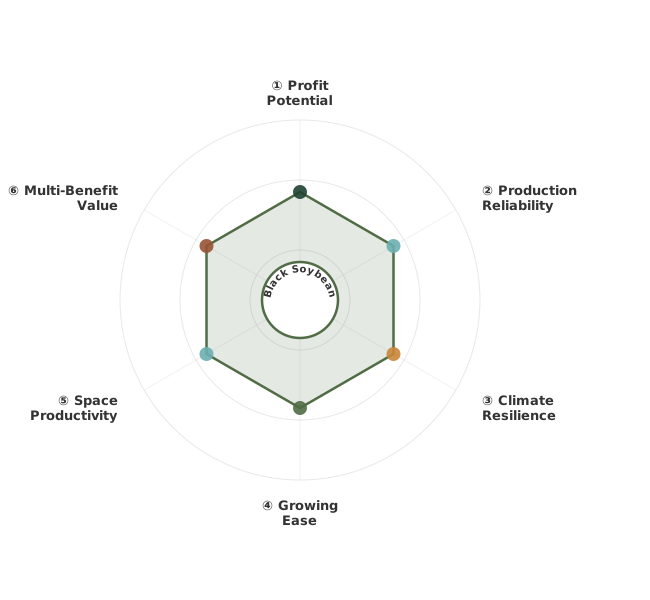
Cold Hardiness Not Recommended A warm-season annual, soybeans require consistent warmth and are sensitive to frost. They do not provide winter ground cover, necessitating complementary winter-hardy cover crops for soil protection.
Weed Suppression Adequate Once established with a dense canopy, soybeans effectively outcompete many weeds, contributing to a cleaner field for subsequent rotations. Early-season weed management can be integrated through mulching or companion planting.
Nitrogen Fixation Ideally Suited As a highly effective legume, soybeans significantly enhance soil fertility by fixing substantial amounts of atmospheric nitrogen, leaving beneficial residual nitrogen for following crops and building soil organic matter.
Root System Depth Adequate Soybeans possess a moderately deep root system that improves soil structure and aeration, facilitating water infiltration and nutrient cycling while supporting nitrogen fixation.
Biomass Production Adequate Soybeans contribute valuable biomass and nitrogen to the soil system, enhancing soil organic matter and providing nutrients for subsequent crops when managed within an integrated system.
Establishment Ease Adequate Soybeans readily germinate and establish with adequate soil warmth and moisture, exhibiting good early vigor that integrates well into diverse cropping systems.
Multi Benefit Value Adequate A valuable legume for soil fertility, soybeans also provide significant biomass for soil health and can offer moderate support for beneficial insects when integrated thoughtfully.
Climate Adaptability Adequate Widely adapted to temperate and subtropical regions, soybeans thrive with sufficient warmth and moisture, requiring careful selection of cultivars suited to local microclimates and integrated pest management strategies.
Maintenance Intensity Adequate As a key nitrogen-fixing component of the rotation, soybeans benefit from healthy soil organic matter and balanced nutrient cycling through compost and cover cropping, integrating pest and disease management within the broader farm ecosystem.

Comparative System: Ratings compare plants within their economic category (e.g., cover crop nitrogen fixation compared to other cover crops, not to all plants). Individual farm conditions and management practices significantly influence actual performance.

7

Learn More

Why farmers use this plant and additional resources

Why Regenerative Farmers Use This Plant

This specialty cash crop offers significant regenerative value and substantial revenue potential per acre, driven by its rapid growth, nutrient-scavenging capabilities, and high anthocyanin content, which appeals to growing demand in health food markets. When managed appropriately, it can produce substantial biomass, estimated at 2,000-5,000 lbs/acre (2,240-5,600 kg/ha) of dry matter, contributing to robust soil health and farm profitability. Its relatively shallow root system, typically reaching 6-18 inches (15-45 cm), effectively cycles nutrients from the upper soil profile, making them available for subsequent crops and reducing reliance on external inputs.

For farmers focused on direct markets, the high anthocyanin content translates to desirable health food attributes, commanding premium prices. Its short days to harvest, often 45-70 days depending on variety, also makes it an excellent candidate for succession planting, maximizing land use and generating consistent revenue throughout the growing season. Growers in USDA Zones 5-7 can achieve up to three successive harvests between May and October, yielding an estimated 8,000-12,000 lbs (3,600-5,400 kg) per acre per harvest cycle with intensive management.

Integrating this crop into a diversified farm system offers numerous benefits beyond direct market sales. As a component of a cover cropping strategy, it can outcompete many common weeds due to its vigorous growth habit, reducing the need for mechanical or chemical weed control. This vigorous growth also contributes to erosion control, protecting valuable topsoil from wind and water displacement, especially on sloped fields. Furthermore, its presence can enhance the habitat for beneficial insects and pollinators, contributing to greater biodiversity on the farm. When intercropped or used as a living mulch, it can create synergistic relationships with other crops, potentially improving their growth and resilience. For instance, its nutrient scavenging can help prevent nutrient leaching from adjacent crops, and its dense foliage can provide shade and moisture retention for sensitive companion plants.

The quantitative ecosystem benefits of this plant are notable. Its dense foliage provides excellent ground cover, leading to improved water infiltration rates by reducing soil compaction and increasing pore space. This improved infiltration means less runoff and greater water retention within the soil profile, a critical benefit in areas prone to drought or heavy rainfall. By effectively cycling nutrients, it reduces the potential for nutrient loss to waterways, thereby protecting water quality. The significant addition of organic matter from its residue contributes to enhanced soil structure, aeration, and water-holding capacity over time, building long-term soil resilience. While specific pollinator visit data varies, its flowering period can attract a range of beneficial insects, contributing to the overall ecological balance of the farm ecosystem.

8

How to Integrate This Plant

Practical guidance for regenerative systems

Establishing this crop is straightforward, with seeding rates typically ranging from 50-100 lbs/acre (56-112 kg/ha) when broadcast, or 30-50 lbs/acre (34-56 kg/ha) when drilled in rows. For smaller-seeded varieties, rates can range from 1-2 lbs/acre (1.1-2.2 kg/ha). The optimal planting depth is shallow, between 0.25-0.5 inches (0.6-1.3 cm), to ensure good seed-to-soil contact and rapid germination. Spacing can vary depending on the desired outcome; for dense ground cover and weed suppression, broadcast seeding is effective. Row planting at 6-12 inches (15-30 cm) is common for intensive production, while wider spacing of 18-30 inches (45-75 cm) apart with plants thinned to 6-12 inches (15-30 cm) within the row is also used. For transplanting, seedlings are set out when they have 2-4 true leaves, spaced 12-18 inches (30-45 cm) apart in rows 24-36 inches (60-90 cm) apart.

In the Northern Hemisphere, planting typically occurs from early spring (March-April) through late summer (July-August), depending on the specific variety and desired harvest window. For earlier harvests, seeds can be started indoors 3-4 weeks prior to the last frost. In the Southern Hemisphere, this translates to planting from September to February. For intensive production and continuous harvest, succession planting every 2-3 weeks from mid-April through late July (Northern Hemisphere) ensures a continuous harvest from June through October.

Management practices should focus on maximizing its growth potential while supporting soil health. Adequate moisture is crucial, with approximately 1-1.5 inches (2.5-3.8 cm) of water per week recommended during establishment and peak growth periods, prioritizing drip irrigation to conserve water and minimize foliar disease. While this crop is relatively efficient at scavenging nutrients, incorporating compost or well-rotted manure prior to planting can provide a robust nutrient base, reducing the need for synthetic fertilizers. Alternatively, its use as a cover crop following a nutrient-depleting cash crop can help remobilize residual nutrients. Growth from seed to maturity typically takes 45-90 days, with plants reaching a height of 1-4 feet (0.3-1.2 m) at harvest, depending on the variety and growing conditions. Pest and disease management should prioritize biological controls and cultural practices; ensuring good air circulation, practicing crop rotation, selecting resistant varieties, and encouraging beneficial insect populations are key.

The production cycle and soil stewardship for this plant are critical for its success in a regenerative framework. Days from seed to harvest generally range from 45 to 90 days, making it suitable for succession planting to ensure a continuous harvest from late spring through fall in temperate regions. Following its harvest, it is highly beneficial to plant a winter cover crop mix, such as cereal rye and hairy vetch, within two weeks to protect soil structure, prevent erosion, and continue building soil organic matter. A minimum 3-year rotation interval with non-related or non-leguminous crops is recommended to break pest and disease cycles effectively without relying on chemical interventions.

Regional adaptations highlight the versatility of this crop. In the corn-soybean rotations of the US Midwest (USDA Zones 4-6), it can be planted as a summer cover crop after early-season harvest or as a component of a multi-species cover crop mix, or planted after early spring greens or as a follow-up to a winter rye cover crop terminated in late April. In the UK's temperate climate (RHS Zones H5-H7), it is successfully cultivated as a market garden crop, often grown in succession for continuous harvest, or sown directly in late April or May, or transplanted out after the risk of frost has passed, often following early potatoes or brassicas. Australian farmers in temperate zones (Australian Zones 2-5) have utilized it in mixed farming systems, benefiting from its rapid growth and soil-improving qualities, or in dryland systems, establishing it with autumn rains, benefiting from its rapid growth and soil-improving qualities before winter. In Brazilian coffee plantations, it can be integrated as an understory crop or cover crop, contributing to soil cover and nutrient cycling within the agroforestry system, or intercropped with young fruit trees or used in a sequence following a short-season grain. In the Pacific Northwest of the USA (USDA Zones 8-9), it is successfully grown in organic vegetable rotations, often following early spring peas or lettuce.