Citronella (Cymbopogon nardus), while having limited mentions in our knowledge base, shows potential in regenerative agriculture systems. The provided excerpt highlights its cultivation within organic farming systems, suggesting its role in diversified plantings. Although specific regenerative uses like cover cropping or nitrogen fixation are not detailed, its integration into organic farming practices implies contributions to soil health and reduced reliance on synthetic inputs. This community service activity focused on comprehensive organic cultivation, including land preparation, planting, maintenance, and pest control, indicating its adaptability to structured regenerative approaches. Farmer experiences, as suggested by the pre- and post-test improvements, point to successful knowledge transfer regarding proper cultivation techniques within an organic framework. Further research would be beneficial to fully understand its capacity for soil building, carbon sequestration, and pollinator support within more complex regenerative designs such as agroforestry or polyculture systems.

Regenerative Quick Profile

All recommendations assume integrated, regenerative practices—not conventional inputs.

Climate & Soil Fit

Climate: Tropical Rainforest, Tropical Monsoon, Tropical Savanna, Hot Semi-Arid (Steppe), Cold Semi-Arid (Steppe), Hot Desert, Cold Desert, Humid Subtropical, Oceanic (Maritime Temperate), Hot-Summer Mediterranean, Warm-Summer Mediterranean, Monsoon-Influenced Humid Subtropical, Subtropical Highland, Hot-Summer Continental, Warm-Summer Continental, Subarctic, Monsoon-Influenced Hot-Summer Continental, Tundra

Zones: USDA 9-11, Australian Zones 11-14, EU Mediterranean, Subtropical

Optimal Soil: Loam Soil

System Role & Functions

Primary: Cash Crop With Services

Secondary: Cover Crop System, Pollinator Support

Key Benefits: Yield Reliability, Disease Pest Resistance

Management Level

Experience: Advanced

Maintenance: Moderate maintenance - As a perennial, Citronella grass benefits from consistent warmth and moisture management, with its vigorous growth requiring integrated system management to prevent overspreading.

Value Streams

  • Vegetable/specialty crop harvest
  • Pollinator habitat and support
1

Climate Suitability Assessment

Will this plant thrive in your climate?

IDEALLY SUITED

Köppen Zone: Af (Tropical Rainforest), Am (Tropical Monsoon), Aw (Tropical Savanna), Cfa (Humid Subtropical), Cwa (Monsoon-Influenced Humid Subtropical)
USDA Zone: 9a, 10a, 11a, 12a
Australian Zone: tropical, subtropical

Citronella grass thrives in consistently warm and humid environments with ample rainfall, performing optimally in Köppen Cfa, Cwa, and Aw zones, as well as USDA zones 8a through 13a, and Australian subtropical and tropical regions. These climates provide the long, frost-free growing seasons and temperatures between 70-90°F (21-32°C) that are crucial for vigorous growth and high essential oil yields. The plant benefits from consistent moisture, making humid subtropical and tropical conditions with 40-60 inches (1000-1500 mm) of annual rainfall ideal. In these zones, establishment is highly reliable, requiring minimal management beyond standard agricultural practices for weed and pest control. Productivity is maximized, with multiple harvests per year yielding abundant biomass rich in citronellal and geraniol, supporting its primary function as a cash crop and its secondary roles in cover cropping and pollinator support due to its flowering habit. Minimal infrastructure is needed, primarily for harvesting and processing, making it an economically viable option in these regions.

ADEQUATE

Köppen Zone: BSh (Hot Semi-Arid (Steppe)), Cfb (Oceanic (Maritime Temperate)), Csa (Hot-Summer Mediterranean), Csb (Warm-Summer Mediterranean), Cwb (Subtropical Highland)
USDA Zone: 8a
Australian Zone: grassland, temperate
EU Climate Region: atlantic, mediterranean

Citronella grass can be successfully cultivated in regions with adequate growing seasons and manageable temperature ranges, including Köppen Cfa and Cwa (with some dry season considerations), USDA zones 7a-7b, Australian grassland and temperate zones, and EU Atlantic and Mediterranean climates. These areas typically offer 120-180 frost-free days and temperatures that, while sometimes cooler or with drier periods than ideal, still support growth. The primary challenge in these zones is water availability; supplemental irrigation is often necessary, particularly during dry summers or in Mediterranean climates with pronounced dry seasons, to maintain optimal growth and essential oil production. Yields may be slightly lower than in ideal tropical or subtropical regions due to temperature fluctuations or water stress. However, with appropriate water management and potentially some season extension techniques, citronella grass can still function effectively as a cash crop and provide cover crop benefits, with establishment success rates generally above 70%.

NOT RECOMMENDED

Köppen Zone: ET (Tundra), BSk (Cold Semi-Arid (Steppe)), BWh (Hot Desert), BWk (Cold Desert), Dfa (Hot-Summer Continental), Dfb (Warm-Summer Continental), Dfc (Subarctic), Dwa (Monsoon-Influenced Hot-Summer Continental)
USDA Zone: 2a, 3a, 3b, 4a, 5a, 5b, 6a, 7a
Australian Zone: arid

Citronella grass is not recommended for cultivation in hot semi-arid (Köppen BSh) and hot desert (Köppen BWh) climates, as well as arid Australian zones. These regions are characterized by extreme heat (often exceeding 100°F/38°C for extended periods) and critically low, erratic rainfall (less than 20 inches/500 mm annually). The plant's high water requirements and sensitivity to prolonged drought and intense solar radiation make establishment and survival extremely difficult and economically unviable without substantial, costly irrigation infrastructure and shade. Growth will be severely stunted, and essential oil yields will be negligible. While technically possible to grow under intensive, greenhouse-like conditions, the high input costs for water, shade, and management make it impractical. Alternative, more drought- and heat-tolerant species are better suited for these challenging environments, fulfilling similar functional roles with greater reliability and lower risk.

Better alternatives for these "not recommended" zones: Lemongrass (Cymbopogon citratus) (Similar aromatic properties, more drought-tolerant than C. nardus), Vetiver Grass (Chrysopogon zizanioides) (Excellent for erosion control and has some aromatic uses, highly drought-tolerant), Sorghum-Sudangrass hybrids (Fast-growing biomass crop for cover cropping, tolerates heat and drought), Saltbush (Atriplex spp.) (Highly drought-tolerant native shrub for fodder and soil stabilization)

Note: Zones listed above represent climates where this plant can produce reliably with reasonable management. Climate zones not mentioned would require intensive climate modification (greenhouses, extensive infrastructure) and are not economically viable for regenerative agriculture purposes.

2

Soil Suitability Assessment

Which soil types work best for this plant?

IDEALLY SUITED

Loam Soil

This plant thrives in these soil types without requiring amendments or remediation. Natural soil conditions support optimal growth and productivity.

ADEQUATE

Acidic Soil, Alkaline Soil, Clay Soil, Rich Soil, Rocky Soil, Sandy Soil

This plant performs acceptably in these soil types with moderate, manageable remediation such as pH adjustment, compost addition, or drainage improvement. The required amendments are practical and cost-effective for regenerative agriculture.

NOT RECOMMENDED

Desert Soil, Saline Soil, Wet Soil

Growing this plant in these soil types would require impractical remediation such as complete soil replacement, extensive amendments, or cost-prohibitive infrastructure. These conditions are not economically viable for regenerative agriculture.

Note: Soil suitability assessments focus on remediation requirements. "Ideally Suited" means the plant generally thrives without the need for substantial amendments, "Adequate" means manageable remediation (lime, compost, mulch), and "Not Recommended" means impractical soil changes would be required. Climate factors like rainfall and temperature also influence success.

3

Seasonal Considerations

Planting timing, growth duration, and harvest windows

For optimal growth and harvest of Citronella grass, plan your planting for the warmth of the season. Start seeds indoors, aiming for about 6-8 weeks before your last expected frost, to give them a strong start. Transplant seedlings outdoors once all danger of frost has passed and soil temperatures consistently reach at least 60°F (15°C). You can also direct sow seeds into prepared beds once the soil has warmed sufficiently in mid-spring.

Citronella grass thrives in the heat of summer, reaching maturity in approximately 90-120 days. The primary harvest window extends through the warmer months, with leaves being continuously cut as needed. Consider succession planting every 6-8 weeks if you desire a continuous supply throughout the growing season. This grass is quite heat tolerant but will slow its growth and eventually die back with the arrival of cold weather. While not typically a fall planting crop for this climate, in warmer zones, you might get a late fall harvest if planted early enough in the summer. Protecting it from frost is crucial for survival through cooler periods.

4

System Role & Multi-Benefit Value

Functional roles, integration strategies, and stacked benefits

Functional Role

Total System Value

Citronella grass offers multifaceted system value in a regenerative agricultural context. Its primary direct harvest value comes from essential oil extraction, providing a marketable product. Beyond this, it significantly enhances the farm system by acting as a robust windbreak, protecting vulnerable crops and soil from wind damage, and its dense root system provides excellent erosion control, stabilizing slopes and preventing soil loss. As an ecosystem service provider, it can attract beneficial insects and pollinators, contributing to biodiversity. Its biomass, when managed appropriately, can be incorporated into composting systems or used as mulch, improving soil organic matter and water retention. This stacking of benefits, from direct income to soil health improvement and landscape stabilization, diversifies farm revenue streams and reduces reliance on single outputs, thereby enhancing overall farm resilience against market fluctuations and environmental stresses.

Integration Characteristics

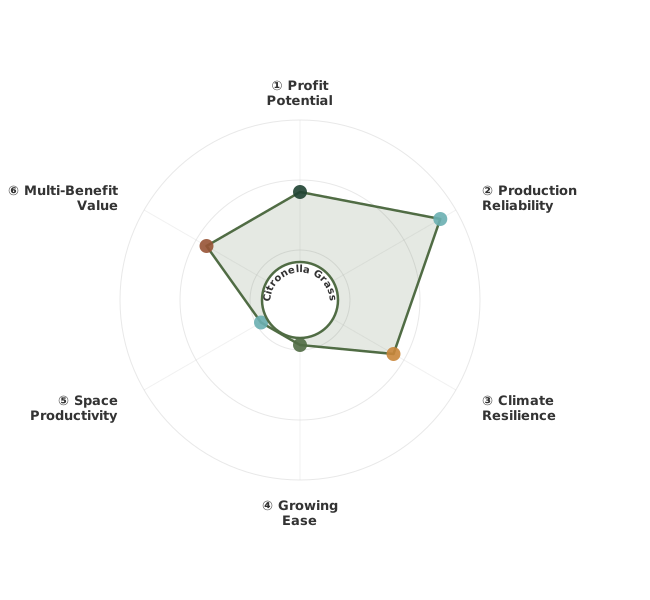
Multi-Benefit Value: Adequate - Its aromatic foliage attracts beneficial insects, and it contributes moderate biomass for soil improvement through nutrient cycling.

5

Management & Care Requirements

Integration guidance, maintenance needs, and care practices

How to Integrate This Plant

Citronella grass (Cymbopogon nardus) can be integrated into regenerative farm systems primarily as a cash crop offering valuable ecosystem services. Its dense growth can serve as an effective windbreak and erosion control measure along field edges or contour lines. While not a nitrogen fixer or a direct shade provider for trees, its biomass can be used as mulch, contributing to soil health and moisture retention. It can also support beneficial insects and potentially deter certain pests, indirectly aiding crop health. Compatible practices include alley cropping, where it can be planted in alleys between rows of slower-growing crops or trees, and hedgerows, providing a functional border. It can also be incorporated into integrated pest management strategies. The timeline to contribution is relatively quick; Year 1 sees its establishment and initial biomass production, providing early erosion control and windbreak benefits. By Year 3-5, its density increases, enhancing its functional roles and providing significant harvestable biomass for oil extraction or other uses. Its value extends beyond direct harvest through its role in soil building and habitat creation.

Integration Practices & Management

The provided knowledge base offers limited detail on the specific regenerative agricultural practices for integrating Cymbopogon nardus (citronella). While one source mentions its cultivation within an organic farming system alongside smart technology, it does not elaborate on establishment methods such as seeding rates, timing, companion planting, or tillage practices. Similarly, information regarding its integration with grazing systems, including mob or rotational grazing, timing, and rest periods, is absent. Termination strategies like natural winterkill, grazing down, crimping, mowing, or herbicide use are also not discussed. Management considerations such as fertility requirements, competition control, or succession planning are not detailed. Furthermore, the knowledge base does not explain how Cymbopogon nardus is incorporated into cash crop systems through relay cropping, intercropping, or rotation sequences. The sole mention focuses on the educational aspect of organic cultivation techniques rather than practical farmer insights on its regenerative integration.

Management Profile

Maintenance Intensity: Adequate - As a perennial, Citronella grass benefits from consistent warmth and moisture management, with its vigorous growth requiring integrated system management to prevent overspreading.

6

Economics & Value Streams

Direct harvest, system benefits, ecosystem services, and risk diversification

Comprehensive economic analysis including direct harvest value, system enhancement contributions, ecosystem services, value timeline, and risk diversification strategies.

Vegetable & Specialty Economics

Metric Value
Seed/Transplant Cost 100-200 $/acre 247-494 $/ha
Expected Yield 3000-6000 lbs/acre 3362-6725 kg/ha
Market Price 1.00-2.00 $/lb 2-4 $/kg
Harvest/Handling Cost 400-800 $/acre 988-1976 $/ha
Marketing/Distribution Cost 200-400 $/acre 494-988 $/ha
Net Annual Return* $1600-$11300/acre/year

Economics highly variable by market channel (direct vs wholesale), scale, and management. Direct marketing commands premiums but requires labor. Values shown for mid-scale market garden operations.

* Net Annual Return = (Yield × Market Price) − (Amortized Establishment Cost + Annual Maintenance). This return is realized only at/after first harvest; early years have costs but no revenue. Range shows worst case to best case scenarios.

System Enhancement Value

Beyond harvest: ecosystem services from regenerative cash crop practices

Ecological Service Contributions

Citronella grass (*Cymbopogon nardus*) offers significant ecosystem services beyond its primary function as a cash crop. It is recognized for its role in pollinator support, likely due to its flowering structures which can attract beneficial insects. While the knowledge base primarily focuses on its insect-repelling oil, the plant itself, when grown, can contribute to biodiversity by providing habitat and nectar sources for pollinators. Furthermore, as a cover crop system, it can improve soil health by adding organic matter, suppressing weeds, and potentially enhancing soil structure. Its dense growth can help stabilize soil and prevent erosion, as noted in its windbreak potential. The cultivation of citronella grass, especially through organic farming systems as highlighted in, promotes sustainable land management practices. The essential oils rich in citronellal, geraniol, and citronellol, as mentioned in, also represent a high-value co-product that can be extracted, further enhancing the integrated value of the system.

Erosion Control (if applicable)

Variable, depends on planting density and row configuration. Potential for 5-15% crop yield improvement in protected areas.

Citronella grass (*Cymbopogon nardus*) can grow to substantial heights, reaching 5-6 feet tall and spreading 3-4 feet wide. This size and density allow it to function as a natural windbreak when planted in rows or as a border. By slowing wind speed, citronella grass can help reduce soil erosion, protect neighboring crops from wind damage, and create microclimates that can benefit more sensitive plants or livestock. The dense foliage can also contribute to a more stable soil structure, further enhancing its erosion control capabilities. While direct quantitative data on its windbreak effectiveness is not provided in the knowledge base, its growth habit suggests a significant potential for physical barrier formation. This can translate to improved soil health and reduced susceptibility to wind-driven degradation across the farm landscape, particularly in exposed areas.

Ecosystem Service Contributions

Environmental contributions: carbon, pollinators, wildlife, and water

  • Carbon Sequestration: Citronella grass is a perennial plant with substantial biomass potential, contributing to carbon sequestration in both above-ground foliage and root systems. Its dense growth and continuous production over its lifespan allow for ongoing carbon storage in the soil.
  • Pollinator Support: Medium. While not its primary function, the flowering parts of citronella grass can attract pollinators, contributing to local biodiversity and supporting other crops that rely on insect pollination.
  • Wildlife Habitat: Low to Medium. The dense foliage can offer some shelter and nesting opportunities for small insects and ground-dwelling invertebrates. However, it is not typically considered a major food source or habitat for larger wildlife.
  • Water Quality: Not applicable

Value Timeline: Production & Services

When you'll see results: varies by crop (annual harvest vs. perennial establishment)

Years 1-2

Establishment of cover crop benefits, beginning of soil stabilization and erosion control. Initial biomass production for potential early harvest of essential oils or for mulch. Establishment of windbreak effect begins.

Years 3-5

Full establishment of windbreak and erosion control benefits. Increased biomass for regular essential oil extraction, establishing consistent cash flow. Pollinator support becomes more pronounced as the plant matures.

Years 10-20

Mature plant stands providing significant and consistent windbreak protection. Optimized essential oil production. Continued soil health benefits through organic matter accumulation. Potential for expansion of integrated systems.

20+ Years

Long-term soil health improvement and ecosystem service provision. Continued cash crop revenue from essential oils. Potential for plant rejuvenation or replacement cycles, maintaining system benefits.

Farm Risk Reduction

How this reduces farm risk: backup income, weather protection, market hedges

  • Multiple Revenue Streams: Essential oil extraction for insect repellents and other fragrance/flavor applications, potential for sale as biomass or mulch, ecosystem services (windbreak, soil health).
  • Temporal Income Spread: Value is generated annually through essential oil harvests, with ongoing ecosystem services provided continuously once established. Windbreak and soil improvement benefits are long-term.
  • Market Risk Hedge: Diversifies farm revenue beyond a single commodity. The essential oil market can be distinct from traditional agricultural commodity markets. The plant's resilience and its role in improving soil health and reducing erosion contribute to overall farm stability and reduce vulnerability to certain environmental and market shocks.
7

Regenerative Suitability Details

Comprehensive trait ratings for system integration assessment

Comparative ratings for this plant across key regenerative agriculture traits.

Trait Suitability Explanation
Season Extension Not Recommended Citronella grass, a tropical perennial, thrives in warmth and is highly sensitive to frost, therefore offering no season extension benefits in cooler climates.
Space Efficiency Adequate This grass forms dense, clumping growth, requiring moderate space while providing a good yield of aromatic foliage relative to its footprint, contributing to ground cover.
Storage Longevity Not Recommended Fresh Citronella grass stalks have a limited storage life, best utilized fresh or dried to retain their aromatic compounds.
Yield Reliability Ideally Suited In tropical and subtropical regions, Citronella grass reliably produces consistent yields, demonstrating excellent resilience to environmental stressors.
Establishment Ease Not Recommended Establishing Citronella grass is most successful through divisions, as seed germination is slow and unreliable, requiring optimal conditions and patience.
Multi Benefit Value Adequate Its aromatic foliage attracts beneficial insects, and it contributes moderate biomass for soil improvement through nutrient cycling.
Climate Adaptability Adequate Thriving in warm climates (zones 9-11), Citronella grass tolerates heat and some drought, but frost significantly limits its growth and oil production.
Maintenance Intensity Adequate As a perennial, Citronella grass benefits from consistent warmth and moisture management, with its vigorous growth requiring integrated system management to prevent overspreading.
Disease Pest Resistance Ideally Suited Citronella grass exhibits exceptional hardiness and natural resistance to most pests and diseases, flourishing in its preferred tropical conditions with minimal intervention.

Comparative System: Ratings compare plants within their economic category (e.g., cover crop nitrogen fixation compared to other cover crops, not to all plants). Individual farm conditions and management practices significantly influence actual performance.

8

Learn More

Why farmers use this plant and additional resources

Why Regenerative Farmers Use This Plant

Cymbopogon nardus, commonly known as Citronella grass, offers significant economic and ecological benefits within regenerative agricultural systems, particularly as a high-value specialty cash crop. Its potent aromatic oils are highly sought after for their natural fragrance and insect-repellent properties, finding applications in natural pest control products, aromatherapy, perfumery, and the personal care industry. This demand translates to strong market potential, with farmers able to achieve substantial revenue per acre, especially through direct-to-consumer sales, farmers' markets, and specialty wholesale channels. The plant's relatively fast growth cycle, typically ready for initial harvest within 6-9 months of planting, allows for efficient land use and potential for multiple harvests within a single growing season in suitable climates, maximizing land use efficiency and revenue per acre. Its inclusion diversifies farm income streams, providing a valuable alternative or complement to staple crops and reducing reliance on monoculture systems.

Beyond its direct economic output, Cymbopogon nardus plays a crucial role in enhancing farm resilience and ecological health. As a vigorous perennial grass, it contributes significantly to soil building by developing an extensive and dense root system that can extend 2-4 feet (0.6-1.2 meters) deep. This root structure effectively binds soil particles, improving soil structure, increasing water infiltration, and reducing erosion from wind and water, especially on sloped terrain. Its dense foliage provides excellent ground cover, suppressing weeds and reducing the need for mechanical or chemical weed control measures, thus lowering labor costs and soil disturbance. In systems where it is integrated, it can act as a living mulch or a component of hedgerows or agroforestry systems, offering habitat and forage for beneficial insects and pollinators, contributing to overall biodiversity and resilience. Furthermore, the strong aroma of Citronella is known to deter certain pests, potentially reducing the need for external pest management interventions and contributing to a more balanced farm ecosystem. Its inclusion can break up pest cycles when rotated with other crops, acting as a natural bio-fumigant and contributing to integrated pest management (IPM) strategies.

The ecological services provided by Cymbopogon nardus extend to improving overall farm biodiversity and soil health. While not a nitrogen-fixing legume, its vigorous growth and deep root systems contribute substantially to soil organic matter accumulation over time, enhancing soil fertility and water-holding capacity, particularly when crop residues are managed appropriately. This improved soil structure leads to better water infiltration and reduced runoff, mitigating the impacts of heavy rainfall and drought. The dense canopy provides habitat and foraging opportunities for beneficial insects and pollinators, supporting a more balanced farm ecosystem. By improving soil structure and organic matter, Citronella grass enhances the soil's capacity to absorb and hold water, lessening irrigation needs and mitigating the impacts of extreme weather events. The presence of Citronella grass can thus foster a more resilient and self-sustaining agricultural environment, reducing external input requirements and promoting natural ecological processes. Its deep rooting also aids in scavenging nutrients from lower soil profiles, making them available to subsequent crops.

Regional success stories highlight the adaptability of Cymbopogon nardus. In Southeast Asia, it has been cultivated for centuries, forming a cornerstone of traditional agroforestry systems and providing a key ingredient for local industries, often grown in smallholder plots and processed locally for essential oil extraction. In parts of South America, such as Brazil, it is cultivated for its oil and can be found in diversified farming operations seeking to add value-added products, being explored for its potential in agroforestry systems and silvopasture designs. In Australia, its drought tolerance and ability to grow in semi-arid conditions (Zones 3-4) make it a viable option for diversifying agricultural enterprises in regions facing increasing climate variability, being explored for its potential in dryland farming systems. Its cultivation is also gaining traction in parts of Africa (e.g., Kenya) as a valuable cash crop that can be integrated into small-scale farming operations. In the humid subtropical regions of the southeastern United States (USDA Zones 8-11), it can be grown as an annual or perennial, with planting in spring after the last frost. In regions with distinct dry seasons, irrigation becomes critical for maintaining consistent production, and farmers often focus on maximizing yields during the wetter periods.

9

How to Integrate This Plant

Practical guidance for regenerative systems

Establishing Cymbopogon nardus is typically achieved through vegetative propagation, most commonly using slips or rooted tillers, though it can also be grown from seed in specific conditions. For vegetative propagation, healthy slips or tillers are planted at a depth of 2-6 inches (5-15 cm). Spacing between plants is generally 2-3 feet (60-90 cm) in rows that are 3-4 feet (90-120 cm) apart, allowing for ample growth and ease of harvest. This method allows for rapid establishment and a consistent planting density, typically around 5,000-10,000 plants per acre (12,000-25,000 plants per hectare). When using seed, seeding rates are generally low, around 1-2 ounces per acre (30-60 grams per acre) for direct sowing, with seeds planted at a shallow depth of 0.25-0.5 inches (0.6-1.3 cm). Planting is best timed with the onset of the rainy season or when irrigation is reliably available, generally in spring (March-May in the Northern Hemisphere) or early autumn (September-November in the Southern Hemisphere). In tropical and subtropical regions, planting can occur year-round, but the onset of the rainy season is ideal for establishment.

Management of Cymbopogon nardus focuses on promoting vigorous vegetative growth and maintaining soil health. The plant requires approximately 1-2 inches (2.5-5 cm) of water per week, either from rainfall or irrigation, especially during its establishment phase and dry periods. Fertility is best managed through biological approaches; incorporating well-rotted compost or manure at planting and side-dressing with organic matter annually will provide sustained nutrition. This reduces the reliance on synthetic fertilizers, with well-managed Citronella grass systems often seeing a reduction in synthetic input needs by 40-60% over time as soil biological activity increases. As a heavy feeder, it benefits from nutrient-rich soil, and while it can reduce the need for synthetic fertilizers, transitional synthetic inputs may be considered to boost growth in depleted soils. The plant typically reaches a mature height of 4-6 feet (1.2-1.8 meters) and can be ready for its first harvest of aromatic leaves and stems within 6-9 months from planting. Pest and disease management should focus on cultural practices; ensuring good air circulation through proper spacing, maintaining plant vigor through adequate fertility, and promptly removing any diseased plant material are key. Biological controls, such as encouraging predatory insects, are also effective.

As a specialty cash crop, Cymbopogon nardus is managed for continuous production and soil stewardship. Days from planting to first harvest can range from 6 to 9 months, with subsequent harvests occurring every 3-4 months in optimal growing conditions, allowing for multiple harvests per year, providing a continuous income stream. For continuous harvest potential, farmers can implement staggered planting schedules, establishing new blocks every few months. To maintain soil health and break pest cycles, it is crucial to follow Citronella grass with a cover crop that complements its nutrient needs or improves soil structure. For instance, after harvest and residue management (leaving stalks and leaves on the field to decompose), a nitrogen-fixing cover crop like cowpeas or a deep-rooted cover crop such as daikon radish can be planted. A minimum rotation interval of 2-3 years with non-related crops is recommended to prevent the buildup of soil-borne diseases specific to grasses. Post-harvest residue management involves chopping the biomass and incorporating it back into the soil or using it as mulch, followed by planting a winter cover crop mix within 2-3 weeks of final harvest if the season allows, to protect soil structure and enhance soil biology.