
Drumstick Tree
Moringa oleifera is integrated into regenerative systems primarily as a nutrient-dense component within agroforestry and polyculture settings. While not explicitly labeled as a cover crop or nitrogen fixer in these excerpts, its fast-growing nature and high nutritional content make it a valuable addition. Studies in Zambia highlight significant enhancements in soil fertility when Moringa is incorporated, showing increases in nitrogen, phosphorus, potassium uptake, soil organic matter, cation exchange capacity, and microbial enzyme activity. Farmers are utilizing Moringa in diverse ways, from protecting young trees in St. Croix with tree tubes before allowing grazing animals like sheep and pigs around them, to drying its nutrient-rich leaves for value-added powder products. Its utility extends to potential use in infant feeding interventions due to its dense nutrient profile. The plant thrives in warm climates and offers a highly nutritious alternative crop, with all parts of the plant being usable.
For a full botanical description see: Wikipedia(opens in new window) (external link)
Regenerative Quick Profile
All recommendations assume integrated, regenerative practices—not conventional inputs.
Climate & Soil Fit
Climate: Tropical Rainforest, Tropical Monsoon, Tropical Savanna, Hot Semi-Arid (Steppe), Cold Semi-Arid (Steppe), Hot Desert, Humid Subtropical, Oceanic (Maritime Temperate), Hot-Summer Mediterranean, Warm-Summer Mediterranean, Monsoon-Influenced Humid Subtropical, Subtropical Highland, Hot-Summer Continental
Zones: USDA 9-11, Australian Zones 11-14, EU Mediterranean, Subtropical
Optimal Soil: Loam Soil
System Role & Functions
Primary: Food Forest
Secondary: Silvopasture, Specialty
Key Benefits: Multi-benefit value, Yield Reliability, Disease Pest Resistance
Management Level
Experience: Beginner-Friendly
Maintenance: Moderate maintenance - Moringa's rapid growth and need for warmth and good drainage are managed through integrated system practices, drawing on its inherent drought tolerance once established and requiring protection from frost.
Value Streams
- Vegetable/specialty crop harvest
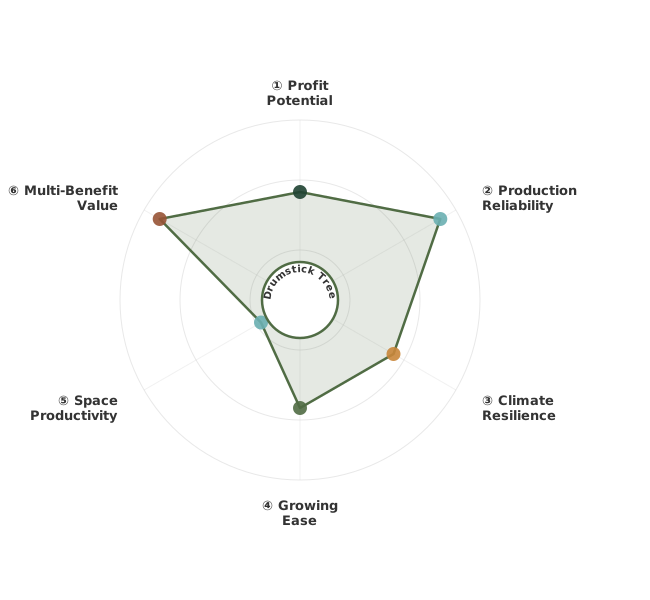
How These Traits Are Calculated
Trait dimensions are ordered clockwise starting from the top of the chart (12 o'clock position):
1. Profit Potential
Net returns per acre from yield, pricing, input costs, and labor efficiency
WHAT: Synthesizes gross revenue potential, input costs, labor requirements, and storage/marketing advantages into net profitability per acre. Captures the complete economic picture from planting to sale.
WHY: Not all vegetables are equally profitable. High-value crops with efficient production can return $10,000-30,000/acre versus $2,000-5,000/acre for lower-value options. Profit potential guides crop selection for maximum return on limited land and determines viable scale for farm businesses.
HOW: Scored via LLM synthesis of economics data (yields, prices, costs), storage advantages (season extension, value-added potential), and labor intensity. Exceptional (3.0): High yields × premium prices with moderate inputs and good storage (garlic, high-value salad greens). Typical (2.0): Moderate returns (tomatoes, squash). Limited (1.0): Low yields, commodity pricing, or intensive labor requirements (low-value greens).
2. Production Reliability
Weighted: yield consistency (60%) + disease/pest resistance (40%)
WHAT: Combines yield reliability (harvest consistency year-to-year) with disease and pest resistance to measure predictable production. Reliable vegetables deliver consistent harvests without catastrophic failures from pests or weather.
WHY: Market commitments and CSA subscriptions require dependable production. Unreliable crops that fail in bad years or require intensive pest management create cash flow gaps and customer dissatisfaction. Reliable producers allow confident planning and reduce input costs from emergency pest interventions.
HOW: Weighted formula prioritizes yield reliability (60% weight) for overall consistency, with disease/pest resistance (40% weight) to prevent total failures. Exceptional (3.0): Consistent yields across variable seasons with strong natural pest resistance. Typical (2.0): Generally reliable with some pest/weather sensitivity. Limited (1.0): Highly variable yields or severe pest vulnerability requiring intensive management.
3. Climate Resilience
Temperature and rainfall tolerance across diverse growing conditions
WHAT: Measures the breadth of climatic conditions where the vegetable produces successfully—temperature extremes, humidity ranges, and rainfall variability. Climate-resilient crops work across diverse regions and weather patterns.
WHY: Climate variability is increasing—unexpected heat waves, cold snaps, or drought periods can wipe out entire vegetable harvests. Resilient crops provide insurance against weather uncertainty and allow geographic expansion for market growth. This is especially critical for direct-market farmers who can't easily substitute crops mid-season.
HOW: Ratings based on the climate_adaptability trait documenting temperature tolerance and geographic range. Exceptional (3.0): Grows successfully in diverse climates (cold to hot, humid to dry) with wide hardiness zone range. Typical (2.0): Moderate climate flexibility. Limited (1.0): Narrow climate requirements (tropical-only, cool-season-only, humidity-sensitive).
4. Growing Ease
Weighted: establishment ease (50%) + low maintenance requirements (50%)
WHAT: Combines establishment difficulty (germination, transplanting) with ongoing maintenance needs (watering, fertilizing, pest management) to measure total labor requirements. Easy crops grow reliably with minimal intervention.
WHY: Labor is the primary cost for small-scale vegetable production. Easy-care crops allow farmers to manage more production area with the same labor, improving profitability. Difficult crops requiring constant attention, precise timing, or specialized skills reduce overall farm productivity and increase risk.
HOW: Weighted formula balances establishment ease (50% weight) for reliable startup and inverted maintenance intensity (50% weight) for ongoing care. Exceptional (3.0): Direct-seeded or easy transplants with minimal water/fertility/pest needs. Typical (2.0): Moderate care requirements. Limited (1.0): Difficult establishment or intensive ongoing management (daily watering, heavy feeding, constant pest monitoring).
5. Space Productivity
Weighted: yield per square foot (60%) + season extension potential (40%)
WHAT: Combines spatial productivity (yield per square foot) with temporal productivity (extended harvest windows from succession planting or season extension). Maximizes production from limited growing area.
WHY: Land is the primary constraint for vegetable farmers—especially those near urban markets. Space-efficient crops delivering high yields in small areas improve per-acre profitability dramatically. Season extension (spring tunnels, fall protection) adds bonus production windows when competing supply is limited and prices are higher.
HOW: Weighted formula prioritizes space efficiency (60% weight) for core yield per area, with season extension potential (40% weight) for bonus production opportunities. Exceptional (3.0): High yields per square foot (10,000+ lbs/acre equivalents) with season extension options. Typical (2.0): Moderate yields and extension potential. Limited (1.0): Low yields or crops unsuitable for season extension.
6. Multi-Benefit Value
Ecosystem services beyond harvest—pollinator support, nitrogen fixing, pest habitat
WHAT: Measures ecosystem services provided beyond harvestable yield. Multi-benefit vegetables contribute to farm ecology through nitrogen fixation (legumes), pollinator support (flowering crops), beneficial insect habitat, soil building, or erosion control.
WHY: Cash crops can either extract from farm ecosystems or contribute to them. Vegetables with strong multi-benefit value build soil fertility, support pollinators needed for fruit/vine crops, and create habitat for pest predators—reducing external input needs. Nitrogen-fixing vegetables (beans, peas) provide $40-80/acre worth of fertility for following crops.
HOW: Ratings based on the multi_benefit_value trait documenting service contributions. Exceptional (3.0): Significant ecosystem services (nitrogen fixation, heavy pollinator support, soil building, pest habitat). Typical (2.0): Some ecosystem contributions. Limited (1.0): Single-purpose cash crops with minimal farm ecology benefits.
Ratings are based on documented performance in regenerative systems, not conventional high-input scenarios. All traits assume integrated management practices focused on soil health and ecosystem services.
4
System Role & Multi-Benefit Value
Functional roles, integration strategies, and stacked benefits
System Role & Multi-Benefit Value
Functional roles, integration strategies, and stacked benefits
Functional Role
Total System Value
Moringa oleifera offers substantial whole-farm resilience through multiple benefit stacking. Its direct harvest value is high, providing nutrient-dense leaves for human consumption and animal feed, with potential for value-added products like powder. System enhancement includes its role in food forests and silvopasture, contributing biomass that improves soil organic matter and potentially nitrogen levels, as indicated by soil fertility enhancements in Zambia studies. Ecosystem services are significant, with its rapid growth sequestering carbon and its dense foliage potentially supporting local wildlife. Risk diversification is achieved by adding a highly productive, drought-tolerant species to the farm landscape, reducing reliance on more sensitive crops and providing a consistent source of nutrition even in challenging conditions. Its ability to thrive in diverse conditions makes it a robust component of a resilient agricultural system.
Integration Characteristics
Multi-Benefit Value: Ideally Suited - Beyond its exceptional nutritional density and rapid biomass generation, Moringa actively contributes to soil health through its interactions within a regenerative system.
Sources behind this view
 Research
-
Effect of Forage Moringa oleifera L. (moringa) on Animal Health and Nutrition and Its Beneficial Applications in Soil, Plants and Water Purification (opens in new window)
Moringa is a multipurpose plant useful as natural pest control, high-protein animal feed, crop enhancer, green fertilizer, and for water purification.
-
Impact of Moringa oleifera L. on Soil Fertility, Resiliency and Crop Productivity for Smallholder Agricultural Systems (opens in new window)
Moringa oleifera trees boosted soil nutrients, organic matter, and water retention in Zambian smallholder farms, increasing crop yields by 10-40% and improving environmental resilience.
6
Economics & Value Streams
Direct harvest, system benefits, ecosystem services, and risk diversification
Economics & Value Streams
Direct harvest, system benefits, ecosystem services, and risk diversification
Comprehensive economic analysis including direct harvest value, system enhancement contributions, ecosystem services, value timeline, and risk diversification strategies.
Vegetable & Specialty Economics
| Metric | Value |
|---|---|
| Seed/Transplant Cost | 50-100 $/acre 123-247 $/ha |
| Expected Yield | 1000-3000 lbs/acre 1120-3362 kg/ha |
| Market Price | 1.50-3.00 $/lb 3-6 $/kg |
| Harvest/Handling Cost | 400-800 $/acre 988-1976 $/ha |
| Marketing/Distribution Cost | 200-400 $/acre 494-988 $/ha |
| Net Annual Return* | $200-$8350/acre/year |
Economics highly variable by market channel (direct vs wholesale), scale, and management. Direct marketing commands premiums but requires labor. Values shown for mid-scale market garden operations.
* Net Annual Return = (Yield × Market Price) − (Amortized Establishment Cost + Annual Maintenance). This return is realized only at/after first harvest; early years have costs but no revenue. Range shows worst case to best case scenarios.
System Enhancement Value
Beyond harvest: how understory complements overstory in polyculture
Food Forest System Contributions
Moringa Oleifera offers a multifaceted array of system benefits beyond direct harvest and soil fertility enhancement. It is noted for improving pollinator biodiversity, which is crucial for the productivity of many agricultural systems, especially those relying on insect pollination. Its leaves and branches can serve as nutrient-dense animal feed for pigs and sheep, facilitating energy cycling and waste reduction within integrated farm systems. This dual role as a fodder crop reduces the need for external feed inputs. Furthermore, moringa has demonstrated an 84% increase in moisture retention and a 36% reduction in surface runoff, highlighting its role in improving water management and mitigating erosion, particularly valuable in arid and semi-arid regions. The tree's fast growth and high nutritional content also position it as a multifunctional bio-input for enhancing overall farm resilience.
Nitrogen Fixation (if legume)
Estimated improvement in nitrogen uptake and availability, reducing reliance on synthetic fertilizers. Quantitative fertilizer replacement value is variable and dependent on specific soil conditions and crop needs, but significant contributions to soil organic matter and nutrient cycling are documented.
While the provided knowledge base excerpts do not explicitly state that Moringa Oleifera is a legume, research indicates its significant positive impact on soil fertility, including nitrogen uptake. A systematic review in Zambia found that Moringa Oleifera significantly enhanced soil fertility, with a 4.79% increase in nitrogen uptake by major crops. This suggests that moringa either directly fixes nitrogen or improves the soil's capacity to retain and cycle it. The observed increase in soil organic matter (15-30%) and cation exchange capacity (11.3%) further points to its role in building soil health, which is intrinsically linked to nitrogen availability. In systems aiming for reduced reliance on synthetic fertilizers, the contribution of moringa to nitrogen cycling can be substantial. While not a direct nitrogen fixer like legumes, its presence demonstrably improves nitrogen availability for companion crops, effectively acting as a bio-input that reduces the need for external nitrogen inputs. The economic value of this contribution can be estimated by the cost of equivalent synthetic nitrogen fertilizer.
Groundcover & Erosion Control
Potential for windbreak establishment, protecting multiple acres per row and contributing to yield improvements of 5-15% (variable based on wind intensity, tree density, and crop type).
The drumstick tree (Moringa Oleifera) is described as a fast-growing and drought-tolerant tree. These characteristics, combined with its upright growth habit, suggest potential for use in windbreak systems, particularly in regions with moderate wind speeds. While not explicitly detailed in the provided excerpts, trees with dense foliage and rapid growth can effectively reduce wind velocity across agricultural fields. This reduction in wind can lead to decreased soil erosion, reduced desiccation of crops, and improved microclimates for more sensitive plants. The economic benefits of windbreaks often manifest as increased crop yields due to protection from wind damage and improved water retention. For instance, effective windbreaks can protect several acres per row and lead to yield improvements of 5-15% for certain crops. The drought tolerance of moringa makes it a resilient choice for windbreak establishment in water-scarce environments, further enhancing its system value.
Ecosystem Service Contributions
Environmental contributions: carbon, pollinators, wildlife, and water
- Carbon Sequestration: Moringa Oleifera is a fast-growing tree with documented carbon fixation rates of 0.54–1.7 t C ha⁻¹ yr⁻¹ in smallholder systems, indicating a significant potential for carbon sequestration.
- Pollinator Support: High, as it contributes to improved pollinator biodiversity.
- Wildlife Habitat: Provides fodder for livestock, contributing to the farm ecosystem. Its dense foliage may offer some nesting or shelter opportunities, though not explicitly detailed.
- Water Quality: Not applicable (primarily known for water retention and runoff reduction, not filtration in riparian contexts).
Value Timeline: Understory Development
When you'll see results: groundcover/herbs year 1, shrubs 2-3, full layer integration 5-10
Years 1-2
Establishment of soil improvement (increased organic matter, improved moisture retention). Initial fodder for livestock. Potential early windbreak effects.
Years 3-5
First harvest of leaves and pods for food. Established fodder production. Significant contribution to soil fertility and nutrient cycling. Noticeable shade development for livestock.
Years 10-20
Mature tree providing consistent and abundant harvests. Significant shade canopy for silvopasture systems. Established windbreak and erosion control benefits. Full potential for animal feed integration.
20+ Years
Long-term, stable producer of food and fodder. Continued soil building and ecosystem services. Potential for timber use if managed for such purposes, though not its primary documented role.
Farm Risk Reduction
How multi-layer systems diversify production and income
- Multiple Revenue Streams: Direct food (leaves, pods), animal fodder, value-added products (dried leaf powder), potential animal sales from integrated silvopasture.
- Temporal Income Spread: Ongoing harvest of leaves and pods throughout the growing season, providing continuous value. Long-term ecosystem services (soil health, water management) provide continuous, albeit less direct, benefits. Potential for eventual timber harvest.
- Market Risk Hedge: Drought tolerance provides resilience in variable climates. Diversified revenue streams across food, feed, and value-added products reduce reliance on any single market. Its role as a soil enhancer and water retainer contributes to overall farm resilience against environmental stresses.
Sources behind this view
Research
-
Impact of Moringa oleifera L. on Soil Fertility, Resiliency and Crop Productivity for Smallholder Agricultural Systems (opens in new window)
Moringa oleifera trees boosted soil nutrients, organic matter, and water retention in Zambian smallholder farms, increasing crop yields by 10-40% and improving environmental resilience.
-
Effect of Forage Moringa oleifera L. (moringa) on Animal Health and Nutrition and Its Beneficial Applications in Soil, Plants and Water Purification (opens in new window)
Moringa is a multipurpose plant useful as natural pest control, high-protein animal feed, crop enhancer, green fertilizer, and for water purification.
-
Moringa (Moringa oleifera Lam.): A Versatile Tree Crop with Horticultural Potential in the Subtropical United States (opens in new window)
Moringa tree has high potential in the subtropical US due to growing demand for exotic produce driven by ethnic diversity and health trends. More research is needed for local cultivation.
8
Learn More
Why farmers use this plant and additional resources
Learn More
Why farmers use this plant and additional resources
Why Regenerative Farmers Use This Plant
Moringa oleifera presents a compelling opportunity for regenerative farmers seeking high-value specialty cash crops with rapid returns and significant nutritional benefits. Its remarkable growth rate allows for multiple harvests within a single growing season, making it ideal for succession planting and maximizing revenue per acre. In regions with suitable climates, farmers can achieve yields of 1,000-5,000 lbs (450-2,270 kg) of fresh leaves per acre per harvest, with harvests occurring every 45-60 days or 3-5 harvests annually in ideal conditions. This rapid turnover supports direct-to-consumer sales, CSA shares, and specialty wholesale markets, providing a consistent and diversified income stream. The nutritional density of moringa leaves, rich in vitamins, minerals, and protein, also positions it as a valuable component in value-added products like dried powders and capsules, further enhancing farm profitability.
Beyond its direct economic potential, moringa integrates seamlessly into regenerative systems by improving soil health and providing ecosystem services. As a fast-growing, nutrient-scavenging plant, it can enhance soil fertility, reducing reliance on external inputs. Its deep root system, reaching up to 15-20 feet (4.5-6 m) in mature trees, helps break up compacted soils and improves water infiltration, crucial for drought resilience. While not a nitrogen fixer, moringa's rapid biomass production contributes significantly to soil organic matter when managed appropriately, especially when residues are incorporated back into the soil. Its presence can also create microclimates that benefit other crops and attract beneficial insects, contributing to a more robust and resilient farm ecosystem.
The ecological contributions of moringa extend to supporting biodiversity and water management. Mature moringa trees can act as natural windbreaks and provide shade, benefiting understory crops or livestock in silvopasture systems. Its prolific flowering attracts a variety of pollinators and beneficial insects, contributing to overall farm biodiversity. The plant's efficient water use, particularly in arid and semi-arid conditions, makes it a valuable component in water-wise farming strategies, helping to maintain soil moisture and reduce irrigation needs. Its ability to thrive in marginal conditions means it can be integrated into degraded landscapes, aiding in their restoration and improving overall ecosystem function.
Moringa oleifera has demonstrated success across diverse agricultural landscapes. In the arid regions of India, it is cultivated both for its nutritional leaves and its oil-rich seeds, often intercropped with staple grains. Brazilian farmers utilize moringa as a fast-growing hedgerow species in coffee and cocoa plantations, providing shade, wind protection, and a source of supplemental nutrition for livestock. In parts of Africa, it is a vital food security crop, grown in smallholder gardens and larger agricultural projects to combat malnutrition and provide income. In the southern United States (USDA Zones 9-11), it can be grown as an annual or perennial. In Australian dryland systems, it can be incorporated into windbreaks or as a fodder source for livestock during dry periods. Its adaptability allows it to be incorporated into various systems, from backyard permaculture designs to large-scale commercial operations, proving its versatility and resilience.
Sources behind this view
 Videos & Podcasts
-
Moringa is a versatile permaculture asset, thriving in warm climates and poor soils. It improves soil quality through decomposition, aids water purification with its seeds, provides nutritious food, a
-
Moringa oleifera is a highly nutritious, easy-to-grow tree suitable for tropical climates, offering significant calcium and protein. It's proposed as a sustainable alternative to major staple crops th
Research
-
Effect of Forage Moringa oleifera L. (moringa) on Animal Health and Nutrition and Its Beneficial Applications in Soil, Plants and Water Purification (opens in new window)
Moringa is a multipurpose plant useful as natural pest control, high-protein animal feed, crop enhancer, green fertilizer, and for water purification.
-
Impact of Moringa oleifera L. on Soil Fertility, Resiliency and Crop Productivity for Smallholder Agricultural Systems (opens in new window)
Moringa oleifera trees boosted soil nutrients, organic matter, and water retention in Zambian smallholder farms, increasing crop yields by 10-40% and improving environmental resilience.