Sweet Marjoram
Existing excerpts suggest its role in enhancing plant resilience and biomass yield within regenerative systems. Studies indicate that sweet marjoram responds positively to organic fertilizers, significantly increasing both qualitative and quantitative biomass, contrasting with traditional NPK fertilizers. Furthermore, research exploring drought stress mitigation highlights the plant's interaction with beneficial microbes like mycorrhizal fungi, which can improve its performance under challenging conditions. This suggests potential for sweet marjoram in polyculture systems where soil health and water management are key. Its ability to produce biomass and thrive with organic inputs aligns with regenerative goals of soil building and nutrient cycling. While specific uses like cover cropping or nitrogen fixation are not detailed in the provided texts, its response to organic amendments and microbial interactions points to its potential as a beneficial component in biodiverse, soil-focused agricultural designs. While coverage in our knowledge base is limited, the above represents documented uses in regenerative systems.
For a full botanical description see: Plants For A Future↗(opens in new window) (external link)
Regenerative Quick Profile
All recommendations assume integrated, regenerative practices—not conventional inputs.
Climate & Soil Fit
Climate: Tropical Rainforest, Tropical Monsoon, Tropical Savanna, Hot Semi-Arid (Steppe), Cold Semi-Arid (Steppe), Hot Desert, Cold Desert, Humid Subtropical, Oceanic (Maritime Temperate), Hot-Summer Mediterranean, Warm-Summer Mediterranean, Monsoon-Influenced Humid Subtropical, Subtropical Highland, Hot-Summer Continental, Warm-Summer Continental, Subarctic, Monsoon-Influenced Hot-Summer Continental, Tundra
Zones: USDA 5-9, Australian Zones 3-11
Optimal Soil: Loam Soil
System Role & Functions
Primary: Cash Crop With Services
Secondary: Pollinator Support, Forage Integration
Key Benefits: Disease Pest Resistance
Management Level
Experience: Beginner-Friendly
Maintenance: Moderate maintenance - Maintaining sweet marjoram involves ensuring excellent soil drainage and consistent moisture, integrating it into systems that naturally regulate water and prevent waterlogging.
Value Streams
- Vegetable/specialty crop harvest
- Livestock forage value
- Pollinator habitat and support
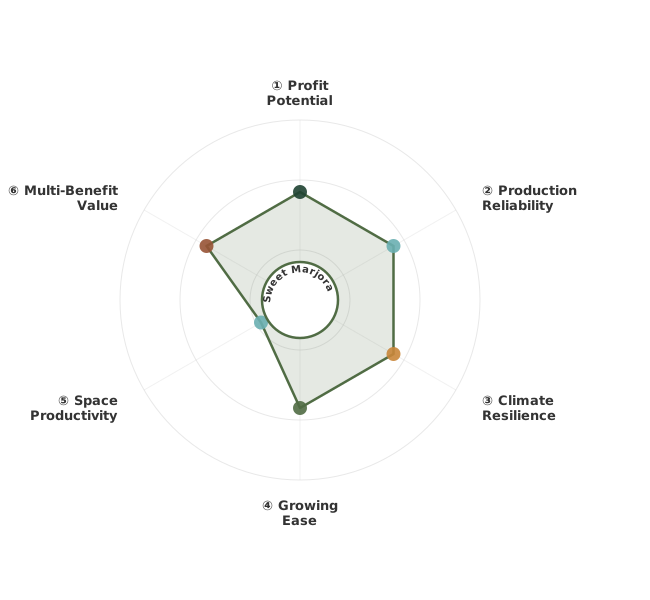
Regenerative Trait Ratings
How These Traits Are Calculated
Trait dimensions are ordered clockwise starting from the top of the chart (12 o'clock position):
1. Profit Potential
Net returns per acre from yield, pricing, input costs, and labor efficiency
WHAT: Synthesizes gross revenue potential, input costs, labor requirements, and storage/marketing advantages into net profitability per acre. Captures the complete economic picture from planting to sale.
WHY: Not all vegetables are equally profitable. High-value crops with efficient production can return $10,000-30,000/acre versus $2,000-5,000/acre for lower-value options. Profit potential guides crop selection for maximum return on limited land and determines viable scale for farm businesses.
HOW: Scored via LLM synthesis of economics data (yields, prices, costs), storage advantages (season extension, value-added potential), and labor intensity. Exceptional (3.0): High yields × premium prices with moderate inputs and good storage (garlic, high-value salad greens). Typical (2.0): Moderate returns (tomatoes, squash). Limited (1.0): Low yields, commodity pricing, or intensive labor requirements (low-value greens).
2. Production Reliability
Weighted: yield consistency (60%) + disease/pest resistance (40%)
WHAT: Combines yield reliability (harvest consistency year-to-year) with disease and pest resistance to measure predictable production. Reliable vegetables deliver consistent harvests without catastrophic failures from pests or weather.
WHY: Market commitments and CSA subscriptions require dependable production. Unreliable crops that fail in bad years or require intensive pest management create cash flow gaps and customer dissatisfaction. Reliable producers allow confident planning and reduce input costs from emergency pest interventions.
HOW: Weighted formula prioritizes yield reliability (60% weight) for overall consistency, with disease/pest resistance (40% weight) to prevent total failures. Exceptional (3.0): Consistent yields across variable seasons with strong natural pest resistance. Typical (2.0): Generally reliable with some pest/weather sensitivity. Limited (1.0): Highly variable yields or severe pest vulnerability requiring intensive management.
3. Climate Resilience
Temperature and rainfall tolerance across diverse growing conditions
WHAT: Measures the breadth of climatic conditions where the vegetable produces successfully—temperature extremes, humidity ranges, and rainfall variability. Climate-resilient crops work across diverse regions and weather patterns.
WHY: Climate variability is increasing—unexpected heat waves, cold snaps, or drought periods can wipe out entire vegetable harvests. Resilient crops provide insurance against weather uncertainty and allow geographic expansion for market growth. This is especially critical for direct-market farmers who can't easily substitute crops mid-season.
HOW: Ratings based on the climate_adaptability trait documenting temperature tolerance and geographic range. Exceptional (3.0): Grows successfully in diverse climates (cold to hot, humid to dry) with wide hardiness zone range. Typical (2.0): Moderate climate flexibility. Limited (1.0): Narrow climate requirements (tropical-only, cool-season-only, humidity-sensitive).
4. Growing Ease
Weighted: establishment ease (50%) + low maintenance requirements (50%)
WHAT: Combines establishment difficulty (germination, transplanting) with ongoing maintenance needs (watering, fertilizing, pest management) to measure total labor requirements. Easy crops grow reliably with minimal intervention.
WHY: Labor is the primary cost for small-scale vegetable production. Easy-care crops allow farmers to manage more production area with the same labor, improving profitability. Difficult crops requiring constant attention, precise timing, or specialized skills reduce overall farm productivity and increase risk.
HOW: Weighted formula balances establishment ease (50% weight) for reliable startup and inverted maintenance intensity (50% weight) for ongoing care. Exceptional (3.0): Direct-seeded or easy transplants with minimal water/fertility/pest needs. Typical (2.0): Moderate care requirements. Limited (1.0): Difficult establishment or intensive ongoing management (daily watering, heavy feeding, constant pest monitoring).
5. Space Productivity
Weighted: yield per square foot (60%) + season extension potential (40%)
WHAT: Combines spatial productivity (yield per square foot) with temporal productivity (extended harvest windows from succession planting or season extension). Maximizes production from limited growing area.
WHY: Land is the primary constraint for vegetable farmers—especially those near urban markets. Space-efficient crops delivering high yields in small areas improve per-acre profitability dramatically. Season extension (spring tunnels, fall protection) adds bonus production windows when competing supply is limited and prices are higher.
HOW: Weighted formula prioritizes space efficiency (60% weight) for core yield per area, with season extension potential (40% weight) for bonus production opportunities. Exceptional (3.0): High yields per square foot (10,000+ lbs/acre equivalents) with season extension options. Typical (2.0): Moderate yields and extension potential. Limited (1.0): Low yields or crops unsuitable for season extension.
6. Multi-Benefit Value
Ecosystem services beyond harvest—pollinator support, nitrogen fixing, pest habitat
WHAT: Measures ecosystem services provided beyond harvestable yield. Multi-benefit vegetables contribute to farm ecology through nitrogen fixation (legumes), pollinator support (flowering crops), beneficial insect habitat, soil building, or erosion control.
WHY: Cash crops can either extract from farm ecosystems or contribute to them. Vegetables with strong multi-benefit value build soil fertility, support pollinators needed for fruit/vine crops, and create habitat for pest predators—reducing external input needs. Nitrogen-fixing vegetables (beans, peas) provide $40-80/acre worth of fertility for following crops.
HOW: Ratings based on the multi_benefit_value trait documenting service contributions. Exceptional (3.0): Significant ecosystem services (nitrogen fixation, heavy pollinator support, soil building, pest habitat). Typical (2.0): Some ecosystem contributions. Limited (1.0): Single-purpose cash crops with minimal farm ecology benefits.
Ratings are based on documented performance in regenerative systems, not conventional high-input scenarios. All traits assume integrated management practices focused on soil health and ecosystem services.
1
Climate Suitability Assessment
Will this plant thrive in your climate?
Climate Suitability Assessment
Will this plant thrive in your climate?
Köppen Zone: Af (Tropical Rainforest), Am (Tropical Monsoon), Aw (Tropical Savanna), Cfa (Humid Subtropical), Cwa (Monsoon-Influenced Humid Subtropical)
USDA Zone: 6a, 7a, 8a, 9a, 10a, 11a, 12a
Australian Zone: temperate
EU Climate Region: atlantic
Sweet Marjoram thrives in regions with mild winters and a long, warm growing season, typically experiencing 180-240 frost-free days. Köppen zones like Cfb, and regional zones such as USDA 7a-8b, Australian temperate, and EU Atlantic, provide these optimal conditions. Temperatures ranging from 60-75°F (15-24°C) during the day and not dropping significantly below 40°F (4°C) at night are ideal for robust growth and perennial survival. Consistent rainfall (30-50 inches/75-125 cm annually) or reliable irrigation supports vigorous vegetative growth and high yields, typically 2-3 harvests per season. Well-drained soils are crucial to prevent root rot, especially in areas with higher rainfall. Minimal management is required, with excellent establishment rates and reliable multi-year productivity, making it a highly valuable cash crop with services for regenerative agriculture.
Köppen Zone: Cfb (Oceanic (Maritime Temperate)), Csa (Hot-Summer Mediterranean), Csb (Warm-Summer Mediterranean), Cwb (Subtropical Highland), Dfa (Hot-Summer Continental), Dfb (Warm-Summer Continental)
USDA Zone: 5a, 5b
Australian Zone: subtropical
EU Climate Region: continental
Sweet Marjoram can perform adequately in climates with moderate temperature fluctuations and a growing season of 120-180 frost-free days, including Köppen zones Cfa, Csa, Csb, and Dfb, as well as USDA zones 5b-6b, 9a-10b, Australian subtropical, and EU continental regions. These zones may experience warmer summers requiring supplemental irrigation (10-20 inches/25-50 cm extra annually) to prevent heat stress and maintain yields, or cooler winters where some winter protection or variety selection might be beneficial. Establishment is generally good (70-85%) with proper timing, but yields may be 10-20% lower than in ideal zones. Stand persistence can be reduced to 2-3 years without careful management of soil moisture and temperature extremes. Standard management practices, including ensuring good drainage and monitoring for pests/diseases exacerbated by humidity, are sufficient for economic viability.
Köppen Zone: ET (Tundra), BSh (Hot Semi-Arid (Steppe)), BSk (Cold Semi-Arid (Steppe)), BWh (Hot Desert), BWk (Cold Desert), Dfc (Subarctic), Dwa (Monsoon-Influenced Hot-Summer Continental)
USDA Zone: 2a, 3a, 3b, 4a
Sweet Marjoram is not recommended for cultivation in regions with extreme temperature fluctuations, particularly very cold winters or excessively hot and dry summers, and short growing seasons. This includes Köppen zones Dfa, and regional zones USDA 3a-5a, which experience winter lows below -10°F (-23°C) leading to high winter kill rates and unreliable perennial survival, or very short growing seasons. In these zones, establishment success drops below 70%, and yields are inconsistent, often requiring intensive management for annual cultivation or significant winter protection. The economic viability is questionable due to high replanting costs and low productivity. Alternative plants such as Mint, Thyme, Oregano, Chives, or Lemon Balm are better suited as they are more cold-hardy, drought-tolerant, or adaptable to shorter growing seasons, offering similar functions with greater reliability.
Note: Zones listed above represent climates where this plant can produce reliably with reasonable management. Climate zones not mentioned would require intensive climate modification (greenhouses, extensive infrastructure) and are not economically viable for regenerative agriculture purposes.
2
Soil Suitability Assessment
Which soil types work best for this plant?
Soil Suitability Assessment
Which soil types work best for this plant?
Loam Soil
This plant thrives in these soil types without requiring amendments or remediation. Natural soil conditions support optimal growth and productivity.
Clay Soil, Rich Soil, Rocky Soil, Sandy Soil
This plant performs acceptably in these soil types with moderate, manageable remediation such as pH adjustment, compost addition, or drainage improvement. The required amendments are practical and cost-effective for regenerative agriculture.
Acidic Soil, Alkaline Soil, Desert Soil, Saline Soil, Wet Soil
Growing this plant in these soil types would require impractical remediation such as complete soil replacement, extensive amendments, or cost-prohibitive infrastructure. These conditions are not economically viable for regenerative agriculture.
Note: Soil suitability assessments focus on remediation requirements. "Ideally Suited" means the plant generally thrives without the need for substantial amendments, "Adequate" means manageable remediation (lime, compost, mulch), and "Not Recommended" means impractical soil changes would be required. Climate factors like rainfall and temperature also influence success.
3
Seasonal Considerations
Planting timing, growth duration, and harvest windows
Seasonal Considerations
Planting timing, growth duration, and harvest windows
Sweet marjoram thrives in warmth and is best started indoors several weeks before your last expected frost. Aim to transplant seedlings into the garden only after all danger of frost has passed and soil temperatures have consistently reached at least 60°F (15°C). Direct seeding is also an option, but wait until mid-spring when the soil has warmed sufficiently. Marjoram is a relatively fast grower, typically reaching maturity within 60-80 days.
Harvesting can begin once plants are established and can continue throughout the summer and into early fall. For a continuous supply, consider succession planting every few weeks, though be mindful of decreasing daylight hours as summer progresses. Sweet marjoram appreciates warm conditions and can tolerate some heat, but prolonged periods of extreme heat can stress the plants. As temperatures cool in late fall, growth will slow significantly. While not typically overwintered as an annual in colder zones, you might get a final harvest before the first expected frost if conditions permit.
4
System Role & Multi-Benefit Value
Functional roles, integration strategies, and stacked benefits
System Role & Multi-Benefit Value
Functional roles, integration strategies, and stacked benefits
Functional Role
Total System Value
Sweet marjoram offers significant multi-benefit stacking potential in regenerative agriculture beyond its direct value as a cash crop. As a medicinal and culinary herb, it diversifies farm income, reducing reliance on single commodities. Its dense foliage can contribute to soil health by adding organic matter when incorporated, and its flowering attracts pollinators and beneficial insects, enhancing the farm's ecosystem services. Excerpts highlight its responsiveness to organic fertilizers and its ability to produce biomass and secondary metabolites, suggesting it can thrive in soil-building systems. While not a primary nitrogen fixer or shade provider, its integration into polycultures, such as alley cropping or food forests, can improve microclimates and support the overall health and resilience of the farming system. This diversification of income streams and enhancement of on-farm biodiversity and ecological functions contribute to a more robust and resilient agricultural operation.
Integration Characteristics
Multi-Benefit Value: Adequate - This culinary herb attracts beneficial insects and provides useful biomass for soil improvement, contributing to the living soil ecosystem.
5
Management & Care Requirements
Integration guidance, maintenance needs, and care practices
Management & Care Requirements
Integration guidance, maintenance needs, and care practices
How to Integrate This Plant
Sweet marjoram, a non-tree cash crop with services, can be integrated into regenerative systems primarily as a valuable component in polycultures and agroforestry systems where its aromatic properties and potential soil benefits are leveraged. Its role as a cash crop means it fits well into alley cropping or intercropping designs, providing a marketable product while supporting the primary crop. While not explicitly mentioned for windbreaks or nitrogen fixation, its dense growth habit could offer minor erosion control and habitat for beneficial insects, especially when grown in hedgerows or as border plantings. Compatible practices include alley cropping and potentially food forests as an understory or companion planting. Its contribution starts early, offering harvestable yields within the first year, with established plantings providing consistent returns and enhancing biodiversity over time. The total system value extends beyond direct harvest by supporting beneficial insect populations, potentially improving soil health through organic matter addition when pruned, and diversifying farm income.
Integration Practices & Management
Current knowledge base coverage on the integration of *Origanum majorana* (sweet marjoram) into regenerative agriculture systems is limited, with existing sources primarily focusing on its response to abiotic and biotic stressors and the impact of organic amendments on its yield. For instance, studies have investigated its performance under drought stress and the effects of mycorrhizal fungi inoculation, as well as the influence of organic fertilizers like moringa water extract and fulvic acid compared to chemical fertilizers. These sources do not detail specific regenerative farming practices such as establishment methods (seeding rate, timing, companion planting, tillage), integration with grazing systems, termination strategies, or detailed management considerations like fertility needs and competition management. Furthermore, the knowledge base does not provide insights into its integration with cash crops through relay cropping, intercropping, or rotation sequences, nor does it offer practical farmer experiences. Therefore, a comprehensive understanding of how regenerative farmers practically integrate *Origanum majorana* based on this knowledge base is not available.
Management Profile
Maintenance Intensity: Adequate - Maintaining sweet marjoram involves ensuring excellent soil drainage and consistent moisture, integrating it into systems that naturally regulate water and prevent waterlogging.
6
Economics & Value Streams
Direct harvest, system benefits, ecosystem services, and risk diversification
Economics & Value Streams
Direct harvest, system benefits, ecosystem services, and risk diversification
Comprehensive economic analysis including direct harvest value, system enhancement contributions, ecosystem services, value timeline, and risk diversification strategies.
Vegetable & Specialty Economics
| Metric | Value |
|---|---|
| Seed/Transplant Cost | 100-200 $/acre 247-494 $/ha |
| Expected Yield | 1000-2000 lbs/acre 1120-2241 kg/ha |
| Market Price | 3.00-6.00 $/lb 6-13 $/kg |
| Harvest/Handling Cost | 400-800 $/acre 988-1976 $/ha |
| Marketing/Distribution Cost | 200-400 $/acre 494-988 $/ha |
| Net Annual Return* | $1600-$11300/acre/year |
Economics highly variable by market channel (direct vs wholesale), scale, and management. Direct marketing commands premiums but requires labor. Values shown for mid-scale market garden operations.
* Net Annual Return = (Yield × Market Price) − (Amortized Establishment Cost + Annual Maintenance). This return is realized only at/after first harvest; early years have costs but no revenue. Range shows worst case to best case scenarios.
System Enhancement Value
Beyond harvest: ecosystem services from regenerative cash crop practices
Ecological Service Contributions
Sweet marjoram (Origanum majorana) significantly contributes to farm system resilience through its role in supporting beneficial insects and integrating with forage systems. As a nectar source for parasitic wasps, it aids in natural pest control, reducing the reliance on external inputs for managing pests like spider mites. Its aromatic foliage may also deter certain pests. By integrating with forage, it can provide a palatable and potentially nutritious component for livestock, especially in mixed grazing systems. The plant's preference for dry, well-drained soil means it can thrive in areas less suitable for other crops, diversifying land use. Furthermore, its cultivation alongside other Mediterranean herbs or within permaculture designs highlights its compatibility with diverse agricultural landscapes, contributing to biodiversity and ecological balance on the farm. The research on drought stress mitigation suggests marjoram's inherent resilience, which can be further enhanced by mycorrhizal fungi and salicylic acid, indicating its potential to perform well under challenging environmental conditions, thereby adding stability to farm operations.
Ecosystem Service Contributions
Environmental contributions: carbon, pollinators, wildlife, and water
- Carbon Sequestration: Sweet marjoram is a herbaceous perennial with a relatively low growth habit (1-2 feet tall). Its carbon sequestration potential is primarily limited to its biomass and root system, contributing moderately to soil organic matter in the short to medium term. It is not a long-lived perennial or a woody species, thus its long-term carbon storage capacity is less significant compared to trees or established grasslands.
- Pollinator Support: High. Sweet marjoram is explicitly mentioned as a source of nectar for parasitic wasps, a key natural predator. Its small, accessible flowers are attractive to a range of beneficial insects crucial for pollination and pest control in integrated farm systems.
- Wildlife Habitat: Provides habitat and food resources for beneficial insects, particularly pollinators and predatory wasps. Its dense growth can offer some cover for smaller beneficial arthropods. It does not typically provide significant mast, nesting, or browse for larger wildlife.
- Water Quality: Not applicable
Value Timeline: Production & Services
When you'll see results: varies by crop (annual harvest vs. perennial establishment)
Years 1-2
Establishment of plant, initial establishment of beneficial insect populations attracted to its flowers. Potential for early, small harvests for culinary use. Contribution to soil health through root development.
Years 3-5
Mature plant growth leading to more significant nectar production for pollinators and natural predators. Increased biomass for harvest, enhanced contribution to soil organic matter. Established role in supporting beneficial insect populations.
Years 10-20
Continued robust flowering and nectar production, solidifying its role in beneficial insect support. Consistent harvests for cash crop and potential for integration into forage systems. Maximized soil health benefits.
20+ Years
Long-term persistence and continued provision of ecosystem services, including pollinator support and natural pest control. Potential for self-seeding and natural spread if conditions are favorable, contributing to landscape resilience.
Farm Risk Reduction
How this reduces farm risk: backup income, weather protection, market hedges
- Multiple Revenue Streams: Direct harvest revenue (cash crop), value from pollinator support (reduced pest damage to other crops, enhanced yields of other crops), value from forage integration (potential livestock feed component).
- Temporal Income Spread: Provides ongoing ecosystem services (pollinator support) throughout its growing season, alongside periodic harvests for direct revenue. Its perennial nature offers continuous value beyond annual cycles.
- Market Risk Hedge: Diversifies farm income through a cash crop and indirect benefits to other agricultural enterprises. Its drought tolerance and preference for well-drained soils can provide resilience against adverse weather conditions and allow for utilization of marginal land. Its role in natural pest control reduces reliance on costly chemical inputs.
7
Regenerative Suitability Details
Comprehensive trait ratings for system integration assessment
Regenerative Suitability Details
Comprehensive trait ratings for system integration assessment
Comparative ratings for this plant across key regenerative agriculture traits.
| Trait | Suitability | Explanation |
|---|---|---|
| Season Extension | Not Recommended | Sweet marjoram thrives in warm conditions and contributes to the productive season when protected from frost, best cultivated during summer's warmth. |
| Space Efficiency | Adequate | This bushy herb efficiently utilizes space, offering a generous harvest of aromatic leaves within its footprint through mindful intercropping. |
| Storage Longevity | Not Recommended | For optimal flavor and nutrient retention, sweet marjoram is best utilized fresh or carefully dried to preserve its essence. |
| Yield Reliability | Adequate | Sweet marjoram offers moderate yield reliability in warm, well-drained systems, benefiting from consistent soil moisture and protection from extreme cold. |
| Establishment Ease | Adequate | Sweet marjoram establishes readily with warmth and good drainage, benefiting from minimal soil disturbance and developing moderate early vigor in healthy soil. |
| Multi Benefit Value | Adequate | This culinary herb attracts beneficial insects and provides useful biomass for soil improvement, contributing to the living soil ecosystem. |
| Climate Adaptability | Adequate | Sweet marjoram flourishes in warmer climates and well-drained soils, requiring protection from frost and excessive moisture to thrive in its preferred zones. |
| Maintenance Intensity | Adequate | Maintaining sweet marjoram involves ensuring excellent soil drainage and consistent moisture, integrating it into systems that naturally regulate water and prevent waterlogging. |
| Disease Pest Resistance | Ideally Suited | Sweet marjoram demonstrates strong natural resistance to pests and diseases, flourishing in healthy, well-drained soils and thriving within a balanced, biodiverse system. |
Comparative System: Ratings compare plants within their economic category (e.g., cover crop nitrogen fixation compared to other cover crops, not to all plants). Individual farm conditions and management practices significantly influence actual performance.
8
Learn More
Why farmers use this plant and additional resources
Learn More
Why farmers use this plant and additional resources
Why Regenerative Farmers Use This Plant
Sweet marjoram (Origanum majorana) offers significant economic and ecological value within regenerative agriculture systems, particularly as a high-value specialty cash crop. Its aromatic leaves are sought after by culinary markets, health food stores, and direct-to-consumer channels like farmers' markets and CSA shares, often commanding premium prices due to its quality and organic certification potential. With a relatively short production cycle, typically reaching harvest maturity in 60-90 days from transplant, it allows for multiple successions within a single growing season, maximizing revenue per acre. For instance, in USDA Zones 5-7, farmers can achieve continuous harvests from June through October by staggering plantings every 2-3 weeks. This rapid turnover and consistent market demand make sweet marjoram a robust component of diversified farm income streams, contributing to financial resilience.
Beyond its direct market appeal, sweet marjoram integrates seamlessly into diverse regenerative farming practices, enhancing overall farm health and productivity. As a relatively shallow-rooted herb (6-12 inches / 15-30 cm), it can be effectively intercropped or grown in rotation with deeper-rooted crops, minimizing competition for resources while providing a stable income. Its aromatic foliage also acts as a natural deterrent to certain pests, contributing to integrated pest management (IPM) strategies and reducing reliance on external inputs. Furthermore, its flowering period attracts a variety of beneficial insects and pollinators, supporting biodiversity across the farm landscape. When managed properly, its dense foliage can also offer some degree of weed suppression, particularly in the early stages of growth.
The ecological contributions of sweet marjoram extend to soil health and ecosystem services. While not a nitrogen fixer, its dense growth habit can contribute to soil organic matter accumulation when crop residues are managed appropriately. Its presence can improve soil structure through root activity and the addition of organic material post-harvest. By supporting a healthy insect population, it contributes to natural pest control services for surrounding crops. In regions with suitable climates, it can be a valuable component of pollinator habitats, providing nectar and pollen resources during its bloom period, which can enhance pollination services for other crops on the farm and in the surrounding environment.
Sweet marjoram has demonstrated success in various regional agricultural settings. In Mediterranean climates, it is a traditional crop that thrives in well-drained soils and warm, dry summers, often grown in small-scale, intensive systems. In the UK and parts of Europe, it is cultivated in temperate zones, often in protected environments or with careful site selection to maximize yield and quality. In North America, it is grown in regions ranging from the Pacific Northwest to the Northeast, with farmers adapting planting and harvesting schedules to suit local climate variations and market demands, often integrating it into organic herb production alongside other high-value crops. In Australia, it is grown in warmer, drier regions, benefiting from irrigation and careful soil management to maximize yield and quality for both domestic and export markets. In Brazilian coffee plantations, it can be integrated as an understory crop in shaded areas, providing a culinary herb while contributing to ground cover and biodiversity.
Sources behind this view
-
Elicitation Promoability with Gamma Irradiation, Chitosan and Yeast to Perform Sustainable and Inclusive Development for Marjoram under Organic Agriculture (opens in new window)
Organic fertilizers, gamma irradiation, chitosan, and yeast improved sweet marjoram yield and quality over chemical fertilizers in a two-year study, promoting sustainable organic farming.
9
How to Integrate This Plant
Practical guidance for regenerative systems
How to Integrate This Plant
Practical guidance for regenerative systems
Establishing sweet marjoram involves careful attention to seeding, planting depth, and spacing to ensure optimal growth and yield. For direct seeding, rates typically range from 0.5 to 1 lb of seed per acre (0.56 to 1.12 kg/ha), sown at a shallow depth of 0.125 to 0.25 inches (0.3 to 0.6 cm). Due to its small seed size, it is often best to broadcast seed and lightly rake it into the soil surface, or use a seed drill with a shallow opener. In many regions, direct sowing occurs in early spring after the last frost, typically March through May in the Northern Hemisphere, or September through November in the Southern Hemisphere. Alternatively, starting seeds indoors 6-8 weeks before the last frost and transplanting seedlings provides a head start. For transplants, spacing is typically 8-12 inches (20-30 cm) apart in rows that are 18-24 inches (45-60 cm) apart. This transplanting method is common for commercial production to achieve uniform stands and earlier harvests.
Management practices for sweet marjoram focus on providing consistent conditions for its growth and maximizing leaf production. It requires approximately 1 inch (2.5 cm) of water per week, especially during establishment and dry periods, with irrigation being crucial for sustained yields in drier climates. Fertility is best managed through biological means; incorporating well-composted organic matter into the soil prior to planting is highly recommended. As an herb, it does not require heavy fertilization, and excessive nitrogen can reduce essential oil content and flavor. Biological amendments like compost tea or a light top-dressing of aged manure can provide necessary nutrients. Sweet marjoram typically establishes within 3-4 weeks and reaches harvestable size in 60-90 days from transplant, with mature plants reaching a height of 1-2 feet (0.3-0.6 m). Pest and disease management prioritizes cultural practices and biological controls; ensuring good air circulation, avoiding overhead watering late in the day, and rotating crops every 3-4 years helps prevent common issues like fungal diseases.
Within a regenerative production cycle, sweet marjoram can be strategically placed to enhance soil health and break pest cycles. Its relatively short growth period makes it an excellent candidate for succession planting, allowing for continuous harvests from early summer through fall. For example, planting every 2-3 weeks from April through July in USDA Zones 5-7 can provide a harvest window of 16-20 weeks. Following the final harvest in early autumn, crop residue can be lightly tilled into the soil surface to decompose, or the area can be overseeded with a quick-growing cover crop like oats or buckwheat to protect the soil over winter and add organic matter. Leaving residue on the surface or lightly incorporating it before planting a winter cover crop, such as a mix of cereal rye and hairy vetch, will protect soil structure, prevent erosion, and begin the process of rebuilding soil organic matter. A 3-year rotation interval with non-related crops like brassicas or legumes is recommended to disrupt pest and disease cycles effectively without chemical intervention.
Regional adaptations for sweet marjoram cultivation highlight its versatility. In the Mediterranean basin, it is often grown in dryland conditions with minimal irrigation, relying on its resilience and deep root system. In the UK and Northern Europe, farmers may utilize hoop houses or tunnels to extend the growing season and protect plants from excessive moisture and cold, ensuring a consistent supply for local markets. In the United States, it is cultivated in diverse climates; in California, it is grown in conjunction with other herbs for wholesale markets, while in the Midwest, it is a popular direct-to-consumer crop. In Australia, it can be integrated into mixed farming systems, benefiting from the country's warm climate, though careful water management is essential in arid and semi-arid regions. In the humid subtropical climates of the southeastern United States, careful attention to drainage and air circulation is crucial to prevent fungal diseases, often requiring planting on mounds or in raised beds. In drier regions of Australia, it can be successfully grown with supplemental irrigation, benefiting from mulching to conserve soil moisture and suppress weeds.