
Oca
Its potential as a tuber-forming crop is evident. Excerpts highlight its use in extending the harvest season, particularly for its tubers which develop as day length shortens in autumn. Protecting the developing tubers from frost using row covers and plastic is crucial for successful harvesting, as noted in farmer experiences. Studies indicate that Oca's performance is sensitive to climate warming, with warmer conditions negatively impacting yields. However, organic fertilization, such as sheep manure, can help maintain yield and biomass, suggesting compatibility with organic nutrient management practices. The knowledge base does not detail its roles as a cover crop, forage, nitrogen fixer, or its integration with specific practices like no-till or agroforestry. Further research would be needed to explore these regenerative applications. While coverage in our knowledge base is limited, the above represents documented uses in regenerative systems.
For a full botanical description see: Plants For A Future(opens in new window) (external link)
Regenerative Quick Profile
All recommendations assume integrated, regenerative practices—not conventional inputs.
Climate & Soil Fit
Climate: Tropical Rainforest, Tropical Monsoon, Tropical Savanna, Hot Semi-Arid (Steppe), Cold Semi-Arid (Steppe), Hot Desert, Cold Desert, Humid Subtropical, Oceanic (Maritime Temperate), Hot-Summer Mediterranean, Warm-Summer Mediterranean, Monsoon-Influenced Humid Subtropical, Subtropical Highland, Hot-Summer Continental, Warm-Summer Continental, Subarctic, Monsoon-Influenced Hot-Summer Continental, Tundra
Zones: USDA 7-9, Australian Zones 3-5
Optimal Soil: Loam Soil
System Role & Functions
Primary: Cash Crop With Services
Secondary: Cover Crop System
Management Level
Experience: Advanced
Maintenance: Moderate maintenance - This tuberous perennial flourishes in cool, moist conditions and requires optimal photoperiods for tuber development, with its sensitivity to frost necessitating thoughtful placement and seasonal planning.
Value Streams
- Vegetable/specialty crop harvest
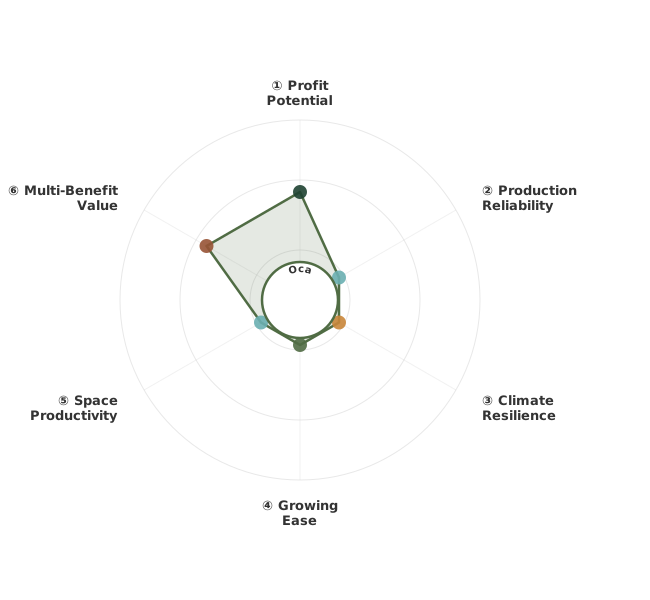
How These Traits Are Calculated
Trait dimensions are ordered clockwise starting from the top of the chart (12 o'clock position):
1. Profit Potential
Net returns per acre from yield, pricing, input costs, and labor efficiency
WHAT: Synthesizes gross revenue potential, input costs, labor requirements, and storage/marketing advantages into net profitability per acre. Captures the complete economic picture from planting to sale.
WHY: Not all vegetables are equally profitable. High-value crops with efficient production can return $10,000-30,000/acre versus $2,000-5,000/acre for lower-value options. Profit potential guides crop selection for maximum return on limited land and determines viable scale for farm businesses.
HOW: Scored via LLM synthesis of economics data (yields, prices, costs), storage advantages (season extension, value-added potential), and labor intensity. Exceptional (3.0): High yields × premium prices with moderate inputs and good storage (garlic, high-value salad greens). Typical (2.0): Moderate returns (tomatoes, squash). Limited (1.0): Low yields, commodity pricing, or intensive labor requirements (low-value greens).
2. Production Reliability
Weighted: yield consistency (60%) + disease/pest resistance (40%)
WHAT: Combines yield reliability (harvest consistency year-to-year) with disease and pest resistance to measure predictable production. Reliable vegetables deliver consistent harvests without catastrophic failures from pests or weather.
WHY: Market commitments and CSA subscriptions require dependable production. Unreliable crops that fail in bad years or require intensive pest management create cash flow gaps and customer dissatisfaction. Reliable producers allow confident planning and reduce input costs from emergency pest interventions.
HOW: Weighted formula prioritizes yield reliability (60% weight) for overall consistency, with disease/pest resistance (40% weight) to prevent total failures. Exceptional (3.0): Consistent yields across variable seasons with strong natural pest resistance. Typical (2.0): Generally reliable with some pest/weather sensitivity. Limited (1.0): Highly variable yields or severe pest vulnerability requiring intensive management.
3. Climate Resilience
Temperature and rainfall tolerance across diverse growing conditions
WHAT: Measures the breadth of climatic conditions where the vegetable produces successfully—temperature extremes, humidity ranges, and rainfall variability. Climate-resilient crops work across diverse regions and weather patterns.
WHY: Climate variability is increasing—unexpected heat waves, cold snaps, or drought periods can wipe out entire vegetable harvests. Resilient crops provide insurance against weather uncertainty and allow geographic expansion for market growth. This is especially critical for direct-market farmers who can't easily substitute crops mid-season.
HOW: Ratings based on the climate_adaptability trait documenting temperature tolerance and geographic range. Exceptional (3.0): Grows successfully in diverse climates (cold to hot, humid to dry) with wide hardiness zone range. Typical (2.0): Moderate climate flexibility. Limited (1.0): Narrow climate requirements (tropical-only, cool-season-only, humidity-sensitive).
4. Growing Ease
Weighted: establishment ease (50%) + low maintenance requirements (50%)
WHAT: Combines establishment difficulty (germination, transplanting) with ongoing maintenance needs (watering, fertilizing, pest management) to measure total labor requirements. Easy crops grow reliably with minimal intervention.
WHY: Labor is the primary cost for small-scale vegetable production. Easy-care crops allow farmers to manage more production area with the same labor, improving profitability. Difficult crops requiring constant attention, precise timing, or specialized skills reduce overall farm productivity and increase risk.
HOW: Weighted formula balances establishment ease (50% weight) for reliable startup and inverted maintenance intensity (50% weight) for ongoing care. Exceptional (3.0): Direct-seeded or easy transplants with minimal water/fertility/pest needs. Typical (2.0): Moderate care requirements. Limited (1.0): Difficult establishment or intensive ongoing management (daily watering, heavy feeding, constant pest monitoring).
5. Space Productivity
Weighted: yield per square foot (60%) + season extension potential (40%)
WHAT: Combines spatial productivity (yield per square foot) with temporal productivity (extended harvest windows from succession planting or season extension). Maximizes production from limited growing area.
WHY: Land is the primary constraint for vegetable farmers—especially those near urban markets. Space-efficient crops delivering high yields in small areas improve per-acre profitability dramatically. Season extension (spring tunnels, fall protection) adds bonus production windows when competing supply is limited and prices are higher.
HOW: Weighted formula prioritizes space efficiency (60% weight) for core yield per area, with season extension potential (40% weight) for bonus production opportunities. Exceptional (3.0): High yields per square foot (10,000+ lbs/acre equivalents) with season extension options. Typical (2.0): Moderate yields and extension potential. Limited (1.0): Low yields or crops unsuitable for season extension.
6. Multi-Benefit Value
Ecosystem services beyond harvest—pollinator support, nitrogen fixing, pest habitat
WHAT: Measures ecosystem services provided beyond harvestable yield. Multi-benefit vegetables contribute to farm ecology through nitrogen fixation (legumes), pollinator support (flowering crops), beneficial insect habitat, soil building, or erosion control.
WHY: Cash crops can either extract from farm ecosystems or contribute to them. Vegetables with strong multi-benefit value build soil fertility, support pollinators needed for fruit/vine crops, and create habitat for pest predators—reducing external input needs. Nitrogen-fixing vegetables (beans, peas) provide $40-80/acre worth of fertility for following crops.
HOW: Ratings based on the multi_benefit_value trait documenting service contributions. Exceptional (3.0): Significant ecosystem services (nitrogen fixation, heavy pollinator support, soil building, pest habitat). Typical (2.0): Some ecosystem contributions. Limited (1.0): Single-purpose cash crops with minimal farm ecology benefits.
Ratings are based on documented performance in regenerative systems, not conventional high-input scenarios. All traits assume integrated management practices focused on soil health and ecosystem services.
5
Management & Care Requirements
Integration guidance, maintenance needs, and care practices
Management & Care Requirements
Integration guidance, maintenance needs, and care practices
How to Integrate This Plant
Oca (Oxalis tuberosa) can be integrated into regenerative systems primarily as a cash crop with additional ecosystem services. Its cultivation is particularly suited to season extension techniques, making it valuable in mixed cropping systems where early or late harvests are desired. As a tuber-forming crop sensitive to frost, it benefits from protection strategies like row covers and plastic mulches, aligning with practices that enhance soil health and reduce reliance on synthetic inputs. While not a nitrogen fixer or a tree providing shade, oca can contribute to ground cover, potentially reducing erosion in the short term. Its main contribution is through direct harvest value and by supporting a diversified agricultural landscape. Integrating oca into food forests or alley cropping systems, particularly in cooler climates or at higher elevations, could provide a unique market niche and extend the harvest season, complementing other staple crops. It fits into systems aiming to maximize land use and provide continuous food production.
Integration Practices & Management
While the knowledge base highlights Oca's specific tuber development needs, requiring short day lengths (less than 10 hours) around mid to late November for tuber formation at 51 degrees North latitude, it does not detail establishment methods such as seeding rates, timing, companion planting, or tillage practices. Similarly, information on integrating Oca with grazing systems, including mob grazing, rotational systems, timing, or rest periods, is absent. Termination strategies are also not explicitly covered, though the need for season extension to prevent frost damage to developing tubers around the fall equinox is mentioned, suggesting protection with row cover and plastic is a relevant practice. The sources do not elaborate on management considerations like fertility needs, competition management, or succession planning. One study noted that warmer climates negatively impacted O. tuberosa production, but organic fertilization (sheep manure) helped maintain yield and biomass. There is no information on integration with cash crops through relay cropping, intercropping, or specific rotation sequences within the provided text. Consequently, practical farmer experiences and detailed integration strategies for Oca in regenerative systems are not present in this knowledge base. While coverage in our knowledge base is limited, the above represents documented uses in regenerative systems.
Management Profile
Maintenance Intensity: Adequate - This tuberous perennial flourishes in cool, moist conditions and requires optimal photoperiods for tuber development, with its sensitivity to frost necessitating thoughtful placement and seasonal planning.
Sources behind this view
 Community
-
Oca is a crop suitable for poor soils and no-dig gardens, with oxalic acid content varying by cultivar. Sweet varieties are low in oxalates and can be eaten raw or cooked; sour varieties require exten
Read more (opens in new window) permies.com
8
Learn More
Why farmers use this plant and additional resources
Learn More
Why farmers use this plant and additional resources
Why Regenerative Farmers Use This Plant
Oxalis tuberosa, commonly known as oca or New Zealand yam, presents a compelling opportunity for regenerative farmers seeking to diversify income streams with a high-value, niche market crop. Its unique flavor profile and vibrant colors make it attractive for direct-to-consumer sales, CSA shares, and specialty wholesale markets. With a relatively short growing season, oca offers excellent potential for succession planting, maximizing land use and generating consistent revenue throughout the harvest window. In suitable climates, a single planting can yield between 5,000-20,000 lbs/acre (5,600-22,400 kg/ha), with prices often ranging from $3-$8 per pound ($6.60-$17.60/kg) depending on market demand and quality, positioning it as a profitable addition to intensive vegetable production systems.
Integrating oca into regenerative systems offers significant ecological benefits beyond direct economic returns. As a non-leguminous crop, it does not fix atmospheric nitrogen but excels at scavenging available nutrients from the soil, particularly phosphorus, which can be less mobile. Its vigorous foliage growth can also provide significant ground cover, contributing to weed suppression and erosion control, especially when planted in permanent beds or as a component of intercropping systems. Its extensive root system, typically reaching depths of 12-18 inches (30-45 cm), helps to break up soil compaction and improve aeration, contributing to enhanced water infiltration and reduced erosion. Oca can be strategically intercropped with other vegetables or used as a component in a multi-species cover crop mix to suppress weeds and create a more resilient agroecosystem. Its presence can also support beneficial insect populations by providing habitat and potential foraging opportunities, contributing to a more balanced farm ecology. While not a primary pollinator attractant, its flowering period can offer a supplementary nectar source for late-season pollinators.
The quantitative ecosystem benefits of oca cultivation are noteworthy. Its dense foliage canopy can improve soil moisture retention and reduce surface runoff, leading to enhanced water infiltration over time, potentially increasing rates by 15-25%. Its root exudates and eventual decomposition add organic matter to the soil, supporting a healthy soil food web. By occupying space and competing with weeds, it can reduce the need for external inputs. In systems where it is grown, it contributes to a more complex biological environment, supporting a greater diversity of soil microorganisms and potentially attracting beneficial insects that contribute to broader pest management within the farm landscape.
Regional success stories highlight oca's adaptability. In the temperate regions of the United Kingdom, growers have found success in cooler, maritime climates, often treating it as an annual crop with harvests in autumn. In Australia, particularly in Tasmania and cooler coastal areas (Australian Zones 3-4), oca is gaining traction as a unique market garden crop, with farmers experimenting with different varieties for flavor and yield. In the Andean regions of South America, its ancestral home, oca has been cultivated for centuries, demonstrating its long-term viability and resilience in diverse farming systems. Farmers in New Zealand have also embraced oca, developing specialized markets for its distinctive tubers. In the Pacific Northwest of the USA (USDA Zones 7-8), farmers have found success growing oca for specialty markets, leveraging its unique flavor profile. In cooler, higher-rainfall regions of Australia (Zones 2-4), growers are exploring its potential as an alternative crop that can thrive where traditional staples may struggle. In the cooler coastal regions of California, USA (USDA Zones 9-10), oca can be planted in early spring and harvested in the fall, often intercropped with heat-tolerant vegetables. In the UK, growers often plant oca in early summer in raised beds to ensure good drainage and easier harvest, integrating it into mixed vegetable plots. In parts of the Andes, it is a staple crop grown in rotation with potatoes and other tubers, benefiting from the diverse soil biology present in traditional farming systems.
Sources behind this view
Community
-
Oca is a crop suitable for poor soils and no-dig gardens, with oxalic acid content varying by cultivar. Sweet varieties are low in oxalates and can be eaten raw or cooked; sour varieties require exten
Read more (opens in new window) permies.com