Sweet Sorghum
Regenerative Quick Profile
All recommendations assume integrated, regenerative practices—not conventional inputs.
Climate & Soil Fit
Climate: Tropical Rainforest, Tropical Monsoon, Tropical Savanna, Hot Semi-Arid (Steppe), Cold Semi-Arid (Steppe), Hot Desert, Cold Desert, Humid Subtropical, Oceanic (Maritime Temperate), Hot-Summer Mediterranean, Warm-Summer Mediterranean, Monsoon-Influenced Humid Subtropical, Subtropical Highland, Hot-Summer Continental, Warm-Summer Continental, Subarctic, Monsoon-Influenced Hot-Summer Continental, Tundra
Zones: USDA 6-11, Australian Zones 1-14
Optimal Soil: Loam Soil
System Role & Functions
Primary: Cover Crop System
Secondary: Forage Integration, Cash Crop With Services
Key Benefits: Climate adaptable, Easy establishment, Weed Suppression
Management Level
Experience: Beginner-Friendly
Maintenance: Moderate maintenance - While drought-tolerant, grain sorghum benefits from thoughtful fertility management and water conservation strategies to optimize its performance and yield within the farming system.
Value Streams
- Cover crop (soil investment)
- Soil building and erosion control
- Livestock forage value
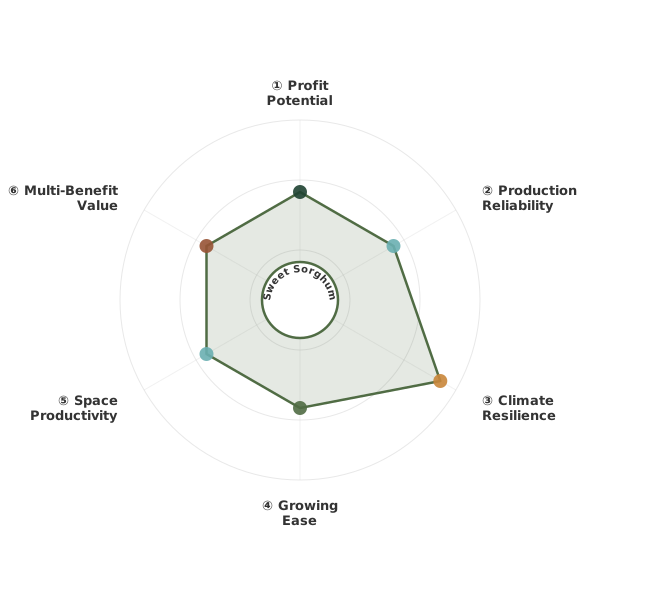
Regenerative Trait Ratings
How These Traits Are Calculated
Trait dimensions are ordered clockwise starting from the top of the chart (12 o'clock position):
1. Profit Potential
Net returns per acre from yield, pricing, input costs, and labor efficiency
WHAT: Synthesizes gross revenue potential, input costs, labor requirements, and storage/marketing advantages into net profitability per acre. Captures the complete economic picture from planting to sale.
WHY: Not all vegetables are equally profitable. High-value crops with efficient production can return $10,000-30,000/acre versus $2,000-5,000/acre for lower-value options. Profit potential guides crop selection for maximum return on limited land and determines viable scale for farm businesses.
HOW: Scored via LLM synthesis of economics data (yields, prices, costs), storage advantages (season extension, value-added potential), and labor intensity. Exceptional (3.0): High yields × premium prices with moderate inputs and good storage (garlic, high-value salad greens). Typical (2.0): Moderate returns (tomatoes, squash). Limited (1.0): Low yields, commodity pricing, or intensive labor requirements (low-value greens).
2. Production Reliability
Weighted: yield consistency (60%) + disease/pest resistance (40%)
WHAT: Combines yield reliability (harvest consistency year-to-year) with disease and pest resistance to measure predictable production. Reliable vegetables deliver consistent harvests without catastrophic failures from pests or weather.
WHY: Market commitments and CSA subscriptions require dependable production. Unreliable crops that fail in bad years or require intensive pest management create cash flow gaps and customer dissatisfaction. Reliable producers allow confident planning and reduce input costs from emergency pest interventions.
HOW: Weighted formula prioritizes yield reliability (60% weight) for overall consistency, with disease/pest resistance (40% weight) to prevent total failures. Exceptional (3.0): Consistent yields across variable seasons with strong natural pest resistance. Typical (2.0): Generally reliable with some pest/weather sensitivity. Limited (1.0): Highly variable yields or severe pest vulnerability requiring intensive management.
3. Climate Resilience
Temperature and rainfall tolerance across diverse growing conditions
WHAT: Measures the breadth of climatic conditions where the vegetable produces successfully—temperature extremes, humidity ranges, and rainfall variability. Climate-resilient crops work across diverse regions and weather patterns.
WHY: Climate variability is increasing—unexpected heat waves, cold snaps, or drought periods can wipe out entire vegetable harvests. Resilient crops provide insurance against weather uncertainty and allow geographic expansion for market growth. This is especially critical for direct-market farmers who can't easily substitute crops mid-season.
HOW: Ratings based on the climate_adaptability trait documenting temperature tolerance and geographic range. Exceptional (3.0): Grows successfully in diverse climates (cold to hot, humid to dry) with wide hardiness zone range. Typical (2.0): Moderate climate flexibility. Limited (1.0): Narrow climate requirements (tropical-only, cool-season-only, humidity-sensitive).
4. Growing Ease
Weighted: establishment ease (50%) + low maintenance requirements (50%)
WHAT: Combines establishment difficulty (germination, transplanting) with ongoing maintenance needs (watering, fertilizing, pest management) to measure total labor requirements. Easy crops grow reliably with minimal intervention.
WHY: Labor is the primary cost for small-scale vegetable production. Easy-care crops allow farmers to manage more production area with the same labor, improving profitability. Difficult crops requiring constant attention, precise timing, or specialized skills reduce overall farm productivity and increase risk.
HOW: Weighted formula balances establishment ease (50% weight) for reliable startup and inverted maintenance intensity (50% weight) for ongoing care. Exceptional (3.0): Direct-seeded or easy transplants with minimal water/fertility/pest needs. Typical (2.0): Moderate care requirements. Limited (1.0): Difficult establishment or intensive ongoing management (daily watering, heavy feeding, constant pest monitoring).
5. Space Productivity
Weighted: yield per square foot (60%) + season extension potential (40%)
WHAT: Combines spatial productivity (yield per square foot) with temporal productivity (extended harvest windows from succession planting or season extension). Maximizes production from limited growing area.
WHY: Land is the primary constraint for vegetable farmers—especially those near urban markets. Space-efficient crops delivering high yields in small areas improve per-acre profitability dramatically. Season extension (spring tunnels, fall protection) adds bonus production windows when competing supply is limited and prices are higher.
HOW: Weighted formula prioritizes space efficiency (60% weight) for core yield per area, with season extension potential (40% weight) for bonus production opportunities. Exceptional (3.0): High yields per square foot (10,000+ lbs/acre equivalents) with season extension options. Typical (2.0): Moderate yields and extension potential. Limited (1.0): Low yields or crops unsuitable for season extension.
6. Multi-Benefit Value
Ecosystem services beyond harvest—pollinator support, nitrogen fixing, pest habitat
WHAT: Measures ecosystem services provided beyond harvestable yield. Multi-benefit vegetables contribute to farm ecology through nitrogen fixation (legumes), pollinator support (flowering crops), beneficial insect habitat, soil building, or erosion control.
WHY: Cash crops can either extract from farm ecosystems or contribute to them. Vegetables with strong multi-benefit value build soil fertility, support pollinators needed for fruit/vine crops, and create habitat for pest predators—reducing external input needs. Nitrogen-fixing vegetables (beans, peas) provide $40-80/acre worth of fertility for following crops.
HOW: Ratings based on the multi_benefit_value trait documenting service contributions. Exceptional (3.0): Significant ecosystem services (nitrogen fixation, heavy pollinator support, soil building, pest habitat). Typical (2.0): Some ecosystem contributions. Limited (1.0): Single-purpose cash crops with minimal farm ecology benefits.
Ratings are based on documented performance in regenerative systems, not conventional high-input scenarios. All traits assume integrated management practices focused on soil health and ecosystem services.
1
Climate Suitability Assessment
Will this plant thrive in your climate?
Climate Suitability Assessment
Will this plant thrive in your climate?
Köppen Zone: Af (Tropical Rainforest), Am (Tropical Monsoon), Aw (Tropical Savanna), Cfa (Humid Subtropical), Cwa (Monsoon-Influenced Humid Subtropical)
USDA Zone: 6a, 7a, 8a, 9a, 10a, 11a, 12a
Australian Zone: subtropical
Sweet sorghum performs optimally in climates offering long, warm growing seasons with temperatures consistently between 70-90°F (21-32°C), and adequate rainfall (30-50 inches annually). These conditions are met in Köppen Cfa and Cwa zones, and USDA zones 6a through 9b, as well as Australian subtropical regions. In these areas, sweet sorghum thrives as a cover crop or forage, producing substantial biomass and offering excellent soil improvement services. Establishment is reliable, and it tolerates summer heat well, making it a highly productive and dependable choice for regenerative agriculture practices. Its ability to grow vigorously under these favorable conditions ensures high yields and significant benefits for soil health and fertility, contributing effectively to cover cropping systems, forage integration, and as a cash crop with ecosystem services.
Köppen Zone: BSh (Hot Semi-Arid (Steppe)), BSk (Cold Semi-Arid (Steppe)), Cfb (Oceanic (Maritime Temperate)), Csa (Hot-Summer Mediterranean), Csb (Warm-Summer Mediterranean), Cwb (Subtropical Highland), Dfa (Hot-Summer Continental), Dfb (Warm-Summer Continental)
USDA Zone: 5a, 5b
Australian Zone: temperate
EU Climate Region: atlantic, continental
Sweet sorghum is adequately suited to climates with warm summers but shorter growing seasons or more variable temperatures, such as Köppen Dfa and Dfb zones, USDA zones 5a-5b and 10a-10b, Australian temperate zones, and EU Atlantic and Continental regions. In these areas, it can be grown successfully as an annual cover crop or for forage, but requires careful management. Variety selection for early maturity is often beneficial, especially in zones with shorter frost-free periods. While it can produce good biomass, yields may be moderate, and it might require supplemental irrigation during dry spells or in very hot conditions (USDA 10a/10b) to prevent heat stress and ensure optimal growth. Its performance is reliable enough to offer benefits for soil health and fertility, but it is not as consistently productive as in ideal subtropical or humid continental climates.
Köppen Zone: ET (Tundra), BWh (Hot Desert), BWk (Cold Desert), Dfc (Subarctic), Dwa (Monsoon-Influenced Hot-Summer Continental)
USDA Zone: 2a, 3a, 3b, 4a
Sweet sorghum is not recommended for climates with extremely short growing seasons and severe winter cold, such as USDA zones 3a, 3b, 4a, and 4b. These zones lack the consistent warmth and sufficient frost-free days (minimum 100-120 days) required for sweet sorghum to establish reliably and produce meaningful biomass. Winter survival is impossible, and even as an annual, yields are minimal and establishment is highly risky due to rapid soil drying or insufficient heat. Cultivation in these zones is economically impractical, and alternative cover crops that are cold-hardy and adapted to shorter seasons are far more suitable for regenerative agriculture practices. These alternatives provide better biomass production, soil protection, and nutrient cycling benefits without the significant challenges and low return associated with attempting to grow sweet sorghum.
Note: Zones listed above represent climates where this plant can produce reliably with reasonable management. Climate zones not mentioned would require intensive climate modification (greenhouses, extensive infrastructure) and are not economically viable for regenerative agriculture purposes.
2
Soil Suitability Assessment
Which soil types work best for this plant?
Soil Suitability Assessment
Which soil types work best for this plant?
Loam Soil
This plant thrives in these soil types without requiring amendments or remediation. Natural soil conditions support optimal growth and productivity.
Acidic Soil, Alkaline Soil, Clay Soil, Desert Soil, Rich Soil, Rocky Soil, Sandy Soil
This plant performs acceptably in these soil types with moderate, manageable remediation such as pH adjustment, compost addition, or drainage improvement. The required amendments are practical and cost-effective for regenerative agriculture.
Saline Soil, Wet Soil
Growing this plant in these soil types would require impractical remediation such as complete soil replacement, extensive amendments, or cost-prohibitive infrastructure. These conditions are not economically viable for regenerative agriculture.
Note: Soil suitability assessments focus on remediation requirements. "Ideally Suited" means the plant generally thrives without the need for substantial amendments, "Adequate" means manageable remediation (lime, compost, mulch), and "Not Recommended" means impractical soil changes would be required. Climate factors like rainfall and temperature also influence success.
3
Seasonal Considerations
Planting timing, growth duration, and harvest windows
Seasonal Considerations
Planting timing, growth duration, and harvest windows
For grain sorghum as a cover crop, timing is key to maximizing its benefits within your rotation. Spring planting should occur after the soil has warmed sufficiently and all danger of frost has passed, aiming for soil temperatures consistently above 50°F (10°C). This allows for rapid establishment, typically within one to two weeks, setting the stage for significant biomass production through the warm summer months.
If incorporating sorghum as a summer cover, plant it after the harvest of an early-season cash crop, ensuring adequate time for growth before cooler temperatures arrive. For fall planting, sow sorghum in late summer or early autumn, well before the first expected frost. It will likely not survive significant frosts in colder climates (D zones) and will enter dormancy or die back in cooler regions (C zones) as temperatures drop. Termination should ideally occur in late fall or early winter, or in early spring before planting your next cash crop, allowing sufficient time for decomposition. This warm-season grass excels at scavenging nutrients and building organic matter when given a full growing season.
4
System Role & Multi-Benefit Value
Functional roles, integration strategies, and stacked benefits
System Role & Multi-Benefit Value
Functional roles, integration strategies, and stacked benefits
Functional Role
Integration Characteristics
Multi-Benefit Value: Adequate - Grain sorghum offers grain and forage production, significant biomass for soil organic matter, improved soil structure via its roots, and effective weed suppression, though it does not fix nitrogen.
5
Economics & Value Streams
Direct harvest, system benefits, ecosystem services, and risk diversification
Economics & Value Streams
Direct harvest, system benefits, ecosystem services, and risk diversification
Comprehensive economic analysis including direct harvest value, system enhancement contributions, ecosystem services, value timeline, and risk diversification strategies.
Vegetable & Specialty Economics
| Metric | Value |
|---|---|
| Seed/Transplant Cost | — |
| Expected Yield | — |
| Market Price | — |
| Harvest/Handling Cost | — |
| Marketing/Distribution Cost | — |
Economics highly variable by market channel (direct vs wholesale), scale, and management. Direct marketing commands premiums but requires labor. Values shown for mid-scale market garden operations.
System Enhancement Value
Beyond cost recovery: soil building, nitrogen, biomass, and weed suppression
Nitrogen Fixation & Cycling
Grain sorghum, as a non-leguminous grass, does not contribute to nitrogen fixation through symbiotic relationships with bacteria. Therefore, it does not provide a direct nitrogen contribution to the soil in the way that legumes do. Its role in nutrient cycling is primarily through the decomposition of its biomass, which returns organic matter and the nutrients it has scavenged from the soil back into the system. In integrated systems, its contribution lies more in scavenging existing nutrients and improving soil structure, which can enhance the availability and uptake of nutrients by subsequent crops or in mixed swards. While it doesn't add nitrogen, its efficient nutrient scavenging can reduce the need for external nitrogen inputs by making existing soil nutrients more accessible.
Soil Building & Weed Suppression
Grain sorghum offers significant system benefits beyond direct harvest, particularly in integrated farming systems. As a warm-season cover crop (Excerpt), it can scavenge nutrients and add substantial biomass to the soil, contributing to increased soil organic matter over time. Its deep root system, as noted for sorghum-Sudan grass in Excerpt, can improve soil structure, enhance water infiltration, and break up compaction, making nutrients more accessible. In dryland conditions, sorghum's drought tolerance, mentioned in Excerpt for sorghum-Sudan, is a critical asset for resilience, as highlighted by its performance during dry spells in Excerpt. When used in a cover cropping strategy, it can provide 'cash crop with services' value, offering forage integration possibilities (Excerpt) for livestock, providing nutritional gaps or late-season grazing. Its role in diverse mixes, as emphasized in Excerpts and, enhances overall system resilience and soil health, contributing to a more robust agricultural ecosystem.
Erosion Control
Variable, depending on planting density and configuration. Can contribute to residue cover, reducing wind erosion by an estimated 10-20% on exposed fields.
While not typically planted as a dedicated windbreak, grain sorghum's dense growth habit and height can offer some degree of windbreak effect, particularly when grown in rows or as part of a mixed stand. In dryland farming systems, maintaining residue cover is paramount for moisture conservation and erosion control, and sorghum's stalks and leaves contribute significantly to this residue. Excerpt highlights Jim Cavin's use of mulch tillage for dryland sorghum and wheat, emphasizing year-round residue cover to conserve moisture and manage weeds. While not a formal windbreak, this residue management, facilitated by sorghum's biomass, helps protect the soil surface from wind erosion and reduces evaporation. The 40-inch row spacing mentioned for sorghum in dryland conditions also aids in residue dispersion and can contribute to surface roughness, further mitigating wind's erosive power. The 'diking' technique mentioned in excerpt also aims to capture rainfall, which is indirectly related to managing the impact of weather events, including wind-driven erosion.
Ecosystem Service Contributions
Environmental contributions: carbon, pollinators, wildlife, and water
- Carbon Sequestration: Grain sorghum has a moderate to high carbon sequestration potential due to its rapid growth and substantial biomass production, especially when managed for residue retention. Its root system also contributes to soil carbon. The decomposition of its organic matter adds carbon to the soil profile.
- Pollinator Support: Low. While some sorghum varieties may produce small flowers, they are not typically considered a primary pollinator attractant compared to dedicated flowering cover crops or other broadleaf species. Its main value is in biomass and nutrient cycling.
- Wildlife Habitat: Moderate. Sorghum can provide some habitat and food sources (grain) for certain wildlife, particularly birds, during its growth cycle and after harvest. Its stalks can offer roosting or nesting sites.
- Water Quality: Not applicable
Value Timeline: Soil Building Process
When you'll see results: immediate soil benefits, compounding over seasons
Years 1-2
Erosion control through residue cover, soil moisture conservation, potential for forage integration/grazing, nutrient scavenging, and initial improvements in soil structure from root activity.
Years 3-5
Continued soil health improvements, increased organic matter, enhanced water infiltration, potential for reduced weed pressure in subsequent cash crops due to cover crop benefits, and established drought resilience in the system.
Years 10-20
Significant improvements in soil organic matter and overall soil health, leading to more stable yields and reduced input needs. The plant's resilience contributes to long-term farm viability, particularly in variable climates.
20+ Years
Long-term soil health benefits, including enhanced water-holding capacity and nutrient cycling, making the system more resilient to climate change and market fluctuations. The plant's contribution to a diverse and healthy soil microbiome supports ongoing ecosystem services.
Farm Risk Reduction
How this reduces farm risk: lower input costs and better soil resilience
- Multiple Revenue Streams: Primary cash crop revenue, forage for livestock integration, potential for cover crop seed production, and the indirect value of improved soil health leading to reduced input costs for other crops.
- Temporal Income Spread: Annual harvest revenue from the grain, with ongoing soil health benefits and potential forage availability that can be utilized at different times of the year, contributing to a more consistent farm output.
- Market Risk Hedge: Drought tolerance provides a significant hedge against water scarcity. Its role as a cover crop in a diverse rotation reduces reliance on a single cash crop, and its integration with livestock offers alternative income and nutrient cycling opportunities, buffering against market volatility for grain prices.
6
Regenerative Suitability Details
Comprehensive trait ratings for system integration assessment
Regenerative Suitability Details
Comprehensive trait ratings for system integration assessment
Comparative ratings for this plant across key regenerative agriculture traits.
| Trait | Suitability | Explanation |
|---|---|---|
| Cold Hardiness | Not Recommended | Grain sorghum is a warm-season annual, sensitive to frost, and will winterkill reliably in Zone 8 and colder, leaving the soil exposed over winter. |
| Weed Suppression | Ideally Suited | Grain sorghum grows rapidly, forming a dense, tall canopy that effectively smothers weeds, and its ample biomass is excellent for subsequent mulch. |
| Nitrogen Fixation | Not Recommended | As a grass, grain sorghum does not fix nitrogen but efficiently scavenges existing nutrients and builds significant biomass. |
| Root System Depth | Adequate | Grain sorghum possesses a robust, fibrous root system reaching 2-4 feet, which effectively scavenges nutrients and enhances topsoil structure through its soil-building action. |
| Biomass Production | Ideally Suited | Grain sorghum can rapidly produce very high biomass, contributing substantial organic matter to the soil, often exceeding 4 tons/acre dry matter. |
| Establishment Ease | Ideally Suited | Grain sorghum establishes quickly in warm soils with minimal soil disturbance, and its vigorous early growth effectively outcompetes weeds, ensuring high survival rates. |
| Multi Benefit Value | Adequate | Grain sorghum offers grain and forage production, significant biomass for soil organic matter, improved soil structure via its roots, and effective weed suppression, though it does not fix nitrogen. |
| Climate Adaptability | Ideally Suited | Grain sorghum excels in heat and drought, performing across zones 5-11 by thriving in arid conditions and producing under stress. |
| Maintenance Intensity | Adequate | While drought-tolerant, grain sorghum benefits from thoughtful fertility management and water conservation strategies to optimize its performance and yield within the farming system. |
Comparative System: Ratings compare plants within their economic category (e.g., cover crop nitrogen fixation compared to other cover crops, not to all plants). Individual farm conditions and management practices significantly influence actual performance.
7
Learn More
Why farmers use this plant and additional resources
Learn More
Why farmers use this plant and additional resources
Why Regenerative Farmers Use This Plant
Sugar cane (Saccharum officinarum) is a high-value specialty cash crop that offers significant revenue potential for regenerative farms seeking to diversify income streams. Its primary appeal lies in the production of sugar-rich stalks, which are processed into syrup, molasses, and sugar. A well-managed acre can yield between 100-150 gallons (378-568 liters) of syrup, commanding premium prices in direct-to-consumer markets, farmers' markets, and through CSA shares. The intensive management and processing requirements create opportunities for value-added products, further enhancing farm profitability. The relatively long growing season, typically 8-18 months depending on variety and climate, allows for substantial biomass accumulation and carbon sequestration potential within the soil profile.
Beyond direct revenue, sugar cane integrates effectively into diverse farm systems by improving soil health and providing ecological services. While not a nitrogen fixer, it possesses a robust fibrous root system that can reach depths of 3-12 feet (0.9-3.6 meters) over time, contributing significantly to soil structure improvement, aeration, and water infiltration. This deep rooting helps scavenge nutrients from lower soil horizons, making them available to subsequent crops. Its dense growth offers excellent ground cover, suppressing weeds and preventing soil erosion, particularly on slopes. While not a cover crop in the traditional sense, its residue, when managed appropriately, contributes organic matter to the soil. Its presence can also support beneficial insect populations by providing habitat and foraging opportunities, though it is primarily wind-pollinated.
The quantitative ecosystem benefits of sugar cane are tied to its biomass production and soil-building capacity. Mature plants can produce significant above-ground biomass, which, when returned to the soil, contributes to soil organic matter accumulation over successive crop cycles. This increased organic matter enhances soil water-holding capacity, reducing irrigation needs and improving resilience to drought. Furthermore, its deep root system helps to break up compacted layers, facilitating better water penetration and reducing surface runoff and erosion. While specific data on pollinator visits or beneficial insect populations is less documented compared to flowering cover crops, its dense canopy offers a protective environment for soil microbes and small soil fauna.
Sugar cane has a long history of successful cultivation across various continents and farm systems. In the humid subtropical regions of the southern United States (USDA Zones 8-10), it has been a staple crop for generations, with small-scale producers focusing on artisanal syrup production. In Australia's sugarcane growing regions (e.g., Queensland, Australian Zones 1-3), large-scale production utilizes specific varieties adapted to local rainfall patterns and soil types, with planting and harvesting cycles tailored to the monsoon season. In Brazil, the world's largest producer, extensive planting occurs in tropical and subtropical zones (USDA Zones 9-11 equivalents), with varieties selected for high sugar content and ratooning ability, often integrated into larger agricultural landscapes. In the Caribbean, it has historically been a dominant crop. In India, where sugar cane is a major agricultural commodity, intercropping with legumes like pulses or oilseeds is practiced in some regions. In regions with shorter growing seasons or cooler winters, selecting early-maturing varieties and using protection methods like row covers or tunnels for young plants may be necessary.
8
How to Integrate This Plant
Practical guidance for regenerative systems
How to Integrate This Plant
Practical guidance for regenerative systems
Establishing sugar cane typically involves planting vegetative cuttings, known as "seed cane" or "setts," rather than seeds. These setts, which are sections of mature cane stalk containing at least two buds, are planted horizontally or at a slight angle in furrows. Planting rates vary based on sett quality and desired stand density. A common recommendation is 2,000-4,000 lbs (907-1814 kg) of seed cane per acre, which translates to approximately 10-20 tons (9-18 metric tons) per hectare, or 8,000 to 16,000 setts per acre (20,000 to 40,000 setts per hectare). The planting depth is crucial for good establishment, typically between 2-8 inches (5-20 cm), ensuring buds are covered by soil and protected by adequate moisture. Spacing between rows is generally 4-6 feet (1.2-1.8 meters) to allow for cultivation and harvesting.
Planting occurs during the warmer months, typically from late spring through early summer in the Northern Hemisphere (e.g., February to April or April to June) and in the Southern Hemisphere from August to October or October to December, aligning with the start of the warmer growing season to ensure good germination and early growth.
Management of sugar cane is intensive, focusing on fertility, water, and weed control. It requires approximately 1-2 inches (2.5-5 cm) of water per week, often necessitating irrigation in drier climates, particularly during establishment and peak growth. Fertility is best managed through biological sources: incorporating compost, using well-rotted manure, and leveraging the residue from preceding cover crops. While sugar cane is a heavy feeder, its need for synthetic NPK inputs can be significantly reduced by building soil organic matter and utilizing nitrogen-fixing cover crops in rotation. Growth is rapid during warm periods, with plants reaching heights of 8-15 feet (2.4-4.5 meters) or more at maturity.
Pest and disease management prioritizes cultural practices such as selecting disease-resistant varieties, maintaining optimal plant spacing for air circulation, and timely sanitation of planting material. Integrated Pest Management (IPM) strategies include monitoring for common pests like borers and mealybugs, and employing biological controls such as parasitic wasps and predatory insects.
The production cycle of sugar cane is longer than many annual vegetables. Plant crops typically require 10-18 months from planting to harvest. Subsequent ratoon (stubble) crops can yield for several subsequent years, usually 3-5 years, before replanting is necessary as sugar content and yield may decline. For continuous syrup production, farmers often stagger planting dates or manage multiple fields at different stages of maturity.
Following the final harvest of a plant or ratoon crop, or if replanting, it is crucial to implement soil-building practices. Before planting sugar cane, a deep-rooted cover crop like daikon radish can be beneficial to break up compaction. After harvest, suitable cover crops that can be planted within 2-4 weeks include sorghum-sudangrass for biomass and weed suppression, or a legume-grass mix like vetch and rye to build fertility and structure. A diverse cover crop mix including cereal rye, hairy vetch, and clover can be sown to protect soil structure, scavenge residual nutrients, and add organic matter. Crop rotation intervals are essential; sugar cane should not follow itself or closely related grasses for at least 3-5 years to minimize pest and disease buildup and prevent nutrient depletion. Post-harvest residue management involves leaving stalks and leaves on the field to decompose, providing a mulch layer that conserves moisture and suppresses weeds, followed by the establishment of a winter cover crop.