
Biodynamic Agriculture
Biodynamic agriculture is a holistic, spiritual-ecological farming system rooted in Rudolf Steiner's anthroposophical philosophy. It views the farm as a living, self-sustaining organism, emphasizing specific preparations and cosmic rhythms to enhance soil vitality and crop quality, distinct from purely pragmatic or scientific approaches like permaculture.
Read More: Complete Description
Biodynamic agriculture is a holistic, spiritual-ecological farming system that perceives the farm as a self-contained, living entity with its own unique constitution and destiny. Developed by philosopher and scientist Rudolf Steiner in the early 20th century, it goes beyond conventional organic practices by integrating a profound understanding of cosmic forces, planetary influences, and specific, energetically charged preparations into its methodology. The core philosophy posits that the farm organism can achieve vital balance and resilience through thoughtful management attuned to natural cycles.
A fundamental tenet of biodynamics is the essential role of its unique preparations, such as preparations 500 (horn manure) and 501 (horn silica), and the compost activators (502-507). These preparations are not merely soil amendments; they are considered catalysts that enhance the energetic life and microbial activity within the soil and compost. The preparation process itself, often involving burying cow horn filled with manure or silica for months in the earth, is seen as a way to imbue these materials with specific terrestrial and cosmic energies. When applied, they are intended to stimulate soil life, improve plant structure, enhance nutrient availability, and foster overall farm vitality.
Biodynamic practitioners also pay close attention to lunar and planetary rhythms, often referred to as the "biodynamic calendar." This calendar, pioneered by figures like Maria Thun, suggests optimal planting, cultivating, and harvesting times based on the moon's phases and its position relative to zodiac constellations. The intention is to work in harmony with these celestial influences, believing that different plants respond optimally when tended during specific astronomical alignments. This aspect of biodynamics is often misunderstood as being purely astrological, but proponents describe it as an ecological observation of how subtle natural rhythms affect plant growth and quality.
Crucially, the spiritual and cosmological dimensions are not optional add-ons in biodynamic agriculture; they are foundational and constitutive to the practice. This spiritual depth is what fundamentally distinguishes it from permaculture, a pragmatic design system focused on ecological principles and scientific observation, or conventional organic farming, which primarily emphasizes the absence of synthetic inputs. While biodynamics shares the goals of soil health, biodiversity, and farm resilience with other regenerative practices, its methodology incorporates esoteric understanding and actively seeks to engage with the farm as a cosmic-individual entity.
The aim is to create a farm that is as self-sufficient as possible, generating its own fertility through composting, cover cropping, and animal integration, thereby minimizing external inputs and fostering a closed-loop nutrient cycle. This approach inherently supports the regenerative principles of minimizing soil disturbance by emphasizing compost applications and avoiding synthetic inputs that disrupt soil life, maximizing crop diversity through thoughtful crop rotation and companion planting, keeping soil covered with living plants or mulch, maintaining living roots through perennial components and cover cropping, and integrating livestock for nutrient cycling and fertility management.
The biodynamic approach requires a deep commitment to observation, intuition, and working with the farm's unique spirit. It calls for farmers to become intimately familiar with their land, its rhythms, and its responses to both terrestrial and cosmic forces. This holistic perspective aims not only for productive yields but for the creation of vibrant, healthy food and a thriving agricultural ecosystem that supports life both above and below ground, fostering a profound connection between the farmer, the land, and the wider cosmos.
Sources behind this view
Sources behind this view
 Videos & Podcasts
-
Biodynamic farming, inspired by Rudolf Steiner, focuses on long-term soil health through compost, aiming for stable, self-sufficient soil in about eight years. Key practices include making biodynamic
-
Biodynamics, a holistic agricultural approach, focuses on nutrient-dense food and earth healing using energetic remedies and a planting calendar. Scientific tests over seven years at a Colorado biodyn

-
Biodynamic agriculture is explained through seven principles, viewing the farm as a living organism. Key aspects include the soil as Earth's breathing organ, plants' verticality, animal integration fo

-
Biodynamics, founded by Rudolph Steiner, views farms as ecosystems that avoid chemicals to protect soil life and human health. It emphasizes integrating diverse elements and leveraging nature's intell

 Community
-
Biodynamics aims to create balanced farm ecosystems using fermented manure, herbs, and minerals to enhance soil, plant, and animal health, working with cosmic influences.
Read more (opens in new window) permies.com -
Biodynamic soil amendments, like manure packed in horns and buried for a lunar cycle, can be understood scientifically as creating a hyper-accelerated microbial environment for improved soil fertility
Read more (opens in new window) permies.com -
Introduces biodynamics as a holistic farm-as-organism approach, highlighting Monty Waldin's 'Biodynamic Gardening' book as a practical guide to its methods, including the influence of moon and nature
Read more (opens in new window) www.permaculture.org.uk -
Biointensive farming can either deplete or build soil; correct implementation of its 8 principles (deep soil prep, close spacing, composting, carbon farming, etc.) is crucial. On a degraded site, bioi
Read more (opens in new window) permies.com
 Research
-
Enrichment of putative plant growth promoting microorganisms in biodynamic compared with organic agriculture soils (opens in new window)
This study found: Biodynamic agriculture soils showed significantly more beneficial plant-growth microbes than organic soils across 24 European farm sites, suggesting biodynamic preparations boost soil health.
-
A review of scientific research on biodynamic agriculture (opens in new window)
This study found: Review of 147 studies (1985-2018) shows biodynamic farming improves soil health and biodiversity, but more research is needed on economic sustainability and food quality. Microbial activity is a promi
-
Hocus pocus? Spirituality and soil care in biodynamic agriculture (opens in new window)
This study found: Spiritual beliefs in biodynamic farming can enhance soil care by fostering attention to nature's agency and mystery, offering alternatives to purely technical approaches.
-
Research in biodynamic food and farming – a review (opens in new window)
This study found: Review of 86 studies (2006-2017) shows biodynamic farming improves soil health, food quality, and plant traits, with compost being key. Holistic study methods are needed for future research.
 From the Web
-
Biodynamic agriculture focuses on life processes and self-sufficiency using biodynamic preparations to attract nitrogen and enhance farm organism health, contrasting with chemical agriculture's salt-b
-
Biodynamic agriculture treats farms as unique 'living organisms' ('farm individuality') aiming for self-sustainability. Internal fertility is built using on-farm livestock manure and compost, with pes
-
Biodynamics treats farms as living organisms, integrating plants and animals to create balanced fertility and reduce external inputs. It emphasizes cultivating farmer awareness and listening to the la
-
Biodynamic farming utilizes composting with animal manure to feed soil microbes. Special liquid preparations, made from minerals, plants, and animals, address non-physical aspects of the farm and are
Key Points
What It Is
- Holistic, spiritual-ecological farming system
- Based on Rudolf Steiner's anthroposophy
- Uses specific preparations (e.g., horn manure)
- Works with cosmic rhythms and farm organism
How This Differs
- Spiritual-ecological farming system (Steiner's anthroposophy)
- Specific preparations: horn manure, horn silica, compost preps
- Cosmic rhythms guide planting and cultivation timing
- Spiritual dimensions are constitutive, not optional
Why Do It
- Enhances soil vitality and microbial life
- Produces nutrient-dense, high-quality food
- Builds farm self-sufficiency and resilience
- Integrates terrestrial and cosmic forces
Know the Debate
- Preparations aim to energize soil and plants, with varied scientific evidence.
- Planting calendars offer timing guidance, with debated practical impact.
- Biodynamic differs from organic due to spiritual and cosmic dimensions.
Benefits - Financial
- Premium pricing increases crop revenue by approximately 15-30% annually.
- Long-term input cost reduction realized at 25-40% below conventional organic levels.
- System maturity drives land value appreciation of 5-10% by year 7.
Benefits - System
- Greatly enhances soil organic matter (Principle 1)
- Maximizes biodiversity above and below ground (Principle 2)
- Keeps soil covered year-round with diverse plantings (Principle 3)
- Maintains living roots for sustained biological activity (Principle 4)
- Integrates livestock for fertility and nutrient cycling (Principle 5)
Risks - Financial
- Initial capital investment ranges from $550 to $3,700 per acre ($1,359–$9,143 per hectare).
- Certification and compliance administrative fees total $500-1,500 annually.
- Potential yield volatility of 15-25% during early transition window.
Risks - System
- Misunderstanding or misapplication of preparations
- Reliance on calendar can lead to inflexibility
- Spiritual dimension not universally accepted
- Requires deep observation and intuition
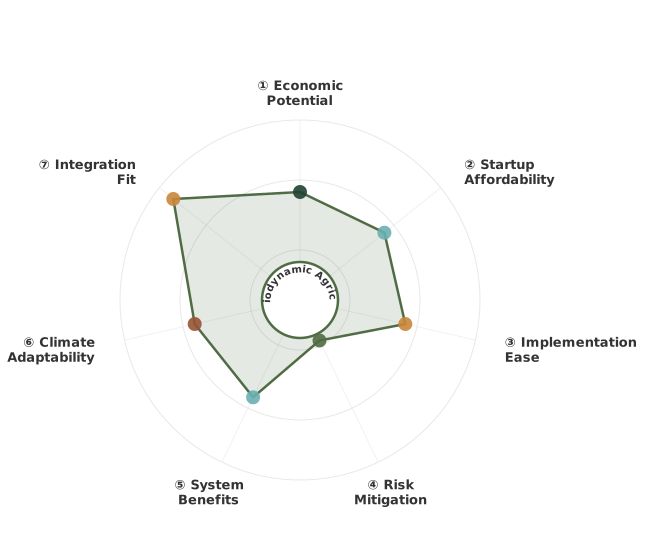
How These Traits Are Calculated
Trait dimensions are ordered clockwise starting from the top of the chart (12 o'clock position):
1. Economic Potential
Financial returns, annual value, and break-even timeline
WHAT: Evaluates financial viability by combining net annual value ($/ha from savings, income, and amortized harvests) with break-even timeline showing when practices pay for themselves.
WHY: Farmers need clear ROI understanding before committing resources. Fast payback (≤3 years) with strong returns (≥$300/ha) enables confident adoption, while long timelines (>10 years) restrict adoption to well-funded operations willing to wait for returns.
HOW: Calculated from net annual value in $/ha and break-even years. Exceptional (≥2.6): fast ROI ≤3 years + high value ≥$300/ha. Typical (1.8-2.5): moderate returns or longer timelines. Limited (<1.8): marginal economics or very long payback >10 years.
2. Startup Affordability
Initial investment costs and financial barrier to entry
WHAT: Measures financial barrier to entry through startup costs for equipment, infrastructure, consulting, and materials. Inverted scoring: lower costs = higher scores = more accessible adoption.
WHY: Affordability determines who can adopt. Low-cost practices (<$250/ha) enable widespread adoption across diverse scales, while high costs (>$2,500/ha) limit adoption to well-capitalized operations, creating barriers that slow regenerative transition.
HOW: Calculated from initial investment parsed from practice content. Inverted scoring: Exceptional (≥2.6): minimal investment <$250/ha. Typical (1.8-2.5): moderate costs $250-2,500/ha. Limited (<1.8): high barrier >$2,500/ha.
3. Implementation Ease
Learning curve and specialized knowledge required
WHAT: Measures how much learning, planning, and specialized knowledge a practice requires. Simpler practices with fewer steps score higher, while complex practices requiring extensive training or specialized resources score lower.
WHY: Complex practices create adoption barriers even when economically viable. Straightforward practices enable faster adoption and broader participation, while those requiring extensive training, timing precision, or specialized equipment limit who can succeed.
HOW: Evaluated by measuring documentation length and identifying complexity markers like location-specific requirements, seasonal timing windows, specialized skills, and dedicated equipment needs. Exceptional (≥2.6): straightforward practices with minimal prerequisites. Typical (1.8-2.5): moderate learning curve with some specialized needs. Limited (<1.8): steep learning curve requiring significant training or resources.
4. Risk Mitigation
Identified financial and ecological risk assessment
WHAT: Evaluates documented risks across financial (investment loss, market volatility) and ecological (crop failure, pest outbreaks) domains. Inverted scoring: fewer risks = higher scores.
WHY: Understanding risk exposure helps farmers make informed decisions. Low-risk practices allow confident implementation, while high-risk practices require careful planning and contingency resources. Risk transparency prevents costly failures.
HOW: Calculated from identified risks in practice content. Inverted scoring: Exceptional (≥2.6): ≤2 risks with manageable severity. Typical (1.8-2.5): 3-5 moderate risks. Limited (<1.8): 6+ risks or severe exposure.
5. System Benefits
How many ways the practice improves your land simultaneously
WHAT: Measures how many aspects of land health improve at once—carbon storage, soil quality, erosion control, water absorption, and biodiversity. Practices that improve multiple areas simultaneously create compounding benefits where each improvement reinforces the others.
WHY: The best practices solve multiple problems at once. For example, addressing erosion simultaneously builds carbon and improves water infiltration, creating a resilient system with positive feedback loops. Single-benefit approaches miss these compound transformation opportunities.
HOW: Evaluated across five key outcomes: carbon sequestration, soil organic matter increase, erosion reduction, water infiltration improvement, and biodiversity enhancement. Exceptional (≥2.6): high carbon storage (>8 t/ha/yr), improvements across 4-5 areas, transformative outcomes. Typical (1.8-2.5): moderate carbon (3-8 t/ha/yr), improvements across 2-3 areas. Limited (<1.8): modest impact (<3 t/ha/yr), single-area focus only.
6. Climate Adaptability
Geographic applicability across Köppen climate zones
WHAT: Evaluates geographic applicability by assessing how many Köppen climate zones successfully support a practice and what adaptation requirements are needed. Measures breadth of climates where farmers can implement with minimal to moderate modifications.
WHY: Universal practices working across diverse climates enable more farmers to adopt regenerative approaches. Practices limited to single climate types (only Mediterranean, only tropical) restrict adoption and slow global transition. Adaptability determines whether a practice serves niche regions or offers broad transformation.
HOW: LLM evaluation of regional success stories, Köppen zone coverage, and adaptation needs. Exceptional (≥2.6): 5+ zones or 4+ climate types, 3+ continents, minimal adaptation. Typical (1.8-2.5): 3-4 zones or 2-3 types, 2 continents, moderate adaptation. Limited (<1.8): 1-2 zones, single region, significant adaptation or highly specialized.
7. Integration Fit
How well this practice combines with others you're doing
WHAT: Measures how well a practice combines with other regenerative practices you might be doing. Some practices work as building blocks that make many other practices easier or more effective, while others work best on their own.
WHY: Practices that combine well with many others create more value on your farm. For example, cover cropping enables no-till, improves grazing, supports crop diversity, and helps water management—making all of them work better together. This helps you build a coherent system rather than juggling disconnected practices.
HOW: Evaluated by identifying which practices combine well and how strong those combinations are. 'Ideally Suited' means strong combinations where practices reinforce each other (practice A makes B easier, while B makes A more effective). 'Adequate' means complementary benefits that work well together. Exceptional (≥2.6): combines well with 6+ practices, serves as a building block. Typical (1.8-2.5): combines with 3-5 practices. Limited (<1.8): 1-2 practices or works best alone.
Going Deeper
1
WHY - The Benefits
Biodynamic agriculture offers a profound approach to farming that seeks to cultivate not just crops and livestock, but a living, breathing farm organism in harmony with natural cycles and cosmic forces. While sharing regenerative goals like soil health and biodiversity,...
Biodynamic agriculture offers a profound approach to farming that seeks to cultivate not just crops and livestock, but a living, breathing farm organism in harmony with natural cycles and cosmic forces. While sharing regenerative goals like soil health and biodiversity, it embeds these within a unique alchemical and ecological framework. The benefits extend from the microscopic life within the soil to the economic viability of the farm and the quality of the food produced.
WHY - The Benefits
Biodynamic agriculture offers a profound approach to farming that seeks to cultivate not just crops and livestock, but a living, breathing farm organism in harmony with natural cycles and cosmic forces. While sharing regenerative goals like soil health and biodiversity,...
Biodynamic agriculture offers a profound approach to farming that seeks to cultivate not just crops and livestock, but a living, breathing farm organism in harmony with natural cycles and cosmic forces. While sharing regenerative goals like soil health and biodiversity, it embeds these within a unique alchemical and ecological framework. The benefits extend from the microscopic life within the soil to the economic viability of the farm and the quality of the food produced.
Soil Health Benefits
The cornerstone of biodynamic farming is the relentless pursuit of vibrant, living soil. Through the strategic use of its unique preparations (like horn manure and horn silica) and compost activators, biodynamics aims to supercharge the soil's biological and energetic potential. These preparations are not merely fertilizers; they are seen as catalysts that stimulate microbial activity, improve soil structure, and enhance the soil's capacity to hold nutrients and water. This leads to increased soil organic matter, improved soil aggregation, and a more resilient soil structure, directly supporting Regenerative Principle 1: Minimize Soil Disturbance.
The practice inherently promotes Regenerative Principle 2: Maximize Crop Diversity. Biodynamic crop rotations are designed to create a diverse living system on the farm, often including not only cash crops but also cover crops, green manures, and border plantings. This diversity supports a wider array of soil microorganisms and beneficial insects, creating a more stable and resilient ecosystem. The understanding of plant relationships and their needs, influenced by cosmic rhythms, further encourages diverse planting strategies.
Biodynamic farmers strive to Keep Soil Covered (Principle 3) through extensive use of cover crops, mulching with compost, and maintaining perennial plantings. Bare soil is seen as a sign of farm organism distress, reducing its ability to interact with cosmic forces and leading to erosion and nutrient loss. The emphasis on compost production on-farm ensures a continuous supply of organic matter to smother weeds, protect soil from environmental extremes, and feed soil life.
Crucially, biodynamics champions Regenerative Principle 4: Maintain Living Roots. The farm organism is envisioned as having a continuous network of living roots that connect it to the earth and the cosmos. This is achieved through long-term crop rotations, perennial plantings, and the year-round management of living cover crops. These living roots provide a constant source of carbon for soil microbes, maintain soil structure, and facilitate nutrient cycling.
Finally, Regenerative Principle 5: Integrate Livestock is fundamental to the biodynamic farm organism. Livestock are not just providers of manure; they are seen as integral partners in the farm's metabolism, "digesting" plant material and returning vital fertility to the soil. Their presence is believed to bring specific terrestrial energies into the farm, balancing the cosmic influences. The manure, particularly when composted with biodynamic activators, becomes a potent soil conditioner.
Economic Benefits
While the spiritual and ecological benefits are paramount, biodynamic agriculture also offers significant economic advantages, particularly in the long term. Farms certified biodynamic often command premium prices for their produce due to consumer trust in the rigorous standards and the perceived higher quality and vitality of biodynamically grown food. This premium can lead to increased revenue per unit sold.
The emphasis on on-farm fertility generation through compost, cover cropping, and livestock manure significantly reduces reliance on purchased off-farm inputs like synthetic fertilizers and pesticides. Over time, this dramatically lowers production costs, improving profit margins. As soil health improves, water retention increases, reducing irrigation needs and enhancing drought resilience, further decreasing input costs and mitigating economic risks associated with extreme weather.
Biodynamic systems, by their nature, build a more resilient and diversified farm enterprise. The integration of various crops, potential livestock enterprises, and often perennial elements means that if one component of the system faces challenges (e.g., a specific pest affecting a cash crop), other parts of the farm can still produce, providing a buffer against economic shocks. This diversification can lead to more stable income streams over the years.
The long-term improvement in soil health—increased organic matter, better water holding capacity, and enhanced microbial activity—means that land farmed biodynamically can become more productive and resilient over decades. This can enhance land value and create intergenerational wealth. While the initial transition may require investment in learning and potentially new practices, the long-term trajectory is towards lower costs, higher quality produce, and a more robust economic foundation.
Regenerative Systems Fit
Biodynamic agriculture is considered a foundational regenerative practice. It not only supports all five regenerative principles but embeds them within a holistic, spiritual-ecological framework.
- Principle 1 (Minimize Soil Disturbance): Achieved through compost applications, lack of synthetic inputs, and emphasis on building living soil structure rather than frequent mechanical alteration.
- Principle 2 (Maximize Crop Diversity): Core to biodynamic rotations, companion planting, and the farm as an organism concept.
- Principle 3 (Keep Soil Covered): Achieved through year-round green manures, mulching, and diverse perennial plantings.
- Principle 4 (Maintain Living Roots): Fundamental to the farm organism concept, with emphasis on perennial elements and cover cropping.
- Principle 5 (Integrate Livestock): Livestock are considered essential for the farm's metabolism and fertility cycle.
Biodynamics can be integrated with other regenerative practices, but its unique preparations and cosmic rhythm focus set it apart. It provides a path for farmers seeking to deepen their connection to the land and cultivate not just food, but vibrant life. Unlike transition practices, biodynamics aims for optimal regenerative function from its inception. It does not require phasing out non-regenerative inputs, as its philosophy naturally precludes them. Its success lies in fully embracing its unique principles from the outset.
Sources behind this view
Videos & Podcasts
-
Biodynamic agriculture is explained through seven principles, viewing the farm as a living organism. Key aspects include the soil as Earth's breathing organ, plants' verticality, animal integration fo
-
Biodynamics, a holistic agricultural approach, focuses on nutrient-dense food and earth healing using energetic remedies and a planting calendar. Scientific tests over seven years at a Colorado biodyn
-
Biodynamic farming, inspired by Rudolf Steiner, focuses on long-term soil health through compost, aiming for stable, self-sufficient soil in about eight years. Key practices include making biodynamic
-
Focuses on community engagement for biodynamics, involving the Steiner school and younger generations through on-farm education and tasting trials. Highlights the synergy with existing composting and

Community
-
Biodynamics aims to create balanced farm ecosystems using fermented manure, herbs, and minerals to enhance soil, plant, and animal health, working with cosmic influences.
Read more (opens in new window) permies.com -
Biointensive farming can either deplete or build soil; correct implementation of its 8 principles (deep soil prep, close spacing, composting, carbon farming, etc.) is crucial. On a degraded site, bioi
Read more (opens in new window) permies.com -
Introduces biodynamics as a holistic farm-as-organism approach, highlighting Monty Waldin's 'Biodynamic Gardening' book as a practical guide to its methods, including the influence of moon and nature
Read more (opens in new window) www.permaculture.org.uk -
Biodynamic soil amendments, like manure packed in horns and buried for a lunar cycle, can be understood scientifically as creating a hyper-accelerated microbial environment for improved soil fertility
Read more (opens in new window) permies.com
Research
-
Regenerative Agriculture: Restoring Ecosystems¢ Resilience and Productivity: A Review (opens in new window)
This study found: Regenerative agriculture builds soil health and ecosystem services through practices like no-till, cover crops, and diverse rotations. It increases soil organic matter, improves water infiltration, bo
-
Enrichment of putative plant growth promoting microorganisms in biodynamic compared with organic agriculture soils (opens in new window)
This study found: Biodynamic agriculture soils showed significantly more beneficial plant-growth microbes than organic soils across 24 European farm sites, suggesting biodynamic preparations boost soil health.
-
Biological soil quality and soil organic carbon change in biodynamic, organic, and conventional farming systems after 42 years (opens in new window)
This study found: After 42 years, biodynamic and organic farming with higher manure rates maintained or increased soil organic carbon and improved soil biology, while conventional systems with less manure lost carbon.
-
Transition to Regenerative Farming (opens in new window)
This study found: A 5-year case study shows a farm successfully transitioned to regenerative practices, reducing soil erosion and increasing wildlife by using cover crops, diversified rotations, and reduced tillage. Pr
From the Web
-
Biodynamic agriculture treats farms as unique 'living organisms' ('farm individuality') aiming for self-sustainability. Internal fertility is built using on-farm livestock manure and compost, with pes
-
Biodynamic farming integrates farm dynamics, soil biology, and minerals, aiming for biologically available nutrients. Interventions include mineral applications, liquid sprays, composts, and biodynami
-
Biodynamic farming utilizes composting with animal manure to feed soil microbes. Special liquid preparations, made from minerals, plants, and animals, address non-physical aspects of the farm and are
-
Biodynamics treats farms as living organisms, integrating plants and animals to create balanced fertility and reduce external inputs. It emphasizes cultivating farmer awareness and listening to the la
2
WHERE - Regional Considerations
Biodynamic agriculture is remarkably adaptable across diverse climates and regions worldwide, demonstrating its capacity to harmonize with varied environmental conditions by understanding and working with local energies. The core principles remain consistent, but...
Biodynamic agriculture is remarkably adaptable across diverse climates and regions worldwide, demonstrating its capacity to harmonize with varied environmental conditions by understanding and working with local energies. The core principles remain consistent, but specific implementation details, species choices, and calendar applications are adapted to local realities.
WHERE - Regional Considerations
Biodynamic agriculture is remarkably adaptable across diverse climates and regions worldwide, demonstrating its capacity to harmonize with varied environmental conditions by understanding and working with local energies. The core principles remain consistent, but...
Biodynamic agriculture is remarkably adaptable across diverse climates and regions worldwide, demonstrating its capacity to harmonize with varied environmental conditions by understanding and working with local energies. The core principles remain consistent, but specific implementation details, species choices, and calendar applications are adapted to local realities.
Click Here to Look up your Region if you don't already know it
Temperate Humid Regions
Representative Locations: Midwestern and Northeastern United States, Northern Europe (UK, France, Germany, Scandinavia), Eastern China, Japan, New Zealand.
Climate Context: Characterized by distinct seasons with warm to hot summers and cool to cold winters. Precipitation is generally ample and distributed throughout the year, supporting robust plant growth. USDA Zones 4-7, Köppen Cfb/Cfa.
Adaptations: These regions often benefit from broad-spectrum biodynamic calendars due to longer growing seasons and consistent moisture. Emphasis is on managing robust growth, preserving fertility during wet periods, and preparing for winter. Compost production is generally straightforward due to ample organic materials and moisture. Crop choices typically include grains, root vegetables, leafy greens, and a variety of fruits. Animal integration is common for fertility, with dairy and beef cattle, sheep, and poultry being well-suited. Succession planting and extended cover cropping are key to maintaining soil health through varied seasonal challenges.
Mediterranean Regions
Representative Locations: California (USA), Mediterranean Basin (Spain, Italy, Greece, North Africa), Central Chile, parts of Australia (Western Australia, South Australia), South Africa.
Climate Context: Known for hot, dry summers and mild, wet winters. Precipitation is highly seasonal, making water management critical. USDA Zones 8-10, Köppen Csa/Csb.
Adaptations: Water conservation is paramount. Biodynamic strategies focus on building soil organic matter to increase water-holding capacity, utilizing mulching extensively, and selecting drought-tolerant crops and tree species. Planting calendars are carefully observed during the wet season, while summer management focuses on protecting soil and conserving resources. Fruit trees (olives, grapes, citrus, figs), drought-resistant grains, and specific vegetables thrive. Livestock integration may involve sheep or goats, which can graze on marginal lands with less water demand, but careful management is needed to avoid soil damage during dry periods. Emphasis on late-season planting and early-season harvesting during the favorable wet periods.
Arid and Semi-Arid Regions
Representative Locations: Southwestern United States, Central Asia, parts of the Middle East, Interior Australia, parts of Africa (Sahel region).
Climate Context: Characterized by very low and often unpredictable rainfall, high temperatures, and intense solar radiation. Growing seasons can be short. USDA Zones 7-9, Köppen BSh/Bsk.
Adaptations: Water capture and retention are critical. Biodynamic approaches focus on creating "living soil" that acts like a sponge, maximizing the benefits of any rainfall through deep organic matter content and mulching. Water harvesting techniques, such as contour ploughing (though minimized in biodynamics), keyline design, or swales, might be employed cautiously to channel and retain scarce water. Crop selection is limited to hardy, drought-tolerant species adapted to arid conditions, often native or traditional varieties. Livestock integration, typically with heat-tolerant breeds like certain goats, sheep, or cattle, relies on extensive grazing management, often involving movement to find fodder and water, aligning with biodynamic principles of working with natural patterns. Soil microbial stimulation is vital to extract nutrients from a limited environment.
Cold Continental and Boreal Regions
Representative Locations: Northern United States and Canada, Northern Europe (Scandinavia, Russia), Northern Asia.
Climate Context: Very short growing seasons, extreme summer heat and severe winter cold. Prone to frost damage. USDA Zones 2-5, Köppen Dfa/Dfb.
Adaptations: Emphasis is on maximizing the short growing season and preparing for long winters. Biodynamic calendars are adapted to the specific frost dates and daylight hours. Crop selection favors fast-maturing varieties, root vegetables, hardy grains, and cold-tolerant greens. Extensive use of season extension techniques, such as cold frames, hoop houses, or greenhouses, are common. Compost piles are managed to retain heat and build fertility during the active growing season. Livestock, such as hardy cattle, sheep, and poultry, require winter housing and adequate feed reserves; their integration helps cycle nutrients and provide warmth and fertility for protected growing areas. Building soil organic matter is crucial for improving soil temperature and drainage in often cool, wet conditions.
Tropical and Subtropical Regions
Representative Locations: Southeast Asia, Central America, East Africa, Northern South America, Southern China, Northern Australia.
Climate Context: High temperatures year-round, with distinct wet and dry seasons or consistent high rainfall. High humidity. Köppen Af/Am/Aw/Cfa.
Adaptations: Management focuses on high biological activity, nutrient cycling, and dealing with intense rainfall and humidity. Biodynamic compost activators are crucial for building high-quality compost quickly and preventing decomposition issues in humid conditions. Crop diversity is typically very high, incorporating multi-story cropping systems that mimic rainforest structure. Maintaining soil cover is critical to prevent erosion from heavy rains. Livestock integration can range from dairy and beef to poultry and pigs, with management focused on access to shade and protection from intense sun and rain, and efficient nutrient cycling through composting or direct application of manure. Pest and disease management relies heavily on high biodiversity and farm vitality rather than external controls.
3
HOW - Implementation Process
Implementing biodynamic agriculture is a journey of holistic farm organism development, requiring observation, adaptation, and a deep commitment to its unique principles and practices. It moves beyond mere input substitution to fundamentally re-envisioning the farm as a...
Implementing biodynamic agriculture is a journey of holistic farm organism development, requiring observation, adaptation, and a deep commitment to its unique principles and practices. It moves beyond mere input substitution to fundamentally re-envisioning the farm as a living entity.
HOW - Implementation Process
Implementing biodynamic agriculture is a journey of holistic farm organism development, requiring observation, adaptation, and a deep commitment to its unique principles and practices. It moves beyond mere input substitution to fundamentally re-envisioning the farm as a...
Implementing biodynamic agriculture is a journey of holistic farm organism development, requiring observation, adaptation, and a deep commitment to its unique principles and practices. It moves beyond mere input substitution to fundamentally re-envisioning the farm as a living entity.
Prerequisites
Before embarking on a full biodynamic transition, a foundational understanding of organic farming principles is highly beneficial. This includes familiarity with:
- Soil health practices: Composting, cover cropping, reduced tillage.
- Integrated pest and disease management: Relying on natural predators, diversification, and plant vitality.
- Crop rotation and diversity: Planning for long-term soil building and resilience.
- Farm ecosystem understanding: Recognizing the farm as an interconnected web of life.
A thorough assessment of the current farm system is also crucial:
- Soil testing: Understanding baseline soil health, nutrient levels, and structure.
- Farm mapping: Identifying water sources, topography, existing vegetation, and microclimates.
- Economic assessment: Understanding current costs, revenues, and potential for investment.
- Personal commitment: Recognizing that biodynamics requires dedication to observation, continuous learning, and adapting to subtle rhythms.
Phase 1: Understanding the Biodynamic Philosophy & Preparations
The initial phase is intellectual and philosophical.
- Study: Reading key texts by Rudolf Steiner, Maria Thun, and other biodynamic pioneers. Attending workshops or seminars is highly recommended to grasp the practical and philosophical nuances.
- The Farm Organism Concept: Begin viewing the farm not as a collection of separate enterprises, but as a single, interconnected living entity. Identify how each part—soil, plants, animals, water, air, sun, moon, planets—interacts and contributes to the whole.
- Biodynamic Preparations: Learn about the function and preparation of the field sprays (500, 501) and compost activators (502-507). While direct preparation might occur later, understanding their role is key. Many practitioners find communal preparation of these potent materials beneficial.
- Biodynamic Calendar: Familiarize yourself with the principles behind the calendar. Observe how different activities (planting, weeding, harvesting) align with lunar and planetary influences on your land, even before fully adopting its recommendations.
Phase 2: Implementing Core Biodynamic Practices (Years 1-3)
This phase focuses on establishing the foundational practices that create a healthier, more vital farm organism.
- Composting Enhancement: Transition from basic composting to biodynamic composting. Use the compost activators (502-507) to create high-energy, vital compost. Focus on diverse organic materials and appropriate aeration and moisture. This is crucial for brewing the "life force" of the farm.
- Field Spray Application: Begin applying Preparation 500 (horn manure) and 501 (horn silica) according to the biodynamic calendar and local conditions. Practice the stirring method rigorously to charge the water and disseminate the preparation's energies. Observe the effects on soil structure, plant vitality, and pest resistance.
- Cover Cropping and Green Manuring: Expand existing cover cropping practices, prioritizing diverse mixes that support soil structure, fertility, and pest management, aligning with biodynamic planting recommendations.
- Crop Rotation Planning: Develop longer, more diverse crop rotations that support soil health and farm organism goals. Consider companion planting and plant families that work synergically.
- Livestock Integration: If livestock are present, ensure their manure is managed for composting. If not present, consider introducing a small herd or flock as an integral part of the fertility cycle.
- Weed and Pest Management: Rely on robust plant vitality, diversity, and natural predators. Observe pest and disease outbreaks as symptoms of imbalance in the farm organism, rather than problems to be eradicated with external solutions.
Phase 3: Deepening the Biodynamic Approach (Years 3-5)
As the farm organism becomes more vigorous, refine practices and integrate more sophisticated biodynamic elements.
- Refine Preparation Application: Fine-tune the timing and quantity of preparations based on observation and experience with your specific farm.
- Rhythm Integration: More fully align planting, cultivation, and harvesting with the biodynamic calendar, observing which astronomical influences seem most impactful for different crops and activities on your land.
- Biodiversity Enhancement: Proactively create habitats for beneficial insects, birds, and wildlife. This includes hedgerows, border plantings, and diverse understory plantings.
- Water Management: Implement strategies to capture, retain, and efficiently use water, recognizing it as a vital medium for energy and life.
- Seed Saving: Begin saving seeds from your most vital and well-adapted crops to foster local adaptation and resilience.
- Farm Organism Health Checks: Develop a routine of observing and assessing the farm's overall vitality: soil life, plant vigor, animal health, and even atmospheric conditions.
Phase 4: Towards Full Farm Organism Maturity (Year 5+)
At this stage, the farm is functioning more as a self-sustaining organism.
- Continuous Improvement: Ongoing observation and refinement of all practices based on the farm's unique evolution.
- Resilience Building: The farm should demonstrate increased resilience to pests, diseases, and climatic extremes.
- External Input Reduction: Aim for maximum self-sufficiency, minimizing reliance on all external inputs.
- Biodynamic Certification: If desired, pursue certification through organizations like Demeter International to validate practices.
- Knowledge Sharing: Engage with the biodynamic community, sharing experiences and learnings.
Transition Timeline & Phase-Out Strategy
Biodynamic agriculture is not a transition practice in the sense of temporarily using non-regenerative methods. Instead, the transition is about phasing in biodynamic principles and practices. The "phase-out" is a gradual reduction of reliance on external inputs and conventional methodologies as the farm organism becomes more self-sufficient and vital.
- Years 1-3: Focus on establishing core biodynamic practices. Reduce reliance on synthetic fertilizers and pesticides by improving compost quality, enhancing cover cropping, and promoting plant vitality. This might involve a 20-50% reduction in synthetic inputs as compost and preparations take effect.
- Years 3-5: With improved soil health and increased farm vitality, further reduce reliance on external inputs. Seed saving and on-farm fertility become more robust. Animal integration can be further optimized for nutrient cycling. Aim for a 75-90% reduction in synthetic inputs. External compost or fertilizers should be phased out entirely.
- Year 5+: The farm should ideally be operating as a closed-loop system, generating its own fertility and vitality. External inputs should be minimal or non-existent for fertility and pest management. Success is indicated by robust soil life, diverse flora and fauna, strong crop vitality, and reduced incidence of pests and diseases.
The "cold turkey" approach of abruptly converting to biodynamics without understanding the underlying principles can lead to crop failure, as the farm organism may not yet possess the inherent vitality to resist challenges. A gradual, observational, and principle-based transition allows the farm to build its own resilience and self-sufficiency over time.
Sources behind this view
Videos & Podcasts
-
Biodynamic farming, inspired by Rudolf Steiner, focuses on long-term soil health through compost, aiming for stable, self-sufficient soil in about eight years. Key practices include making biodynamic
-
Biodynamics, a holistic agricultural approach, focuses on nutrient-dense food and earth healing using energetic remedies and a planting calendar. Scientific tests over seven years at a Colorado biodyn
-
Biodynamic agriculture is explained through seven principles, viewing the farm as a living organism. Key aspects include the soil as Earth's breathing organ, plants' verticality, animal integration fo
-
Focuses on community engagement for biodynamics, involving the Steiner school and younger generations through on-farm education and tasting trials. Highlights the synergy with existing composting and
Community
-
Biodynamic soil amendments, like manure packed in horns and buried for a lunar cycle, can be understood scientifically as creating a hyper-accelerated microbial environment for improved soil fertility
Read more (opens in new window) permies.com -
Biointensive farming can either deplete or build soil; correct implementation of its 8 principles (deep soil prep, close spacing, composting, carbon farming, etc.) is crucial. On a degraded site, bioi
Read more (opens in new window) permies.com -
Introduces biodynamics as a holistic farm-as-organism approach, highlighting Monty Waldin's 'Biodynamic Gardening' book as a practical guide to its methods, including the influence of moon and nature
Read more (opens in new window) www.permaculture.org.uk -
Biodynamics aims to create balanced farm ecosystems using fermented manure, herbs, and minerals to enhance soil, plant, and animal health, working with cosmic influences.
Read more (opens in new window) permies.com
Research
-
Enrichment of putative plant growth promoting microorganisms in biodynamic compared with organic agriculture soils (opens in new window)
This study found: Biodynamic agriculture soils showed significantly more beneficial plant-growth microbes than organic soils across 24 European farm sites, suggesting biodynamic preparations boost soil health.
-
RETRO-INNOVATION IN BIODYNAMIC AGRICULTURE: BRIDGING TRADITIONAL WISDOM AND SMART TECHNOLOGIES FOR SUSTAINABLE FARMING (opens in new window)
This study found: Retro-innovation, blending traditional wisdom with smart tech like AI and sensors, offers a path to more sustainable biodynamic farming, despite implementation challenges.
-
Biological soil quality and soil organic carbon change in biodynamic, organic, and conventional farming systems after 42 years (opens in new window)
This study found: After 42 years, biodynamic and organic farming with higher manure rates maintained or increased soil organic carbon and improved soil biology, while conventional systems with less manure lost carbon.
-
A review of scientific research on biodynamic agriculture (opens in new window)
This study found: Review of 147 studies (1985-2018) shows biodynamic farming improves soil health and biodiversity, but more research is needed on economic sustainability and food quality. Microbial activity is a promi
From the Web
-
Biodynamic farming integrates farm dynamics, soil biology, and minerals, aiming for biologically available nutrients. Interventions include mineral applications, liquid sprays, composts, and biodynami
-
Biodynamic agriculture treats farms as unique 'living organisms' ('farm individuality') aiming for self-sustainability. Internal fertility is built using on-farm livestock manure and compost, with pes
-
Biodynamic farming utilizes composting with animal manure to feed soil microbes. Special liquid preparations, made from minerals, plants, and animals, address non-physical aspects of the farm and are
-
Biodynamic agriculture focuses on life processes and self-sufficiency using biodynamic preparations to attract nitrogen and enhance farm organism health, contrasting with chemical agriculture's salt-b
4
Know the Debate
Biodynamic agriculture offers a holistic, spiritual-ecological approach that views the farm as a living organism. While adaptable across climates, ...
Know the Debate
Biodynamic agriculture offers a holistic, spiritual-ecological approach that views the farm as a living organism. While adaptable across climates, ...
Biodynamic agriculture offers a holistic, spiritual-ecological approach that views the farm as a living organism. While adaptable across climates, specific implementation varies. In temperate regions, robust growth and compost cycles are key. Mediterranean climates demand meticulous water conservation and drought-tolerant species. Arid lands focus on extreme water retention and hardy crops. Cold regions prioritize maximizing short seasons and winter resilience. Tropical areas manage high humidity and biodiversity. Costs for transition involve education and unique inputs, with long-term economic benefits from reduced costs and premium markets, but risks include knowledge gaps and market access. Systemic success hinges on deep observation and embracing the farm organism's interconnectedness.
How do biodynamic preparations work?
Energetic Catalyst for Soil Life
Biodynamic preparations are seen as potent catalysts that energize soil microbes and enhance plant vitality through terrestrial and cosmic forces. Proper application, like the stirring of horn manure (500), is believed to unlock deeper soil potential beyond conventional amendments.
Sources behind this view
Sources behind this view
Videos & Podcasts
-
Biodynamic agriculture is explained through seven principles, viewing the farm as a living organism. Key aspects include the soil as Earth's breathing organ, plants' verticality, animal integration for closed cycles, and the use of specific preparations (horn manure, horn silica, compost) to connect with cosmic forces, fostering farm individuality and social harmony.
-
Biodynamic agriculture, founded by Rudolph Steiner, uses herbal preparations like dandelion and yarrow added to compost to replenish the earth. These preparations work with 'forces' and cosmic influences, not just material substance, to heal the soil.
Research
-
The Science Behind Biodynamic Preparations: A Literature Review (opens in new window)
This study found: This review looks at scientific studies about the special "preparations" used in biodynamic farming. Biodynamics is a type of organic farming that uses nine unique inputs, developed by Rudolph Steiner, which farmers believe improve soil and boost crop harvests. The goal of this review is to give clear, science-based information about these preparations to agricultural advisors and Master Gardeners.
-
Dynamic use of Cow Pat Pit, Biodynamic Preparations and Peppering in Organic Farming (opens in new window)
This study found: Biodynamic farming is a holistic approach to organic farming that works with natural energies, including those from the sun, moon, and stars, to promote healthy crops and soil. It uses special preparations made from herbs, minerals, and cow manure, such as 'Cow Pat Pit' (CPP) and numbered 'Biodynamic Preparations' (like 500-508), to boost soil life and fertility. A technique called 'peppering' is used to naturally manage pests and weeds. The goal is to create living soil and healthy plants, leading to more nutritious food and a more sustainable farm system by using available natural resources.
From the Web
-
Biodynamics is a holistic, ecological, and ethical farming approach based on Rudolf Steiner's work, treating farms as living organisms. It emphasizes unique 'farm individuality' and utilizes special biodynamic preparations to enhance land vitality, adaptable to diverse contexts.
Limited or Scientifically Unresolved Mechanism
Scientific reviews indicate that the unique preparations of biodynamic farming show minimal additional benefits compared to organic compost. Their precise mechanistic pathway for enhancing plant growth or soil health beyond basic organic matter is scientifically unresolved.
Sources behind this view
Sources behind this view
Research
-
The Science Behind Biodynamic Preparations: A Literature Review (opens in new window)
This study found: This review looks at scientific studies about the special "preparations" used in biodynamic farming. Biodynamics is a type of organic farming that uses nine unique inputs, developed by Rudolph Steiner, which farmers believe improve soil and boost crop harvests. The goal of this review is to give clear, science-based information about these preparations to agricultural advisors and Master Gardeners.
-
Organic and Biodynamic Management Effects on Soil Biology (opens in new window)
This study found: This study compared organic and biodynamic farming practices to see if they improve soil life. Researchers tested different fertilizers: regular composted manure, special biodynamic compost (made with added preparations), chemical fertilizers, and no fertilizer. They also tested using special biodynamic sprays. After two years, both regular compost and biodynamic compost significantly boosted soil microbes, increased soil 'breathing' (respiration), improved soil enzyme activity, and increased the amount of carbon released from the soil. Earthworm populations also grew. Importantly, the regular compost and the biodynamic compost had similar positive effects on these soil health indicators. The special biodynamic sprays had only minor effects in the first year. The study concluded that organic management in general greatly improved soil biological activity, but the specific biodynamic preparations didn't add significant benefits beyond standard organic composting.
From the Web
-
Biodynamic farming utilizes composting with animal manure to feed soil microbes. Special liquid preparations, made from minerals, plants, and animals, address non-physical aspects of the farm and are considered a remedy for climate change.
Making Sense of the Differences
The preparations' mechanisms are debated: practitioners view them as energetic catalysts vital for the farm organism, while scientific literature highlights limited replicated evidence for effects beyond standard organic practices. The difference lies in the acceptance of subtle, non-material forces versus a need for empirical, measurable biological or chemical changes.
Do biodynamic planting calendars affect crop outcomes?
Calendars Offer Optimal Timing Guidance
Biodynamic calendars, based on lunar and planetary cycles, are believed to align farming activities with cosmic forces for improved plant vitality, nutrient density, and increased resilience. Practitioners observe and report tangible benefits from following specific astronomical timings for planting and tending.
Sources behind this view
Sources behind this view
Videos & Podcasts
-
Biodynamics uses buried cow horn manure and silica preparations to enhance plant nutrient density, root systems, and resilience to drought and flood. Application involves stirring 30g/30L water for an hour and spraying.
-
Biodynamic farming, inspired by Rudolf Steiner, focuses on long-term soil health through compost, aiming for stable, self-sufficient soil in about eight years. Key practices include making biodynamic compost with specific ingredients and considering lunar/planetary cycles. Resources like Steiner's lectures and books by Proctor, Lovell, and Klutz are recommended for learning.
Research
-
Dynamic use of Cow Pat Pit, Biodynamic Preparations and Peppering in Organic Farming (opens in new window)
This study found: Biodynamic farming is a holistic approach to organic farming that works with natural energies, including those from the sun, moon, and stars, to promote healthy crops and soil. It uses special preparations made from herbs, minerals, and cow manure, such as 'Cow Pat Pit' (CPP) and numbered 'Biodynamic Preparations' (like 500-508), to boost soil life and fertility. A technique called 'peppering' is used to naturally manage pests and weeds. The goal is to create living soil and healthy plants, leading to more nutritious food and a more sustainable farm system by using available natural resources.
From the Web
-
Biodynamics aligns farming with earth and cosmic rhythms using calendars for optimal timing. It holistically manages pests by building farm health and contributes to social and economic well-being through regenerative practices.
Calendar Benefits Lack Consistent Scientific Proof
Rigorous scientific reviews of biodynamic practices show that while soil health improves with organic methods, the unique contributions of biodynamic preparations and specific cosmic timing calendars lack consistent, replicated scientific validation compared to standard organic management.
Sources behind this view
Sources behind this view
Research
-
A review of scientific research on biodynamic agriculture (opens in new window)
This study found: This review analyzed scientific studies on biodynamic farming, a type of organic agriculture developed by Rudolf Steiner. After examining 147 research papers published between 1985 and 2018, the review found that biodynamic practices generally improve soil health and increase the variety of life on farms. However, more research is needed to fully understand its long-term economic benefits and the quality of biodynamic food products. A key area for future study is the activity of soil microbes and how they contribute to soil fertility and human health, especially when looking at the farm as a whole system. The review suggests biodynamic farming can benefit the environment, and more research and innovation are encouraged to provide better information for farmers and policymakers.
-
The Science Behind Biodynamic Preparations: A Literature Review (opens in new window)
This study found: This review looks at scientific studies about the special "preparations" used in biodynamic farming. Biodynamics is a type of organic farming that uses nine unique inputs, developed by Rudolph Steiner, which farmers believe improve soil and boost crop harvests. The goal of this review is to give clear, science-based information about these preparations to agricultural advisors and Master Gardeners.
Making Sense of the Differences
The use of biodynamic planting calendars is a core practice for many practitioners, who report tangible benefits in plant vitality and resilience aligned with cosmic rhythms. However, scientific studies often struggle to isolate these effects from general organic practices or find consistent, replicated evidence supporting calendar-specific outcomes. This suggests a gap between practitioner observation and controlled scientific methodology, possibly due to the complexity of isolating subtle energetic influences or the variability of cosmic effects on different farm conditions.
How does biodynamic farming differ from organic farming?
Holistic Farm Organism & Spiritual-Ecological Approach
Biodynamics views the farm as a unique living organism, integrating spiritual and cosmic influences alongside ecological practices. It uses specific preparations and emphasizes whole-farm vitality to achieve self-sufficiency and high-quality food.
Sources behind this view
Sources behind this view
Videos & Podcasts
-
Biodynamic agriculture is explained through seven principles, viewing the farm as a living organism. Key aspects include the soil as Earth's breathing organ, plants' verticality, animal integration for closed cycles, and the use of specific preparations (horn manure, horn silica, compost) to connect with cosmic forces, fostering farm individuality and social harmony.
-
Biodynamics, founded by Rudolph Steiner, views farms as ecosystems that avoid chemicals to protect soil life and human health. It emphasizes integrating diverse elements and leveraging nature's intelligence for plant nutrition through soil-plant communication, rather than relying on synthetic inputs.
Research
-
Organic and Biodynamic Agriculture: A Review in Relation to Sustainability (opens in new window)
This study found: This review looks at organic and biodynamic farming and how they relate to sustainability. Both approaches are good for farm health, boosting the variety of life, natural nutrient cycles, and the activity of microbes in the soil. Biodynamic farming goes a step further by using special compost additives and sprays made from fermented plants. While historically separate, the authors suggest that organic and biodynamic farming are essentially the same sustainable system because they both take a big-picture, holistic view of the farm.
From the Web
-
Biodynamic agriculture treats farms as unique 'living organisms' ('farm individuality') aiming for self-sustainability. Internal fertility is built using on-farm livestock manure and compost, with pests/diseases indicating imbalances to be corrected.
Organic Focus on Ecological & Material Practices
Organic farming prioritizes ecological management and the avoidance of synthetic inputs and genetically modified organisms. It focuses on soil health, biodiversity, and nutrient cycling through approved materials and practices, without incorporating the spiritual or cosmic elements of biodynamics.
Sources behind this view
Sources behind this view
Videos & Podcasts
-
Biodynamics, founded by Rudolph Steiner, views farms as ecosystems that avoid chemicals to protect soil life and human health. It emphasizes integrating diverse elements and leveraging nature's intelligence for plant nutrition through soil-plant communication, rather than relying on synthetic inputs.
Research
-
Organic and Biodynamic Agriculture: A Review in Relation to Sustainability (opens in new window)
This study found: This review looks at organic and biodynamic farming and how they relate to sustainability. Both approaches are good for farm health, boosting the variety of life, natural nutrient cycles, and the activity of microbes in the soil. Biodynamic farming goes a step further by using special compost additives and sprays made from fermented plants. While historically separate, the authors suggest that organic and biodynamic farming are essentially the same sustainable system because they both take a big-picture, holistic view of the farm.
-
Organic and Biodynamic Management Effects on Soil Biology (opens in new window)
This study found: This study compared organic and biodynamic farming practices to see if they improve soil life. Researchers tested different fertilizers: regular composted manure, special biodynamic compost (made with added preparations), chemical fertilizers, and no fertilizer. They also tested using special biodynamic sprays. After two years, both regular compost and biodynamic compost significantly boosted soil microbes, increased soil 'breathing' (respiration), improved soil enzyme activity, and increased the amount of carbon released from the soil. Earthworm populations also grew. Importantly, the regular compost and the biodynamic compost had similar positive effects on these soil health indicators. The special biodynamic sprays had only minor effects in the first year. The study concluded that organic management in general greatly improved soil biological activity, but the specific biodynamic preparations didn't add significant benefits beyond standard organic composting.
Making Sense of the Differences
The core distinction lies in biodynamics' spiritual-ecological framework and use of specific preparations, viewing the farm as a unique 'organism' influenced by cosmic forces. Organic farming, while sharing soil health and ecological goals, is primarily focused on material inputs and biological processes without the esoteric dimensions. While biodynamic practices often encompass organic methods, the integrative philosophy and unique preparations set it apart.
5
HOW MUCH - Costs & Investment
Note: Costs shown in USD; multiply by local labor and material cost indices for your region. Labor costs vary significantly internationally. The primary "investment" in biodynamics is in knowledge, observation, and time, rather than heavily mechanized equipment.
Note: Costs shown in USD; multiply by local labor and material cost indices for your region. Labor costs vary significantly internationally. The primary "investment" in biodynamics is in knowledge, observation, and time, rather than heavily mechanized equipment.
HOW MUCH - Costs & Investment
Note: Costs shown in USD; multiply by local labor and material cost indices for your region. Labor costs vary significantly internationally. The primary "investment" in biodynamics is in knowledge, observation, and time, rather than heavily mechanized equipment.
Note: Costs shown in USD; multiply by local labor and material cost indices for your region. Labor costs vary significantly internationally. The primary "investment" in biodynamics is in knowledge, observation, and time, rather than heavily mechanized equipment.
Note: All costs are based on recent US economic data (2024–2026) and may vary substantially by region based on local labor rates, material costs, and regulatory requirements. All figures have been adjusted by a 4.2% inflation factor to reflect current market conditions.
Initial Setup & Transition Costs
Initial investments for biodynamic operations are categorized by the scale of the farm organism and the degree to which fertility programs are internalized. For small-scale farms (under 50 acres (20 ha)), initial setup ranges from $960 to $3,700, driven heavily by the decision to DIY or purchase biodynamic preparations and compost activators. Mid-size operations (50–500 acres (20–202 ha)) face setup costs between $750 and $3,280, where economies of scale in seed procurement and livestock management begin to buffer against individual preparation costs. Large-scale operations (500+ acres) show the lowest per-acre expenditure, ranging from $550 to $2,240, primarily due to bulk purchasing power and the ability to maintain dedicated on-farm staff for preparation management.
Biodynamic Preparations & Fertility
The core of the biodynamic budget lies in the specialized preparations (B-D 500 through 508). Small-scale farms often utilize DIY methods, spending $50–$210, whereas large-scale operations may invest $20–$105 in specialized equipment for mechanical soil application to maintain efficiency across hundreds of acres. Premium cover crop seed mixes, essential for soil structure and fertility building, represent a significant line item, costing $55–$160 for small plots to $50–$105 for large acreage. Purchased compost activators, if not produced entirely on-farm, add $60–$160 to the annual per-acre budget depending on the level of intensity required to jumpstart local biological activity.
Educational & Operational Infrastructure
Transitioning to biodynamic agriculture necessitates an investment in human capital—specifically knowledge. Small-scale farmers typically allocate $210–$520 for workshops, certifications, and educational literature. Larger operations often focus investments on technical infrastructure, such as dedicated composting facilities and climate-controlled storage for biodynamic remedies, which can require an initial capital outlay of $1,000–$2,000+ depending on existing equipment.
Most Spend: Most small-scale operations spend $1,250–$2,080 per acre ($3,089–$5,140/ha), mid-size operations spend $1,040–$1,870 per acre ($2,570–$4,621/ha), and large-scale operations spend $730–$1,250 per acre ($1,804–$3,089/ha) during the initial three-year integration phase.
Why the Range?: Cost ranges are driven primarily by the "DIY versus outsource" decision for preparations and the presence of existing farm infrastructure. A operation that already possesses high-quality livestock, healthy soil, and an existing composting system will naturally trend toward the lower end of the pricing spectrum, while those importing fertility, external consulting advice, or lacking specialized application equipment will see costs escalate toward the high end of the range.
Sources behind this view
Videos & Podcasts
-
Transitioning to regenerative agriculture and biodynamics shifts costs from synthetic inputs to compost and labor, requiring a long-term view but ultimately improving soil health, carbon sequestration
-
Biodynamics, a holistic agricultural approach, focuses on nutrient-dense food and earth healing using energetic remedies and a planting calendar. Scientific tests over seven years at a Colorado biodyn
-
Biodynamic farming, inspired by Rudolf Steiner, focuses on long-term soil health through compost, aiming for stable, self-sufficient soil in about eight years. Key practices include making biodynamic
-
Biodynamics offers commercial advantages by building soil resilience and biology across various farming systems. It's seen as enhancing biological agriculture, with tangible benefits like improved cro
Research
-
Soybean crop profitability: biodynamic <i>vs</i> conventional farming in a 7-yr case study in Brazil (opens in new window)
This study found: Seven-year Brazil study: Biodynamic soybeans had higher costs and lower yields but significantly higher prices, leading to greater profitability than conventional farming.
-
Enhancing Water Use Efficiency and Carbon Profitability Through the Long-Term Impact of Sustainable Farming Systems (opens in new window)
This study found: Six-year study shows biodynamic farming boosts water efficiency, crop yields, soil carbon storage (13% more than organic), and net profit for corn and faba beans compared to organic and conventional m
-
Effect of type of farming practices on the soil carbon sequestration and yield of some crops (opens in new window)
This study found: Five-year study shows organic and biodynamic farming in Egypt improve soil health, increase crop yields, and enhance soil carbon sequestration compared to conventional methods, with organic farming yi
-
Enrichment of putative plant growth promoting microorganisms in biodynamic compared with organic agriculture soils (opens in new window)
This study found: Biodynamic agriculture soils showed significantly more beneficial plant-growth microbes than organic soils across 24 European farm sites, suggesting biodynamic preparations boost soil health.
6
REWARDS AND RISKS - Economics & Risk Factors
Economic Scenarios
Economic Scenarios
REWARDS AND RISKS - Economics & Risk Factors
Economic Scenarios
Economic Scenarios
Best-Case Scenario In the best-case scenario, the farm achieves synergy between livestock and cropping by year 5, resulting in a 25–40% decrease in overall input costs. If the operator secures Demeter certification, they can access premium market pricing—often 15–30% above standard organic commodities—adding an estimated $500–$1,200 in gross revenue per acre annually. Total recovery of the initial $960–$3,700/acre ($2,372–$9,143/ha) investment is typically realized by year 5 through the combination of input savings and specialized market premiums.
Typical Scenario In a typical scenario, the transition takes 3–5 years. Soil organic matter increases by 0.5–1% annually, reducing the need for purchased amendments. While yield stability may fluctuate during the first 24 months, by year 4, productivity stabilizes at historical organic levels. Gross margins improve by 10–20% by year 6 as the farm reaches maturity and the "farm organism" fosters higher natural pest resistance, saving roughly $100–$250/acre ($247–$618/ha) annually on biological inputs.
Worst-Case Scenario The worst-case scenario entails a failure to effectively integrate the biodynamic calendar with local site-specific observations, leading to stagnant crop vitality and potential yield losses of 15–25% in the first three years. If certification is pursued but marketing fails to materialize, the producer faces a "cost-plus" scenario without the buffer of premiums, leading to potential financial strain of $500–$800/acre ($1,236–$1,977/ha) over the initial transition period.
Transition Period Risks
- Knowledge/Management Gap: Moving from prescriptive systems to observational ones carries a risk of "misalignment." If prep application is mistimed or compost is poorly managed (e.g., thermal instability), input efficiency drops. Mitigation includes enrolling in established local biodynamic guilds at a cost of $200–$500/year.
- Market Certification Risk: Attaining Demeter or related status requires rigorous documentation costing $500–$1,500 in auditor time and administrative fees. Failure to secure these certificates can mean the loss of the "biodynamic" premium, effectively turning an investment into an uncompensated labor cost.
Sources behind this view
Videos & Podcasts
-
Biodynamic farming, inspired by Rudolf Steiner, focuses on long-term soil health through compost, aiming for stable, self-sufficient soil in about eight years. Key practices include making biodynamic
-
Biodynamics, a holistic agricultural approach, focuses on nutrient-dense food and earth healing using energetic remedies and a planting calendar. Scientific tests over seven years at a Colorado biodyn
-
Focuses on community engagement for biodynamics, involving the Steiner school and younger generations through on-farm education and tasting trials. Highlights the synergy with existing composting and
-
Transitioning to regenerative agriculture and biodynamics shifts costs from synthetic inputs to compost and labor, requiring a long-term view but ultimately improving soil health, carbon sequestration
Community
-
Biointensive farming can either deplete or build soil; correct implementation of its 8 principles (deep soil prep, close spacing, composting, carbon farming, etc.) is crucial. On a degraded site, bioi
Read more (opens in new window) permies.com -
Biodynamic soil amendments, like manure packed in horns and buried for a lunar cycle, can be understood scientifically as creating a hyper-accelerated microbial environment for improved soil fertility
Read more (opens in new window) permies.com -
Biodynamic principles focus on integrating animals for soil fertility, developing diverse landscapes with agroforestry and crop rotation, and collaborating with local farmers. Key practices include us
Read more (pp. 1-2) (opens PDF, pp. 1-2) permies.com -
Biodynamics aims to create balanced farm ecosystems using fermented manure, herbs, and minerals to enhance soil, plant, and animal health, working with cosmic influences.
Read more (opens in new window) permies.com
Research
-
Carbon Credits from Organic and Biodynamic Agriculture as a Tool for Shifting the Economic Paradigm (opens in new window)
This study found: Six-year Egypt study: Biodynamic/organic farming eventually yielded more than conventional, stored 4x more soil carbon, and could double farmer income when carbon credits were included.
-
Biological soil quality and soil organic carbon change in biodynamic, organic, and conventional farming systems after 42 years (opens in new window)
This study found: After 42 years, biodynamic and organic farming with higher manure rates maintained or increased soil organic carbon and improved soil biology, while conventional systems with less manure lost carbon.
-
Effect of type of farming practices on the soil carbon sequestration and yield of some crops (opens in new window)
This study found: Five-year study shows organic and biodynamic farming in Egypt improve soil health, increase crop yields, and enhance soil carbon sequestration compared to conventional methods, with organic farming yi
-
Impact of Organic Farming Practices on Crop Productivity and Soil Health: A Review (opens in new window)
This study found: Organic farming practices boost soil health, increase crop resilience to drought, and enhance nutritional quality, though initial yields may be lower. Long-term benefits include carbon sequestration a
7
COMPATIBLE PRACTICES - Integration Opportunities
Biodynamic agriculture is a comprehensive system in itself, but its principles resonate with and can be synergistically integrated with other regenerative practices. The key is ensuring integration amplifies the farm organism's vitality and self-sufficiency.
Biodynamic agriculture is a comprehensive system in itself, but its principles resonate with and can be synergistically integrated with other regenerative practices. The key is ensuring integration amplifies the farm organism's vitality and self-sufficiency.
COMPATIBLE PRACTICES - Integration Opportunities
Biodynamic agriculture is a comprehensive system in itself, but its principles resonate with and can be synergistically integrated with other regenerative practices. The key is ensuring integration amplifies the farm organism's vitality and self-sufficiency.
Biodynamic agriculture is a comprehensive system in itself, but its principles resonate with and can be synergistically integrated with other regenerative practices. The key is ensuring integration amplifies the farm organism's vitality and self-sufficiency.
Composting (On-Farm)
- Integration Notes: Biodynamic composting is a cornerstone, using specific compost activators (502-507) to imbue compost with vital forces. This produces a highly energized "food" for the soil organism.
- Synergy Rating: ⭐⭐⭐⭐⭐ Essential. Conventional or basic organic composting is a precursor, but biodynamic compost is a critical differentiator.
Cover Cropping and Green Manuring
- Integration Notes: Aligns perfectly with biodynamic goals of keeping soil covered and maintaining living roots. Biodynamic calendars can guide species selection and timing for optimal growth and fertility contribution.
- Synergy Rating: ⭐⭐⭐⭐⭐ Highest. Supports soil structure, nutrient cycling, and the farm's vitality.
Crop Rotation
- Integration Notes: Biodynamic rotations are designed with long-term farm organism health in mind, considering plant families, root depths, and nutritional needs in a cyclical manner, often influenced by astrological patterns for optimal timing.
- Synergy Rating: ⭐⭐⭐⭐⭐ Foundational. Ensures long-term soil fertility and resilience.
Livestock Integration
- Integration Notes: Livestock are integral to the biodynamic farm organism, providing manure for composting, nutrient cycling, and bringing terrestrial energies. Their management (grazing, housing) should align with biodynamic principles of vitality and balance.
- Synergy Rating: ⭐⭐⭐⭐⭐ Integral to the farm organism concept.
Biodynamic Preparations Application
- Integration Notes: Use of 500 (horn manure) and 501 (horn silica) sprays, and compost activators are unique to biodynamics. These are not compatible with practices that might negate their energetic effects (e.g., broad-spectrum synthetic pesticides).
- Synergy Rating: ⭐⭐⭐⭐⭐ Defines the practice. These preparations are the energetic catalysts.
Reduced Tillage
- Integration Notes: While biodynamics doesn't strictly mandate no-till, it strongly favors practices that protect and enhance soil structure, avoiding excessive disturbance. Compost applications and healthy soil biology naturally reduce the need for tillage.
- Synergy Rating: ⭐⭐⭐⭐ Supports soil health and structure, complementing other biodynamic practices.
Biodiversity Enhancement
- Integration Notes: Creating diverse habitats for beneficial insects, birds, and wildlife is a natural extension of fostering a vibrant farm organism. This natural balance helps prevent pest outbreaks.
- Synergy Rating: ⭐⭐⭐⭐ Enhances farm resilience and balances ecosystem dynamics.
Conventional/Organic Input Reduction
- Integration Notes: As the farm organism gains vitality and self-sufficiency through biodynamic practices, reliance on external inputs, including conventional fertilizers and pesticides (even organic ones used excessively), naturally decreases.
- Synergy Rating: ⭐⭐⭐⭐ A natural outcome of successful biodynamic implementation.
Sources behind this view
Videos & Podcasts
-
Biodynamics, a holistic agricultural approach, focuses on nutrient-dense food and earth healing using energetic remedies and a planting calendar. Scientific tests over seven years at a Colorado biodyn
-
Biodynamic agriculture is explained through seven principles, viewing the farm as a living organism. Key aspects include the soil as Earth's breathing organ, plants' verticality, animal integration fo
-
Biodynamic farming, inspired by Rudolf Steiner, focuses on long-term soil health through compost, aiming for stable, self-sufficient soil in about eight years. Key practices include making biodynamic
-
Focuses on community engagement for biodynamics, involving the Steiner school and younger generations through on-farm education and tasting trials. Highlights the synergy with existing composting and
Community
-
Biointensive farming can either deplete or build soil; correct implementation of its 8 principles (deep soil prep, close spacing, composting, carbon farming, etc.) is crucial. On a degraded site, bioi
Read more (opens in new window) permies.com -
Biodynamics aims to create balanced farm ecosystems using fermented manure, herbs, and minerals to enhance soil, plant, and animal health, working with cosmic influences.
Read more (opens in new window) permies.com -
Introduces biodynamics as a holistic farm-as-organism approach, highlighting Monty Waldin's 'Biodynamic Gardening' book as a practical guide to its methods, including the influence of moon and nature
Read more (opens in new window) www.permaculture.org.uk -
Biodynamic soil amendments, like manure packed in horns and buried for a lunar cycle, can be understood scientifically as creating a hyper-accelerated microbial environment for improved soil fertility
Read more (opens in new window) permies.com
Research
-
Enrichment of putative plant growth promoting microorganisms in biodynamic compared with organic agriculture soils (opens in new window)
This study found: Biodynamic agriculture soils showed significantly more beneficial plant-growth microbes than organic soils across 24 European farm sites, suggesting biodynamic preparations boost soil health.
-
Integration of organic dairy cattle into a whole farm context (opens in new window)
This study found: Integrating organic dairy cattle with other farm enterprises can create synergistic systems, improving resource use, animal welfare, and nutrient recycling through cooperation and circular economy pri
-
Sustainable Agriculture and Soil Health: A Comprehensive Review of Bio-Inputs (opens in new window)
This study found: Sustainable farming with natural biological inputs (biofertilizers, compost) is key to restoring soil health, reducing chemical use, and increasing soil carbon. These inputs improve nutrient uptake an
-
Regenerative Agriculture: Restoring Ecosystems¢ Resilience and Productivity: A Review (opens in new window)
This study found: Regenerative agriculture builds soil health and ecosystem services through practices like no-till, cover crops, and diverse rotations. It increases soil organic matter, improves water infiltration, bo
From the Web
-
Biodynamic farming integrates farm dynamics, soil biology, and minerals, aiming for biologically available nutrients. Interventions include mineral applications, liquid sprays, composts, and biodynami
-
Biodynamic farming utilizes composting with animal manure to feed soil microbes. Special liquid preparations, made from minerals, plants, and animals, address non-physical aspects of the farm and are
-
Biodynamic agriculture treats farms as unique 'living organisms' ('farm individuality') aiming for self-sustainability. Internal fertility is built using on-farm livestock manure and compost, with pes
-
Improve soil fertility by testing soil, pasture, and water, and observing soil structure, organisms, plant species, and drainage. Interventions may include mineral applications or biodynamic sprays, f