
Continuous Grazing
Continuous grazing is a livestock management strategy where animals remain in a single pasture area for an extended period, often an entire season, without subdivision or frequent movement. This approach aims for simplicity but can lead to overgrazing of preferred plants, underutilization of less palatable species, and soil compaction. In regenerative systems, it's often viewed as a starting point towards more adaptive grazing methods.
Read More: Complete Description
Continuous grazing, also known as set-stocking, is one of the simplest livestock management systems. Animals are placed in a designated paddock or field and left to graze for an extended period, typically weeks or months, with minimal or no intervention in terms of moving them to new areas. This contrasts sharply with rest-rotational grazing or adaptive multi-paddock grazing, which involve frequent subdivision and movement of livestock to allow pastures to recover and promote plant diversity.
From a strictly conventional economic standpoint, continuous grazing offers a significant advantage in terms of labor and infrastructure simplicity. It requires minimal fencing (often just perimeter fences) and significantly reduces daily or weekly labor demands associated with moving animals. For farmers or ranchers seeking to minimize daily intervention, this can be an appealing aspect. Furthermore, in environments where water is scarce and the water source is located in a central area, continuous grazing might seem practical as it minimizes the need to pipe water to multiple paddocks.
However, when assessed against the five principles of regenerative agriculture, continuous grazing presents considerable challenges and often violates several core tenets, especially in its common implementation.
Regenerative Principles Violation & Context:
-
Minimize Soil Disturbance: While continuous grazing itself is not a tillage practice, the prolonged grazing pressure on the same land without adequate rest can lead to severe soil compaction. Animals, especially cattle, repeatedly walk over the same soil, particularly around water sources, shade areas, and preferred grazing spots. This repeated trampling, especially when the soil is moist, collapses soil aggregates, reduces pore space, impedes water infiltration, and can inhibit root growth. Over time, this leads to anaerobic conditions, reduced biological activity, and increased susceptibility to erosion.
-
Maximize Crop Diversity: Continuous grazing nearly always leads to a decline in plant diversity. Animals are selective grazers; they preferentially eat palatable species (like clover or certain grasses) and avoid less palatable ones (like sedges or some coarse grasses). With no rest period, the preferred species are repeatedly defoliated before they can recover, weaken, and eventually die out. The less palatable species, receiving less grazing pressure, proliferate. This selective grazing pressure, combined with the lack of diverse root systems, reduces the overall above-ground and below-ground biodiversity of the pasture ecosystem.
-
Keep Soil Covered: While the pasture plants are living, the selective grazing under continuous systems often leaves significant areas of soil exposed or sparsely vegetated, especially during dry periods or after prolonged grazing. Preferred plants are grazed down to the crown, weakening them and making them susceptible to desiccation and death. This lack of consistent, multi-species ground cover increases soil erosion from wind and rain, leads to increased soil temperature extremes, and reduces moisture retention.
-
Maintain Living Roots: Repeated grazing of preferred plants without adequate rest prevents them from photosynthesizing sufficiently to rebuild their root reserves and extend their root systems. This leads to a decline in root mass and depth, shortening the plant's ability to access water and nutrients and reducing its contribution to soil organic matter. The overall lifespan of perennial plants is often shortened, and the system relies heavily on annuals that may not persist year-round.
-
Integrate Livestock: While livestock are present, continuous grazing often misses the opportunity to use animals as a tool for regeneration. Instead of stimulating plant growth, nutrient cycling, and soil building, the prolonged pressure typically leads to degradation. Livestock are confined to a space where they exert constant pressure, leading to overgrazing of preferred species, underutilization of others, and soil compaction. The potential for animals to uniformly distribute nutrients is lost as they tend to congregate around essential resources, leading to nutrient imbalances.
Transition Context:
Continuous grazing is often the initial state of many livestock operations before a transition to regenerative practices. It is not a foundational regenerative practice. It is context-dependent in that its negative impacts are amplified in certain climates and soil types, but its principle of simplicity might be a starting point for extremely resource-limited operations. However, its common outcomes are extractive rather than regenerative.
For farms starting with continuous grazing, the transition to regenerative systems requires recognizing its limitations. The goal is to move "towards" more adaptive grazing. This might involve:
- Gradual Intensification: Before implementing complex rotational systems, one might begin by simply subdividing larger continuous pastures into two or three sections and alternating grazing between them. This provides minimal rest, but it's a step.
- Focus on Cover: Aiming to keep more plant material on the ground by increasing stocking rates for a shorter duration in each area (even if only 2-3 areas) can help. The key is to shorten the grazing impact period.
- Introducing Diversity: Actively seeding more diverse forage species into existing pastures can bolster resilience even under continuous grazing. This helps to ensure a broader range of plants are available, potentially supporting more life and a more diverse root system.
- Timeline: A transition from continuous grazing to a fully regenerative system like adaptive multi-paddock grazing can take anywhere from 3-7 years, depending on the scale of the operation, the existing land condition, and the operator's resources and commitment. A simple subdivision may be year 1, introducing water points and electric fencing for more paddocks year 2-3, and then adapting grazing timing based on plant response year 4-7.
The risk of adhering to continuous grazing indefinitely is the progressive degradation of the ecosystem, leading to reduced resilience, lower carrying capacity, increased reliance on external inputs (like supplemental feed or synthetic fertilizers if used), and diminished long-term profitability. There is no "cold turkey" approach to abandoning continuous grazing; it's typically a phased adoption of more complex, but ultimately more beneficial, grazing management strategies. The core principle is to move away from constant pressure towards strategic pressure and planned rest.
Sources behind this view
Sources behind this view
 Videos & Podcasts
-
Regenerative grazing (adaptive multi-paddock) uses high-density, short-duration grazing with long recovery to stimulate soil health, increase biomass, and improve water infiltration, mimicking natural
-
A 5-year case study in Mississippi transformed a degraded farm using adaptive grazing, bale grazing, and plant diversity. Soil organic matter, water infiltration, and forage species increased dramatic

-
This cluster details ultra-high stock density grazing (UHSDG) and 'total grazing' for cattle, emphasizing intensive management, long pasture recovery, and increased stocking rates. The speaker advocat
-
Seven grazing principles are detailed: maintain stocking below capacity, leave ample forage, allow full plant recovery, rest pastures, top graze, increase pasture numbers (30+), and use high stock den
 Community
-
Adopts a holistic grazing management approach emphasizing diverse perennial pastures, higher residuals (4"), and longer rest periods (avg. 45 days) to build soil health, increase organic matter (3.4%
Read more (opens in new window) smallfarms.cornell.edu -
Discusses regenerative grazing with cattle, sheep, and goats, emphasizing high-density impact and long recovery periods for soil health and ecosystem restoration in arid regions. Debates overgrazing,
Read more (opens in new window) permies.com -
Manage rotational grazing by setting recovery (15-40+ days, adapting to region/season) and grazing periods (2-3 days). Aim to 'take half, leave half' for livestock and soil microbes. High stocking den
Read more (opens in new window) smallfarms.cornell.edu -
Advocates for simpler regenerative methods based on Soil Foodweb and Holistic Management, emphasizing soil restructuring for water retention and reducing reliance on inputs like biochar. Promotes holi
Read more (opens in new window) permies.com
 Research
-
Managing Grazing to Restore Soil Health, Ecosystem Function, and Ecosystem Services (opens in new window)
This study found: Properly managed grazing animals can reverse environmental damage. Regenerative practices, like Adaptive Multi-Paddock (AMP) grazing, boost soil health, increase soil carbon, reduce erosion, and enhan
-
Regenerative Livestock Farming as a Socioeconomic Model for Sustainable Agribusiness in Latin America (opens in new window)
This study found: Regenerative livestock farming in Latin America improved soil carbon, biodiversity, and water quality, while boosting farmer income and quality of life. Government support is key for wider adoption.
-
Do regenerative grazing management practices improve vegetation and soil health in grazed rangelands? Preliminary insights from a space-for-time study in the Great Barrier Reef catchments, Australia (opens in new window)
This study found: Regenerative grazing in Queensland, Australia, improved soil nitrogen and carbon over 5-20 years by enhancing plant growth and organic matter. Benefits may take years to become statistically significa
-
FORAGES AND PASTURES SYMPOSIUM: COVER CROPS IN LIVESTOCK PRODUCTION: WHOLE-SYSTEM APPROACH: Managing grazing to restore soil health and farm livelihoods1 (opens in new window)
This study found: Regenerative grazing management is key to sustainable, climate-resilient farms. It restores soil health, enhances ecosystem services like carbon capture and water infiltration, and improves farm profi
 From the Web
-
Five steps to regenerative agriculture: Holistic Planned Grazing, no-till farming, planting diverse cover crops/interseeding, using compost/inoculants (with caution), and incorporating silvopasture/wo
-
Adaptive grazing, emphasizing longer paddock rest periods, promotes pasture diversity and soil health. This leads to improved livestock nutrition, milk/meat quality, and extended grazing seasons, as d
-
A 10-step plan for regenerative grazing emphasizes adaptive management, goal setting, mapping, infrastructure assessment, and proper stocking rates. It advises starting small to gain experience before
-
Six soil health principles (context, cover, minimize disturbance, diversity, living roots, integrate livestock) guide regenerative agriculture within four ecosystem processes (energy, water, nutrient
Key Points
What It Is
- Animals graze single pasture area long-term
- No or minimal paddock subdivision
- Extended periods of constant grazing pressure
- Simple, low labor management
Why Do It
- Minimizes daily labor requirements
- Reduces upfront infrastructure needs
- May simplify water access logistics initially
- Can be starting point for many operations
Know the Debate
- Results vary from immediate forage gains to 5-7 years for soil health.
- Economics shift from low labor/low return to higher investment/higher return.
- Infrastructure needs grow from perimeter fence to complex paddock systems.
- Management shifts from simple to adaptive, observational, and strategic.
Benefits - Financial
- Increases carrying capacity by 30–50% over 5–7 years.
- Reduces annual supplemental feed costs by $52–$156 per acre ($128–$385 per hectare).
- Enhances annual weight gain by 10–15% through higher forage quality.
Benefits - System
- Can maintain basic livestock production
- Minimal soil disturbance (compared to tillage)
- Keeps soil covered *mostly* year-round
Risks - Financial
- High initial infrastructure costs ranging from $6,252–$364,700.
- Potential 5–10% yield reduction during the 1–3 year transition.
- Ineffective implementation wastes $15,630–$78,150 in annual capital expenditure.
Risks - System
- Violates crop diversity principle; plant monocultures
- Leads to soil compaction under continuous pressure
- Overgrazing of preferred species, underutilization of others
- Reduces ecosystem resilience to drought and pests
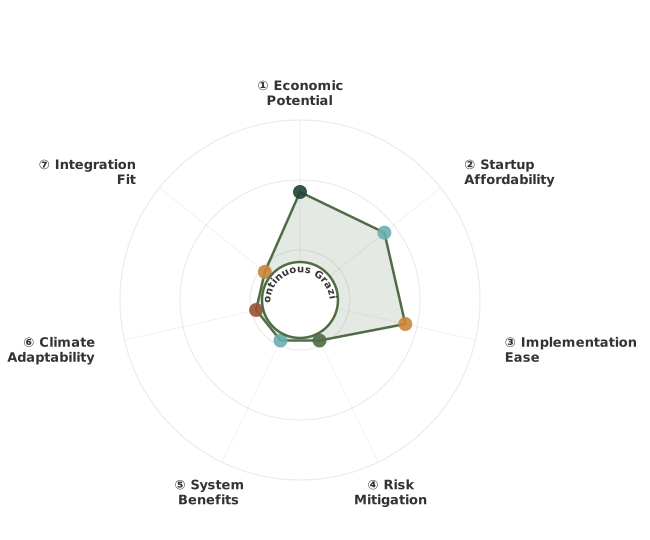
How These Traits Are Calculated
Trait dimensions are ordered clockwise starting from the top of the chart (12 o'clock position):
1. Economic Potential
Financial returns, annual value, and break-even timeline
WHAT: Evaluates financial viability by combining net annual value ($/ha from savings, income, and amortized harvests) with break-even timeline showing when practices pay for themselves.
WHY: Farmers need clear ROI understanding before committing resources. Fast payback (≤3 years) with strong returns (≥$300/ha) enables confident adoption, while long timelines (>10 years) restrict adoption to well-funded operations willing to wait for returns.
HOW: Calculated from net annual value in $/ha and break-even years. Exceptional (≥2.6): fast ROI ≤3 years + high value ≥$300/ha. Typical (1.8-2.5): moderate returns or longer timelines. Limited (<1.8): marginal economics or very long payback >10 years.
2. Startup Affordability
Initial investment costs and financial barrier to entry
WHAT: Measures financial barrier to entry through startup costs for equipment, infrastructure, consulting, and materials. Inverted scoring: lower costs = higher scores = more accessible adoption.
WHY: Affordability determines who can adopt. Low-cost practices (<$250/ha) enable widespread adoption across diverse scales, while high costs (>$2,500/ha) limit adoption to well-capitalized operations, creating barriers that slow regenerative transition.
HOW: Calculated from initial investment parsed from practice content. Inverted scoring: Exceptional (≥2.6): minimal investment <$250/ha. Typical (1.8-2.5): moderate costs $250-2,500/ha. Limited (<1.8): high barrier >$2,500/ha.
3. Implementation Ease
Learning curve and specialized knowledge required
WHAT: Measures how much learning, planning, and specialized knowledge a practice requires. Simpler practices with fewer steps score higher, while complex practices requiring extensive training or specialized resources score lower.
WHY: Complex practices create adoption barriers even when economically viable. Straightforward practices enable faster adoption and broader participation, while those requiring extensive training, timing precision, or specialized equipment limit who can succeed.
HOW: Evaluated by measuring documentation length and identifying complexity markers like location-specific requirements, seasonal timing windows, specialized skills, and dedicated equipment needs. Exceptional (≥2.6): straightforward practices with minimal prerequisites. Typical (1.8-2.5): moderate learning curve with some specialized needs. Limited (<1.8): steep learning curve requiring significant training or resources.
4. Risk Mitigation
Identified financial and ecological risk assessment
WHAT: Evaluates documented risks across financial (investment loss, market volatility) and ecological (crop failure, pest outbreaks) domains. Inverted scoring: fewer risks = higher scores.
WHY: Understanding risk exposure helps farmers make informed decisions. Low-risk practices allow confident implementation, while high-risk practices require careful planning and contingency resources. Risk transparency prevents costly failures.
HOW: Calculated from identified risks in practice content. Inverted scoring: Exceptional (≥2.6): ≤2 risks with manageable severity. Typical (1.8-2.5): 3-5 moderate risks. Limited (<1.8): 6+ risks or severe exposure.
5. System Benefits
How many ways the practice improves your land simultaneously
WHAT: Measures how many aspects of land health improve at once—carbon storage, soil quality, erosion control, water absorption, and biodiversity. Practices that improve multiple areas simultaneously create compounding benefits where each improvement reinforces the others.
WHY: The best practices solve multiple problems at once. For example, addressing erosion simultaneously builds carbon and improves water infiltration, creating a resilient system with positive feedback loops. Single-benefit approaches miss these compound transformation opportunities.
HOW: Evaluated across five key outcomes: carbon sequestration, soil organic matter increase, erosion reduction, water infiltration improvement, and biodiversity enhancement. Exceptional (≥2.6): high carbon storage (>8 t/ha/yr), improvements across 4-5 areas, transformative outcomes. Typical (1.8-2.5): moderate carbon (3-8 t/ha/yr), improvements across 2-3 areas. Limited (<1.8): modest impact (<3 t/ha/yr), single-area focus only.
6. Climate Adaptability
Geographic applicability across Köppen climate zones
WHAT: Evaluates geographic applicability by assessing how many Köppen climate zones successfully support a practice and what adaptation requirements are needed. Measures breadth of climates where farmers can implement with minimal to moderate modifications.
WHY: Universal practices working across diverse climates enable more farmers to adopt regenerative approaches. Practices limited to single climate types (only Mediterranean, only tropical) restrict adoption and slow global transition. Adaptability determines whether a practice serves niche regions or offers broad transformation.
HOW: LLM evaluation of regional success stories, Köppen zone coverage, and adaptation needs. Exceptional (≥2.6): 5+ zones or 4+ climate types, 3+ continents, minimal adaptation. Typical (1.8-2.5): 3-4 zones or 2-3 types, 2 continents, moderate adaptation. Limited (<1.8): 1-2 zones, single region, significant adaptation or highly specialized.
7. Integration Fit
How well this practice combines with others you're doing
WHAT: Measures how well a practice combines with other regenerative practices you might be doing. Some practices work as building blocks that make many other practices easier or more effective, while others work best on their own.
WHY: Practices that combine well with many others create more value on your farm. For example, cover cropping enables no-till, improves grazing, supports crop diversity, and helps water management—making all of them work better together. This helps you build a coherent system rather than juggling disconnected practices.
HOW: Evaluated by identifying which practices combine well and how strong those combinations are. 'Ideally Suited' means strong combinations where practices reinforce each other (practice A makes B easier, while B makes A more effective). 'Adequate' means complementary benefits that work well together. Exceptional (≥2.6): combines well with 6+ practices, serves as a building block. Typical (1.8-2.5): combines with 3-5 practices. Limited (<1.8): 1-2 practices or works best alone.
Going Deeper
1
WHY - The Benefits
Continuous grazing, while often a starting point for livestock operations, presents significant long-term challenges when evaluated against the principles of ecological health and sustainable productivity. Its perceived benefits are primarily in immediate simplicity and...
Continuous grazing, while often a starting point for livestock operations, presents significant long-term challenges when evaluated against the principles of ecological health and sustainable productivity. Its perceived benefits are primarily in immediate simplicity and reduced labor, but these often come at the cost of ecosystem degradation and reduced carrying capacity over time. Understanding these trade-offs is crucial for farmers considering a transition to regenerative systems.
WHY - The Benefits
Continuous grazing, while often a starting point for livestock operations, presents significant long-term challenges when evaluated against the principles of ecological health and sustainable productivity. Its perceived benefits are primarily in immediate simplicity and...
Continuous grazing, while often a starting point for livestock operations, presents significant long-term challenges when evaluated against the principles of ecological health and sustainable productivity. Its perceived benefits are primarily in immediate simplicity and reduced labor, but these often come at the cost of ecosystem degradation and reduced carrying capacity over time. Understanding these trade-offs is crucial for farmers considering a transition to regenerative systems.
Soil Health Benefits
In its simplest form, continuous grazing does little to actively improve soil health; in fact, it often contributes to its decline. The constant pressure from livestock, especially on the same areas around water, shade, and preferred forage plants, leads to overgrazing and soil compaction. Compaction reduces water infiltration, limits root growth, and creates anaerobic zones, hindering soil biological activity like earthworm populations and microbial function. Over time, as soil structure degrades, it becomes more prone to erosion. While plant cover may exist, the selective grazing and lack of rest periods mean that the diversity of roots contributing to soil aggregation and organic matter is reduced, hindering the development of a robust soil ecosystem.
Economic Benefits
The primary economic benefit of continuous grazing is its low operational complexity and reduced labor demand. This can translate to immediate cost savings in terms of daily management time and potentially lower investment in fencing and water infrastructure compared to more complex rotational systems. For small-scale operations or those with limited labor, this simplicity can be a significant factor. However, these short-term savings are often offset by long-term economic disadvantages.
Reduced carrying capacity due to overgrazed preferred plants and underutilized less palatable species means fewer animals can be supported per hectare (acre) over time. This leads to lower overall animal production and revenue. Furthermore, degraded soil health often correlates with a reduced ability of the pasture to withstand drought, leading to increased reliance on costly supplemental feed during dry spells. Weed pressure often increases as preferred plants disappear, requiring additional costs for weed control.
Regenerative Systems Fit
Continuous grazing is, by its common implementation, largely antithetical to regenerative agriculture principles. It is typically considered a transition practice or an initial state that a farm must move away from.
Principle 1 (Minimize Soil Disturbance): While not a tillage practice, the constant, undirected pressure of livestock leads to significant soil compaction, a form of disturbance. Lack of rest prevents biological processes from repairing this compaction, leading to long-term structural damage.
Principle 2 (Maximize Crop Diversity): Continuous grazing actively reduces plant diversity. Selective grazing pressure weakens and eliminates palatable species, allowing less palatable or invasive species to dominate. This simplification of the plant community results in a less resilient and less functionally diverse ecosystem.
Principle 3 (Keep Soil Covered): While perennial plants are present, the intensity of grazing on preferred areas often leads to bare soil exposure, especially around points of congregation. This lack of consistent, multi-species cover increases erosion risk and reduces moisture retention.
Principle 4 (Maintain Living Roots): Repeated defoliation without adequate rest prevents preferred plants from photosynthesizing and replenishing root reserves. This shortens the life span of desirable perennials, reduces root mass and depth, and negatively impacts the continuity of living roots throughout the year.
Principle 5 (Integrate Livestock): Livestock are present but are not used as a strategic tool for regeneration. Their constant, indiscriminate grazing pressure on a single area tends to degrade the ecosystem rather than build it. Nutrient distribution is uneven, and the potential for animals to stimulate diverse plant growth and soil biology is largely missed.
The primary pathway for those practicing continuous grazing to move towards regenerative agriculture is to abandon the "set and forget" approach. This involves gradually increasing the complexity of grazing management by introducing subdivisions, planning grazing periods for rest and recovery, and actively managing the timing and intensity of livestock impact to promote plant and soil health. This typically involves a phased transition over several years, moving towards adaptive multi-paddock grazing systems.
Sources behind this view
Videos & Podcasts
-
Regenerative grazing (adaptive multi-paddock) uses high-density, short-duration grazing with long recovery to stimulate soil health, increase biomass, and improve water infiltration, mimicking natural
-
Holistic planned grazing (HPG), also called adaptive multi-paddock grazing, significantly improves soil carbon (3 tons/ha/yr more than continuous grazing), water infiltration, and ecological function
-
Laura Payne details how managed grazing enhances soil health, water quality, and wildlife habitat, citing research on reduced erosion, improved stream health, and support for grassland birds. Key prin
-
Holistic grazing, with high-density short grazing (2-3 days) and long rest periods (3-4 months), dramatically increases pasture diversity, eliminates pests like grasshoppers, and boosts livestock prod
Community
-
Adopts a holistic grazing management approach emphasizing diverse perennial pastures, higher residuals (4"), and longer rest periods (avg. 45 days) to build soil health, increase organic matter (3.4%
Read more (opens in new window) smallfarms.cornell.edu -
Manage rotational grazing by setting recovery (15-40+ days, adapting to region/season) and grazing periods (2-3 days). Aim to 'take half, leave half' for livestock and soil microbes. High stocking den
Read more (opens in new window) smallfarms.cornell.edu -
Discusses regenerative grazing with cattle, sheep, and goats, emphasizing high-density impact and long recovery periods for soil health and ecosystem restoration in arid regions. Debates overgrazing,
Read more (opens in new window) permies.com -
Advocates for Soil Foodweb principles and Holistic Management, emphasizing land leasing and custom grazing/growing over labor-intensive methods. Focuses on soil restructuring for water availability an
Read more (opens in new window) permies.com
Research
-
Managing Grazing to Restore Soil Health, Ecosystem Function, and Ecosystem Services (opens in new window)
This study found: Properly managed grazing animals can reverse environmental damage. Regenerative practices, like Adaptive Multi-Paddock (AMP) grazing, boost soil health, increase soil carbon, reduce erosion, and enhan
-
Regenerative Livestock Farming as a Socioeconomic Model for Sustainable Agribusiness in Latin America (opens in new window)
This study found: Regenerative livestock farming in Latin America improved soil carbon, biodiversity, and water quality, while boosting farmer income and quality of life. Government support is key for wider adoption.
-
Do regenerative grazing management practices improve vegetation and soil health in grazed rangelands? Preliminary insights from a space-for-time study in the Great Barrier Reef catchments, Australia (opens in new window)
This study found: Regenerative grazing in Queensland, Australia, improved soil nitrogen and carbon over 5-20 years by enhancing plant growth and organic matter. Benefits may take years to become statistically significa
-
Transitioning from conventional continuous grazing to planned rest-rotation grazing: A beef cattle case study from central Texas (opens in new window)
This study found: A 5-year Texas case study found planned rest-rotation grazing showed potential for more forage and better soil health on cultivated paddocks compared to continuous grazing, with similar overall profit
From the Web
-
Adaptive grazing, emphasizing longer paddock rest periods, promotes pasture diversity and soil health. This leads to improved livestock nutrition, milk/meat quality, and extended grazing seasons, as d
-
Adaptive grazing (AMP, ASG, RG) with high stock densities and flexible management improves vegetation, soil health, soil carbon, and animal production over continuous grazing. Research shows short gra
-
A 10-step plan for regenerative grazing emphasizes adaptive management, goal setting, mapping, infrastructure assessment, and proper stocking rates. It advises starting small to gain experience before
-
Adaptive multi-paddock and holistic planned grazing significantly enhance soil carbon and nitrogen stocks, improve grassland resilience, and can make farms net carbon sinks. Studies show these methods
2
WHERE - Regional Considerations
Continuous grazing is practiced across a wide variety of regions globally due to its simplicity, but its ecological and economic consequences are heavily influenced by local conditions. Its suitability is inversely related to the fragility of the ecosystem and the...
Continuous grazing is practiced across a wide variety of regions globally due to its simplicity, but its ecological and economic consequences are heavily influenced by local conditions. Its suitability is inversely related to the fragility of the ecosystem and the variability of climate.
WHERE - Regional Considerations
Continuous grazing is practiced across a wide variety of regions globally due to its simplicity, but its ecological and economic consequences are heavily influenced by local conditions. Its suitability is inversely related to the fragility of the ecosystem and the...
Continuous grazing is practiced across a wide variety of regions globally due to its simplicity, but its ecological and economic consequences are heavily influenced by local conditions. Its suitability is inversely related to the fragility of the ecosystem and the variability of climate.
Click Here to Look up your Region if you don't already know it
Humid Temperate Regions
Representative Locations: Southeastern United States, northern Europe (UK, Germany, Poland), eastern China, Japan, New Zealand
Climate Context: Warm to hot summers and cool to cold winters with moderate to high annual precipitation (75-150 cm or 30-60 inches) distributed relatively evenly. USDA Zones 6-8, Köppen Cfb/Cfa.
Considerations: In these regions, pastures are often highly productive during the growing season. Continuous grazing can lead to rapid overgrazing of preferred cool-season grasses and legumes, especially in spring. This results in significant loss of plant diversity as less palatable species emerge. Soil compaction can be severe, particularly during wet periods. The high potential for growth means that the visual impact of degradation might not be immediately apparent, but carrying capacity will decline over years. Transition to rotational grazing is highly recommended to leverage high productivity without degrading the resource base.
Mediterranean Regions
Representative Locations: California, Mediterranean basin (Spain, Italy, Greece), central Chile, southwestern Australia, Western Cape South Africa
Climate Context: Hot, dry summers and mild, wet winters. Annual precipitation 40-90 cm (15-35 inches), highly seasonal. USDA Zones 8-10, Köppen Csa/Csb.
Considerations: These regions are characterized by distinct wet and dry seasons. Continuous grazing during the favorable wet season can lead to severe overgrazing of desirable annual forages and perennial grasses before they can set seed or replenish reserves. The dry summer period exacerbates the damage, leaving soils exposed and vulnerable to wind and water erosion. This practice is particularly detrimental to soil organic matter and water retention. Any attempt at regenerative agriculture here must prioritize maintaining soil cover and allowing plants adequate rest, making continuous grazing a poor choice. Summer dormancy of many forages makes strategic feeding management, rather than continuous grazing, essential.
Arid/Semi-Arid Regions
Representative Locations: Western USA, North Africa, Central Asia, Interior Australia
Climate Context: Low annual precipitation (<40 cm or 15 inches), high temperatures, short and often unpredictable growing season. USDA Zones 7-9, Köppen BSh/BSk.
Considerations: Continuous grazing is particularly damaging in arid and semi-arid environments where plant growth is slow and recovery times are long. Overgrazing preferred perennial grasses and shrubs can lead to a permanent loss of plant cover and soil degradation. The fragile rangelands become highly susceptible to desertification. Soil compaction further reduces the limited water infiltration. In these environments, the principles of rest and recovery are paramount. Continuous grazing is fundamentally incompatible with maintaining the health of arid ecosystems. Adaptive grazing, with very long rest periods and careful attention to animal distribution, is critical, making continuous grazing an unsustainable option.
Cold Continental Regions
Representative Locations: Northern USA and Canada, Northern Europe, Northern Asia
Climate Context: Very short growing seasons, extreme summer heat, severe winter cold. USDA Zones 3-5, Köppen Dfa/Dfb.
Considerations: In regions with short growing seasons, regenerating pasture after grazing is critical. Continuous grazing can strip desirable plant species before they can accumulate sufficient root reserves to survive harsh winters. Compaction is still a concern, particularly in areas with thawing soils. The long winter dormancy period in these regions means that pastures are not actively growing for a significant portion of the year, and continuous grazing during the brief growing season can have disproportionately negative impacts on perennial plant health and long-term pasture viability.
Subtropical Regions
Representative Locations: Southeastern USA, Southern China, Southern Brazil, Eastern Australia
Climate Context: Hot, humid summers and mild winters with generally ample rainfall. USDA Zones 9-11, Köppen Cfa/Cwa.
Considerations: Similar to humid temperate regions, subtropical climates offer high potential for lush forage growth. Continuous grazing can lead to aggressive overgrazing of highly productive grasses and legumes. The high rainfall, coupled with potential soil compaction and reduced plant cover, can increase nutrient runoff and erosion risk. The extended warm season allows for year-round or near year-round grazing pressure, making the lack of rest under continuous systems particularly detrimental to plant diversity and soil health.
Tropical Regions
Representative Locations: Central America, Southeast Asia, East Africa, Northern Australia, Northern South America
Climate Context: High temperatures year-round, with distinct wet and dry seasons or consistent high rainfall. Köppen Af/Am/Aw.
Considerations: Tropical and sub-tropical pastures are often characterized by highly vigorous growth but can be susceptible to nutrient depletion and soil degradation under improper management. Continuous grazing in these regions, especially during the wet season, can lead to severe overgrazing of desirable forage species, leading to a decline in plant diversity and soil organic matter. The warm temperatures and high humidity can accelerate decomposition, but if grazing pressure is too high or defoliation too frequent, the rate of organic matter input from roots and litter can be outpaced by decomposition and harvest, leading to soil degradation. The presence of parasitic diseases can also be exacerbated in continuously grazed tropical systems.
3
HOW - Implementation Process
Continuous grazing is a management lack rather than an active implementation process. Its "implementation" is essentially not subdividing paddocks and not moving animals. However, to guide a transition away from it towards regenerative systems, we describe the...
Continuous grazing is a management lack rather than an active implementation process. Its "implementation" is essentially not subdividing paddocks and not moving animals. However, to guide a transition away from it towards regenerative systems, we describe the "anti-implementation" steps—what to do instead.
HOW - Implementation Process
Continuous grazing is a management lack rather than an active implementation process. Its "implementation" is essentially not subdividing paddocks and not moving animals. However, to guide a transition away from it towards regenerative systems, we describe the...
Continuous grazing is a management lack rather than an active implementation process. Its "implementation" is essentially not subdividing paddocks and not moving animals. However, to guide a transition away from it towards regenerative systems, we describe the "anti-implementation" steps—what to do instead.
Prerequisites for Transitioning Away
- Acknowledgement of Limitations: Recognize that continuous grazing degrades pasture and soil over time, reducing long-term carrying capacity and resilience.
- Desire for Improvement: Commitment to improving soil health, plant diversity, and livestock performance.
- Basic Water Access: Ability to provide water to livestock across the farm/ranch, even if currently centralized.
- Perimeter Fencing: Existing perimeter fencing is usually sufficient to begin most transition strategies.
Phase 1: Initial Subdivision & Minimalist Rest (Months 1-12)
Objective: Introduce the concept of rest, even if minimal.
Action: 1. Identify a Central Water Source: Locate the primary water source available to your livestock. 2. Install 1-2 Temporary Subdivisions: Use temporary electric fencing (portable netting, polywire) with temporary posts to divide your largest continuous grazing area into 2-3 smaller areas. 3. Implement Basic Rotation: Move animals to a new subdivision of the pasture every 1-2 weeks. The goal is not precise rest periods but simply to remove grazing pressure from any one area for a significant amount of time before animals return to it. This is often called "sacrificial grazing" on one area while others recover. 4. Observe Plant Response: Note which plants are preferred, which are avoided. Notice if preferred plants recover somewhat between grazings. 5. Document Livestock Performance: Track average daily gain, conception rates, or milk production to establish a baseline.
Equipment: Electric fence (polywire, temporary posts, energizer), spare water troughs if needed. Labor: 1-2 extra hours per week for moving animals and checking water. Cost: $50-300 USD equivalent for portable fencing materials.
Phase 2: Establishing Planned Rest & Basic Rotation (Years 1-3)
Objective: Introduce planned rest periods and observe the impact of rotational movement.
Action: 1. Install More Permanent Fencing: Invest in permanent interior fences to create 4-8 paddocks. This could be high-tensile wire, electric fencing, or other durable materials. 2. Develop a Simple Grazing Plan: Based on your pasture type and climate, aim for grazing periods of 3-7 days per paddock, followed by rest periods of 30-60 days. This is a simplified rotational grazing model. 3. Ensure Water Access: Install water points (troughs, tanks) in each new paddock or at strategic locations to allow for movement and extended rest. This might involve piping water or using portable tanks. 4. Observe Plant Recovery: Notice if preferred species start to recover, if less palatable species are grazed more as preferred plants recover, and if overall pasture density increases. 5. Monitor Soil Health: Begin simple soil assessments: check for earthworms, assess soil surface cover, look for signs of compaction.
Equipment: Permanent fencing materials, water troughs/piping, possibly additional portable fencing for finer adjustments. Labor: 2-4 extra hours per week for moving animals, checking fences, and managing water. Cost: $500-3,000+ USD equivalent for fencing and water infrastructure per 40-160 hectares (100-400 acres), depending on intensity and existing infrastructure.
Phase 3: Adaptive Management & Diversity (Years 3-7)
Objective: Move towards managing grazing based on plant growth and soil health indicators.
Action: 1. Increase Paddock Number: Create more paddocks (10-30+) to allow for shorter grazing periods (1-3 days) and longer rest periods (45-90+ days). 2. Implement Adaptive Grazing: Learn to "read" your pasture. Adjust grazing duration and rest periods based on plant growth rates, soil moisture, and desired outcomes (e.g., promoting specific species, building soil cover). 3. Introduce Plant Diversity: Seed a more diverse mix of grasses, legumes, and forbs into pastures, aiming to increase biodiversity above and below ground. 4. Monitor Soil and Ecosystem Health Continuously: Track soil organic matter, infiltration rates, earthworm populations, and biodiversity indicators. 5. Integrate Livestock Strategically: Consider using livestock to trample in cover crops, manage weeds, or distribute manure effectively through planned movements.
Equipment: High-density paddock fencing (often electric), strategically placed water points, potentially specialized seeders for forage diversity. Labor: 3-6+ extra hours per week, but potentially more fulfilling as management becomes strategic rather than reactive. Cost: $1,000-5,000+ USD equivalent per 40-160 hectares (100-400 acres) for advanced fencing and water systems, seed, and potentially specialized equipment.
Transition Timeline & Phase-Out Strategy
The "phase-out" here isn't about eliminating a practice, but about evolving away from it.
- Year 1: Phase out the concept of "set and forget." Introduce the idea that animals are moved for a reason related to plant recovery.
- Years 1-3: Phase out the reliance on extensive supplemental feed due to overgrazing by improving pasture regeneration. Phase out passive observation and move to active management based on simple rotation plans.
- Years 3-7: Phase out the need for reactive weed control or drought feeding by building resilient, diverse pastures. Move from simple rotation to adaptive grazing informed by plant growth and soil health.
- Beyond Year 7: Continuous grazing becomes a historical footnote. The operation focuses on holistic planning, ecological monitoring, and continuous improvement of the grazing ecosystem.
Graduating to Regenerative: Success looks like increased carrying capacity, reduced reliance on external inputs (feed, fertilizer if used), visibly improved plant diversity and ground cover, increased soil organic matter and water infiltration, and greater resilience to weather extremes. The operation moves from simple animal husbandry to complex ecosystem management.
Sources behind this view
Videos & Podcasts
-
A 5-year case study in Mississippi transformed a degraded farm using adaptive grazing, bale grazing, and plant diversity. Soil organic matter, water infiltration, and forage species increased dramatic
-
Regenerative grazing (adaptive multi-paddock) uses high-density, short-duration grazing with long recovery to stimulate soil health, increase biomass, and improve water infiltration, mimicking natural
-
Holistic grazing, with high-density short grazing (2-3 days) and long rest periods (3-4 months), dramatically increases pasture diversity, eliminates pests like grasshoppers, and boosts livestock prod
-
Transitioned to regenerative grazing with more paddocks for longer rest periods, focusing on the ecological value of cattle. This increased herd size by 32% despite less rain, improved breeding succes
Community
-
Adopts a holistic grazing management approach emphasizing diverse perennial pastures, higher residuals (4"), and longer rest periods (avg. 45 days) to build soil health, increase organic matter (3.4%
Read more (opens in new window) smallfarms.cornell.edu -
Manage rotational grazing by setting recovery (15-40+ days, adapting to region/season) and grazing periods (2-3 days). Aim to 'take half, leave half' for livestock and soil microbes. High stocking den
Read more (opens in new window) smallfarms.cornell.edu -
Allan Savory explains holistic management prevents desertification by using livestock to mimic nature, replacing prescriptive grazing systems. Holistic Planned Grazing, with decisions guided by a holi
Read more (opens in new window) permies.com -
Discusses regenerative grazing with cattle, sheep, and goats, emphasizing high-density impact and long recovery periods for soil health and ecosystem restoration in arid regions. Debates overgrazing,
Read more (opens in new window) permies.com
Research
-
Managing Grazing to Restore Soil Health, Ecosystem Function, and Ecosystem Services (opens in new window)
This study found: Properly managed grazing animals can reverse environmental damage. Regenerative practices, like Adaptive Multi-Paddock (AMP) grazing, boost soil health, increase soil carbon, reduce erosion, and enhan
-
Regenerative Livestock Farming as a Socioeconomic Model for Sustainable Agribusiness in Latin America (opens in new window)
This study found: Regenerative livestock farming in Latin America improved soil carbon, biodiversity, and water quality, while boosting farmer income and quality of life. Government support is key for wider adoption.
-
FORAGES AND PASTURES SYMPOSIUM: COVER CROPS IN LIVESTOCK PRODUCTION: WHOLE-SYSTEM APPROACH: Managing grazing to restore soil health and farm livelihoods1 (opens in new window)
This study found: Regenerative grazing management is key to sustainable, climate-resilient farms. It restores soil health, enhances ecosystem services like carbon capture and water infiltration, and improves farm profi
-
Impacts of holistic planned grazing with bison compared to continuous grazing with cattle in South Dakota shortgrass prairie (opens in new window)
This study found: Managed grazing with bison in South Dakota's shortgrass prairie significantly improved soil health, water infiltration, forage, and plant composition compared to continuous cattle grazing over a decad
From the Web
-
A 10-step plan for regenerative grazing emphasizes adaptive management, goal setting, mapping, infrastructure assessment, and proper stocking rates. It advises starting small to gain experience before
-
Five steps to regenerative agriculture: Holistic Planned Grazing, no-till farming, planting diverse cover crops/interseeding, using compost/inoculants (with caution), and incorporating silvopasture/wo
-
Transition to adaptive grazing with a three-step approach: inventory land/animals/infrastructure, start small using existing resources to increase stock density gradually, and observe/measure progress
-
Adaptive grazing, emphasizing longer paddock rest periods, promotes pasture diversity and soil health. This leads to improved livestock nutrition, milk/meat quality, and extended grazing seasons, as d
4
Know the Debate
Continuous grazing, while simple, often leads to declining pasture health and carrying capacity over time. Transitioning to regenerative systems li...
Know the Debate
Continuous grazing, while simple, often leads to declining pasture health and carrying capacity over time. Transitioning to regenerative systems li...
Continuous grazing, while simple, often leads to declining pasture health and carrying capacity over time. Transitioning to regenerative systems like adaptive multi-paddock grazing offers significant long-term benefits but requires a phased approach. Key elements for success involve increasing paddock complexity from minimal subdivisions to dozens, ensuring adequate rest periods for plant recovery (30-90+ days), and adapting management based on plant growth and soil observation. This transition requires investment in fencing and water infrastructure, with costs varying significantly by scale, from a few hundred dollars for temporary fencing to tens of thousands for permanent systems. Labor demands shift from daily animal checks to strategic planning and observation, emphasizing the cultivation of critical ecological monitoring skills.
How long until regenerative grazing shows results?
Forage improvements (1-3 years), soil health (3-7 years)
In humid, high-rainfall areas, visible differences in forage quantity and quality can emerge within 1-3 years of implementing rotational grazing. Significant improvements in soil health markers like organic matter and water infiltration typically take 3-7 years as biological systems establish and recover.
Sources behind this view
Sources behind this view
Videos & Podcasts
-
Holistic management involves moving cattle between paddocks with short grazing periods (max 3 days) and long recovery periods (min 2 months). This method rapidly improves land, enhances seedbeds, and allows sunlight for grass growth.
-
Effective grazing requires adequate rest periods and observation, not just fixed timelines. Stock stocking rates based on worst-drought capacity, using yearlings/custom grazing for good years. Frequent animal movement (daily or multiple times/day) triples carrying capacity by increasing forage growth, biomass, and diversity.
Research
-
Transitioning from conventional continuous grazing to planned rest-rotation grazing: A beef cattle case study from central Texas (opens in new window)
This study found: This five-year study in central Texas looked at what happens when beef cattle ranchers switch from grazing their pastures all the time (continuous grazing) to a planned system where pastures are rested and rotated. The researchers found that the planned rest-rotation system showed promise for growing more grass overall and improving soil health on cultivated areas planted with multiple types of forage crops. However, continuous grazing resulted in fatter cows and more immediate income. Overall, the study found that both grazing methods resulted in similar profits. Key challenges included establishing new forage crops without tilling the soil and ensuring proper fertilization and feed supplements during colder months.
From the Web
-
Prescriptive grazing contrasts with continuous grazing by promoting plant recovery and soil health. Key practices include grazing at 6-10 inches and resting pastures until 3-4 inches, focusing on soil fertility, water access, and flexible adaptation to seasonal conditions.
Soil carbon gains may take 5-10 years or plateau
In semi-arid rangelands or areas with already-degraded soils, the slow decomposition rates and longer plant recovery times mean soil carbon sequestration takes longer, potentially 5-10 years to become measurable. Some studies indicate carbon gains may plateau after initial recovery.
Sources behind this view
Sources behind this view
Videos & Podcasts
-
Utilizes mob grazing with temporary electric fences for cattle, moving them frequently to ensure a balanced diet and stimulate pasture diversity. This method, unlike annual cropping, maintains year-round green cover and improves soil health by mimicking natural grazing patterns.
Research
-
Multi-paddock grazing on rangelands: why the perceptual dichotomy between research results and rancher experience? (opens in new window)
This study found: There's a disconnect between what scientific studies often show and what experienced ranchers observe about multi-paddock grazing (also known as rotational or holistic grazing). While many ranchers report that carefully planned grazing improves pasture health, forage growth, and livestock production, many scientific reviews find little difference compared to continuous year-round grazing. This paper explores why this gap exists. It discusses how grazing ecosystems function, outlines key principles that successful ranchers use for adaptive management (adjusting practices based on observations), and suggests that much past research hasn't adequately captured the real-world goals and complexities faced by ranchers. The authors aim to provide a better framework for understanding how planned grazing can help manage rangelands effectively, especially as climate conditions change, and propose areas for future research.
-
A Global Meta‐Analysis of Grazing Impacts on Soil Health Indicators (opens in new window)
This study found: A large global study analyzing data from 64 different research sites found that how livestock graze significantly impacts soil health. Leaving land ungrazed generally resulted in better soil organic matter and nitrogen levels compared to continuous grazing. While both continuous and rotational grazing led to more soil compaction (higher bulk density) than no grazing, rotational grazing was less compacting than continuous grazing and showed similar soil organic carbon levels to ungrazed land. This suggests that managed grazing systems, like rotational grazing, can improve soil health and potentially help store carbon, offering benefits for climate change mitigation. The study also highlighted that local environmental conditions play a big role in how grazing affects soil.
Economic benefits within 2-5 years, soil health longer
Economic benefits like reduced supplemental feed costs and improved animal gains can often be realized within 2-5 years by improving forage utilization. However, substantial improvements in soil health indicators often require 5-10 years of consistent adaptive grazing management.
Sources behind this view
Sources behind this view
Videos & Podcasts
-
Moving from continuous to intensive grazing (rotational, strip, forward) improves forage productivity, grazing efficiency, and stocking rates, leading to economic benefits. Continuous grazing hinders plant and root recovery due to lack of rest.
-
Compares high-impact, low-frequency grazing favorably to continuous grazing, highlighting benefits like lower risk, higher profit, improved soil health, and animal well-being, while noting the need for more paddocks and adapted livestock.
Research
-
Transitioning from conventional continuous grazing to planned rest-rotation grazing: A beef cattle case study from central Texas (opens in new window)
This study found: This five-year study in central Texas looked at what happens when beef cattle ranchers switch from grazing their pastures all the time (continuous grazing) to a planned system where pastures are rested and rotated. The researchers found that the planned rest-rotation system showed promise for growing more grass overall and improving soil health on cultivated areas planted with multiple types of forage crops. However, continuous grazing resulted in fatter cows and more immediate income. Overall, the study found that both grazing methods resulted in similar profits. Key challenges included establishing new forage crops without tilling the soil and ensuring proper fertilization and feed supplements during colder months.
Making Sense of the Differences
The timeline for seeing results from adaptive grazing varies significantly by climate, starting soil health, and management intensity. Humid regions with fertile soils and high rainfall see faster forage improvements (1-3 years), while arid lands with degraded soils require longer patience (3-7 years for soil health, 5-10 years for measurable carbon gains). Economic benefits can appear sooner (2-5 years) through better forage utilization and reduced feed costs. Farmers should expect a longer adaptation period in drier climates and focus on soil health indicators for long-term gains.
How do economics change with adaptive grazing vs. continuous?
Reduced supplemental feed & higher revenue (2-7 years)
Moving to adaptive grazing can reduce supplemental feed costs by 20-50% within 2-5 years as pasture productivity and carrying capacity increase. Higher animal gains and improved fertility can further boost revenue by 10-20% once the system is established, often offsetting initial infrastructure investments.
Sources behind this view
Sources behind this view
Videos & Podcasts
-
Moving from continuous to intensive grazing (rotational, strip, forward) improves forage productivity, grazing efficiency, and stocking rates, leading to economic benefits. Continuous grazing hinders plant and root recovery due to lack of rest.
-
Compares high-impact, low-frequency grazing favorably to continuous grazing, highlighting benefits like lower risk, higher profit, improved soil health, and animal well-being, while noting the need for more paddocks and adapted livestock.
Research
-
Transitioning from conventional continuous grazing to planned rest-rotation grazing: A beef cattle case study from central Texas (opens in new window)
This study found: This five-year study in central Texas looked at what happens when beef cattle ranchers switch from grazing their pastures all the time (continuous grazing) to a planned system where pastures are rested and rotated. The researchers found that the planned rest-rotation system showed promise for growing more grass overall and improving soil health on cultivated areas planted with multiple types of forage crops. However, continuous grazing resulted in fatter cows and more immediate income. Overall, the study found that both grazing methods resulted in similar profits. Key challenges included establishing new forage crops without tilling the soil and ensuring proper fertilization and feed supplements during colder months.
From the Web
-
Holistic Management contrasts conventional continuous grazing with planned grazing periods and pasture recovery. This nature-based approach enhances photosynthesis, carbon cycling, and land productivity, allowing for increased livestock numbers and improved financial returns, as explained by Fallon Turner Stover.
Higher upfront costs for infrastructure
Transitioning from continuous grazing requires significant upfront investment in fencing and water systems. Costs can range from $1,000-$7,000 for portable fencing and basic water on small holdings to $20,000-$150,000+ for permanent infrastructure on large-scale operations.
Sources behind this view
Sources behind this view
Videos & Podcasts
-
Details grazing management, stressing long pasture recovery periods, high animal impact vs. overgrazing, and the benefits of paddocks and record-keeping to prevent soil compaction and improve forage production.
-
Overgrazing is determined by time (max 3 days/paddock), not animal numbers. Holistic Planned Grazing uses monitoring for strategic movement, enabling timely destocking. Increased soil organic matter significantly boosts water-holding capacity.
From the Web
-
Prescriptive grazing contrasts with continuous grazing by promoting plant recovery and soil health. Key practices include grazing at 6-10 inches and resting pastures until 3-4 inches, focusing on soil fertility, water access, and flexible adaptation to seasonal conditions.
-
Explores using annual crops like cereals and Brassicas for supplemental forage and extending grazing seasons. Discusses improved grazing management, including rotational grazing, stocking rates, animal distribution, and various grazing systems. Addresses potential animal health hazards like bloat and prussic acid poisoning.
Higher ongoing labor shifts to strategic management
While continuous grazing requires minimal daily labor, adaptive systems demand more strategic observation and movement planning. This shifts labor from routine checking to more analytical management, potentially requiring 3-6+ hours weekly, especially during transition.
Sources behind this view
Sources behind this view
Videos & Podcasts
-
Managed grazing involves moving livestock every 1-3 days to new pastures, allowing 30+ days of grass recovery. This creates perennial cover that filters water, absorbs nutrients, and prevents soil erosion.
From the Web
-
Adaptive grazing uses high stock density and extended rest periods on diverse pastures to regenerate soil and water cycles, improving forage availability and land resilience. It emphasizes flexibility and temporary fencing.
-
Dr. Allen Williams offers 10 tips for successful grazing: avoid early spring grazing, prepare for worst-case conditions, prevent overgrazing by managing plant exposure, utilize livestock for weed control, protect soil by maintaining cover, limit consumption to 50% leaf volume to protect roots, manage for plant diversity, introduce annual disruptions, combine herds, and practice daily observation.
Making Sense of the Differences
The economics of adaptive grazing involve a trade-off between upfront infrastructure investment and long-term operational gains. While continuous grazing appears cheaper due to low labor and infrastructure, adaptive systems lead to improved carrying capacity, reduced feed costs, and better animal performance within 2-5 years, often outweighing initial capital outlays. The increased labor shifts from routine checks to strategic planning and observation. Farmers must balance infrastructure investment with long-term ecological and economic sustainability, as continuous grazing typically leads to declining profitability.
What infrastructure and management changes are needed for adaptive grazing?
Transition from perimeter to paddock fencing
Continuous grazing typically relies on perimeter fencing only. Adaptive grazing necessitates dividing larger areas into multiple paddocks (4-8 initially, then 10-30+), requiring significant investment in temporary electric fencing for flexibility or more permanent fencing for structured rotation.
Sources behind this view
Sources behind this view
Videos & Podcasts
-
Managed grazing involves moving livestock every 1-3 days to new pastures, allowing 30+ days of grass recovery. This creates perennial cover that filters water, absorbs nutrients, and prevents soil erosion.
-
Overgrazing is determined by time (max 3 days/paddock), not animal numbers. Holistic Planned Grazing uses monitoring for strategic movement, enabling timely destocking. Increased soil organic matter significantly boosts water-holding capacity.
From the Web
-
Prescriptive grazing contrasts with continuous grazing by promoting plant recovery and soil health. Key practices include grazing at 6-10 inches and resting pastures until 3-4 inches, focusing on soil fertility, water access, and flexible adaptation to seasonal conditions.
-
Introduces grazing systems as custom tools for livestock management, detailing four types for Nebraska Sandhills: continuous, rest rotation, deferred rotation, and short duration. Continuous grazing has low costs but lower harvest efficiency (25%) due to uneven utilization, potentially harming preferred plants.
Develop distributed water systems
Continuous grazing often relies on a single central water source. Adaptive grazing requires distributed water access within each paddock or strategically placed troughs to allow livestock to graze diverse areas and enable longer rest periods.
Sources behind this view
Sources behind this view
Videos & Podcasts
-
Compares high-impact, low-frequency grazing favorably to continuous grazing, highlighting benefits like lower risk, higher profit, improved soil health, and animal well-being, while noting the need for more paddocks and adapted livestock.
-
Effective grazing requires adequate rest periods and observation, not just fixed timelines. Stock stocking rates based on worst-drought capacity, using yearlings/custom grazing for good years. Frequent animal movement (daily or multiple times/day) triples carrying capacity by increasing forage growth, biomass, and diversity.
-
Details grazing management, stressing long pasture recovery periods, high animal impact vs. overgrazing, and the benefits of paddocks and record-keeping to prevent soil compaction and improve forage production.
From the Web
-
Prescriptive grazing contrasts with continuous grazing by promoting plant recovery and soil health. Key practices include grazing at 6-10 inches and resting pastures until 3-4 inches, focusing on soil fertility, water access, and flexible adaptation to seasonal conditions.
Shift from passive to active, observational management
Continuous grazing requires minimal active management. Adaptive grazing demands daily observation of plant status, soil conditions, and animal behavior, shifting labor towards strategic planning and decision-making.
Sources behind this view
Sources behind this view
Videos & Podcasts
-
Effective grazing management follows six soil health principles: know your context, keep soil covered, minimize disturbance, maintain living roots, increase diversity, and integrate livestock. Practices should focus on improving ecosystem processes and addressing limiting factors.
-
Effective grazing management prioritizes time-based strategies over spatial ones. Minimize negative impacts by shortening grazing periods and extending recovery periods. This approach is crucial for plant health, soil regeneration, and increasing carrying capacity.

From the Web
-
Adaptive grazing uses high stock density and extended rest periods on diverse pastures to regenerate soil and water cycles, improving forage availability and land resilience. It emphasizes flexibility and temporary fencing.
-
Dr. Allen Williams offers 10 tips for successful grazing: avoid early spring grazing, prepare for worst-case conditions, prevent overgrazing by managing plant exposure, utilize livestock for weed control, protect soil by maintaining cover, limit consumption to 50% leaf volume to protect roots, manage for plant diversity, introduce annual disruptions, combine herds, and practice daily observation.
Making Sense of the Differences
Transitioning from continuous grazing to adaptive systems requires moving from minimal infrastructure and labor to investing in increased fencing and water distribution. While continuous grazing often uses only perimeter fences and centralized water, adaptive grazing necessitates sufficient subdivisions to allow for planned rest periods. This infrastructural shift frees up the farmer's time from constant animal movement to focus on observation and strategic planning, crucial for ecological regeneration.
5
HOW MUCH - Costs & Investment
Note: Costs are illustrative and in USD equivalent; actual costs will vary significantly by region based on local labor rates, material availability, currency exchange, and regulatory requirements. Regional research is essential.
Note: Costs are illustrative and in USD equivalent; actual costs will vary significantly by region based on local labor rates, material availability, currency exchange, and regulatory requirements. Regional research is essential.
HOW MUCH - Costs & Investment
Note: Costs are illustrative and in USD equivalent; actual costs will vary significantly by region based on local labor rates, material availability, currency exchange, and regulatory requirements. Regional research is essential.
Note: Costs are illustrative and in USD equivalent; actual costs will vary significantly by region based on local labor rates, material availability, currency exchange, and regulatory requirements. Regional research is essential.
Note: All costs are based on recent US economic data (2024–2026) and may vary substantially by region based on local labor rates, material costs, and regulatory requirements. All figures below include a standardized 4.2% inflationary adjustment to reflect current market conditions.
Portable Infrastructure
For operations transitioning from continuous grazing to basic rotational paddocks, the primary investment involves temporary fencing and supplemental water. For small-scale operations (under 50 acres (20 ha)), high-tensile polywire, geared reels, and fiberglass step-in posts are the standard, costing $208–$625 per season. Mid-size operations (50–500 acres (20–202 ha)) typically require more frequent equipment replenishment, costing $834–$2,605 annually. Large-scale operations (500+ acres) face costs of $2,605–$6,252 per season, primarily due to the quantity of polywire and long-range solar chargers needed to maintain effective animal voltage across vast pastures. Portable water systems remain a significant variable; expect $313–$834 for small-scale, $1,563–$4,168 for mid-size, and $5,210–$12,504 for large-scale operations to manage reliable, clean stock water. Labor remains a primary operational cost, requiring an additional 3–5 hours per week for small operations, 5–10 hours for mid-size, and 15–25 hours for large-scale setups, calculated at local prevailing wage rates of $18–$25 per hour.
Permanent Infrastructure
Transitioning to a permanent rotational system significantly reduces the daily labor drag associated with moving portable fencing. Permanent high-tensile electric fencing, including wire, treated posts, insulators, and heavy-duty energizers, averages $0.83–$1.56 per linear foot when professionally installed. For a 50-acre (20 ha) small-scale operation, partitioning the land into 10–15 paddocks requires an investment of $6,252–$15,630. Mid-size operations managing 50–500 acres (20–202 ha) typically invest $26,050–$88,570 to upgrade perimeter and internal subdivision fencing. Large-scale operations exceeding 500 acres (202 ha) often scale investment by utilizing central alleyway systems, with capital expenditure ranging from $104,200–$364,700 depending on topography and existing water proximity. Permanent water systems, consisting of buried pipelines, frost-free hydrants, and heavy-duty troughs, are the foundation of this system; expect $2,084–$7,294 for small, $10,420–$46,890 for mid-size, and $52,100–$156,300 for large-scale operations. Specialized solar-powered pumping systems fluctuate between $1,563 and $6,252 based on lift capability and flow requirements.
Maintenance and Annual Inputs
Beyond initial capital, annual maintenance is required to ensure system efficacy. Fence maintenance is generally budgeted at 3–5% of the total installation cost per year to replace brittle insulators or tension wire. Forage monitoring, including potential reseeding or overseeding to drive botanical diversity, adds $21–$52 per acre ($52–$128/ha) annually for small/mid-size operations, while large-scale operations typically see costs of $16–$42 per acre ($40–$104/ha) due to bulk purchasing power for cover crop seeds. Finally, granular soil health testing and diagnostic reporting costs $104–$313 annually, providing the baseline data necessary to adjust stocking rates.
Most Spend: The middle 60% of most operations falls within a range of $4,500–$12,000 in portable setup costs for small-mid holdings, and between $45,000–$140,000 for permanent infrastructure in full-cycle rotational projects. This range represents standard reliance on commercial-grade components rather than ultra-budget gear or extreme, top-tier automated technology.
Why the Range?: Costs vary primarily due to "geospatial complexity"—the combination of water accessibility, existing fence quality, and specific topographical constraints. Operations with centralized water sources and flat, uniform fields consistently trend toward the lower end of the cost ranges, while irregular paddocks with poor existing layout drive costs toward the higher end.
Sources behind this view
Videos & Podcasts
-
Increase grazing frequency (e.g., twice daily) for better pasture utilization and animal performance. Invest heavily in water infrastructure and use temporary fencing in long, narrow paddocks to maxim
-
Details the practical implementation of intensive rotational grazing, including infrastructure (fencing, water points) and management strategies for large Australian properties. This approach signific
-
Discusses advanced grazing management, emphasizing paddock layout, skipping paddocks for fly control, and the critical role of fencing and water. Highlights how subdivision and shorter grazing periods
-
Improved grazing management boosts ranch economics through higher stocking rates, better cows-per-man ratios, extended grazing seasons, and reduced feeding costs. Strategic fencing and water developme
Community
-
Manage rotational grazing by setting recovery (15-40+ days, adapting to region/season) and grazing periods (2-3 days). Aim to 'take half, leave half' for livestock and soil microbes. High stocking den
Read more (opens in new window) smallfarms.cornell.edu -
Recommends permanent rotational pastures using high tensile fencing and cattle panels for goats and sheep, with advice on water lines, pallet-built shelters, and cost-effective handling systems.
Read more (opens in new window) permies.com -
Investigates financial benefits of rotational grazing, including extended grazing season and cattle weight gains, while detailing the use of portable electric fences and HDPE water hoses due to infras
Read more (opens in new window) ucanr.edu -
Effective pasture rotation uses smaller paddocks, frequent moves, and electric fencing, with water source availability being critical. Recommendations include learning from Joel Salatin and starting c
Read more (opens in new window) permies.com
Research
-
Transitioning from conventional continuous grazing to planned rest-rotation grazing: A beef cattle case study from central Texas (opens in new window)
This study found: A 5-year Texas case study found planned rest-rotation grazing showed potential for more forage and better soil health on cultivated paddocks compared to continuous grazing, with similar overall profit
-
Effects of 27 mo of rotational vs. continuous grazing on horse and pasture condition (opens in new window)
This study found: Rotational grazing for horses in NJ resulted in taller, more abundant pastures with better plant composition, despite slightly lower horse body condition scores compared to continuous grazing. Costs w
-
Cost-Benefit Analysis of Continuous and Rotational Grazing Systems——A Case Study in Maqu County, China (opens in new window)
This study found: Rotational grazing in China was more expensive and less profitable per sheep than continuous grazing, potentially hindering adoption. Policy support is needed to incentivize and help farmers adapt to
-
456 Allocating distribution of pasture utilization across the grazing landscape in grazing steers equipped with virtual fencing collars (opens in new window)
This study found: GPS collars on steers showed cattle graze less far from water, with rotational grazing concentrating use near water. Technology can help manage pasture distribution.
6
REWARDS AND RISKS - Economics & Risk Factors
Economic Scenarios
Economic Scenarios
REWARDS AND RISKS - Economics & Risk Factors
Economic Scenarios
Economic Scenarios
In the best-case scenario, producers successfully manage grazing protocols to increase biomass and forage utilization, boosting carrying capacity by 30–50% within 5–7 years. By minimizing overgrazed patches, these producers reduce supplemental feed costs by $52–$156 per acre ($128–$385/ha) annually, while generating animal weight gains of 10–15%. This high-performance scenario often yields an internal rate of return (IRR) on infrastructure capital exceeding 12% annually by the end of the first decade. In a more typical scenario, carrying capacity improves by 10–20% over 5 years. Supplemental feed requirements decline by 15–25%, providing a net financial gain of $21–$62 per acre ($52–$153/ha) once annual debt service for infrastructure is satisfied. Conversely, in a worst-case scenario where animals are moved poorly—often based solely on calendar days rather than plant growth—soil health degrades and weed pressure increases. These managers may experience a 5–10% decline in carrying capacity, with overhead costs increasing by $16–$31 per acre ($40–$77/ha) annually for mechanical weed control and fertilizer.
Market factors play a vital role in profitability. When grain prices for supplemental feed rise 20–30%, operations with established, high-quality pastures are insulated from this volatility, as their feed is largely home-grown, providing a margin advantage over conventional competitors. Furthermore, in drought years, adaptive grazing systems can often maintain 70–80% of normal biomass production where continuous systems drop to 30–40%, preventing the need to market cattle early at depressed prices.
The transition period (years 1–3) remains the highest risk phase for the producer. Many operations experience a "production dip" where carrying capacity may decrease 5–10% while the manager identifies the optimal recovery interval for their specific forage species. Mitigation requires a conservative, gradual approach. Implementing rotational grazing on just 20% of the property initially limits capital exposure to $5,210–$15,630 and serves as a low-risk training ground. Cost-share programs (such as the USDA NRCS EQIP) are critical, often subsidizing 50–75% of fencing and water costs, which effectively accelerates the return on investment from a 10-year horizon down to a 3–5 year window. Managers should always include a 20% liquid capital buffer in the Year 1 budget to cover emergency supplemental forage if the grazing plan falters.
Sources behind this view
Videos & Podcasts
-
Seven grazing principles are detailed: maintain stocking below capacity, leave ample forage, allow full plant recovery, rest pastures, top graze, increase pasture numbers (30+), and use high stock den
-
This cluster details ultra-high stock density grazing (UHSDG) and 'total grazing' for cattle, emphasizing intensive management, long pasture recovery, and increased stocking rates. The speaker advocat
-
Holistic grazing, with high-density short grazing (2-3 days) and long rest periods (3-4 months), dramatically increases pasture diversity, eliminates pests like grasshoppers, and boosts livestock prod
-
Adaptive grazing, emphasizing high stock density, flexibility, and frequent movement/rest, rapidly builds soil organic matter and microbial populations. A Mississippi case study showed dramatic improv

Community
-
Adopts a holistic grazing management approach emphasizing diverse perennial pastures, higher residuals (4"), and longer rest periods (avg. 45 days) to build soil health, increase organic matter (3.4%
Read more (opens in new window) smallfarms.cornell.edu -
Manage rotational grazing by setting recovery (15-40+ days, adapting to region/season) and grazing periods (2-3 days). Aim to 'take half, leave half' for livestock and soil microbes. High stocking den
Read more (opens in new window) smallfarms.cornell.edu -
Practical rotational grazing advice for small acreage with goats, sheep, and chickens, emphasizing frequent moves, sacrificial paddocks, and specific forage types (fescue, rye, Bermuda) for Zone 8b. M
Read more (opens in new window) permies.com -
Prescribed grazing is a controlled harvest of vegetation by animals to improve plant health, animal productivity, water quality, and soil conditions. Key components include resource inventory, balanci
Read more (pp. 1-2) (opens PDF, pp. 1-2) efotg.sc.egov.usda.gov
Research
-
Managing Grazing to Restore Soil Health, Ecosystem Function, and Ecosystem Services (opens in new window)
This study found: Properly managed grazing animals can reverse environmental damage. Regenerative practices, like Adaptive Multi-Paddock (AMP) grazing, boost soil health, increase soil carbon, reduce erosion, and enhan
-
Adaptive multi-paddock grazing management’s influence on soil food web community structure for: increasing pasture forage production, soil organic carbon, and reducing soil respiration rates in southeastern USA ranches (opens in new window)
This study found: Adaptive multi-paddock grazing in the southeastern US increased pasture growth by 46%, improved soil food webs, reduced soil respiration by 19.5%, and boosted soil organic carbon by 20.6% compared to
-
Impacts of holistic planned grazing with bison compared to continuous grazing with cattle in South Dakota shortgrass prairie (opens in new window)
This study found: Managed grazing with bison in South Dakota's shortgrass prairie significantly improved soil health, water infiltration, forage, and plant composition compared to continuous cattle grazing over a decad
-
Vegetation, Water Infiltration, and Soil Carbon Responses to Adaptive Multi‐Paddock and Conventional Grazing in Northern Great Plains, USA, Ranches (opens in new window)
This study found: Adaptive Multi-Paddock grazing in the Northern Great Plains improved plant cover and soil carbon compared to continuous grazing, showing significant ecological benefits and increased productivity.
From the Web
-
Daily grazing management involves pasture moves based on animal needs and behavior, adapting to ranch conditions. Observations of animal restlessness signal moves, while diverse forages and cover crop
-
This section details paddock setup, fencing, and water systems for rotational grazing. It provides seasonal adjustment guidelines for cool-season and warm-season grasses, emphasizing plant recovery pe
-
A 10-step plan for regenerative grazing emphasizes adaptive management, goal setting, mapping, infrastructure assessment, and proper stocking rates. It advises starting small to gain experience before
-
Adaptive multi-paddock grazing requires flexible paddock design based on goals, animal species, grazing period, recovery, stock density, and animal impact. Key factors include vegetation types, biome,
7
WHO - Labor & Expertise
Labor is a critical factor in managing grazing systems. Continuous grazing requires minimal labor but offers minimal returns. Transitioning away requires an increase in observational labor and management time.
Labor is a critical factor in managing grazing systems. Continuous grazing requires minimal labor but offers minimal returns. Transitioning away requires an increase in observational labor and management time.
WHO - Labor & Expertise
Labor is a critical factor in managing grazing systems. Continuous grazing requires minimal labor but offers minimal returns. Transitioning away requires an increase in observational labor and management time.
Labor is a critical factor in managing grazing systems. Continuous grazing requires minimal labor but offers minimal returns. Transitioning away requires an increase in observational labor and management time.
Labor Requirements & Variations:
- Continuous Grazing: Requires minimal daily labor—primarily checking fences, ensuring water access, and occasional animal health checks. Estimated: 0.5-1 hour per day for a typical operation, scaling with herd size.
- Phase 1 (Minimal Rest): Adds 1-2 hours per week. Primarily involves moving electric fences and animals, checking water, and observing pasture response.
- Phase 2 (Basic Rotation): Adds 2-4 hours per week. Requires more consistent fence checking, moving larger numbers of animals, managing multiple water points/troughs.
- Phase 3 (Adaptive Grazing): Can require 3-6+ hours per week, but this is highly variable based on the number of paddocks and management intensity. The "labor" shifts from repetitive tasks to strategic observation, planning, and decision-making. For example, planning a month of grazing moves might take a few hours one weekend.
- International Context: Labor costs vary immensely worldwide. In regions with high labor costs (e.g., much of North America and Europe), investing in infrastructure (better fencing, automated water systems) to reduce daily labor is economically sensible. In regions with lower labor availability and cost (e.g., parts of South America, Africa, Asia), more intensive daily management might be economically feasible, though observational skills are still paramount.
Expertise Required & Gained:
- Continuous Grazing: Requires basic livestock husbandry skills. Minimal expertise in pasture management or soil science is needed.
-
Transitioning Away:
- Observation Skills: Crucial for learning to "read" the pasture—identifying plant species, their condition, and their response to grazing. This is the most vital skill gained.
- Basic Botany/Agronomy: Understanding pasture species, their growth cycles, and nutrient needs becomes increasingly important.
- Soil Health Awareness: Learning to identify signs of compaction, erosion, and poor soil structure, and understanding how grazing management impacts them.
- Planning & Adaptability: Moving from reactive crisis management to proactive planning and adapting plans based on real-time environmental and plant feedback.
- Infrastructure Management: Learning to install, maintain, and troubleshoot fencing and water systems.
-
Advanced Regenerative Grazing: Requires significant expertise in holistic planning, ecosystem monitoring, plant community dynamics, and understanding ecological processes. This expertise is often gained through experience, workshops, and study.
Hiring Considerations:
- For transition: Hiring custom fencing contractors or skilled laborers for infrastructure development.
- For management: As operations scale, hiring managers specifically trained in adaptive grazing or investing in education for existing farm staff.
- Consulting: Engaging with regenerative grazing consultants for initial planning, troubleshooting, and monitoring assistance.
Sources behind this view
Videos & Podcasts
-
This cluster details ultra-high stock density grazing (UHSDG) and 'total grazing' for cattle, emphasizing intensive management, long pasture recovery, and increased stocking rates. The speaker advocat
-
Judy L's 'Grazing Management Principles' course covers grassland ecosystems, plant-soil-animal interactions, and practical methods like monitoring and planned grazing. It emphasizes universal principl
-
Laura Payne details how managed grazing enhances soil health, water quality, and wildlife habitat, citing research on reduced erosion, improved stream health, and support for grassland birds. Key prin
-
Holistic grazing, with high-density short grazing (2-3 days) and long rest periods (3-4 months), dramatically increases pasture diversity, eliminates pests like grasshoppers, and boosts livestock prod
Community
-
Adopts a holistic grazing management approach emphasizing diverse perennial pastures, higher residuals (4"), and longer rest periods (avg. 45 days) to build soil health, increase organic matter (3.4%
Read more (opens in new window) smallfarms.cornell.edu -
Manage rotational grazing by setting recovery (15-40+ days, adapting to region/season) and grazing periods (2-3 days). Aim to 'take half, leave half' for livestock and soil microbes. High stocking den
Read more (opens in new window) smallfarms.cornell.edu -
Discusses regenerative grazing with cattle, sheep, and goats, emphasizing high-density impact and long recovery periods for soil health and ecosystem restoration in arid regions. Debates overgrazing,
Read more (opens in new window) permies.com -
Practical rotational grazing advice for small acreage with goats, sheep, and chickens, emphasizing frequent moves, sacrificial paddocks, and specific forage types (fescue, rye, Bermuda) for Zone 8b. M
Read more (opens in new window) permies.com
Research
-
Managing Grazing to Restore Soil Health, Ecosystem Function, and Ecosystem Services (opens in new window)
This study found: Properly managed grazing animals can reverse environmental damage. Regenerative practices, like Adaptive Multi-Paddock (AMP) grazing, boost soil health, increase soil carbon, reduce erosion, and enhan
-
Impacts of holistic planned grazing with bison compared to continuous grazing with cattle in South Dakota shortgrass prairie (opens in new window)
This study found: Managed grazing with bison in South Dakota's shortgrass prairie significantly improved soil health, water infiltration, forage, and plant composition compared to continuous cattle grazing over a decad
-
Regenerative Livestock Farming as a Socioeconomic Model for Sustainable Agribusiness in Latin America (opens in new window)
This study found: Regenerative livestock farming in Latin America improved soil carbon, biodiversity, and water quality, while boosting farmer income and quality of life. Government support is key for wider adoption.
-
Multi-paddock grazing on rangelands: why the perceptual dichotomy between research results and rancher experience? (opens in new window)
This study found: Ranchers often see benefits from multi-paddock grazing that scientific studies don't always confirm. This review explores the gap, highlighting rancher-led adaptive management principles and suggestin
From the Web
-
Dr. Allen Williams offers 10 tips for successful grazing: avoid early spring grazing, prepare for worst-case conditions, prevent overgrazing by managing plant exposure, utilize livestock for weed cont
-
A 10-step plan for regenerative grazing emphasizes adaptive management, goal setting, mapping, infrastructure assessment, and proper stocking rates. It advises starting small to gain experience before
-
Transitioning to adaptive grazing involves mapping land, soil testing (Haney test), evaluating carrying capacity, starting small, and measuring progress. Developing a written grazing plan with specifi
-
This section details paddock setup, fencing, and water systems for rotational grazing. It provides seasonal adjustment guidelines for cool-season and warm-season grasses, emphasizing plant recovery pe
8
EQUIPMENT - Tools & Infrastructure
Transitioning from continuous grazing significantly increases the need for fencing and water infrastructure. The complexity and cost vary based on the scale and intensity of the management system adopted.
Transitioning from continuous grazing significantly increases the need for fencing and water infrastructure. The complexity and cost vary based on the scale and intensity of the management system adopted.
EQUIPMENT - Tools & Infrastructure
Transitioning from continuous grazing significantly increases the need for fencing and water infrastructure. The complexity and cost vary based on the scale and intensity of the management system adopted.
Transitioning from continuous grazing significantly increases the need for fencing and water infrastructure. The complexity and cost vary based on the scale and intensity of the management system adopted.
Essential Infrastructure for Transition
-
Fencing:
- Temporary Fencing: Essential for initial subdivisions and adaptive paddock management.
- Polywire/Tape: Lightweight, visible, good for short-term use.
- Braided Electric Wire: More durable, better conductivity.
- Temporary Posts: Fiberglass, plastic, or steel tread-in posts.
- Energizer: Battery-powered or mains-powered unit to electrify the system.
- Insulators & Connectors: For attaching wire to posts and making connections.
- Permanent Fencing: For creating stable paddocks and long-term management.
- High-Tensile Wire Fencing: Durable, cost-effective for containing livestock over large areas. Requires sturdy corner posts and tensioners.
- Barbed Wire: Traditional, but can be less effective for finer control and may injure animals.
- Net Wire: Often used in conjunction with electric strands for smaller livestock or to create specific barriers.
- Wooden Posts: For corners, gates, and anchor points.
- Temporary Fencing: Essential for initial subdivisions and adaptive paddock management.
-
Water Systems:
- Portable Water Troughs: Lightweight, easy to move between paddocks.
- Gravity-Fed Troughs: Connected via hoses or pipes to elevated tanks or natural water sources.
- Pipeline Systems: Buried pipes from a central water source (well, tank) to multiple drinker points in paddocks. Requires pumps and pressure management.
- Solar Pumps: For remote water access where mains power is unavailable.
- Remote Troughs: Designed to be self-filling with floats and connected to a piped system.
-
Livestock Handling Equipment:
- Loading/Unloading Ramps: For moving animals between paddocks or to/from market.
- Drags/Chutes: For temporary containment and health checks in paddocks.
- Gates: Essential for controlling access and movement between paddocks.
Optional but Beneficial Equipment
- Mobile Shade Structures: Can be useful in hot climates to provide shade in paddocks and help distribute grazing pressure.
- GPS Devices/Apps: Increasingly used for mapping paddocks, tracking animal movements, and planning grazing rotations.
- Pasture Probes/Penetrometers: For assessing soil compaction levels.
- Infiltration Rings: To measure how quickly water enters the soil.
- Pasture/Forage Seeders: For renovating pastures and introducing diverse species.
International Sourcing & Costs:
- Fencing Supplies: Available globally through agricultural supply stores, rural merchandise outlets, and online retailers. Costs will vary significantly by country based on import duties, local manufacturing, and currency exchange rates.
- Water Infrastructure: Components like pipes, tanks, pumps, and troughs are accessible from local plumbing, agricultural, and hardware suppliers worldwide. Custom fabrication might be required in some regions.
- Labor vs. Equipment: In regions with lower labor costs, labor-intensive methods (e.g., more frequent manual water hauling, temporary fence adjustments) might be prioritized over capital investment in extensive water piping. Conversely, in high labor cost regions, upfront investment in infrastructure to reduce daily management is more common.
Sources behind this view
Videos & Podcasts
-
Increase grazing frequency (e.g., twice daily) for better pasture utilization and animal performance. Invest heavily in water infrastructure and use temporary fencing in long, narrow paddocks to maxim
-
Details the practical implementation of intensive rotational grazing, including infrastructure (fencing, water points) and management strategies for large Australian properties. This approach signific
-
Discusses advanced grazing management, emphasizing paddock layout, skipping paddocks for fly control, and the critical role of fencing and water. Highlights how subdivision and shorter grazing periods
-
Kevin Wilty details the essential infrastructure for grazing systems: robust fencing (high-tensile electric, polywire) and water systems. He is adopting virtual fencing (Halters) to increase daily mov

Community
-
Recommends permanent rotational pastures using high tensile fencing and cattle panels for goats and sheep, with advice on water lines, pallet-built shelters, and cost-effective handling systems.
Read more (opens in new window) permies.com -
Practical rotational grazing advice for small acreage with goats, sheep, and chickens, emphasizing frequent moves, sacrificial paddocks, and specific forage types (fescue, rye, Bermuda) for Zone 8b. M
Read more (opens in new window) permies.com -
Manage rotational grazing by setting recovery (15-40+ days, adapting to region/season) and grazing periods (2-3 days). Aim to 'take half, leave half' for livestock and soil microbes. High stocking den
Read more (opens in new window) smallfarms.cornell.edu -
Implement rotational grazing with strong perimeter and interior fencing (high tensile electric recommended, focus on grounding) and reliable water systems, using resources like 'The Art and Science of
Read more (opens in new window) smallfarms.cornell.edu
Research
-
Review: Precision Livestock Farming technologies in pasture-based livestock systems. (opens in new window)
This study found: Smart farming tech (GPS, drones, virtual fencing) can improve livestock management on pasture for cattle, sheep, goats, pigs, and poultry, despite challenges like battery life and cost.
-
Optimising intensive grazing: a comprehensive review of rotational grassland management, innovative grazing strategies and infrastructural requirements (opens in new window)
This study found: Intensive grazing requires good infrastructure. 24-36 hour pasture allocations reduce cow competition. Farm roadway quality and location are key for efficient movement, cow health, and labor efficienc
-
Pasture-Based Dairy Systems in Temperate Lowlands: Challenges and Opportunities for the Future (opens in new window)
This study found: Pasture-based dairy in temperate lowlands can improve efficiency and sustainability by using more legumes for nitrogen, extending grazing, and selecting robust cows. This reduces chemical inputs, lowe
-
Impacts of grazing management on hill country pastures: principles and practices (opens in new window)
This study found: Smart grazing on hilly pastures balances animal needs with grass availability. Managing livestock numbers and types, and grazing at the right time, improves pasture quality and quantity for better far
From the Web
-
This section details paddock setup, fencing, and water systems for rotational grazing. It provides seasonal adjustment guidelines for cool-season and warm-season grasses, emphasizing plant recovery pe
9
COMPATIBLE PRACTICES - Integration Opportunities
Moving from continuous grazing towards regenerative agriculture involves integrating other practices that enhance soil health, plant diversity, and livestock well-being.
Moving from continuous grazing towards regenerative agriculture involves integrating other practices that enhance soil health, plant diversity, and livestock well-being.
COMPATIBLE PRACTICES - Integration Opportunities
Moving from continuous grazing towards regenerative agriculture involves integrating other practices that enhance soil health, plant diversity, and livestock well-being.
Moving from continuous grazing towards regenerative agriculture involves integrating other practices that enhance soil health, plant diversity, and livestock well-being.
Holistic Management / Planned Grazing
- Integration: This is a planning framework that provides the decision-making context for how to implement rotational grazing. It prioritizes ecological health, financial viability, and social well-being.
- Synergy: Ensures that grazing decisions are informed by ecological principles and specific farm goals, leading to more effective transitions and sustained improvements in soil health and biodiversity.
Cover Cropping
- Integration: During the transition on fields where livestock are not actively grazing, or in paddocks undergoing extended rest, cover crops can be planted to ensure constant living roots and soil cover.
- Synergy: Cover crops boost soil organic matter, improve soil structure, add nitrogen (if legumes are used), and provide forage without the compaction pressure of livestock. They accelerate pasture recovery and build soil resilience.
Increasing Forage Diversity
- Integration: Actively seeding a wider variety of grasses, legumes, and forbs into pastures during periods of reduced grazing pressure or paddock renovation.
- Synergy: Diverse root systems improve soil structure and nutrient cycling. A varied diet improves livestock health and performance. Increased plant diversity leads to a more resilient and productive ecosystem.
Keyline Design / Water Harvesting
- Integration: Implementing earthworks like swales or contour ploughing to capture and infiltrate rainfall more effectively.
- Synergy: Improves soil moisture availability, which is critical for pasture health and recovery. Helps to prevent erosion, especially on sloped land, and supports plant growth during dry periods, aiding the rest and recovery process.
Note: Transitioning from continuous grazing to any regenerative system means actively phasing out the "set it and forget it" mentality. The synergy comes from intentionally managing animal impact and rest periods to rebuild soil health and ecosystem function.
Sources behind this view
Videos & Podcasts
-
Regenerative grazing (adaptive multi-paddock) uses high-density, short-duration grazing with long recovery to stimulate soil health, increase biomass, and improve water infiltration, mimicking natural
-
Holistic management with cattle is key to improving soil health, water cycles, and carbon sequestration. Maximize animal impact (hooves, dung, urine) for diversity and plant growth, while breeding cat
-
Holistic management and planned grazing are foundational for 100% grass-fed dairy, improving soil health, nutrient cycling, and economic viability by reducing feed costs. This regenerative approach be
-
Holistic grazing, with high-density short grazing (2-3 days) and long rest periods (3-4 months), dramatically increases pasture diversity, eliminates pests like grasshoppers, and boosts livestock prod
Community
-
Adopts a holistic grazing management approach emphasizing diverse perennial pastures, higher residuals (4"), and longer rest periods (avg. 45 days) to build soil health, increase organic matter (3.4%
Read more (opens in new window) smallfarms.cornell.edu -
Advocates for Soil Foodweb principles and Holistic Management, emphasizing land leasing and custom grazing/growing over labor-intensive methods. Focuses on soil restructuring for water availability an
Read more (opens in new window) permies.com -
Advocates for simpler regenerative methods based on Soil Foodweb and Holistic Management, emphasizing soil restructuring for water retention and reducing reliance on inputs like biochar. Promotes holi
Read more (opens in new window) permies.com -
Build healthy pasture soils by minimizing tillage, maintaining living roots and species diversity, and implementing proper grazing management. Livestock are essential for nutrient cycling and stimulat
Read more (opens in new window) smallfarms.cornell.edu
Research
-
Managing Grazing to Restore Soil Health, Ecosystem Function, and Ecosystem Services (opens in new window)
This study found: Properly managed grazing animals can reverse environmental damage. Regenerative practices, like Adaptive Multi-Paddock (AMP) grazing, boost soil health, increase soil carbon, reduce erosion, and enhan
-
The Indigenous Roots of Regenerative Agriculture (opens in new window)
This study found: Modern regenerative agriculture practices are rooted in millennia of Indigenous land stewardship, offering profound knowledge and a crucial value system of respect and reciprocity for true transformat
-
FORAGES AND PASTURES SYMPOSIUM: COVER CROPS IN LIVESTOCK PRODUCTION: WHOLE-SYSTEM APPROACH: Managing grazing to restore soil health and farm livelihoods1 (opens in new window)
This study found: Regenerative grazing management is key to sustainable, climate-resilient farms. It restores soil health, enhances ecosystem services like carbon capture and water infiltration, and improves farm profi
-
Regenerative Livestock Farming as a Socioeconomic Model for Sustainable Agribusiness in Latin America (opens in new window)
This study found: Regenerative livestock farming in Latin America improved soil carbon, biodiversity, and water quality, while boosting farmer income and quality of life. Government support is key for wider adoption.
From the Web
-
Five steps to regenerative agriculture: Holistic Planned Grazing, no-till farming, planting diverse cover crops/interseeding, using compost/inoculants (with caution), and incorporating silvopasture/wo
-
Six soil health principles (context, cover, minimize disturbance, diversity, living roots, integrate livestock) guide regenerative agriculture within four ecosystem processes (energy, water, nutrient
-
Key regenerative agriculture methods include no-till farming, cover cropping, agroforestry, perennial crops, planned rotational grazing (Holistic Management), and compost application, all aimed at imp
-
Adaptive grazing, emphasizing longer paddock rest periods, promotes pasture diversity and soil health. This leads to improved livestock nutrition, milk/meat quality, and extended grazing seasons, as d