
Direct Marketing
Direct marketing involves selling the food you raise directly to consumers, bypassing traditional supply chains like wholesalers or large retailers. This means you connect directly with your customers, whether at a farmers' market, through a farm stand, a Community Supported Agriculture (CSA) share, or online sales. It allows you to capture more of the retail price, build relationships with your buyers, and gain valuable feedback on your products.
Read More: Complete Description
Direct marketing is a sales and distribution strategy where agricultural producers sell their products directly to end consumers, eliminating the need for intermediaries like wholesalers, distributors, or large retailers. This practice fosters a direct connection between the farm and the consumer, allowing producers to articulate their farming practices, build community trust, and retain a larger share of the final retail price. Common direct marketing channels include roadside stands, on-farm stores, farmers' markets, Community Supported Agriculture (CSA) programs, online sales platforms, and direct delivery services.
From a regenerative agriculture perspective, direct marketing is a context-dependent practice. When aligned with regenerative principles, it can be a powerful tool for building a resilient, localized food system. By selling directly, farmers can often better communicate the value of their sustainably produced goods, justifying potentially higher prices that reflect the true cost of regenerative practices—such as increased labor, diverse inputs, and long-term soil health investment. This direct relationship allows farmers to share their story, educating consumers about soil health, biodiversity, water conservation, and animal welfare, thereby fostering consumer support for regenerative agriculture.
However, direct marketing can also be extractive if it leads to overproduction driven by market demand without regard for the land's carrying capacity, or if it encourages unsustainable transport logistics. The regenerative aspect hinges on the farmer's intent and execution. A farmer practicing direct marketing might use it to:
- Support Minimal Soil Disturbance (Principle 1): By selling produce that requires minimal processing and handling, and by communicating crop rotation or cover cropping practices to consumers.
- Maximize Crop Diversity (Principle 2): By offering a wider array of unique or heirloom varieties that consumers can't find in supermarkets, thus supporting on-farm biodiversity and genetic resilience.
- Keep Soil Covered (Principle 3): By educating consumers about the importance of living plant cover and minimal disturbance, and by showcasing how their products are grown using these methods.
- Maintain Living Roots (Principle 4): By explaining the benefits of continuous biomass production for soil health and how their farming practices achieve this.
- Integrate Livestock (Principle 5): By selling ethically raised animal products or produce fertilized by livestock, and educating consumers about the role of animals in nutrient cycling.
The transition to direct marketing often involves a shift in focus from pure production volume to value-added products and customer relationship management. For farmers transitioning to regenerative agriculture, direct marketing can provide an essential economic bridge. The increased margins from selling directly can offset the costs or temporary yield dips associated with regenerative transitions, making the shift more financially feasible. For example, a farmer reducing synthetic fertilizer inputs might experience a temporary yield reduction in the first year. Selling directly to consumers who value quality over quantity, or who are willing to pay a premium for sustainably grown food, can make this transition economically viable.
Crucially, direct marketing empowers farmers to control their market narrative. A regenerative farmer can highlight how their methods improve soil health, sequester carbon, enhance biodiversity, and reduce reliance on off-farm inputs. This transparent communication builds trust and loyalty, creating a customer base that actively supports the farm's regenerative journey. This marketing approach also allows for shorter supply chains, reducing transportation emissions and food spoilage, aligning with ecological stewardship.
However, direct marketing requires significant time and energy beyond farm production. It involves marketing, sales, customer service, packaging, and logistics. For a farmer already stretched thin managing regenerative practices, this added workload can be substantial. International examples abound: wheat farmers in Ukraine selling artisanal bread made from heritage grains, rice farmers in Southeast Asia offering direct shares of their harvest, pastoralists in East Africa marketing directly to urban centers for ethically sourced lamb, cattle ranchers in Brazil selling grass-fed beef directly online, and mixed farms in Australia offering "farm boxes" of seasonal produce. These examples showcase the global applicability and adaptability of direct marketing as a regenerative strategy.
The success of direct marketing for regenerative farmers often depends on their ability to differentiate their products based on quality, sustainability, and story, rather than competing solely on price. By fostering direct relationships, farmers can educate consumers, build demand for regenerative products, and create a more resilient and equitable food system that benefits both producers and the planet.
Sources behind this view
Sources behind this view
 Videos & Podcasts
-
Farmers should tell their story effectively, focusing on values like quality ingredients, ethical treatment, nutrient density, and traceability. Sharing these narratives via social media and direct sa

-
Transitioning to regenerative agriculture increases production costs by forgoing conventional efficiency tools. Essential consumer education is needed to explain higher prices, counter corporate messa

-
Farmers can improve risk-return profiles by developing direct market access for grains, leveraging storytelling and quality beyond product metrics. Cooperatives can enhance processing capabilities, le

-
Transitioning to regenerative agriculture and direct marketing requires prioritizing education, learning from others' mistakes, and engaging with the community's willingness to share knowledge and avo

 Community
-
Direct marketing methods like farmers' markets and roadside stands enable growers to increase profits and community support, though they require extra labor and may involve permits and liability conce
Read more (opens in new window) ucanr.edu -
Direct marketing strategies like agritourism, niche products, and CSAs can enhance farm financial stability. Examples include The Apple Farm (organic apples, value-added), Laguna Farms (CSA), and Prat
Read more (opens in new window) ucanr.edu -
Direct marketing allows farmers to capture more of the consumer dollar and control pricing, but requires significant time and cost investment; evaluate options within a farm business plan.
Read more (opens in new window) smallfarms.cornell.edu
 Research
-
Collective Marketing Enterprises among Small- Scale Organic and Low-input Farmers: Balancing Community-based Values in Relation to the Marketplace (opens in new window)
This study found: Small organic/low-input farmers use collective marketing, including online sales, to boost demand. Market managers balance economic goals with community values, supported by farmers' commitment to sus
-
Organic Markets, Participatory Guarantee Systems, and Community-Supported Agriculture for Sustainable Food Communities (opens in new window)
This study found: Local organic food systems like CSA and PGS build communities, support farmers, and promote social and ecological sustainability for a resilient green economy.
 From the Web
-
Direct marketing allows farmers to sell directly to consumers, increasing profitability and supporting local economies. Legislation like the Farmer-to-Consumer Direct Marketing Act of 1976 and Califor
Key Points
What It Is
- Selling products directly to consumers
- Bypasses traditional intermediaries
- Builds consumer-farm relationships
- Various channels: markets, CSA, online
Why Do It
- Capture higher retail margins
- Control product story and branding
- Educate consumers on regenerative practices
- Build market resilience and loyalty
Know the Debate
- Profitability varies: intense labor for potential higher margins
- Economic return linked to management skills and market type
- Time investment critical for customer relationships and sales
Benefits - Financial
- Captures 50–70% higher price realization versus standard wholesale market outlets.
- Provides consistent cash flow via CSA subscriptions with 60–80% upfront payments.
- Net income potential reaches $104.2–$312.6 per acre ($257–$772 per hectare) annually.
Benefits - System
- Supports crop diversity value (Principle 2)
- Facilitates communication of regenerative practices
- Reduces transportation miles/emissions
- Strengthens local food systems resilience
Risks - Financial
- Initial startup investments range widely from $5,210 to $260,500.
- 10–25% revenue volatility during the 2–4 year transition period.
Risks - System
- Requires strong customer service skills
- Risk of overproduction if sales forecast wrong
- Market saturation in popular direct sales channels
- Can disincentivize regenerative practices if focused solely on yield
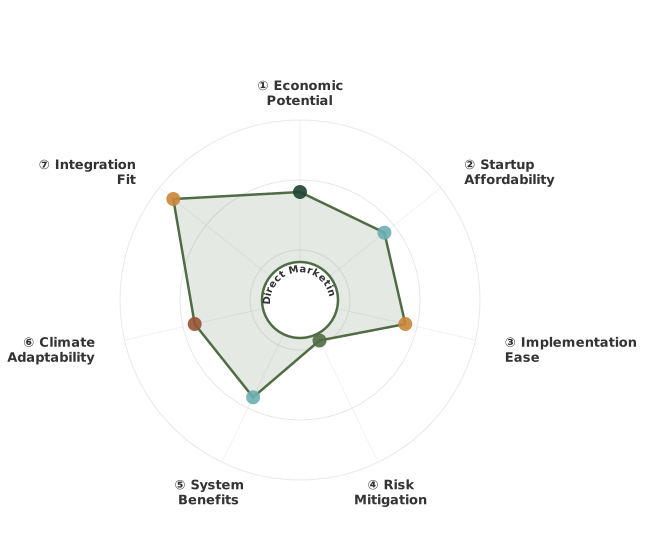
How These Traits Are Calculated
Trait dimensions are ordered clockwise starting from the top of the chart (12 o'clock position):
1. Economic Potential
Financial returns, annual value, and break-even timeline
WHAT: Evaluates financial viability by combining net annual value ($/ha from savings, income, and amortized harvests) with break-even timeline showing when practices pay for themselves.
WHY: Farmers need clear ROI understanding before committing resources. Fast payback (≤3 years) with strong returns (≥$300/ha) enables confident adoption, while long timelines (>10 years) restrict adoption to well-funded operations willing to wait for returns.
HOW: Calculated from net annual value in $/ha and break-even years. Exceptional (≥2.6): fast ROI ≤3 years + high value ≥$300/ha. Typical (1.8-2.5): moderate returns or longer timelines. Limited (<1.8): marginal economics or very long payback >10 years.
2. Startup Affordability
Initial investment costs and financial barrier to entry
WHAT: Measures financial barrier to entry through startup costs for equipment, infrastructure, consulting, and materials. Inverted scoring: lower costs = higher scores = more accessible adoption.
WHY: Affordability determines who can adopt. Low-cost practices (<$250/ha) enable widespread adoption across diverse scales, while high costs (>$2,500/ha) limit adoption to well-capitalized operations, creating barriers that slow regenerative transition.
HOW: Calculated from initial investment parsed from practice content. Inverted scoring: Exceptional (≥2.6): minimal investment <$250/ha. Typical (1.8-2.5): moderate costs $250-2,500/ha. Limited (<1.8): high barrier >$2,500/ha.
3. Implementation Ease
Learning curve and specialized knowledge required
WHAT: Measures how much learning, planning, and specialized knowledge a practice requires. Simpler practices with fewer steps score higher, while complex practices requiring extensive training or specialized resources score lower.
WHY: Complex practices create adoption barriers even when economically viable. Straightforward practices enable faster adoption and broader participation, while those requiring extensive training, timing precision, or specialized equipment limit who can succeed.
HOW: Evaluated by measuring documentation length and identifying complexity markers like location-specific requirements, seasonal timing windows, specialized skills, and dedicated equipment needs. Exceptional (≥2.6): straightforward practices with minimal prerequisites. Typical (1.8-2.5): moderate learning curve with some specialized needs. Limited (<1.8): steep learning curve requiring significant training or resources.
4. Risk Mitigation
Identified financial and ecological risk assessment
WHAT: Evaluates documented risks across financial (investment loss, market volatility) and ecological (crop failure, pest outbreaks) domains. Inverted scoring: fewer risks = higher scores.
WHY: Understanding risk exposure helps farmers make informed decisions. Low-risk practices allow confident implementation, while high-risk practices require careful planning and contingency resources. Risk transparency prevents costly failures.
HOW: Calculated from identified risks in practice content. Inverted scoring: Exceptional (≥2.6): ≤2 risks with manageable severity. Typical (1.8-2.5): 3-5 moderate risks. Limited (<1.8): 6+ risks or severe exposure.
5. System Benefits
How many ways the practice improves your land simultaneously
WHAT: Measures how many aspects of land health improve at once—carbon storage, soil quality, erosion control, water absorption, and biodiversity. Practices that improve multiple areas simultaneously create compounding benefits where each improvement reinforces the others.
WHY: The best practices solve multiple problems at once. For example, addressing erosion simultaneously builds carbon and improves water infiltration, creating a resilient system with positive feedback loops. Single-benefit approaches miss these compound transformation opportunities.
HOW: Evaluated across five key outcomes: carbon sequestration, soil organic matter increase, erosion reduction, water infiltration improvement, and biodiversity enhancement. Exceptional (≥2.6): high carbon storage (>8 t/ha/yr), improvements across 4-5 areas, transformative outcomes. Typical (1.8-2.5): moderate carbon (3-8 t/ha/yr), improvements across 2-3 areas. Limited (<1.8): modest impact (<3 t/ha/yr), single-area focus only.
6. Climate Adaptability
Geographic applicability across Köppen climate zones
WHAT: Evaluates geographic applicability by assessing how many Köppen climate zones successfully support a practice and what adaptation requirements are needed. Measures breadth of climates where farmers can implement with minimal to moderate modifications.
WHY: Universal practices working across diverse climates enable more farmers to adopt regenerative approaches. Practices limited to single climate types (only Mediterranean, only tropical) restrict adoption and slow global transition. Adaptability determines whether a practice serves niche regions or offers broad transformation.
HOW: LLM evaluation of regional success stories, Köppen zone coverage, and adaptation needs. Exceptional (≥2.6): 5+ zones or 4+ climate types, 3+ continents, minimal adaptation. Typical (1.8-2.5): 3-4 zones or 2-3 types, 2 continents, moderate adaptation. Limited (<1.8): 1-2 zones, single region, significant adaptation or highly specialized.
7. Integration Fit
How well this practice combines with others you're doing
WHAT: Measures how well a practice combines with other regenerative practices you might be doing. Some practices work as building blocks that make many other practices easier or more effective, while others work best on their own.
WHY: Practices that combine well with many others create more value on your farm. For example, cover cropping enables no-till, improves grazing, supports crop diversity, and helps water management—making all of them work better together. This helps you build a coherent system rather than juggling disconnected practices.
HOW: Evaluated by identifying which practices combine well and how strong those combinations are. 'Ideally Suited' means strong combinations where practices reinforce each other (practice A makes B easier, while B makes A more effective). 'Adequate' means complementary benefits that work well together. Exceptional (≥2.6): combines well with 6+ practices, serves as a building block. Typical (1.8-2.5): combines with 3-5 practices. Limited (<1.8): 1-2 practices or works best alone.
Going Deeper
1
WHY - The Benefits
Direct marketing is more than just a sales channel; it's a strategic approach that can profoundly impact the economic viability and regenerative trajectory of a farm. By cutting out middlemen, farmers can capture a greater portion of the food dollar, invest more in...
Direct marketing is more than just a sales channel; it's a strategic approach that can profoundly impact the economic viability and regenerative trajectory of a farm. By cutting out middlemen, farmers can capture a greater portion of the food dollar, invest more in...
WHY - The Benefits
Direct marketing is more than just a sales channel; it's a strategic approach that can profoundly impact the economic viability and regenerative trajectory of a farm. By cutting out middlemen, farmers can capture a greater portion of the food dollar, invest more in...
Direct marketing is more than just a sales channel; it's a strategic approach that can profoundly impact the economic viability and regenerative trajectory of a farm. By cutting out middlemen, farmers can capture a greater portion of the food dollar, invest more in...
Soil Health Benefits
While direct marketing doesn't inherently improve soil, it creates the economic capacity and market justification to implement soil-building practices. When farmers sell directly, they can often command higher prices for their produce, especially if they emphasize their regenerative methods. This premium allows farmers to invest in crop diversity, cover cropping, reduced tillage, and other practices that enhance soil organic matter, water infiltration, and nutrient cycling.
For instance, a farmer selling heirloom tomatoes directly to consumers can often charge more than a conventional grower. This extra income can fund the planting of diverse cover crops between cash crop seasons, a practice that keeps soil covered (Principle 3) and maintains living roots (Principle 4). The farmer can then communicate to their direct customers why those cover crops are beneficial—how they build soil organic matter and reduce erosion—transforming a technical process into a shared value.
Similarly, direct sales of grass-fed beef can command premium prices, providing the financial buffer needed to implement cell grazing or adaptive multi-paddock grazing (Principle 5), practices that actively build soil health through animal integration. Without the direct market connection, the economic returns from these regenerative methods might not be sufficient to justify the investment or management effort.
Economic Benefits
The most immediate and tangible benefit of direct marketing is increased financial return. By selling directly, farmers bypass wholesalers who take a significant cut of the retail price. This means more money stays with the farmer, improving farm profitability and cash flow. For example, a farmer selling vegetables at a farmers' market often receives 2-4 times more per pound than they would through a wholesale distributor.
This increased revenue is crucial for transitioning to regenerative agriculture. Regenerative practices can sometimes incur higher upfront costs or lead to temporary yield reductions during the learning curve. Direct marketing provides a financial cushion, allowing farmers to absorb these costs and invest in soil amendments, diverse seed mixes, or new equipment (like no-till planters) without jeopardizing farm viability.
Furthermore, direct marketing can lead to more stable and predictable income streams. Community Supported Agriculture (CSA) programs, for instance, involve consumers paying upfront for a season's share of produce. This pre-payment provides farmers with crucial operating capital early in the season and guarantees a market for their harvest. online sales platforms and subscription services can also offer a more consistent revenue.
Water Cycle Benefits
Direct marketing can indirectly benefit water cycles by enabling farmers to invest in water-wise regenerative practices. When farmers earn more from their produce, they have the resources to implement strategies like cover cropping for water retention, contour farming to slow runoff, or silvopasture systems that improve water infiltration and reduce evaporation through shade and mulch.
By selling produce directly and showcasing these methods, farmers can also educate consumers about water conservation in agriculture. A farmer might explain how their no-till system prevents soil erosion, thereby protecting local waterways from sediment pollution. This consumer education can foster a deeper appreciation for the environmental stewardship involved in regenerative food production, creating a supportive market for water-friendly farming.
Carbon Sequestration and Climate Resilience
Direct marketing empowers farmers to adopt and promote carbon-sequestering regenerative practices. Practices like cover cropping, no-till farming, and incorporating livestock manure increase soil organic matter, which is a significant store of carbon. The higher profitability derived from direct sales can fund the adoption of these practices on a larger scale.
Furthermore, direct marketing strengthens local food systems, making them more resilient to climate-related disruptions. Shorter supply chains mean food travels less distance, reducing associated carbon emissions from transportation. A robust local direct-market network can also ensure food availability during extreme weather events that might disrupt long-distance supply chains. Farmers can directly communicate their climate-resilient strategies to consumers, fostering a market demand for sustainably produced food that actively combats climate change.
Biodiversity Benefits
Direct marketing allows farmers to showcase and capitalize on the biodiversity inherent in regenerative systems. By offering a wide range of heirloom varieties, specialty crops, or products from diverse livestock breeds, farmers can attract consumers seeking unique, high-quality foods. This market demand incentivizes farmers to grow a greater variety of crops and raise diverse animal breeds, supporting on-farm biodiversity.
The connection forged through direct sales allows farmers to explain the ecological benefits of biodiversity. They can talk about how diverse plantings support beneficial insects, improve pollination, and create healthier ecosystems. Consumers who buy directly are more likely to understand and appreciate the value of these ecological services, creating a market for diversified, biologically rich farms.
Regenerative Systems Fit
Direct marketing is a context-dependent practice that can significantly enhance the adoption and success of regenerative agriculture, particularly during the transition phase.
Supporting Principles:
- Principle 1 (Minimize Soil Disturbance): Direct marketers can highlight their use of no-till or reduced tillage methods, selling produce that requires minimal processing. Consumers who value these practices may pay a premium, incentivizing farmers to continue minimizing disturbance.
- Principle 2 (Maximize Crop Diversity): Direct marketing is an ideal avenue to sell diverse, specialty, or heirloom crops that may not have wholesale market appeal. This economic incentive directly supports the goal of increased genetic and species diversity on the farm.
- Principle 3 (Keep Soil Covered): Farmers can educate their direct customers about the benefits of year-round cover crops and perennial systems, marketing produce grown under these conditions as superior and thereby creating demand for it.
- Principle 4 (Maintain Living Roots): The direct connection allows farmers to explain the importance of continuous living root systems for soil health, and to market produce from farms that prioritize this principle, potentially commanding higher prices.
- Principle 5 (Integrate Livestock): Direct sales of ethically raised animal products (e.g., grass-fed beef, pasture-raised eggs) allow farmers to capture value that reflects the land-building benefits of integrated livestock systems, incentivizing them to continue and optimize this integration.
Role in the Regenerative Transition: For farmers undertaking a whole-farm regenerative transition, direct marketing provides critical economic support. The increased profit margins can offset temporary yield dips or higher input costs (like diverse seed mixes) associated with early-stage regenerative adoption. It allows farmers to absorb the transition period without severe financial strain, making the shift to full regenerative practice more feasible. The direct relationship also builds a community of support among customers who are invested in the farmer's success, providing market stability during the transition.
Sources behind this view
Videos & Podcasts
-
Transitioning to regenerative agriculture increases production costs by forgoing conventional efficiency tools. Essential consumer education is needed to explain higher prices, counter corporate messa
-
Direct-to-consumer success hinges on effective marketing, promotion, and customer acquisition through community engagement and reputation building, not traditional ads. Farmers must know their market,

-
Farmers can improve risk-return profiles by developing direct market access for grains, leveraging storytelling and quality beyond product metrics. Cooperatives can enhance processing capabilities, le
-
Direct marketing success relies on diversity (one-stop shop), using commission-based sales reps, differentiating products by focusing on customer benefits ('why'), and reducing customer hurdles like c

Community
-
Direct marketing methods like farmers' markets and roadside stands enable growers to increase profits and community support, though they require extra labor and may involve permits and liability conce
Read more (opens in new window) ucanr.edu -
Direct marketing strategies like agritourism, niche products, and CSAs can enhance farm financial stability. Examples include The Apple Farm (organic apples, value-added), Laguna Farms (CSA), and Prat
Read more (opens in new window) ucanr.edu
Research
-
Collective Marketing Enterprises among Small- Scale Organic and Low-input Farmers: Balancing Community-based Values in Relation to the Marketplace (opens in new window)
This study found: Small organic/low-input farmers use collective marketing, including online sales, to boost demand. Market managers balance economic goals with community values, supported by farmers' commitment to sus
-
Organic Markets, Participatory Guarantee Systems, and Community-Supported Agriculture for Sustainable Food Communities (opens in new window)
This study found: Direct organic marketing (CSA, PGS) builds sustainable food communities by connecting consumers to farmers, fostering trust, and supporting social/ecological health for a resilient food system.
-
Organic Markets, Participatory Guarantee Systems, and Community-Supported Agriculture for Sustainable Food Communities (opens in new window)
This study found: Local organic food systems like CSA and PGS build communities, support farmers, and promote social and ecological sustainability for a resilient green economy.
-
Substitute or complementary (opens in new window)
This study found: US farmers adopting organic farming are less likely to also adopt direct marketing. Organic farming improved income, while direct marketing did not show a significant effect.
2
WHERE - Regional Considerations
Direct marketing finds success across diverse regions, but its implementation must be adapted to local climate, demographics, and agricultural landscape.
Direct marketing finds success across diverse regions, but its implementation must be adapted to local climate, demographics, and agricultural landscape.
WHERE - Regional Considerations
Direct marketing finds success across diverse regions, but its implementation must be adapted to local climate, demographics, and agricultural landscape.
Direct marketing finds success across diverse regions, but its implementation must be adapted to local climate, demographics, and agricultural landscape.
Click Here to Look up your Region if you don't already know it
Temperate Regions (Humid and Dry)
Representative Locations: North America (Midwest USA, Great Plains, Eastern Canada), Europe (Western and Central Europe, Ukraine), parts of Asia (Northern China, Japan, South Korea), Australia (Southern regions), New Zealand. Climate Context: Characterized by distinct seasons, including warm summers and cold winters. Precipitation varies from moderate to high and can be seasonal. USDA Zones 3-7, Köppen Cfb, Dfb, Dfa, BSk. Application: These regions often have established agricultural infrastructure and consumer bases. Direct marketing via farmers' markets, CSAs, and roadside stands is common. Success relies on showcasing seasonal variety and building community trust. Challenges include managing extreme weather events and competing with large-scale agricultural operations.
Mediterranean Regions
Representative Locations: California (USA), Mediterranean Basin (Spain, Italy, Greece), Central Chile, Southwestern Australia, Cape Province (South Africa). Climate Context: Hot, dry summers and mild, wet winters. Precipitation is highly seasonal. USDA Zones 8-10, Köppen Csa, Csb. Application: Direct marketing thrives by offering unique, sun-ripened produce and value-added products like olive oils or preserved goods. Seasonality is a key driver; farmers often focus on drought-tolerant crops or utilize irrigation strategically to extend the growing season. Water management is a critical factor for direct marketers in these regions.
Arid and Semi-Arid Regions
Representative Locations: Southwestern USA, North Africa, Central Asia, Australian Outback, parts of Eastern Africa. Climate Context: Low annual rainfall, high temperatures, and often short growing seasons. USDA Zones 5-9, Köppen BWh, BSh, BSa, Bsb. Application: Direct marketing here often focuses on hardy, drought-resistant crops and livestock products. Water conservation is paramount. Farmers may leverage intensive soil-building techniques to maximize limited moisture. Strategies like on-farm stands with pre-booked orders or targeted delivery to urban centers can reduce transportation needs and costs in vast, sparsely populated areas. Emphasis on sustainability and water-wise practices resonates strongly with consumers.
Subtropical Regions
Representative Locations: Southeastern USA, Southern China, Southern Brazil, Eastern Australia, Southeast Asia. Climate Context: Hot, humid summers and mild winters with generally ample rainfall. USDA Zones 9-11, Köppen Cfa, Cwa. Application: These regions support a long growing season, allowing for diverse vegetable, fruit, and livestock production year-round. Direct marketing can capitalize on the abundance of fresh produce. Farmers often focus on year-round CSAs and market sales. Challenges include managing heat, humidity, and associated pest/disease pressures. Emphasis on tropical fruits, exotic vegetables, and lean meats can differentiate offerings.
Tropical Regions
Representative Locations: Central America, Southeast Asia, East Africa, Northern Australia, Northern South America. Climate Context: High temperatures year-round, with distinct wet and dry seasons or consistent high rainfall. Köppen Af, Am, Aw. Application: Tropical regions offer opportunities for continuous production of a wide range of fruits, vegetables, and animal products. Direct marketing can involve supplying local markets directly, operating farm stands near tourist areas, or establishing CSA-like models for specialty crops resilient to tropical conditions. Food preservation and processing are vital as product perishability is high. Building direct relationships with chefs and upscale restaurants can be a successful strategy.
3
HOW - Implementation Process
Direct marketing is a multifaceted practice requiring careful planning, execution, and ongoing management. The process can be broken down into key phases, from initial planning to ongoing relationship building.
Direct marketing is a multifaceted practice requiring careful planning, execution, and ongoing management. The process can be broken down into key phases, from initial planning to ongoing relationship building.
HOW - Implementation Process
Direct marketing is a multifaceted practice requiring careful planning, execution, and ongoing management. The process can be broken down into key phases, from initial planning to ongoing relationship building.
Direct marketing is a multifaceted practice requiring careful planning, execution, and ongoing management. The process can be broken down into key phases, from initial planning to ongoing relationship building.
Prerequisites
Before diving into direct marketing, consider these foundational elements:
- Product Identification: Clearly define what you will sell. High-quality, unique, or specialty products often fare best in direct markets. Examples include heirloom vegetables, grass-fed meats, artisanal cheeses, or unique fruit varieties.
- Production Capacity: Honestly assess your farm's ability to consistently produce the volume and quality needed for your chosen direct market channels. Over-promising and under-delivering can quickly damage your reputation.
- Market Research: Understand your potential customer base. What are their preferences? What are they willing to pay? Where do they shop? Research local competition and identify market gaps.
- Logistics Planning: How will products get from your farm to the customer? Consider packaging, transportation, storage, and any licensing or food safety requirements.
- Pricing Strategy: Determine pricing that covers your costs, reflects the value of your regenerative practices, and is competitive within your target market.
Phase 1: Strategy and Channel Selection
Choose the direct marketing channels that best suit your operation, products, and target audience.
- Farmers' Markets:
- Pros: High visibility, direct customer interaction, cash sales, community building.
- Cons: Time-consuming (requires staffing, transportation, setup), weather-dependent, market fees, competition.
- Implementation: Research local markets (availability, fees, rules), assess which offers best fit for your products and customer base. Prepare attractive displays, clear pricing, and compelling information about your farm.
- Community Supported Agriculture (CSA):
- Pros: Guaranteed income, predictable sales, strong customer loyalty, reduced waste.
- Cons: Requires consistent production of diverse items, significant customer communication, managing share distributions.
- Implementation: Define share size, pricing, pick-up/delivery logistics, and duration. Develop a communication plan to keep members informed and engaged.
- Farm Stand/On-Farm Sales:
- Pros: Lower overhead than markets, full control over presentation, can build farm experience.
- Cons: Requires on-farm presence, dependent on local traffic, may need significant investment in infrastructure.
- Implementation: Ensure easy access, clear signage, attractive display, and secure payment methods (cash, card reader). Offer self-serve or staffed options.
- Online Sales/Direct Delivery:
- Pros: Wider reach, convenience for customers, 24/7 sales opportunity.
- Cons: Requires website/e-commerce setup, robust delivery logistics (cold chain), marketing effort to drive traffic.
- Implementation: Choose an e-commerce platform or build your own, develop a clear order/delivery system, market heavily online. Consider partnerships for delivery if you lack infrastructure.
- Wholesale to Local Restaurants/Grocers:
- Pros: Larger, consistent orders, less direct customer service.
- Cons: Lower margins than other direct channels, often requires specific product consistency and certifications.
- Implementation: Network with local chefs and store buyers, build relationships, establish clear delivery and payment terms.
Phase 2: Production and Operations Planning
Align your production system with your chosen direct marketing channels. This is where regenerative principles shine.
- Crop Planning for Diversity: If using CSAs or markets, plan to offer a wide variety of produce throughout the season. Prioritize heirloom and specialty varieties that differentiate you. This directly supports Principle 2 (Maximize Crop Diversity).
- Season Extension Techniques: Utilize hoop houses, cold frames, or high tunnels to extend your growing season, providing product for more market days or longer CSA deliveries. This helps keep soil covered (Principle 3) and maintain living roots (Principle 4) for longer periods.
- Quality Control: Direct markets demand high-quality products. Focus on flavor, freshness, and appearance. Regenerative practices often lead to superior quality, which can be a key selling point.
- Packaging and Presentation: Develop attractive, functional packaging that protects your product and showcases its value. For regenerative products, consider eco-friendly or reusable packaging.
- Logistics Management: Develop efficient systems for harvesting, packing, storing, and transporting your products. For CSAs and delivery routes, optimize routes to minimize fuel use and save time.
- Labor Allocation: Direct marketing can be labor-intensive. Plan for staffing needs for market days, packing, customer service, and deliveries. This might involve hiring part-time help.
Phase 3: Marketing and Customer Engagement
Building a customer base is paramount for direct marketing success.
- Telling Your Story: As a regenerative farmer, your story is your most powerful marketing tool. Clearly communicate your farming practices – minimal tillage, cover cropping, integrated livestock, use of organic inputs – and their benefits for soil health, biodiversity, and consumer well-being. Use signage, websites, social media, and conversations at market.
- Visual Marketing: High-quality photos of your farm, produce, and practices are essential for online and print materials. Showcase the vibrancy of your regenerative systems.
- Building Relationships: Engage with customers. Answer their questions, provide recipe ideas, and share updates from the farm. Loyalty is built on trust and connection.
- Pricing Strategy: Set prices that reflect the quality and regenerative value of your products. Educate customers on why your products are worth a premium.
- Leveraging Online Platforms: Develop a user-friendly website with an e-commerce function, utilize social media for promotion, and consider email newsletters to keep customers informed.
Phase 4: Financial Management and Feedback
Direct marketing requires diligent financial tracking and continuous improvement.
- Record Keeping: Track sales per channel, per product. Monitor expenses (inputs, labor, market fees, transportation). Calculate profitability for each market.
- Pricing Adjustments: Regularly review pricing based on costs, market demand, and perceived value.
- Customer Feedback: Actively solicit feedback from customers. What do they like? What could be improved? Use this to refine your offerings and practices.
- Adaptation: Be prepared to adapt your strategy based on sales data, customer feedback, and market trends.
Sources behind this view
Videos & Podcasts
-
Direct-to-consumer success hinges on effective marketing, promotion, and customer acquisition through community engagement and reputation building, not traditional ads. Farmers must know their market,
-
Details five steps for direct marketing: education, business planning, understanding costs, navigating regulations, and developing sales platforms (website, social media), emphasizing proper pricing a

-
Direct marketing success relies on diversity (one-stop shop), using commission-based sales reps, differentiating products by focusing on customer benefits ('why'), and reducing customer hurdles like c
-
Direct marketing is not essential for success in modern agriculture, but efficient management and adapting to market conditions are. While valuable for learning and building a customer base, profitabi

Community
-
Success in farming requires high quality standards, detailed record-keeping, early product branding, and premium pricing based on costs. Season extension allows for early market entry and better prici
Read more (opens in new window) permies.com -
Direct marketing methods like farmers' markets and roadside stands enable growers to increase profits and community support, though they require extra labor and may involve permits and liability conce
Read more (opens in new window) ucanr.edu -
Direct marketing strategies like agritourism, niche products, and CSAs can enhance farm financial stability. Examples include The Apple Farm (organic apples, value-added), Laguna Farms (CSA), and Prat
Read more (opens in new window) ucanr.edu
Research
-
Collective Marketing Enterprises among Small- Scale Organic and Low-input Farmers: Balancing Community-based Values in Relation to the Marketplace (opens in new window)
This study found: Small organic/low-input farmers use collective marketing, including online sales, to boost demand. Market managers balance economic goals with community values, supported by farmers' commitment to sus
-
Organic Markets, Participatory Guarantee Systems, and Community-Supported Agriculture for Sustainable Food Communities (opens in new window)
This study found: Direct organic marketing (CSA, PGS) builds sustainable food communities by connecting consumers to farmers, fostering trust, and supporting social/ecological health for a resilient food system.
-
Organic Markets, Participatory Guarantee Systems, and Community-Supported Agriculture for Sustainable Food Communities (opens in new window)
This study found: Local organic food systems like CSA and PGS build communities, support farmers, and promote social and ecological sustainability for a resilient green economy.
4
Know the Debate
Direct marketing's success and labor requirements vary widely. In regions with strong consumer demand for local, high-quality food and established ...
Know the Debate
Direct marketing's success and labor requirements vary widely. In regions with strong consumer demand for local, high-quality food and established ...
Direct marketing's success and labor requirements vary widely. In regions with strong consumer demand for local, high-quality food and established market channels, farmers can achieve significant profit increases, but this requires dedicated marketing effort. In areas with lower population density or less consumer interest in premium-priced goods, the economic benefits might be marginal, and the labor commitment may not always be directly rewarded, making strategic channel selection crucial.
Does direct marketing consistently boost farm profits?
Profitable with skill and relationships
Experienced farmers find substantial economic benefits through direct marketing by capturing higher retail prices and building loyal customer bases. Success hinges on effective storytelling, diverse products, and intensive customer engagement.
Sources behind this view
Sources behind this view
Videos & Podcasts
-
Producers shared insights on direct sales channels: on-farm sales with tours build relationships, farmers markets are competitive, flexible CSAs improve retention, and restaurant sales require strong chef connections. Diversification is key.
-
Direct marketing is not essential for success in modern agriculture, but efficient management and adapting to market conditions are. While valuable for learning and building a customer base, profitability can be achieved through various channels, and producers must know their product's value and price it appropriately.
From the Web
-
Direct marketing allows farmers to sell directly to consumers, increasing profitability and supporting local economies. Legislation like the Farmer-to-Consumer Direct Marketing Act of 1976 and California's Certified Farmers’ Markets have revitalized this practice.
Profitability varies; not always a clear gain
Academic research indicates mixed profitability, with some studies showing direct marketing does not significantly boost overall farm income. Factors like organic status, management skill, and market context influence net results.
Sources behind this view
Sources behind this view
Research
-
Substitute or complementary (opens in new window)
This study found: A study using US farm data found that farmers who choose to farm organically are less likely to also sell their products directly to consumers (like at farm stands or farmers' markets). While organic farming tended to increase overall farm income, direct marketing did not show a significant income boost in this analysis. This suggests farmers often make decisions about organic certification and direct sales together, and that government programs promoting one or the other might need better coordination.
-
Use of Direct Marketing Strategies by Farmers and Their Impact on Farm Business Income (opens in new window)
This study found: A study of U.S. farmers found that while many use direct marketing (selling directly to consumers) to potentially get better prices, the intensity of using these strategies didn't significantly increase overall farm income. In fact, participating in farmers markets was linked to lower gross farm income across different income levels. This suggests that simply selling directly to consumers, or focusing heavily on farmers markets, may not be a guaranteed path to higher profits for all farms.
-
Impact of marketing channels on perceptions of quality of life and profitability for Wisconsin's organic vegetable farmers (opens in new window)
This study found: A study of organic vegetable farmers in Wisconsin found that how farmers sell their produce impacts their satisfaction with both their income and their personal lives. Farmers selling directly to consumers at farmers' markets or through Community Supported Agriculture (CSA) programs were more often unhappy with their profits. On the other hand, farmers who sold to wholesalers, restaurants, or institutions were more often unhappy with their quality of life. This suggests farmers often face a choice between markets that offer better pay but may demand more of their time and energy, and markets that offer a better work-life balance but potentially lower profits. The research highlights the need for support programs that help farmers improve profitability in markets that also support a good quality of life.
Making Sense of the Differences
Profitability from direct marketing is highly context-dependent. While many practitioners find it essential for higher margins and customer loyalty, academic data reveals inconsistent financial returns, influenced by factors like market saturation, operational scale, and management intensity. Success often hinges on understanding specific market demands and effectively communicating the value added by regenerative practices.
Is the labor investment in direct marketing worth the reward?
Rewarding labor through relationships and mission
Experienced direct marketers find the labor intensive nature of sales, marketing, and customer interaction deeply rewarding due to community building and mission fulfillment, even if direct financial ROI is variable.
Sources behind this view
Sources behind this view
Videos & Podcasts
-
Producers shared insights on direct sales channels: on-farm sales with tours build relationships, farmers markets are competitive, flexible CSAs improve retention, and restaurant sales require strong chef connections. Diversification is key.
-
Direct marketing offers emotional support by fostering positive customer interactions, which builds confidence and a sense of value in farm children by showing the importance of their work.

From the Web
-
Direct marketing allows farmers to capture full consumer dollar and control prices, but requires significant time and cost investment; evaluate options within a farm business plan.
Significant labor with variable financial return
Academic studies acknowledge the substantial time commitment for direct marketing, often 10-20+ hours weekly, with variable correlations to overall farm income, suggesting the return on labor is not always guaranteed.
Sources behind this view
Sources behind this view
Research
-
Do farm operators benefit from direct to consumer marketing strategies? (opens in new window)
This study found: This study looked at how farmers choose to sell their products directly to customers and how this affects their farm's financial success. It found that good management and marketing skills are important for selling directly to consumers. Interestingly, farmers who *only* sell directly to customers tended to earn less than those who used a mix of selling methods. Having strong marketing skills helped boost earnings from direct sales. The research also highlighted that simply choosing to sell directly might not guarantee higher profits, and other factors or selection biases need to be considered for accurate results.
-
Impact of marketing channels on perceptions of quality of life and profitability for Wisconsin's organic vegetable farmers (opens in new window)
This study found: A study of organic vegetable farmers in Wisconsin found that how farmers sell their produce impacts their satisfaction with both their income and their personal lives. Farmers selling directly to consumers at farmers' markets or through Community Supported Agriculture (CSA) programs were more often unhappy with their profits. On the other hand, farmers who sold to wholesalers, restaurants, or institutions were more often unhappy with their quality of life. This suggests farmers often face a choice between markets that offer better pay but may demand more of their time and energy, and markets that offer a better work-life balance but potentially lower profits. The research highlights the need for support programs that help farmers improve profitability in markets that also support a good quality of life.
From the Web
-
Direct marketing via farmers markets offers urban farmers full consumer dollar share and price control, but requires significant time investment. Success hinges on understanding market rules, customer demographics, and enjoying interaction. Growing diverse crops is key for a long season. Resources for NY farmers markets are available.
Making Sense of the Differences
Direct marketing's labor demands are substantial, often requiring 10-20+ hours weekly, which competes with production time. While practitioners find the work rewarding through customer connection and mission fulfillment, academic analyses show variable financial returns for this labor. Effective time management, technology, and relationship-building are key factors in determining if the intensive effort translates into significant economic gains.
5
HOW MUCH - Costs & Investment
Note: Costs shown in USD; multiply by local labor and material cost indices for your region. Labor costs vary significantly internationally.
Note: Costs shown in USD; multiply by local labor and material cost indices for your region. Labor costs vary significantly internationally.
HOW MUCH - Costs & Investment
Note: Costs shown in USD; multiply by local labor and material cost indices for your region. Labor costs vary significantly internationally.
Note: Costs shown in USD; multiply by local labor and material cost indices for your region. Labor costs vary significantly internationally.
Note: All costs are based on recent US economic data (2024–2026) and may vary substantially by region based on local labor rates, material costs, and regulatory requirements.
Market Infrastructure & Retail Displays
Small operations (under 50 acres (20 ha)) focus on mobility and low-footprint setups to attend weekly farmers' markets. Investment ranges from $1,200 to $12,000 for weather-grade pop-up tents, collapsible shelving, and portable weighing stations. Mid-size operations (50–500 acres (20–202 ha)) often prioritize seasonal farm stands or high-traffic event stalls, necessitating an investment of $12,000 to $85,000. This tier includes permanent architectural improvements, weather-resistant cabinetry, and professional-grade refrigerated glass-front merchandisers to maintain strict cold chain integrity. Large operations (500+ acres) developing full-scale agritourism or on-farm retail centers allocate $85,000 to $160,000, covering permanent construction, ADA-compliant accessibility ramps, point-of-sale central hubs, and comprehensive security and lighting systems.
Transportation & Cold Chain Logistics
Direct-to-consumer delivery mandates high uptime for temperature-sensitive inventory. Small farms leverage existing personal vehicles plus $800 to $6,000 in specialized equipment, including high-capacity rotomolded coolers, thermal pallet covers, and cellular temperature sensors. Mid-size operators typically require dedicated delivery units, spending $15,000 to $65,000 to retrofit used box trucks or cargo vans with specialized insulation and high-efficiency refrigeration inserts. Large-scale providers moving professional CSA volumes or servicing multiple regional outlets invest $65,000 to $200,000+ in dedicated refrigerated trailer fleets, on-site walk-in cooler installations requiring 3-phase power, and GPS-enabled software for routing, ensuring zero-defect food safety compliance across multi-state or large regional delivery networks.
E-commerce & Digital Presence
Digital infrastructure forms the primary sales funnel, requiring different degrees of automation. Small farms spend approximately $600 to $3,000 per year on entry-level website hosting, professional domain management, and basic mobile payment integration. Mid-size operations managing complex inventory flows and recurring CSA revenue models require robust SaaS software suites and automated email marketing platforms, costing $3,000 to $12,000 annually, including professional photography and branding. Large-scale direct marketing operations implement sophisticated enterprise-grade ERP systems that consolidate wholesale distribution tracking, mobile app development, and high-level CRM tools, totaling $12,000 to $40,000 in annual recurring licensing and IT maintenance costs.
Packaging & Regulatory Compliance
Compliance and branding demand persistent, recurring expenditures. Small farms allocate $500 to $4,000 annually for biodegradable containers, thermal bag labeling, and health-department-approved food handling surfaces. Mid-size farms invest $4,000 to $15,000 to secure necessary retail insurance, product liability policies, and specialized custom-printed packaging that meets regional food storage regulations. Large operations that process or package value-added food items incur annual costs of $15,000 to $50,000 for licensed facility maintenance, organic or GAP certification audit fees, and professional graphic design for commercial-grade retail packaging.
Most Spend: Most agricultural producers fall within the $45,000 to $180,000 range when optimizing for both physical mobile retail setups and the digital infrastructure required to manage sustainable customer base growth.
Why the Range?: The extreme variance in cost is driven by the level of automation and physical permanency of the retail space. Farms that leverage existing infrastructure and personal transit remain at the lower end, while operations shifting to dedicated agritourism or proprietary digital platforms move into the upper cost tiers to capture long-term retail margins.
Sources behind this view
Videos & Podcasts
-
Farm startup costs are categorized into three tiers: backyard (<$5k), committed ($10-15k), and full build-out ($25-30k). Choose a tier based on affordability and risk tolerance, prioritizing learning

6
REWARDS AND RISKS - Economics & Risk Factors
Direct marketing offers significant economic rewards but also inherent risks that must be carefully managed.
Direct marketing offers significant economic rewards but also inherent risks that must be carefully managed.
REWARDS AND RISKS - Economics & Risk Factors
Direct marketing offers significant economic rewards but also inherent risks that must be carefully managed.
Direct marketing offers significant economic rewards but also inherent risks that must be carefully managed.
Economic Scenarios In a Best Case Scenario, the operation successfully internalizes the full retail value of their goods, effectively capturing the 50–70% of revenue traditionally surrendered to wholesalers. This results in annual net income gains of $250 to $312.60 per acre ($618–$772/ha). With strategic marketing, initial investment costs are typically recouped within 24 months. In a Typical Case Scenario, producers realize a more modest 15–30% revenue lift over commodity prices, with net income hovering around $150 to $200 per acre ($371–$494/ha). Here, the investment is recouped in approximately 36 months as the customer base builds through word-of-mouth. In a Worst Case Scenario, high logistical overhead and excessive packaging costs erode the direct-marketing premium. If investments exceed $200,000 without achieving a 75% customer retention rate, the operation may enter a period of negative cash flow, failing to reach breakeven status within the 4-year cycle.
Market Factors & Risk Mitigation Regional market saturation is a primary threat, as farmers' markets have finite stall counts and physical floor space. Mitigation involves a dual-track strategy: digital advertising and territory expansion. Farms should budget $2,000 to $5,000 annually for hyper-targeted social media campaigns to reach new demographic segments beyond the immediate physical vicinity. To anchor revenue, producers should utilize "pre-sell" or tiered CSA subscription models, which can secure 60–80% of projected gross income prior to the start of the growing season. This infusion of working capital significantly mitigates the economic risks of market volatility and seasonal downtime.
Transition Period Risks Transitioning to direct marketing often coincides with a period of soil and system adjustment, which can lead to a 10–25% reduction in marketable yields during years 1 through 3. During this time, fixed costs—such as refrigeration electricity and vehicle maintenance—remain constant despite lower box volume, tightening net margins. To mitigate this, farms should adopt a "buffer crop" strategy, planting at least 15% more diversity than is explicitly required for current subscription demands. This protects the core delivery model against localized crop failure. Furthermore, allocating at least $3,000 annually toward "transparent storytelling" marketing helps retain customer loyalty during the transition, as educated consumers are significantly more likely to accept minor produce inconsistencies when they understand the regenerative ecological benefits of the farming model.
Sources behind this view
Videos & Podcasts
-
Direct-to-consumer success hinges on effective marketing, promotion, and customer acquisition through community engagement and reputation building, not traditional ads. Farmers must know their market,
-
Direct-to-consumer marketing success hinges on sharing your farm's story, mission, and journey, using tools like social media for relationship building, not just sales.
-
Prioritizes marketing and storytelling for direct-to-consumer sales, emphasizing consistent communication of the farm's 'why' through social media and email to build customer loyalty and drive sales.
-
Overcoming marketing inconvenience requires focusing on visibility (website, content marketing), accessibility (buying clubs), and convenience through pre-packaged frozen bundles to ensure year-round

Community
-
Success in farming requires high quality standards, detailed record-keeping, early product branding, and premium pricing based on costs. Season extension allows for early market entry and better prici
Read more (opens in new window) permies.com -
Farmers facing market access issues are advised to diversify sales channels through CSAs, restaurants, health food stores, and online platforms. Suggestions include selling eggs, honey, meat, flowers,
Read more (opens in new window) permies.com -
Direct marketing methods like farmers' markets and roadside stands enable growers to increase profits and community support, though they require extra labor and may involve permits and liability conce
Read more (opens in new window) ucanr.edu -
Direct marketing strategies like agritourism, niche products, and CSAs can enhance farm financial stability. Examples include The Apple Farm (organic apples, value-added), Laguna Farms (CSA), and Prat
Read more (opens in new window) ucanr.edu
Research
-
Collective Marketing Enterprises among Small- Scale Organic and Low-input Farmers: Balancing Community-based Values in Relation to the Marketplace (opens in new window)
This study found: Small organic/low-input farmers use collective marketing, including online sales, to boost demand. Market managers balance economic goals with community values, supported by farmers' commitment to sus
-
Organic Markets, Participatory Guarantee Systems, and Community-Supported Agriculture for Sustainable Food Communities (opens in new window)
This study found: Direct organic marketing (CSA, PGS) builds sustainable food communities by connecting consumers to farmers, fostering trust, and supporting social/ecological health for a resilient food system.
-
Organic Markets, Participatory Guarantee Systems, and Community-Supported Agriculture for Sustainable Food Communities (opens in new window)
This study found: Local organic food systems like CSA and PGS build communities, support farmers, and promote social and ecological sustainability for a resilient green economy.
-
Do farm operators benefit from direct to consumer marketing strategies? (opens in new window)
This study found: Farm-level study shows management & marketing skills boost direct-to-consumer sales. Farmers selling *only* directly earned less; marketing skills improved DTC earnings. Selection bias is important fo
From the Web
-
Small farms should prioritize direct-to-consumer sales via farmstands or subscription programs to increase profits and offer fresher food at lower prices. This model reduces transportation, supports b
-
Market gardeners need a focused marketing plan, prioritizing direct sales (farmers' markets, CSA) for higher income, though wholesale can offer better net returns. Diversity in crops and sales channel
-
Direct marketing via farmstands and subscription farming is crucial for small farms to cut out middlemen, increase profitability, and offer consumers fresher, cheaper produce. This strategy offers num
7
COMPATIBLE PRACTICES - Integration Opportunities
Direct marketing thrives when integrated with other regenerative practices, creating synergistic benefits for both the farm and its customers.
Direct marketing thrives when integrated with other regenerative practices, creating synergistic benefits for both the farm and its customers.
COMPATIBLE PRACTICES - Integration Opportunities
Direct marketing thrives when integrated with other regenerative practices, creating synergistic benefits for both the farm and its customers.
Direct marketing thrives when integrated with other regenerative practices, creating synergistic benefits for both the farm and its customers.
Cover Cropping
- Integration: Marketing produce grown from fields that utilize diverse cover crops year-round.
- Benefit: Consumers can be educated on how cover crops improve soil health, water retention, and biodiversity, justifying premium pricing for produce grown with these methods. This directly supports Principle 3 (Keep Soil Covered) and Principle 4 (Maintain Living Roots).
Crop Diversity
- Integration: Direct marketing is the ideal channel to sell unique, heirloom, or niche varieties that are less viable in wholesale markets.
- Benefit: Encourages farmers to grow a wider array of species, supporting Principle 2 (Maximize Crop Diversity). Customers appreciate the novelty and quality, creating a market advantage for diversified farms.
Educated Consumer Engagement
- Integration: Using every direct interaction (market, website, newsletter) to educate customers about regenerative practices.
- Benefit: Builds customer loyalty, justifies higher prices, fosters a supportive community for regenerative farming, and creates market demand for sustainably produced goods.
Reduced Tillage / No-Till
- Integration: Marketing produce grown with minimal or zero soil disturbance.
- Benefit: Customers can be informed about how reduced tillage protects soil structure, prevents erosion, and sequesters carbon, aligning with their values for sustainable food. This directly supports Principle 1 (Minimize Soil Disturbance).
Integrated Livestock Systems
- Integration: Direct marketing of meat, eggs, dairy, or produce fertilized by livestock manure.
- Benefit: Allows farmers to capture value reflecting the land-building role of livestock. Customers can buy ethically raised products and learn about nutrient cycling through manure, supporting Principle 5 (Integrate Livestock).
Season Extension Techniques
- Integration: Offering produce from hoophouses, greenhouses, or cold frames to extend the direct marketing season.
- Benefit: Provides a more consistent supply for CSAs and market customers, enhancing customer loyalty and farm revenue. It also allows for continuous soil cover and living roots for longer periods.
Local Food Hubs / Cooperatives
- Integration: Collaborating with other farms on delivery logistics, shared marketing platforms, or collective buying/selling.
- Benefit: Reduces individual overhead and time commitment, expands reach, and strengthens the local food economy.
Direct marketing, when strategically linked to regenerative production methods, creates a virtuous cycle: regenerative practices yield higher quality products, direct marketing captures their value, increased revenue funds further regenerative investments, and educated customers become advocates for the entire system.
Sources behind this view
Videos & Podcasts
-
Direct-to-consumer success hinges on effective marketing, promotion, and customer acquisition through community engagement and reputation building, not traditional ads. Farmers must know their market,
-
Advocates for family consensus, focus, and starting small in direct marketing. Emphasizes that prioritizing soil health is crucial for producing nutrient-dense, flavorful products and highlights adapt
-
Farmers can improve risk-return profiles by developing direct market access for grains, leveraging storytelling and quality beyond product metrics. Cooperatives can enhance processing capabilities, le
-
Direct marketing success relies on diversity (one-stop shop), using commission-based sales reps, differentiating products by focusing on customer benefits ('why'), and reducing customer hurdles like c
Community
-
Direct marketing methods like farmers' markets and roadside stands enable growers to increase profits and community support, though they require extra labor and may involve permits and liability conce
Read more (opens in new window) ucanr.edu -
Direct marketing strategies like agritourism, niche products, and CSAs can enhance farm financial stability. Examples include The Apple Farm (organic apples, value-added), Laguna Farms (CSA), and Prat
Read more (opens in new window) ucanr.edu
Research
-
Collective Marketing Enterprises among Small- Scale Organic and Low-input Farmers: Balancing Community-based Values in Relation to the Marketplace (opens in new window)
This study found: Small organic/low-input farmers use collective marketing, including online sales, to boost demand. Market managers balance economic goals with community values, supported by farmers' commitment to sus
-
Organic Markets, Participatory Guarantee Systems, and Community-Supported Agriculture for Sustainable Food Communities (opens in new window)
This study found: Direct organic marketing (CSA, PGS) builds sustainable food communities by connecting consumers to farmers, fostering trust, and supporting social/ecological health for a resilient food system.
-
Organic Markets, Participatory Guarantee Systems, and Community-Supported Agriculture for Sustainable Food Communities (opens in new window)
This study found: Local organic food systems like CSA and PGS build communities, support farmers, and promote social and ecological sustainability for a resilient green economy.