
Farm Operations Management
Farm operations management is the strategic oversight of all farm activities, from planning and resource allocation to execution and monitoring. It involves making informed decisions about crop selection, livestock integration, labor, finances, and land use to achieve specific production and sustainability goals. Effective farm operations management is crucial for optimizing farm productivity, profitability, and long-term ecological health.
Read More: Complete Description
Farm operations management encompasses the holistic and integrated planning, coordination, and execution of all activities on a farm or ranch. It's the engine that drives the farm forward, ensuring that resources such as land, labor, capital, machinery, and knowledge are utilized efficiently and effectively to meet production targets while aligning with broader goals, including those of regenerative agriculture. This practice is context-dependent, meaning its regenerative potential is determined by how it is implemented and the principles it prioritizes.
In a regenerative agriculture framework, farm operations management is not just about maximizing yield or profit in the short term, but about building long-term ecological resilience and economic viability. This involves making deliberate choices that support the five regenerative principles: minimizing soil disturbance, maximizing crop diversity, keeping soil covered, maintaining living roots, and integrating livestock. For example, operational planning includes selecting machinery that reduces soil compaction, scheduling planting and harvesting to minimize bare soil periods, choosing diverse crop rotations, and integrating grazing animals in a way that enhances soil fertility and ecosystem function.
The complexity of farm operations management varies greatly depending on the farm’s size, enterprise mix, and the goals of the operator. A small, diversified organic farm might focus on intricate crop rotations, frequent small-scale livestock movements, and direct market sales, requiring detailed daily and weekly operational plans. In contrast, a large-scale grain and cattle operation might require sophisticated financial planning, long-term investment strategies in fencing and water infrastructure for adaptive grazing, and advanced logistical coordination for harvesting and transport. Both require diligent management, but the nature of the planning and execution differs significantly.
Farm operations management is context-dependent in its relationship with regenerative principles. For instance, machinery management becomes regenerative when it prioritizes minimal soil disturbance. This means choosing implements like no-till drills, cover crop rollers, or low-impact cultivation tools, and planning operations to avoid working wet soils, thereby preventing compaction. Conversely, it becomes extractive when operations rely on heavy tillage equipment, broadcast application of synthetic inputs without considering soil biology, or neglecting cover crop establishment, leading to erosion and nutrient depletion.
The economic dimension of farm operations management is paramount. Sound financial planning involves budgeting for inputs, labor, and capital expenditures, managing cash flow, and securing financing. In a regenerative context, this also means accounting for the long-term economic benefits of improved soil health, reduced input costs (fertilizers, pesticides), enhanced water use efficiency, and diversified income streams from integrated enterprises. Operational decisions are guided by a blend of agronomic, ecological, and economic considerations.
Labor management is another critical component. This includes hiring, training, and managing farm staff, ensuring adequate skills for specialized regenerative tasks like adaptive grazing or soil health monitoring, and fostering a strong farm culture aligned with regenerative values. For operations integrating livestock, managing animal health, welfare, and breeding programs becomes a significant part of the operational plan.
Resource management extends to water, energy, and waste. Regenerative operations often focus on water conservation through improved soil infiltration and judicious irrigation strategies, energy efficiency through reduced tillage and optimized machinery use, and waste reduction through composting manure and crop residues. Decision-making under farm operations management must therefore be adaptive, allowing for adjustments based on weather patterns, market fluctuations, soil health indicators, and livestock performance. It’s a continuous cycle of planning, implementing, monitoring, and adjusting.
Ultimately, effective farm operations management in a regenerative system moves beyond traditional linear production models. It embraces complexity, views the farm as an interconnected ecosystem, and prioritizes building biological capital over extracting ecological resources. It requires a deep understanding of ecological processes, meticulous record-keeping, strong leadership skills, and an unwavering commitment to continuous learning and adaptation.
Sources behind this view
Sources behind this view
 Videos & Podcasts
-
Regenerative agriculture provides solutions for climate change, human health, and soil degradation, contrasting with industrial agriculture's harmful impacts, including glyphosate use. Practices like
-
Case studies of farmers like Duane Beck, Kofi Boa, David Brandt, and Gabe Brown demonstrate that regenerative agriculture (no-till, cover crops, diverse rotations) significantly increases soil health,
-
Regenerative farming, using no-till, cover crops, and diverse rotations, rapidly rebuilds soil organic matter and soil life. Examples from Ohio and Ghana show these practices increase profitability by

 Community
-
Regenerative agriculture rebuilds soil organic matter and biodiversity through practices like cover cropping, reduced tillage, minimal artificial fertilizers, and regenerative grazing, ultimately impr
Read more (pp. 8-9) (opens PDF, pp. 8-9) permies.com
 Research
-
Regenerative Agriculture: Restoring Ecosystems¢ Resilience and Productivity: A Review (opens in new window)
This study found: Regenerative agriculture builds soil health and ecosystem services through practices like no-till, cover crops, and diverse rotations. It increases soil organic matter, improves water infiltration, bo
-
Systematic review of regenerative farming: Addressing agricultural sustainability challenges (opens in new window)
This study found: Systematic review of 31 studies shows regenerative farming improves soil health, biodiversity, and carbon capture, aiding sustainability. Technology is key for adoption, but policy, farmer understandi
-
The Indigenous Roots of Regenerative Agriculture (opens in new window)
This study found: Modern regenerative agriculture practices are rooted in millennia of Indigenous land stewardship, offering profound knowledge and a crucial value system of respect and reciprocity for true transformat
-
Regenerative Agriculture: Insights and Challenges in Farmer Adoption (opens in new window)
This study found: Review of 7 regenerative agriculture practices (no-till, crop rotation, cover crops, etc.) highlights benefits and key adoption challenges like cost, farm size, and institutional barriers for scalable
 From the Web
-
Five steps to regenerative agriculture: Holistic Planned Grazing, no-till farming, planting diverse cover crops/interseeding, using compost/inoculants (with caution), and incorporating silvopasture/wo
-
Regenerative Agriculture rebuilds soil health and biodiversity through four principles: no tillage, continuous soil cover, increased plant diversity, and livestock integration. This approach aims for
-
Regenerative agriculture restores soil health through practices like cover cropping and crop rotation, leading to carbon sequestration, increased resiliency, and reduced reliance on off-farm inputs, b
-
Regenerative Agriculture, guided by a holistic management framework and a 'holistic context,' is proposed to regenerate soils, economies, and environments. It reintroduces livestock as a key tool and
Key Points
What It Is
- Integrated farm planning and execution
- Resource allocation for sustainability
- Decision making for ecological health
- Adaptable management of farm activities
Why Do It
- Maximizes farm productivity and efficiency
- Builds long-term ecological resilience
- Enhances profitability and financial stability
- Directly supports regenerative principles
Know the Debate
- Transition timeline varies: 3-5 years (optimistic) to 5-10 years (realistic).
- Input costs can reduce 15-40% annually by year 5.
- Yield increases range from 10-25% over 5-10 years.
- Optimistic yield increases can reach 30-50% on degraded soils.
Benefits - Financial
- Net farm income increases 30-50% annually in optimal management scenarios.
- Synthetic input costs are reduced by 15-40% by year five.
- Diversified income streams increase gross annual revenue by 10-30%.
- Improved soil health can boost agricultural land appraisal by 10-30%.
Benefits - System
- Restored soil structure and health
- Enhanced water infiltration: 50-100% increase
- Increased biodiversity: 3-5x species counts
- Strengthened soil carbon sequestration
Risks - Financial
- Initial capital investment ranges from $7,294 to $833,600 based on scale.
- Yield dips of 5-15% possible during the 1-3 year transition.
- Poor management execution may cause $100-300 per acre ($247–$741 per hectare) annual losses during transition.
Risks - System
- Poor integration of livestock and crops
- Inadequate weed/pest management without synthetics
- Failure to adapt to changing conditions
- Lack of timely soil health monitoring
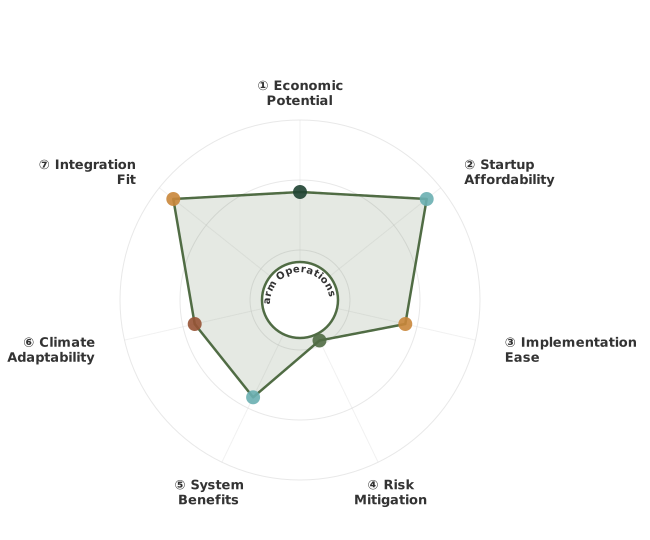
How These Traits Are Calculated
Trait dimensions are ordered clockwise starting from the top of the chart (12 o'clock position):
1. Economic Potential
Financial returns, annual value, and break-even timeline
WHAT: Evaluates financial viability by combining net annual value ($/ha from savings, income, and amortized harvests) with break-even timeline showing when practices pay for themselves.
WHY: Farmers need clear ROI understanding before committing resources. Fast payback (≤3 years) with strong returns (≥$300/ha) enables confident adoption, while long timelines (>10 years) restrict adoption to well-funded operations willing to wait for returns.
HOW: Calculated from net annual value in $/ha and break-even years. Exceptional (≥2.6): fast ROI ≤3 years + high value ≥$300/ha. Typical (1.8-2.5): moderate returns or longer timelines. Limited (<1.8): marginal economics or very long payback >10 years.
2. Startup Affordability
Initial investment costs and financial barrier to entry
WHAT: Measures financial barrier to entry through startup costs for equipment, infrastructure, consulting, and materials. Inverted scoring: lower costs = higher scores = more accessible adoption.
WHY: Affordability determines who can adopt. Low-cost practices (<$250/ha) enable widespread adoption across diverse scales, while high costs (>$2,500/ha) limit adoption to well-capitalized operations, creating barriers that slow regenerative transition.
HOW: Calculated from initial investment parsed from practice content. Inverted scoring: Exceptional (≥2.6): minimal investment <$250/ha. Typical (1.8-2.5): moderate costs $250-2,500/ha. Limited (<1.8): high barrier >$2,500/ha.
3. Implementation Ease
Learning curve and specialized knowledge required
WHAT: Measures how much learning, planning, and specialized knowledge a practice requires. Simpler practices with fewer steps score higher, while complex practices requiring extensive training or specialized resources score lower.
WHY: Complex practices create adoption barriers even when economically viable. Straightforward practices enable faster adoption and broader participation, while those requiring extensive training, timing precision, or specialized equipment limit who can succeed.
HOW: Evaluated by measuring documentation length and identifying complexity markers like location-specific requirements, seasonal timing windows, specialized skills, and dedicated equipment needs. Exceptional (≥2.6): straightforward practices with minimal prerequisites. Typical (1.8-2.5): moderate learning curve with some specialized needs. Limited (<1.8): steep learning curve requiring significant training or resources.
4. Risk Mitigation
Identified financial and ecological risk assessment
WHAT: Evaluates documented risks across financial (investment loss, market volatility) and ecological (crop failure, pest outbreaks) domains. Inverted scoring: fewer risks = higher scores.
WHY: Understanding risk exposure helps farmers make informed decisions. Low-risk practices allow confident implementation, while high-risk practices require careful planning and contingency resources. Risk transparency prevents costly failures.
HOW: Calculated from identified risks in practice content. Inverted scoring: Exceptional (≥2.6): ≤2 risks with manageable severity. Typical (1.8-2.5): 3-5 moderate risks. Limited (<1.8): 6+ risks or severe exposure.
5. System Benefits
How many ways the practice improves your land simultaneously
WHAT: Measures how many aspects of land health improve at once—carbon storage, soil quality, erosion control, water absorption, and biodiversity. Practices that improve multiple areas simultaneously create compounding benefits where each improvement reinforces the others.
WHY: The best practices solve multiple problems at once. For example, addressing erosion simultaneously builds carbon and improves water infiltration, creating a resilient system with positive feedback loops. Single-benefit approaches miss these compound transformation opportunities.
HOW: Evaluated across five key outcomes: carbon sequestration, soil organic matter increase, erosion reduction, water infiltration improvement, and biodiversity enhancement. Exceptional (≥2.6): high carbon storage (>8 t/ha/yr), improvements across 4-5 areas, transformative outcomes. Typical (1.8-2.5): moderate carbon (3-8 t/ha/yr), improvements across 2-3 areas. Limited (<1.8): modest impact (<3 t/ha/yr), single-area focus only.
6. Climate Adaptability
Geographic applicability across Köppen climate zones
WHAT: Evaluates geographic applicability by assessing how many Köppen climate zones successfully support a practice and what adaptation requirements are needed. Measures breadth of climates where farmers can implement with minimal to moderate modifications.
WHY: Universal practices working across diverse climates enable more farmers to adopt regenerative approaches. Practices limited to single climate types (only Mediterranean, only tropical) restrict adoption and slow global transition. Adaptability determines whether a practice serves niche regions or offers broad transformation.
HOW: LLM evaluation of regional success stories, Köppen zone coverage, and adaptation needs. Exceptional (≥2.6): 5+ zones or 4+ climate types, 3+ continents, minimal adaptation. Typical (1.8-2.5): 3-4 zones or 2-3 types, 2 continents, moderate adaptation. Limited (<1.8): 1-2 zones, single region, significant adaptation or highly specialized.
7. Integration Fit
How well this practice combines with others you're doing
WHAT: Measures how well a practice combines with other regenerative practices you might be doing. Some practices work as building blocks that make many other practices easier or more effective, while others work best on their own.
WHY: Practices that combine well with many others create more value on your farm. For example, cover cropping enables no-till, improves grazing, supports crop diversity, and helps water management—making all of them work better together. This helps you build a coherent system rather than juggling disconnected practices.
HOW: Evaluated by identifying which practices combine well and how strong those combinations are. 'Ideally Suited' means strong combinations where practices reinforce each other (practice A makes B easier, while B makes A more effective). 'Adequate' means complementary benefits that work well together. Exceptional (≥2.6): combines well with 6+ practices, serves as a building block. Typical (1.8-2.5): combines with 3-5 practices. Limited (<1.8): 1-2 practices or works best alone.
Going Deeper
1
WHY - The Benefits
Effective farm operations management is the linchpin of any successful agricultural endeavor, but in a regenerative context, its purpose extends far beyond mere productivity. It becomes the strategic framework for building a resilient, profitable, and ecologically sound...
Effective farm operations management is the linchpin of any successful agricultural endeavor, but in a regenerative context, its purpose extends far beyond mere productivity. It becomes the strategic framework for building a resilient, profitable, and ecologically sound...
WHY - The Benefits
Effective farm operations management is the linchpin of any successful agricultural endeavor, but in a regenerative context, its purpose extends far beyond mere productivity. It becomes the strategic framework for building a resilient, profitable, and ecologically sound...
Effective farm operations management is the linchpin of any successful agricultural endeavor, but in a regenerative context, its purpose extends far beyond mere productivity. It becomes the strategic framework for building a resilient, profitable, and ecologically sound...
Soil Health Benefits
Regenerative farm operations management directly translates into fundamental improvements in soil health. By prioritizing practices that minimize soil disturbance, managers ensure that soil structure is preserved and enhanced. This includes scheduling tillage operations (if any) only when absolutely necessary and using implements that reduce compaction and residue disturbance. Operations designed around cover cropping and perennial systems actively keep soil covered, preventing erosion from wind and water. This continuous soil cover provides habitat and food for soil biota, fostering a rich and diverse underground ecosystem.
The mandate to maintain living roots year-round, a core regenerative principle, is operationalized through strategic planning of crop rotations, cover cropping sequences, and grazing management. This ensures consistent photosynthetic activity, feeding soil microbes and contributing to soil organic matter accumulation. The integration of livestock is managed operationally to distribute manure, stimulate plant growth through controlled grazing, and cycle nutrients efficiently, further enhancing soil fertility and biological activity.
Quantifiably, farms adopting these operational strategies see significant improvements. Soil organic matter levels can increase by 0.5-1.5% over 5-10 years in many agricultural systems, with rates varying based on climate, starting soil condition, and management intensity. Water infiltration rates can improve by 50-100%, drastically reducing runoff and erosion. Soil aggregate stability, a key indicator of healthy soil structure, can increase by 20-40%, making soils more resilient to drought and heavy rainfall. The reduction in synthetic inputs, a common outcome of operational shifts to regenerative practices, also leads to a healthier, more balanced soil microbiome.
Economic Benefits
The economic advantages of well-managed regenerative farm operations are substantial and accrue over time. Initially, there may be higher upfront costs associated with transitioning to new equipment, implementing diverse rotations, or establishing fencing for integrated livestock. However, these investments typically yield significant returns.
Reduced input costs are a primary economic driver. By building soil fertility and health, the need for synthetic fertilizers, pesticides, and herbicides diminishes considerably. Farms can see reductions in these input costs ranging from 15-40% annually by year 5 of transition, as soil biology begins to fulfill its natural functions. This not only saves money but also reduces financial risk associated with volatile input markets.
Yield stability and improvement are also key. While some regenerative transitions might see temporary yield dips (5-15%) in the first 1-3 years, the long-term effect of improved soil structure, water retention, and nutrient cycling leads to more resilient crops. Many regenerative operations report yield increases of 10-25% over a 5-10 year period, particularly in drought conditions or other weather extremes where conventional systems fail.
Diversification of income streams is another powerful economic benefit. Integrating livestock into cropping systems, establishing agroforestry elements, or developing niche markets for regeneratively produced goods can add significantly to farm revenue. This diversification reduces reliance on single commodities and buffers against market volatility. Net income from diversified systems can be 20-50% higher than from monocultures.
Finally, operations management that prioritizes soil health and ecological resilience increases the long-term value of the farm asset itself. Healthy land with robust soil biology and water-holding capacity is more productive, less risky, and more attractive to future buyers or inheritors. Land value can see an increase of 10-30% over a decade due to its improved ecological function and reduced reliance on external inputs.
Regenerative Systems Fit
Farm operations management is foundational to integrating and maximizing the benefits of all regenerative agriculture principles. It acts as the conductor orchestrating the symphony of individual practices.
Principle 1 (Minimize Soil Disturbance): Operational management dictates the choice of equipment (e.g., no-till drills, cover crop rollers) and the scheduling of any necessary interventions to minimize soil disruption. This includes planning field access to avoid working wet soils, thus preventing compaction.
Principle 2 (Maximize Crop Diversity): The farm's crop rotation plan, including the integration of cover crops and potential companion planting or agroforestry elements, is a direct result of operational planning. This ensures a diverse mix of species above and below ground, offering varied root structures, nutrient cycling pathways, and habitat.
Principle 3 (Keep Soil Covered): Operational calendars determine planting and harvesting dates, ensuring that fields are covered by cash crops, cover crops, or mulch for the maximum possible duration. This active management prevents bare soil periods exposed to erosion and depletion.
Principle 4 (Maintain Living Roots): By strategically planning crop sequences and integrating perennials or dual-purpose cover crops, operations management ensures that living roots are present in the soil for as much of the year as possible, continuously feeding soil biology and maintaining soil structure.
Principle 5 (Integrate Livestock): For farms incorporating livestock, operational plans dictate grazing rotations, herd movements, infrastructure development (fencing, water), and the timing of integration with cropping cycles. This ensures livestock contribute positively to nutrient cycling, plant health, and soil building without causing overgrazing or compaction.
For farms transitioning from conventional practices, operational management plays a critical role in phasing out non-regenerative inputs. This involves a planned reduction in synthetic fertilizer and pesticide use over 3-5 years, replacing them with biologically-based solutions and diversified systems. This gradual transition, guided by performance monitoring and soil health indicators, minimizes the risk of yield crashes and economic instability, making the move toward a fully regenerative system more attainable and sustainable. The success of this phase-out is directly proportional to the thoughtfulness and rigor of the operational planning.
Sources behind this view
Videos & Podcasts
-
Regenerative agriculture provides solutions for climate change, human health, and soil degradation, contrasting with industrial agriculture's harmful impacts, including glyphosate use. Practices like
-
Provides actionable steps for regenerative agronomy: balanced N:C inputs (molasses, humates), microbial teas, yeast metabolites, calcium, and effective seed treatments. Emphasizes scalability, systems
-
Case studies of farmers like Duane Beck, Kofi Boa, David Brandt, and Gabe Brown demonstrate that regenerative agriculture (no-till, cover crops, diverse rotations) significantly increases soil health,
-
Adopts regenerative agriculture principles: minimize disturbance, keep living roots, use soil armor, integrate animals (livestock grazing, multi-species), and increase biodiversity. These practices bu

Community
-
Advocates for Soil Foodweb principles and Holistic Management, emphasizing land leasing and custom grazing/growing over labor-intensive methods. Focuses on soil restructuring for water availability an
Read more (opens in new window) permies.com -
Build healthy pasture soils by minimizing tillage, maintaining living roots and species diversity, and implementing proper grazing management. Livestock are essential for nutrient cycling and stimulat
Read more (opens in new window) smallfarms.cornell.edu -
Jon from Wild Roots Farm in Vermont advocates for regenerative practices like limited tillage, crop rotations, and rotational grazing to build resilience in food systems. He explains how these methods
Read more (opens in new window) smallfarms.cornell.edu -
Regenerative agriculture rebuilds soil organic matter and biodiversity through practices like cover cropping, reduced tillage, minimal artificial fertilizers, and regenerative grazing, ultimately impr
Read more (pp. 8-9) (opens PDF, pp. 8-9) permies.com
Research
-
Regenerative Agriculture: Restoring Ecosystems¢ Resilience and Productivity: A Review (opens in new window)
This study found: Regenerative agriculture builds soil health and ecosystem services through practices like no-till, cover crops, and diverse rotations. It increases soil organic matter, improves water infiltration, bo
-
The Indigenous Roots of Regenerative Agriculture (opens in new window)
This study found: Modern regenerative agriculture practices are rooted in millennia of Indigenous land stewardship, offering profound knowledge and a crucial value system of respect and reciprocity for true transformat
-
Systematic review of regenerative farming: Addressing agricultural sustainability challenges (opens in new window)
This study found: Systematic review of 31 studies shows regenerative farming improves soil health, biodiversity, and carbon capture, aiding sustainability. Technology is key for adoption, but policy, farmer understandi
-
Regenerative Agriculture: Insights and Challenges in Farmer Adoption (opens in new window)
This study found: Review of 7 regenerative agriculture practices (no-till, crop rotation, cover crops, etc.) highlights benefits and key adoption challenges like cost, farm size, and institutional barriers for scalable
From the Web
-
Key regenerative agriculture methods include no-till farming, cover cropping, agroforestry, perennial crops, planned rotational grazing (Holistic Management), and compost application, all aimed at imp
-
Regenerative agriculture regenerates topsoil, increases biodiversity, and improves carbon/water cycles through methods like minimal tillage, soil cover, diversity, and animal integration, boosting pro
-
Five steps to regenerative agriculture: Holistic Planned Grazing, no-till farming, planting diverse cover crops/interseeding, using compost/inoculants (with caution), and incorporating silvopasture/wo
-
Regenerative agriculture is achievable by focusing on soil health through six principles: know your context, cover the soil, minimize disturbance, increase diversity, maintain living plants/roots, and
2
WHERE - Regional Considerations
Farm operations management, while universal in its core principles, requires significant regional adaptation. The specific climate, soil types, available resources, market access, and regulatory environments all influence how operations are planned and executed to...
Farm operations management, while universal in its core principles, requires significant regional adaptation. The specific climate, soil types, available resources, market access, and regulatory environments all influence how operations are planned and executed to...
WHERE - Regional Considerations
Farm operations management, while universal in its core principles, requires significant regional adaptation. The specific climate, soil types, available resources, market access, and regulatory environments all influence how operations are planned and executed to...
Farm operations management, while universal in its core principles, requires significant regional adaptation. The specific climate, soil types, available resources, market access, and regulatory environments all influence how operations are planned and executed to...
Click Here to Look up your Region if you don't already know it
Humid Temperate Regions
Representative Locations: Southeastern United States, northern Europe (UK, Germany, Poland), eastern China, Japan, New Zealand
Climate Context: Warm to hot summers and cool to cold winters with moderate to high annual precipitation (75-150 cm or 30-60 inches) distributed relatively evenly. USDA Zones 6-8, Köppen Cfb/Cfa.
Operational Considerations: These regions offer long growing seasons, allowing for diverse crop rotations and multiple cover crop cycles per year. However, high rainfall can increase the risk of soil erosion and compaction, especially on heavy soils, demanding careful attention to soil cover and no-till practices. Operations often focus on managing excess moisture, integrating drainage solutions where necessary, and building soil structure to handle traffic. Livestock integration is generally highly successful, with ample forage potential. Challenges include disease pressure management in humid conditions and potential for nutrient leaching if soil cover is inadequate. Operational planning emphasizes timing of operations to avoid working wet soils and maximizing the use of resilient cash crops and diverse cover crop mixes that can withstand varied weather.
Mediterranean Regions
Representative Locations: California, Mediterranean basin (Spain, Italy, Greece), central Chile, southwestern Australia, Western Cape South Africa
Climate Context: Hot, dry summers and mild, wet winters. Annual precipitation 40-75 cm (15-30 inches), highly seasonal. USDA Zones 8-10, Köppen Csa/Csb.
Operational Considerations: The distinct wet and dry seasons heavily influence operational planning. Summer presents a significant challenge for keeping soil covered and maintaining living roots, necessitating drought-tolerant cover crops, efficient irrigation strategies (if used), and mulching techniques. Winter rains can lead to soil saturation and erosion if land is bare; therefore, planning for winter cover crops and early spring planting is critical. Operations often focus on water harvesting and conservation techniques, selecting drought-tolerant crop and livestock breeds, and optimizing grazing to match forage availability. Transitioning to regenerative no-till is highly beneficial for water retention. Operational planning might involve strategic scheduling of light-impact tillage only when necessary to break temporary surface crusting, immediately followed by cover cropping, or focusing on perennial systems.
Arid/Semi-Arid Regions
Representative Locations: Western USA, North Africa, Central Asia, Interior Australia, parts of Canada
Climate Context: Low annual precipitation (<40 cm or 15 inches), high temperatures, short and often unpredictable growing season. USDA Zones 7-9, Köppen BSh/BSk.
Operational Considerations: Water is the most critical limiting factor. Farm operations management must prioritize water conservation and efficient water use above all else. This means heavy reliance on no-till methods to maximize infiltration and reduce evaporation, extensive cover cropping with drought-tolerant species, and strategic livestock integration that complements forage production without overgrazing. Irrigation, if available, must be managed meticulously to avoid waterlogging and salinization, often integrated with soil moisture monitoring. Operational plans focus on maximizing the benefit of unpredictable rainfall, building soil organic matter to improve water-holding capacity, and selecting crops and livestock adapted to arid conditions. Planning often involves multi-year crop and livestock rotations to build resilience.
Cold Continental Regions
Representative Locations: Northern USA and Canada, Northern Europe, Northern Asia
Climate Context: Very short growing seasons, extreme summer heat, severe winter cold. USDA Zones 3-5, Köppen Dfa/Dfb.
Operational Considerations: The short growing season dictates a constrained operational window. Prioritizing quick-maturing cash crops and short-season cover crops is essential. Maximizing opportunity planting and harvesting is key. Keeping soil covered during the long, cold winters is crucial to prevent erosion and protect soil biology. Frost-tolerant cover crops or heavy mulch layers are vital. Operations in these regions often focus on building soil organic matter quickly to improve soil warming in spring and extend the effective growing season marginally. Livestock integration can provide fertility and manage crop residues, but requires robust infrastructure for winter housing and feeding. Operational planning needs to account for potential frost damage to crops and cover crops, and careful management of harvested residues.
Subtropical Regions
Representative Locations: Southeastern USA, Southern China, Southern Brazil, Eastern Australia
Climate Context: Hot, humid summers and mild winters with generally ample rainfall. USDA Zones 9-11, Köppen Cfa/Cwa.
Operational Considerations: These regions often have year-round potential for plant growth, allowing for continuous cover cropping and double-cropping. However, high heat and humidity can accelerate organic matter decomposition, requiring diligent soil building and cover cropping strategies to restore and maintain soil organic matter. Operations often focus on managing the risk of nutrient leaching due to high rainfall and the potential for soilborne diseases. Livestock can be integrated year-round, but heat stress management for animals and maintaining high-quality forage during hot periods are key operational concerns. Planning emphasizes plant diversity, selecting appropriate cover crops for different seasons, and optimizing grazing to manage forage quality and prevent overgrazing.
Tropical Regions
Representative Locations: Central America, Southeast Asia, East Africa, Northern Australia, Northern South America
Climate Context: High temperatures year-round, with distinct wet and dry seasons or consistent high rainfall. Köppen Af/Am/Aw.
Operational Considerations: Tropical regions offer extensive growing season potential but present unique challenges for regenerative operations, primarily related to rapid decomposition of organic matter in high heat and humidity, and intense rainfall during wet seasons. Intense rainfall necessitates aggressive soil cover and structural improvement to prevent erosion and nutrient loss. Operational management must focus on building soil organic matter to buffer against decomposition rates, selecting cover crops that thrive in high heat and humidity, and managing land to prevent runoff. Livestock integration is typically abundant, but managing forage quality and animal health in tropical conditions requires specialized knowledge. Planning emphasizes multi-strata diversity, erosion control, and optimizing land use to maximize biological activity throughout the year.
3
HOW - Implementation Process
Farm operations management in a regenerative context is about strategic planning and execution to achieve ecological and economic goals. This process is iterative and adaptive, moving from broad planning to detailed execution and continuous monitoring.
Farm operations management in a regenerative context is about strategic planning and execution to achieve ecological and economic goals. This process is iterative and adaptive, moving from broad planning to detailed execution and continuous monitoring.
HOW - Implementation Process
Farm operations management in a regenerative context is about strategic planning and execution to achieve ecological and economic goals. This process is iterative and adaptive, moving from broad planning to detailed execution and continuous monitoring.
Farm operations management in a regenerative context is about strategic planning and execution to achieve ecological and economic goals. This process is iterative and adaptive, moving from broad planning to detailed execution and continuous monitoring.
Prerequisites
- Clear Goals: Define specific objectives for the farm, whether economic (e.g., profitability targets, input cost reduction) or ecological (e.g., soil organic matter increase, biodiversity enhancement, water quality improvement).
- Resource Assessment: Understand available resources: land base and soil types, existing infrastructure (fencing, water, buildings), machinery, labor capacity, financial capital, and local knowledge.
- Site Assessment: Conduct a thorough assessment of current farm conditions, including soil health indicators (organic matter, aggregation, infiltration), current yield benchmarks, pest/disease pressures, and biodiversity levels.
- Learning & Research: Dedicate time to learning about regenerative principles and practices most suited to the farm's context. Engage with extension services, research institutions, and experienced regenerative farmers.
Phase 1: Strategic Planning (Annual/Multi-Year)
This phase involves setting the overarching direction for the farm’s operations.
Crop/Livestock Planning:
- Diversity: Design crop rotations that include a minimum of 3-4 crops and 1-2 cover crops per year. Consider including legumes, grasses, deep-rooted species, and potentially perennial crops or agroforestry elements.
- Livestock Integration: If applicable, plan the species, number, and type of livestock, and how they will interact with cropping cycles (e.g., grazing cover crops, pre-planting clean-up, post-harvest gleaning, or incorporating manure into cropping systems).
- Species Selection: Choose crop and livestock varieties that are adapted to local climate, soil conditions, and market demands, prioritizing resilience and nutritional quality for both humans and livestock.
Land Management Planning:
- Tillage Strategy: Commit to a no-till or minimum-till strategy. If severe compaction exists, plan for a one-time deep tillage intervention (as per the "One-Time Tillage for Severe Compaction Relief" practice) followed immediately by regenerative plantings.
- Soil Cover: Develop a strategy to maintain living cover or mulch on soil 365 days a year. This involves planning cover crop sequences for fallow periods, selecting cover crops that survive winter, or utilizing perennial crops and pastures.
- Water Management: Assess water needs and sources. Implement strategies to improve soil water infiltration and retention (e.g., no-till, cover crops, organic matter building). If irrigation is necessary, plan for efficiency using technologies like drip irrigation or soil moisture sensors.
Financial Planning:
- Budgeting: Develop detailed budgets for crop and livestock enterprises, including projected input costs (seeds, biologicals, minimal synthetics if transitioning), labor, machinery, and infrastructure.
- Investment Strategy: Plan for any necessary capital investments in machinery, fencing, water systems, or livestock infrastructure needed for regenerative practices.
- Risk Management: Identify potential financial risks (e.g., yield variability, market price fluctuations, input cost increases) and develop mitigation strategies.
Phase 2: Tactical Execution (Seasonal/Operational)
This phase translates the strategic plan into actionable tasks.
Field Operations:
- Field Preparation: If any minimal tillage is required, perform it at the optimal soil moisture conditions to avoid creating structural damage. Prioritize using implements that leave residue on the surface (e.g., chisel plows over moldboard plows).
- Planting/Seeding: Utilize no-till drills or planters for all crop and cover crop establishment to minimize soil disturbance and preserve soil structure. Ensure proper seed-to-soil contact and depth for optimal germination.
- Crop/Cover Crop Management: Monitor crop and cover crop growth. Implement timely interventions for nutrient management (e.g., compost application, biological inoculants), pest and disease scouting, and weed management through diverse planting, timing, and mechanical methods.
Livestock Management:
- Grazing Rotations: Implement planned grazing systems (e.g., rotational, adaptive, holistic planned grazing) using portable electric fencing, well-designed paddocks, and strategic water access. Ensure adequate rest periods for pasture regeneration.
- Animal Health: Maintain robust animal health programs focusing on preventative measures, good nutrition, and minimal reliance on synthetic medicines.
- Manure Management: Plan for manure distribution across fields through grazing or composting, turning waste into a valuable fertility resource.
Labor & Machinery:
- Scheduling: Develop detailed weekly or bi-weekly schedules for field operations, livestock care, and maintenance tasks.
- Machinery Maintenance: Ensure all equipment, especially no-till planters, rollers, and lighter-impact implements, are well-maintained to perform optimally and minimize soil disturbance. Schedule maintenance to coincide with low-activity periods.
Phase 3: Monitoring and Adaptation (Ongoing/Annual)
This is the feedback loop of operations management, allowing for continuous improvement.
Data Collection:
- Soil Health Monitoring: Regularly assess soil organic matter, infiltration rates, earthworm populations, aggregate stability, and other key indicators. Use visual assessments, spade tests, and standardized lab tests.
- Crop/Livestock Performance: Track yield data, stand counts, weed/pest/disease incidence, animal weight gains, reproductive rates, and feed conversion ratios.
- Financial Tracking: Keep meticulous records of all income and expenses, tracking profitability by enterprise and field. Monitor input usage and changes over time.
Analysis and Decision Making:
- Performance Review: Regularly analyze collected data against initial goals and benchmarks. Identify what is working well and what needs improvement.
- Adaptive Adjustments: Be prepared to adjust plans based on monitoring results. If cover crops aren't establishing, investigate causes. If livestock are causing compaction, adjust rest periods or stocking densities. If a particular crop is underperforming, consider its integration into the rotation or suitability for the site.
- Record Keeping: Maintain detailed farm records for all operations, inputs, outputs, and monitoring data. This is crucial for tracking progress, identifying trends, and making informed decisions.
[If Transition Practice:]
Transition Timeline & Phase-Out Strategy
For farms transitioning from conventional to regenerative operations management, a structured phase-out strategy for non-regenerative practices is crucial. This is not typically done "cold turkey," as abrupt changes can lead to economic and ecological instability.
Year 1-2: Foundation Building & Gradual Reduction
- Goal: Establish core regenerative practices and begin reducing reliance on synthetic inputs.
- Operational Changes:
- Implement diverse cover cropping on 50-75% of land, or all fallow land.
- Introduce no-till or reduced tillage for primary crop establishment.
- Begin gradual reduction of synthetic nitrogen fertilizer by 20-30%, compensating with compost, manure, or nitrogen-fixing cover crops.
- Scout for pests/diseases; introduce beneficial insect habitat; use targeted biological controls instead of broad-spectrum pesticides.
- If integrating livestock, start with small numbers or on a portion of the land, focusing on well-managed grazing.
- Monitoring Focus: Soil health indicators (organic matter, aggregation), cover crop establishment rates, presence of beneficial insects, initial changes in synthetic input use.
Year 3-4: Intensive Biology & Further Reduction
- Goal: Fully establish biological systems and significantly reduce or eliminate synthetic inputs.
- Operational Changes:
- Achieve 100% cover cropping for all fallow periods, aiming for year-round living roots.
- Fully transition to no-till or permanent minimum-till practices.
- Reduce synthetic nitrogen by another 30-50%. Eliminate synthetic pesticides if possible, relying on integrated pest management and ecological balance.
- Scale up livestock integration, ensuring sound grazing management practices.
- Invest in soil biology enhancement (e.g., compost teas, microbial inoculants) if beneficial.
- Monitoring Focus: Yield performance, soil biology metrics (earthworms, microbial activity), pest/disease pressure indices, changes in livestock performance, further reduction in input costs.
Year 5+: Fully Regenerative & Optimization
- Goal: Operate as a fully regenerative system, focusing on optimization and further enhancing ecological functions.
- Operational Changes:
- Eliminate synthetic nitrogen and pesticide inputs. Rely entirely on biological fertility and ecological balance.
- Optimize crop rotations and cover crop mixes for maximum biodiversity and soil building.
- Refine livestock integration for maximum benefit to soil and crop enterprises.
- Focus on building carbon, enhancing water cycling, and maximizing biodiversity.
- Monitoring Focus: Long-term soil health trends, economic viability of regenerative system, biodiversity counts, climate resilience indicators, farmer well-being.
Indicators of Readiness to Graduate:
- Consistent yield performance comparable to or exceeding previous levels, especially during stress years (drought, heavy rain).
- Measurable, sustained improvements in soil health indicators.
- Significant reduction in input costs and reliance on external synthetics.
- Increased presence of beneficial insects, pollinators, and soil organisms.
- Improved water infiltration and reduced erosion.
- Positive economic returns from the regenerative system, demonstrating financial viability.
The operational management must be characterized by patience, adaptation, and a commitment to ecological principles. Abruptly eliminating inputs or changing systems without building biological capacity can lead to yield crashes and economic hardship, undermining the transition. A phased, well-monitored approach, guided by ecological indicators, ensures a robust and lasting shift to regenerative farm operations.
Sources behind this view
Videos & Podcasts
-
Transitioning to regenerative agriculture is a human/psychological process requiring trials to reduce risk and build trust. Increased consumer awareness of ecology and health would drive demand for re
-
Regenerative agriculture provides solutions for climate change, human health, and soil degradation, contrasting with industrial agriculture's harmful impacts, including glyphosate use. Practices like
-
Provides actionable steps for regenerative agronomy: balanced N:C inputs (molasses, humates), microbial teas, yeast metabolites, calcium, and effective seed treatments. Emphasizes scalability, systems
-
Adopting regenerative practices should start small and incrementally, focusing on soil health over short-term yields. Collaboration, strategic nutrient sourcing, and leveraging resources like Continuu
Community
-
Advocates for converting conventional land to permaculture, recommending a gradual transition with cover crops and farmer collaboration, aiming to reduce chemical inputs over 3 years as soil heals.
Read more (opens in new window) permies.com
Research
-
Regenerative Agriculture: Restoring Ecosystems¢ Resilience and Productivity: A Review (opens in new window)
This study found: Regenerative agriculture builds soil health and ecosystem services through practices like no-till, cover crops, and diverse rotations. It increases soil organic matter, improves water infiltration, bo
-
The Indigenous Roots of Regenerative Agriculture (opens in new window)
This study found: Modern regenerative agriculture practices are rooted in millennia of Indigenous land stewardship, offering profound knowledge and a crucial value system of respect and reciprocity for true transformat
-
Systematic review of regenerative farming: Addressing agricultural sustainability challenges (opens in new window)
This study found: Systematic review of 31 studies shows regenerative farming improves soil health, biodiversity, and carbon capture, aiding sustainability. Technology is key for adoption, but policy, farmer understandi
-
Regenerative Agriculture: Insights and Challenges in Farmer Adoption (opens in new window)
This study found: Review of 7 regenerative agriculture practices (no-till, crop rotation, cover crops, etc.) highlights benefits and key adoption challenges like cost, farm size, and institutional barriers for scalable
From the Web
-
Five steps to regenerative agriculture: Holistic Planned Grazing, no-till farming, planting diverse cover crops/interseeding, using compost/inoculants (with caution), and incorporating silvopasture/wo
-
Regenerative agriculture is driven by principles like building soil health, promoting biodiversity, and enhancing climate resilience, adapted to local ecosystems, rather than a checklist of practices.
-
Regenerative agriculture improves soil health, forage, and resilience, but adoption faces practical, political, and personal barriers, requiring education, adaptation, and a mindset shift.
4
Know the Debate
Effective farm operations management is pivotal for regenerative agriculture, but its outcomes are deeply influenced by context. In humid regions w...
Know the Debate
Effective farm operations management is pivotal for regenerative agriculture, but its outcomes are deeply influenced by context. In humid regions w...
Effective farm operations management is pivotal for regenerative agriculture, but its outcomes are deeply influenced by context. In humid regions with reliable rainfall, transitions may show results within two years, while semi-arid rangelands require five to seven years for soil tests to reflect change. Entry costs vary significantly by scale, from $1,000-$7,000 for temporary fencing on small farms to $20,000+ for permanent infrastructure on larger operations, with daily labor of 1-2 hours for paddock moves being constant. The potential for input cost reduction spans 20-90% and yield gains from 10% to over 50%, driven by starting soil health and management intensity.
How long does regenerative transition take?
3-5 year recovery (ideal conditions)
Academic research suggests farms can achieve comparable or improved yields within 3-5 years with diligent cover cropping and no-till. This timeline assumes good starting soil health and meticulous management.
Sources behind this view
Sources behind this view
Videos & Podcasts
-
Farm planning translates to management change through self-audits and peer discussion, focusing on foundational principles and understanding the farm's 'operating system' before infrastructure planning.
Research
-
Regenerative Agriculture: Restoring Ecosystems¢ Resilience and Productivity: A Review (opens in new window)
This study found: Regenerative agriculture is a farming approach that views farms as living ecosystems, moving away from the 'take-make-dispose' model of conventional farming. Instead of relying heavily on outside inputs, it focuses on building up the farm's natural resources and services. Key practices include disturbing the soil as little as possible (like no-till or reduced tillage), planting cover crops, rotating different crops, integrating livestock in a managed way, using compost, reducing synthetic fertilizers and pesticides, and incorporating trees. The approach is tailored to each farm's specific conditions. Farmers monitor soil health indicators like organic matter, how well soil holds water, and the amount of life in the soil. Studies show that regenerative practices can significantly increase soil organic matter (by 0.5-2% in 3-5 years), improve water infiltration (2-10 times better), boost soil microbial life (30-50% more), and increase beneficial insects (60-80% more). Farms can also capture 0.5 to 3 tons of carbon per hectare annually. Economically, these farms often have 20-40% lower input costs and can be more profitable in the long run, becoming more productive and stable over time.
-
REGENERATIVE AGRICULTURE AND ITS ROLE IN IMPROVING SOIL HEALTH AND ECOSYSTEM RESILIENCE: A REVIEW (opens in new window)
This study found: This article reviews regenerative agriculture, a farming method that works with nature to fix problems like soil damage and lower crop yields. It focuses on rebuilding soil health, making farms more resilient to climate change, and strengthening entire ecosystems. The core ideas of regenerative farming are: understanding your local environment, disturbing the soil as little as possible (like reducing plowing), keeping the soil covered, having plants growing with roots in the ground all year, encouraging a wide variety of life on the farm, and bringing livestock back into the farming system. The review covers the advantages of this approach but also points out difficulties in getting farmers to adopt it, how to scale it up, and the importance of more long-term studies. It suggests regenerative agriculture offers a practical way for farms to be both productive and able to handle climate challenges.
From the Web
-
Profitability is crucial for enabling regenerative agriculture, allowing farmers to focus on soil health, sunshine, rainfall, and ingenuity over fossil fuels. Key management areas include production, economics, people, and marketing, with strategies for grazing, livestock, farming systems (no-till, cover crops), and marketing.
5-10 year recovery (realistic/degraded soils)
Experienced farmers report transition periods of 5-10 years, with yield dips in the first few years. Building soil biology and adapting management on degraded land takes considerable time and risk management.
Sources behind this view
Sources behind this view
Videos & Podcasts
-
Adopting regenerative practices should start small and incrementally, focusing on soil health over short-term yields. Collaboration, strategic nutrient sourcing, and leveraging resources like Continuum Ag are key to successful implementation.
-
Transitioning to regenerative agriculture requires a whole-systems mindset, focusing on soil health principles: reduce tillage/compaction, increase diversity (plants, animals), eliminate bio-cides/fertilizers. Plan transitions gradually, involve employees, monitor changes, and understand that soil regeneration is a long-term process.

-
Regenerative farming is a questioning thought process focused on reducing input costs by improving soil health. Key practices include managing soil weight, reducing tillage, and monitoring soil organic matter and microbial activity via tests like Solvita. This approach is context-dependent on soil type and climate.

Making Sense of the Differences
The transition timeline for regenerative agriculture varies based on starting soil conditions, climate, and management intensity. Farms with degraded soils or facing climate challenges may need 5-10 years for robust recovery, while those with better baseline health and optimal conditions may see significant improvements in 3-5 years. Patience, continuous learning, and adaptive management are key to navigating the transition, regardless of the specific timeline.
How much can input costs be reduced?
Significant reduction (15-40% annually)
Academic research and some practitioner reports indicate that by year 5, farms can expect annual input cost reductions of 15-40% due to reduced need for synthetic fertilizers and pesticides.
Sources behind this view
Sources behind this view
Research
-
Regenerative Agriculture: Restoring Ecosystems¢ Resilience and Productivity: A Review (opens in new window)
This study found: Regenerative agriculture is a farming approach that views farms as living ecosystems, moving away from the 'take-make-dispose' model of conventional farming. Instead of relying heavily on outside inputs, it focuses on building up the farm's natural resources and services. Key practices include disturbing the soil as little as possible (like no-till or reduced tillage), planting cover crops, rotating different crops, integrating livestock in a managed way, using compost, reducing synthetic fertilizers and pesticides, and incorporating trees. The approach is tailored to each farm's specific conditions. Farmers monitor soil health indicators like organic matter, how well soil holds water, and the amount of life in the soil. Studies show that regenerative practices can significantly increase soil organic matter (by 0.5-2% in 3-5 years), improve water infiltration (2-10 times better), boost soil microbial life (30-50% more), and increase beneficial insects (60-80% more). Farms can also capture 0.5 to 3 tons of carbon per hectare annually. Economically, these farms often have 20-40% lower input costs and can be more profitable in the long run, becoming more productive and stable over time.
-
REGENERATIVE AGRICULTURE AND ITS ROLE IN IMPROVING SOIL HEALTH AND ECOSYSTEM RESILIENCE: A REVIEW (opens in new window)
This study found: This article reviews regenerative agriculture, a farming method that works with nature to fix problems like soil damage and lower crop yields. It focuses on rebuilding soil health, making farms more resilient to climate change, and strengthening entire ecosystems. The core ideas of regenerative farming are: understanding your local environment, disturbing the soil as little as possible (like reducing plowing), keeping the soil covered, having plants growing with roots in the ground all year, encouraging a wide variety of life on the farm, and bringing livestock back into the farming system. The review covers the advantages of this approach but also points out difficulties in getting farmers to adopt it, how to scale it up, and the importance of more long-term studies. It suggests regenerative agriculture offers a practical way for farms to be both productive and able to handle climate challenges.
From the Web
-
Regenerative farming rebuilds soil health through practices like cover cropping, no-till, rotational grazing, and composting, focusing on long-term life and resilience over short-term yields.
-
Regenerative agriculture restores degraded soils by working with nature, enhancing soil health and profitability. Key practices reduce input costs, improve resilience, and benefit the environment through cleaner air and water.
Marginal to substantial reduction (20-90% over 7-10 years)
Experienced farmers report the possibility of very high input reductions (up to 70-90%) over 7-10 years by fully eliminating synthetics and leveraging on-farm fertility, though results vary widely.
Sources behind this view
Sources behind this view
Videos & Podcasts
-
Enhancing soil biology is key to profitable regenerative farming by reducing chemical inputs. Farmers must consider social, environmental, and financial contexts, analyze enterprise numbers, and fully adopt regenerative principles for exponential returns.

-
Regenerative agriculture is defined as a system that improves soil health, reduces external inputs, and enhances ecosystem function, leading to healthier plants, animals, and humans. It offers economic benefits through increased efficiency, reduced costs, and improved profitability, with a growing consumer demand for regeneratively produced products.
-
Regenerative farming requires eliminating synthetics, intensive management, and strategic marketing to triple gross margins. A diversified planting strategy (perennials like alfalfa, teff grass, hairy vetch; annuals like radishes, oats, barley, triticale, peas, clover; forage sugar beets) enhances nutrient density and soil health, creating products for CPG brands.

Making Sense of the Differences
Input cost reduction in regenerative agriculture ranges from moderate to substantial, depending on the farm's starting point and the depth of transition. Farms that fully eliminate synthetic inputs and build on-farm fertility (e.g., through livestock integration and cover crops) can achieve reductions of 70-90% over 7-10 years. However, many realize significant savings of 15-40% within 5 years by reducing reliance on external fertilizers and pesticides, with savings potentially plateauing as unique biological inputs are utilized.
What are the potential yield increases?
Modest increases (10-25% over 5-10 years)
Scientific literature suggests improved soil health can lead to yield stability in stressful conditions and modest crop increases over 5-10 years as biological systems develop.
Sources behind this view
Sources behind this view
Research
-
Regenerative Agriculture: Restoring Ecosystems¢ Resilience and Productivity: A Review (opens in new window)
This study found: Regenerative agriculture is a farming approach that views farms as living ecosystems, moving away from the 'take-make-dispose' model of conventional farming. Instead of relying heavily on outside inputs, it focuses on building up the farm's natural resources and services. Key practices include disturbing the soil as little as possible (like no-till or reduced tillage), planting cover crops, rotating different crops, integrating livestock in a managed way, using compost, reducing synthetic fertilizers and pesticides, and incorporating trees. The approach is tailored to each farm's specific conditions. Farmers monitor soil health indicators like organic matter, how well soil holds water, and the amount of life in the soil. Studies show that regenerative practices can significantly increase soil organic matter (by 0.5-2% in 3-5 years), improve water infiltration (2-10 times better), boost soil microbial life (30-50% more), and increase beneficial insects (60-80% more). Farms can also capture 0.5 to 3 tons of carbon per hectare annually. Economically, these farms often have 20-40% lower input costs and can be more profitable in the long run, becoming more productive and stable over time.
-
REGENERATIVE AGRICULTURE AND ITS ROLE IN IMPROVING SOIL HEALTH AND ECOSYSTEM RESILIENCE: A REVIEW (opens in new window)
This study found: This article reviews regenerative agriculture, a farming method that works with nature to fix problems like soil damage and lower crop yields. It focuses on rebuilding soil health, making farms more resilient to climate change, and strengthening entire ecosystems. The core ideas of regenerative farming are: understanding your local environment, disturbing the soil as little as possible (like reducing plowing), keeping the soil covered, having plants growing with roots in the ground all year, encouraging a wide variety of life on the farm, and bringing livestock back into the farming system. The review covers the advantages of this approach but also points out difficulties in getting farmers to adopt it, how to scale it up, and the importance of more long-term studies. It suggests regenerative agriculture offers a practical way for farms to be both productive and able to handle climate challenges.
-
Developing Sustainable Food Systems through Regenerative Agriculture (opens in new window)
This study found: This study reviewed different farming approaches like organic farming, conservation tillage (reducing plows), agroforestry (trees on farms), integrated pest management, permaculture, and regenerative agriculture. The goal was to find the best ways to build sustainable food systems that are good for the environment and ensure we have enough food long-term. After comparing their effects on soil health and crop harvests, the researchers concluded that regenerative agriculture stands out. It's considered the best overall for improving soil organic matter, preventing soil erosion, and making ecosystems more resilient, leading to better crop yields and environmental sustainability.
From the Web
-
Profitability is crucial for enabling regenerative agriculture, allowing farmers to focus on soil health, sunshine, rainfall, and ingenuity over fossil fuels. Key management areas include production, economics, people, and marketing, with strategies for grazing, livestock, farming systems (no-till, cover crops), and marketing.
Substantial increases (30-50%+ on degraded land)
Practitioner reports indicate substantial yield increases (30-50%+) on previously degraded land within 5-7 years. This is achieved through comprehensive soil biology building and adaptive management, especially with livestock integration.
Sources behind this view
Sources behind this view
Videos & Podcasts
-
Enhancing soil biology is key to profitable regenerative farming by reducing chemical inputs. Farmers must consider social, environmental, and financial contexts, analyze enterprise numbers, and fully adopt regenerative principles for exponential returns.
-
Regenerative farming reduces tillage to preserve soil carbon and water absorption, increases biodiversity through crop rotation and diversification, replenishes nutrients with compost and dung, and manages grazing livestock to prevent soil degradation.
-
Regenerative farming is a questioning thought process focused on reducing input costs by improving soil health. Key practices include managing soil weight, reducing tillage, and monitoring soil organic matter and microbial activity via tests like Solvita. This approach is context-dependent on soil type and climate.
-
Regenerative farming requires eliminating synthetics, intensive management, and strategic marketing to triple gross margins. A diversified planting strategy (perennials like alfalfa, teff grass, hairy vetch; annuals like radishes, oats, barley, triticale, peas, clover; forage sugar beets) enhances nutrient density and soil health, creating products for CPG brands.
Making Sense of the Differences
Yield outcomes in regenerative agriculture range from modest improvements (10-25%) over 5-10 years in established systems to substantial gains (30-50%+) on previously degraded land within 5-7 years. The higher end of gains is often seen when transitioning from severely depleted soils and integrating livestock effectively. Faster improvements are generally linked to the farm's capacity to quickly rebuild soil biology and structure, and the farmer's adaptive management skills.
5
HOW MUCH - Costs & Investment
Note: All costs are estimates and subject to significant variation based on region, scale, specific practices implemented, and existing infrastructure. Values are presented in USD equivalents. Local pricing for materials, equipment, and labor should always be researched.
Note: All costs are estimates and subject to significant variation based on region, scale, specific practices implemented, and existing infrastructure. Values are presented in USD equivalents. Local pricing for materials, equipment, and labor should always be researched.
HOW MUCH - Costs & Investment
Note: All costs are estimates and subject to significant variation based on region, scale, specific practices implemented, and existing infrastructure. Values are presented in USD equivalents. Local pricing for materials, equipment, and labor should always be researched.
Note: All costs are estimates and subject to significant variation based on region, scale, specific practices implemented, and existing infrastructure. Values are presented in USD equivalents. Local pricing for materials, equipment, and labor should always be researched.
Note: All costs are based on recent US economic data (2024–2026) and may vary substantially by region based on local labor rates, material costs, and regulatory requirements.
Equipment Upgrades & Retooling
Implementing regenerative farm operations requires specialized machinery to manage high-residue environments without disturbing soil structures. Small-scale operations (under 50 acres (20 ha)) typically budget $5,200–$31,300 for used no-till drills or retrofitting existing planters, including $1,000–$5,200 for roller-crimper attachments. Mid-size operations (50–500 acres (20–202 ha)) require more robust capacities, necessitating $31,300–$104,200 in capital. This range covers the acquisition of reliable used no-till equipment and $5,200–$15,600 for precision hydraulic fencing carts or specialized attachments. Large-scale operations (500+ acres) invest $104,200–$521,000 for high-capacity, precision-guided machinery, with advanced no-till drills alone ranging from $78,150–$260,500 and heavy-duty cover crop management tools exceeding $41,680.
Regenerative Inputs & Seeding
Shifting from synthetic-heavy inputs to biologicals requires a calibrated investment in the soil microbiome. Small-scale operations spend $52–$156 per acre ($128–$385/ha) on initial inoculants and biological fertilizers, while large-scale operations leverage volume purchasing to reduce these costs to $31–$104 per acre ($77–$257/ha). Cover crop seed—the engine of regenerative soil health—represents a recurring annual expense. Small enterprises typically allocate $78–$156 per acre ($193–$385/ha) for highly diverse seed mixes, whereas large-scale enterprises optimize logistics to drop costs to $52–$104 per acre ($128–$257/ha). These investments are specifically structured to build soil organic matter, which facilitates a 15–40% reduction in synthetic nitrogen requirements over a five-year cycle.
Infrastructure for Adaptive Grazing
Successful livestock integration requires robust fencing and water delivery to facilitate managed grazing. Small-scale configurations require $1,040–$5,200 for mobile electric fencing and basic solar-powered water pumps. Mid-size operations, which necessitate higher water volumes and more complex paddock rotation, typically invest $8,300–$36,500 for perimeter security and centralized watering galleries that prevent overgrazing. Large-scale installations, characterized by intensive rotational management, require $20,800–$104,200 to deploy automated water distribution grids that monitor herd hydration across hundreds of individual acres.
Management, Labor, and Data Training
Regenerative operations succeed through data-driven planning rather than mechanical repetition. Small operations often spend $312–$4,689 on professional workshops and certification training to gain technical proficiency. Mid-size operations typically allocate $2,080–$13,500 for specialized agronomic consulting to monitor soil health metrics such as aggregate stability and carbon sequestration. Large-scale enterprises, which require high-level operational oversight, hire dedicated managers or specialized consultants at an annual cost of $5,210–$26,050 to ensure systematic alignment of transition goals.
Most Spend: Most small operations invest $15,600–$26,050; mid-size operations invest $72,940–$114,620; and large-scale operations consistently invest $364,700–$521,000. These figures represent the typical barrier to entry when equipping for long-term soil health and operational efficiency.
Why the Range?: Cost fluctuations are primarily driven by the initial soil quality of the property and the level of mechanical automation chosen by the producer. Higher costs reflect the decision to purchase new, high-precision equipment or pay for premium soil-testing consulting, while lower costs indicate the effective use of repurposed machinery, DIY infrastructure projects, and participation in subsidized state or federal technical support programs.
Sources behind this view
Videos & Podcasts
-
Transitioning to regenerative farming costs $75k-$140k over two years but saves money compared to conventional nitrogen expenses ($195k/year). Start small (50-100 acres) with cover crops (hairy vetch,
-
Case studies of farmers like Duane Beck, Kofi Boa, David Brandt, and Gabe Brown demonstrate that regenerative agriculture (no-till, cover crops, diverse rotations) significantly increases soil health,
-
Soil Capital's strategy for regenerative transition: 1) Optimize agrochemical/pesticide use for 10-40% savings. 2) Invest savings in multi-species cover crops and crop rotation diversification (oats,
-
Regenerative farming, using no-till, cover crops, and diverse rotations, rapidly rebuilds soil organic matter and soil life. Examples from Ohio and Ghana show these practices increase profitability by
Research
-
Regenerative Agriculture: Restoring Ecosystems¢ Resilience and Productivity: A Review (opens in new window)
This study found: Regenerative agriculture builds soil health and ecosystem services through practices like no-till, cover crops, and diverse rotations. It increases soil organic matter, improves water infiltration, bo
-
Transition to Regenerative Farming (opens in new window)
This study found: A 5-year case study shows a farm successfully transitioned to regenerative practices, reducing soil erosion and increasing wildlife by using cover crops, diversified rotations, and reduced tillage. Pr
-
Systematic review of regenerative farming: Addressing agricultural sustainability challenges (opens in new window)
This study found: Systematic review of 31 studies shows regenerative farming improves soil health, biodiversity, and carbon capture, aiding sustainability. Technology is key for adoption, but policy, farmer understandi
-
Regenerative farming and conservation tillage: economic benefits and ecological impacts in contemporary agriculture (opens in new window)
This study found: Regenerative farming with conservation tillage (no-till, strip-till) improves soil health, reduces emissions, and boosts farm profits by cutting costs and stabilizing yields. Requires farmer training
6
REWARDS AND RISKS - Economics & Risk Factors
REWARDS AND RISKS - Economics & Risk Factors
Economic Scenarios
- Best Case Scenario: Within 3–5 years, diligent implementation of biological management yields a 15–25% reduction in synthetic input costs and a 10–20% increase in total harvest volume. By stacking livestock enterprises on top of existing cash crops, producers can boost gross revenue by 20–30%. Total net farm income levels increase by 30–50% annually, excluding potential carbon credit revenue or soil health premiums.
- Typical Scenario: Over a 5–7 year period, operations realize a 10–20% reduction in synthetic expenditure and stabilized yield growth of 5–10%. Diversified revenue from auxiliary enterprises adds 10–20% to gross turnover. Net farm income sees sustained annual growth of 15–25%, with the initial capital investment reaching full break-even within 4–6 years.
- Worst Case Scenario: Poor execution—such as neglecting the establishment of living soil cover or mismanaged grazing—can lead to yield reductions of 10–20%. High costs for unproven biological inputs coupled with negative production trends result in annual losses of $100–$300 per acre ($247–$741/ha) during the first 3 years. This typically stems from a failure to synchronize the reduction of synthetic inputs with the gradual recovery of soil biological functionality.
Market Factors & Risk Mitigation Regenerative operations decouple farm income from the volatility of synthetic nitrogen and fuel markets. Risk mitigation is primarily achieved through: 1. Phased Implementation: Reducing synthetic nitrogen applications in 20% increments prevents total system shock and allows soil microbes to take over nutrient cycling duties gradually. 2. Cost-Share Integration: Leveraging USDA programs, such as EQIP or CSP, can offset 50–75% of equipment modification and infrastructure fencing costs, effectively reducing net capital exposure by $5,200–$52,100 per farm. 3. Enterprise Diversification: Integrating livestock functions as a financial hedge, as grazing revenue is generally uncorrelated with commodity cash crop price swings, providing an additional $10–$80 per acre ($25–$198/ha) in revenue diversity.
Transition Period Risks The 3–7 year transition period requires aggressive management to avoid common bottlenecks:
- Yield Dips: Expect a potential 5–15% yield reduction during years 1–3. Mitigation involves using reduced-rate starter fertilizers and deep-mulch cover crops to maintain soil temperature.
- Timeline to Recovery: Converting raw manure and plant residue into plant-available nitrogen is the greatest economic hurdle. In cooler climates, this "biological bridge" can take up to 5 years to peak.
- Operational Risk: Improper residue management can hinder seed-to-soil contact. Investing $2,080–$10,420 in specialized row cleaners and pressurized down-force settings on planters is a necessary corrective measure to prevent early-season germination failure.
Sources behind this view
Videos & Podcasts
-
Transitioning to regenerative agriculture is a human/psychological process requiring trials to reduce risk and build trust. Increased consumer awareness of ecology and health would drive demand for re
-
Regenerative agriculture provides solutions for climate change, human health, and soil degradation, contrasting with industrial agriculture's harmful impacts, including glyphosate use. Practices like
-
Case studies of farmers like Duane Beck, Kofi Boa, David Brandt, and Gabe Brown demonstrate that regenerative agriculture (no-till, cover crops, diverse rotations) significantly increases soil health,
-
Soil Capital's strategy for regenerative transition: 1) Optimize agrochemical/pesticide use for 10-40% savings. 2) Invest savings in multi-species cover crops and crop rotation diversification (oats,
Community
-
Advocates for converting conventional land to permaculture, recommending a gradual transition with cover crops and farmer collaboration, aiming to reduce chemical inputs over 3 years as soil heals.
Read more (opens in new window) permies.com -
Key takeaways for scaling regenerative agriculture include consistent certification standards, secure data sharing, long-term investment and financing, supply chain transparency, and collaborative eff
Read more (opens in new window) ucanr.edu
Research
-
Regenerative Livestock Farming as a Socioeconomic Model for Sustainable Agribusiness in Latin America (opens in new window)
This study found: Regenerative livestock farming in Latin America improved soil carbon, biodiversity, and water quality, while boosting farmer income and quality of life. Government support is key for wider adoption.
-
Regenerative Agriculture: Restoring Ecosystems¢ Resilience and Productivity: A Review (opens in new window)
This study found: Regenerative agriculture builds soil health and ecosystem services through practices like no-till, cover crops, and diverse rotations. It increases soil organic matter, improves water infiltration, bo
-
Systematic review of regenerative farming: Addressing agricultural sustainability challenges (opens in new window)
This study found: Systematic review of 31 studies shows regenerative farming improves soil health, biodiversity, and carbon capture, aiding sustainability. Technology is key for adoption, but policy, farmer understandi
-
Transition to Regenerative Farming (opens in new window)
This study found: A 5-year case study shows a farm successfully transitioned to regenerative practices, reducing soil erosion and increasing wildlife by using cover crops, diversified rotations, and reduced tillage. Pr
From the Web
-
Five steps to regenerative agriculture: Holistic Planned Grazing, no-till farming, planting diverse cover crops/interseeding, using compost/inoculants (with caution), and incorporating silvopasture/wo
-
Regenerative agriculture aligns environmental and financial goals by improving soil health, leading to cost savings and better plant nutrition. This approach demonstrates economic viability, encouragi
-
Regenerative agriculture restores degraded soils by working with nature, enhancing soil health and profitability. Key practices reduce input costs, improve resilience, and benefit the environment thro
-
Regenerative agriculture shifts focus from yield to net profit, reducing input costs by leveraging nature's free resources. This requires new financial and observational skills, potentially culling li
7
COMPATIBLE PRACTICES - Integration Opportunities
Effective farm operations management is enhanced by integrating with a range of other regenerative practices. This integration amplifies benefits, creating synergistic effects that accelerate ecological regeneration and economic stability.
Effective farm operations management is enhanced by integrating with a range of other regenerative practices. This integration amplifies benefits, creating synergistic effects that accelerate ecological regeneration and economic stability.
COMPATIBLE PRACTICES - Integration Opportunities
Effective farm operations management is enhanced by integrating with a range of other regenerative practices. This integration amplifies benefits, creating synergistic effects that accelerate ecological regeneration and economic stability.
Effective farm operations management is enhanced by integrating with a range of other regenerative practices. This integration amplifies benefits, creating synergistic effects that accelerate ecological regeneration and economic stability.
Cover Cropping
- Integration: Part of the crop rotation and fallow period management.
- Benefit: Maintains soil cover, adds organic matter, improves soil structure, suppresses weeds, fixes nitrogen, provides forage for livestock. Operational decisions directly influence cover crop success.
No-Till or Minimum-Tillage Farming
- Integration: Core principle of field preparation and planting operations.
- Benefit: Minimizes soil disturbance, preserves soil structure, retains moisture, supports soil biology, reduces erosion. Operations must be planned around its requirements.
Crop Rotation & Diversity
- Integration: The backbone of crop planning in the operational calendar.
- Benefit: Breaks pest and disease cycles, improves soil fertility (legumes), enhances soil structure (diverse root systems), diversifies risk.
Adaptive Multi-Paddock Grazing
- Integration: Planned rotations of livestock across pastures and crop residues.
- Benefit: Distributes fertility, stimulates plant growth, prevents overgrazing, helps manage crop residues, builds soil organic matter. Requires careful operational planning for herd movement and pasture rest.
Agroforestry / Silvopasture
- Integration: Incorporating trees into cropping or grazing land.
- Benefit: Adds multiple layers of diversity, provides shade and habitat, sequesters carbon, offers additional income streams (timber, nuts, fruit), improves microclimate. Requires long-term operational planning.
Composting & Manure Management
- Integration: Recycling on-farm organic matter and livestock waste.
- Benefit: Creates nutrient-rich soil amendments, reduces waste, improves soil fertility and structure. Operational plan includes composting facility management and application timing.
Water Harvesting & Conservation
- Integration: Designing land contours, using swales, managing irrigation efficiency.
- Benefit: Improves water availability and infiltration, reduces erosion, enhances drought resilience. Operational planning can incorporate water management structures.
Biological Pest & Disease Management
- Integration: Promoting beneficial insects, using microbial inoculants, selecting resistant varieties.
- Benefit: Reduces reliance on synthetic pesticides, supports soil biology, enhances plant health. Operational focus shifts from eradication to ecosystem balance.
Holistic Planned Grazing
- Integration: Detailed planning of livestock movement and rest periods.
- Benefit: Optimizes pasture production, enhances soil health, integrates animal and plant cycles. Requires meticulous daily/weekly operational planning.
The success of farm operations management is directly linked to how well it integrates these practices. For example, a no-till operation is significantly enhanced by strong cover cropping and diverse crop rotations, which provide the biological activity and organic matter needed to maintain soil health without tillage. Similarly, livestock integrated through adaptive grazing can significantly boost crop nutrient cycling and weed management when operations are planned in concert. For farms transitioning from conventional agriculture, operational management must strategically introduce and scale up these compatible practices, phasing out less regenerative elements over time. ```
Sources behind this view
Videos & Podcasts
-
Regenerative agriculture provides solutions for climate change, human health, and soil degradation, contrasting with industrial agriculture's harmful impacts, including glyphosate use. Practices like
-
Holistic management with cattle is key to improving soil health, water cycles, and carbon sequestration. Maximize animal impact (hooves, dung, urine) for diversity and plant growth, while breeding cat
-
Utilize multi-species cover crops based on specific 'resource concerns' to improve soil health, nitrogen fixation, and water retention. Integrate livestock for grazing, calving, and overwintering, enh
-
Provides actionable steps for regenerative agronomy: balanced N:C inputs (molasses, humates), microbial teas, yeast metabolites, calcium, and effective seed treatments. Emphasizes scalability, systems
Community
-
Advocates for Soil Foodweb principles and Holistic Management, emphasizing land leasing and custom grazing/growing over labor-intensive methods. Focuses on soil restructuring for water availability an
Read more (opens in new window) permies.com -
Build healthy pasture soils by minimizing tillage, maintaining living roots and species diversity, and implementing proper grazing management. Livestock are essential for nutrient cycling and stimulat
Read more (opens in new window) smallfarms.cornell.edu -
Explains regenerative agriculture principles: no-till gardening to support soil microbiome and sequester carbon; using compost to reduce erosion and compaction; and planting diverse cover crops (grass
Read more (opens in new window) ucanr.edu -
Regenerative agriculture rebuilds soil organic matter and biodiversity through practices like cover cropping, reduced tillage, minimal artificial fertilizers, and regenerative grazing, ultimately impr
Read more (pp. 8-9) (opens PDF, pp. 8-9) permies.com
Research
-
Regenerative Agriculture: Restoring Ecosystems¢ Resilience and Productivity: A Review (opens in new window)
This study found: Regenerative agriculture builds soil health and ecosystem services through practices like no-till, cover crops, and diverse rotations. It increases soil organic matter, improves water infiltration, bo
-
The Indigenous Roots of Regenerative Agriculture (opens in new window)
This study found: Modern regenerative agriculture practices are rooted in millennia of Indigenous land stewardship, offering profound knowledge and a crucial value system of respect and reciprocity for true transformat
-
Managing Grazing to Restore Soil Health, Ecosystem Function, and Ecosystem Services (opens in new window)
This study found: Properly managed grazing animals can reverse environmental damage. Regenerative practices, like Adaptive Multi-Paddock (AMP) grazing, boost soil health, increase soil carbon, reduce erosion, and enhan
-
Systematic review of regenerative farming: Addressing agricultural sustainability challenges (opens in new window)
This study found: Systematic review of 31 studies shows regenerative farming improves soil health, biodiversity, and carbon capture, aiding sustainability. Technology is key for adoption, but policy, farmer understandi
From the Web
-
Key regenerative agriculture methods include no-till farming, cover cropping, agroforestry, perennial crops, planned rotational grazing (Holistic Management), and compost application, all aimed at imp
-
Five steps to regenerative agriculture: Holistic Planned Grazing, no-till farming, planting diverse cover crops/interseeding, using compost/inoculants (with caution), and incorporating silvopasture/wo
-
Six soil health principles (context, cover, minimize disturbance, diversity, living roots, integrate livestock) guide regenerative agriculture within four ecosystem processes (energy, water, nutrient
-
Regenerative agriculture restores soil health through practices like cover cropping and crop rotation, leading to carbon sequestration, increased resiliency, and reduced reliance on off-farm inputs, b