
Installing Filter Strips
Filter strips are permanently vegetated areas of grasses, forbs, or shrubs planted alongside water bodies, ditches, or critical areas. They act as a natural buffer, slowing down runoff, trapping sediment, nutrients, and pesticides before they reach sensitive water resources. They are versatile tools implemented across various agricultural landscapes to improve water quality and enhance on-farm biodiversity.
Read More: Complete Description
Filter strips, also known as buffer strips, are specifically designed vegetated zones established along watercourses, field edges, drainage ditches, or other areas prone to runoff. Their primary purpose is to intercept overland flow (sheet flow) from adjacent agricultural fields before it enters streams, rivers, lakes, or groundwater. The plants within the strip—typically diverse mixes of grasses, legumes, and forbs—slow down the speed of this incoming water. This reduction in velocity allows suspended solids, such as silt and clay particles, to settle out and be trapped within the strip. Furthermore, the plant roots and microbial communities within the filter strip absorb excess nutrients (like nitrogen and phosphorus) and can bind or break down pesticides that are otherwise carried by runoff.
These vegetated buffers offer a multitude of benefits that align well with regenerative agriculture principles, particularly when designed and managed with ecological function in mind. By reducing soil erosion from fields and trapping sediment, filter strips directly support Principle 1 (Minimize Soil Disturbance) by preventing valuable topsoil from leaving the farm. The introduction of diverse plant species in the filter strip contributes to Principle 2 (Maximize Crop Diversity), creating habitat above and below ground not only for beneficial insects and pollinators but also for soil microbes and fungi. Allowing roots to grow year-round and the presence of living plants in the strip upholds Principle 3 (Keep Soil Covered) and Principle 4 (Maintain Living Roots), preventing bare soil and continuous biological activity. While not directly integrating livestock, they create healthier surrounding ecosystems that can better support integrated grazing systems by protecting water sources and enhancing local biodiversity, indirectly supporting Principle 5 (Integrate Livestock) by safeguarding the overall farm ecosystem.
The effectiveness of a filter strip is determined by several factors: its width, the type and density of vegetation, the slope of the land, and the volume and speed of runoff it receives. Wider strips generally trap more sediment and nutrients, provide more robust habitat, and offer greater infiltration capacity. A dense vegetation mix, including grasses for filtering and forbs/shrubs for deeper root penetration and habitat diversity, is more effective than monocultures. The slope plays a crucial role; steeper slopes mean faster runoff and a greater need for wider, denser strips. International application of filter strips is widespread, from protecting rice paddies in Asia from nutrient runoff to buffering cattle ranches in South America from soil erosion, and maintaining water quality for vineyards in Europe.
While filter strips are often recognized for their environmental services, they can also provide economic benefits. They can reduce the need for costly sediment removal from drainage systems, protect downstream water rights, and contribute to the long-term health of the agricultural landscape. For farmers, filter strips can be integrated into conservation programs offering financial incentives, making them an economically sound investment. They can also provide forage for certain livestock, habitat for game species, or materials for biomass if managed sustainably.
However, filter strips are not a panacea and can be an extractive practice if poorly managed. Overgrown strips can become weed reservoirs, or if they collect excessive sediment, they can become choked and lose function. Inadequate vegetation or width can lead to channelized flow and erosion within the strip itself. The key is intentional design and ongoing stewardship. Transitioning to filter strips is generally straightforward, but requires commitment to establishing and maintaining the vegetated area, which may initially take land out of production or require adjustments to farm equipment access.
Ultimately, filter strips are a context-dependent practice that can be highly regenerative when implemented strategically as part of a whole-farm plan. They are a testament to nature-based solutions, leveraging the power of plant communities to mitigate environmental risks while building ecological resilience. Their widespread adoption across continents reflects their established value in protecting water resources and enhancing ecological functions within agricultural landscapes.
Sources behind this view
Sources behind this view
 Videos & Podcasts
-
Riparian buffers at field edges are crucial for water quality, acting as filters and slowing runoff. They also offer economic, recreational, and ecological benefits, and can be managed for non-timber

-
Riparian forest buffers (trees, shrubs, herbs) filter runoff, stabilize soil, protect water quality, and support wildlife. Example in western Wisconsin. Can also provide income from nut/berry shrubs.

 Community
-
Contour buffer strips (NRCS Code 332) reduce soil erosion, sediment transport, and runoff velocity by using vegetated strips on the contour, improving water quality and wildlife habitat.
Read more (pp. 1-2) (opens PDF, pp. 1-2) efotg.sc.egov.usda.gov -
NRCS Contour Buffer Strips (Practice 332) on sloping cropland reduce erosion, increase infiltration, and enhance biodiversity. They improve soil health and water quality, with variable impacts on crop
Read more (p. 1) (opens PDF, p. 1) efotg.sc.egov.usda.gov
 Research
-
Riparian vegetated buffer strips in water‐quality restoration and stream management (opens in new window)
This study found: Vegetated buffer strips along streams significantly reduced nitrogen runoff from corn/soybean fields in Illinois. Wooded buffers were better for nitrogen, grassy for phosphorus, but both released phos
-
A design aid for sizing filter strips using buffer area ratio (opens in new window)
This study found: A new design tool helps farmers size filter strips based on buffer area ratio, improving pollutant removal on fields with uneven runoff. It considers slope, soil, and management to achieve specific wa
-
Sediment and Chemical Load Reduction by Grass and Riparian Filters (opens in new window)
This study found: Grass and riparian filter strips in North Carolina reduced agricultural runoff loads by 50-80% for sediment and nutrients, though heavy rains could overwhelm them.
-
Riparian buffer effectiveness as a function of buffer design and input loads (opens in new window)
This study found: Flexible riparian buffer designs with harvesting options had minimal impact (<5%) on nutrient and sediment removal, but buffers with lower removal efficiency removed more total pollution mass under hi
Key Points
What It Is
- Vegetated buffer along watercourses
- Traps sediment, nutrients, and pesticides
- Reduces runoff velocity at field edges
- Minimum width: 3 meters (10 feet)
Why Do It
- Protects water quality from agricultural runoff
- Reduces soil erosion from fields
- Enhances on-farm biodiversity and habitat
- Supports Principles 1, 2, 3, 4 Regenerative Ag
Benefits - Financial
- Cost-share programs offset 50–80% of total initial investment costs.
- Reduced fertilizer wastage saves $25–$45 per acre ($62–$111 per hectare) annually.
- Potential land value increase of 2–5% via water management improvements.
Benefits - System
- Sediment trapping efficiency: 60-85% increase
- Nutrient uptake: 15-50% of N & P removed
- Supports pollinators and beneficial insects
- Maintains connectivity in farm ecosystem
Risks - Financial
- Full reseeding failure costs ranging from $200–$500 per acre ($494–$1,236 per hectare).
- Annual maintenance and upkeep costs of $25–$50 per acre ($62–$124 per hectare).
- Opportunity cost of land revenue loss: $150–$300 per acre ($371–$741 per hectare) per year.
Risks - System
- Plant establishment failure in drought
- Can become weed seed source if unmanaged
- May channelize water if not properly designed
- Ineffective if runoff overwhelms capacity
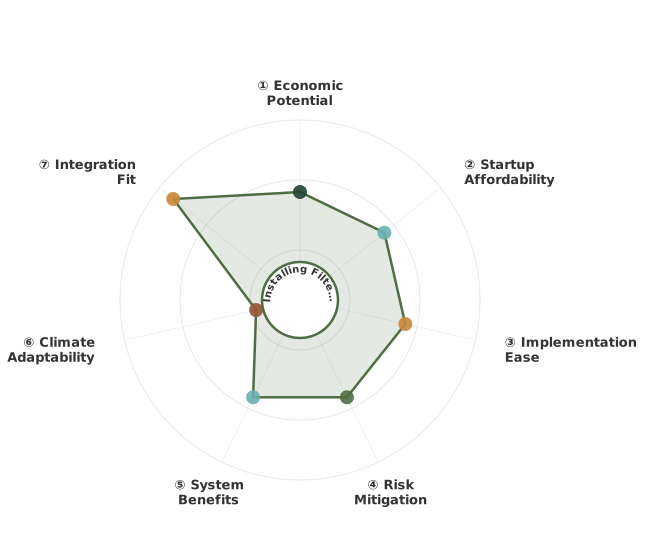
How These Traits Are Calculated
Trait dimensions are ordered clockwise starting from the top of the chart (12 o'clock position):
1. Economic Potential
Financial returns, annual value, and break-even timeline
WHAT: Evaluates financial viability by combining net annual value ($/ha from savings, income, and amortized harvests) with break-even timeline showing when practices pay for themselves.
WHY: Farmers need clear ROI understanding before committing resources. Fast payback (≤3 years) with strong returns (≥$300/ha) enables confident adoption, while long timelines (>10 years) restrict adoption to well-funded operations willing to wait for returns.
HOW: Calculated from net annual value in $/ha and break-even years. Exceptional (≥2.6): fast ROI ≤3 years + high value ≥$300/ha. Typical (1.8-2.5): moderate returns or longer timelines. Limited (<1.8): marginal economics or very long payback >10 years.
2. Startup Affordability
Initial investment costs and financial barrier to entry
WHAT: Measures financial barrier to entry through startup costs for equipment, infrastructure, consulting, and materials. Inverted scoring: lower costs = higher scores = more accessible adoption.
WHY: Affordability determines who can adopt. Low-cost practices (<$250/ha) enable widespread adoption across diverse scales, while high costs (>$2,500/ha) limit adoption to well-capitalized operations, creating barriers that slow regenerative transition.
HOW: Calculated from initial investment parsed from practice content. Inverted scoring: Exceptional (≥2.6): minimal investment <$250/ha. Typical (1.8-2.5): moderate costs $250-2,500/ha. Limited (<1.8): high barrier >$2,500/ha.
3. Implementation Ease
Learning curve and specialized knowledge required
WHAT: Measures how much learning, planning, and specialized knowledge a practice requires. Simpler practices with fewer steps score higher, while complex practices requiring extensive training or specialized resources score lower.
WHY: Complex practices create adoption barriers even when economically viable. Straightforward practices enable faster adoption and broader participation, while those requiring extensive training, timing precision, or specialized equipment limit who can succeed.
HOW: Evaluated by measuring documentation length and identifying complexity markers like location-specific requirements, seasonal timing windows, specialized skills, and dedicated equipment needs. Exceptional (≥2.6): straightforward practices with minimal prerequisites. Typical (1.8-2.5): moderate learning curve with some specialized needs. Limited (<1.8): steep learning curve requiring significant training or resources.
4. Risk Mitigation
Identified financial and ecological risk assessment
WHAT: Evaluates documented risks across financial (investment loss, market volatility) and ecological (crop failure, pest outbreaks) domains. Inverted scoring: fewer risks = higher scores.
WHY: Understanding risk exposure helps farmers make informed decisions. Low-risk practices allow confident implementation, while high-risk practices require careful planning and contingency resources. Risk transparency prevents costly failures.
HOW: Calculated from identified risks in practice content. Inverted scoring: Exceptional (≥2.6): ≤2 risks with manageable severity. Typical (1.8-2.5): 3-5 moderate risks. Limited (<1.8): 6+ risks or severe exposure.
5. System Benefits
How many ways the practice improves your land simultaneously
WHAT: Measures how many aspects of land health improve at once—carbon storage, soil quality, erosion control, water absorption, and biodiversity. Practices that improve multiple areas simultaneously create compounding benefits where each improvement reinforces the others.
WHY: The best practices solve multiple problems at once. For example, addressing erosion simultaneously builds carbon and improves water infiltration, creating a resilient system with positive feedback loops. Single-benefit approaches miss these compound transformation opportunities.
HOW: Evaluated across five key outcomes: carbon sequestration, soil organic matter increase, erosion reduction, water infiltration improvement, and biodiversity enhancement. Exceptional (≥2.6): high carbon storage (>8 t/ha/yr), improvements across 4-5 areas, transformative outcomes. Typical (1.8-2.5): moderate carbon (3-8 t/ha/yr), improvements across 2-3 areas. Limited (<1.8): modest impact (<3 t/ha/yr), single-area focus only.
6. Climate Adaptability
Geographic applicability across Köppen climate zones
WHAT: Evaluates geographic applicability by assessing how many Köppen climate zones successfully support a practice and what adaptation requirements are needed. Measures breadth of climates where farmers can implement with minimal to moderate modifications.
WHY: Universal practices working across diverse climates enable more farmers to adopt regenerative approaches. Practices limited to single climate types (only Mediterranean, only tropical) restrict adoption and slow global transition. Adaptability determines whether a practice serves niche regions or offers broad transformation.
HOW: LLM evaluation of regional success stories, Köppen zone coverage, and adaptation needs. Exceptional (≥2.6): 5+ zones or 4+ climate types, 3+ continents, minimal adaptation. Typical (1.8-2.5): 3-4 zones or 2-3 types, 2 continents, moderate adaptation. Limited (<1.8): 1-2 zones, single region, significant adaptation or highly specialized.
7. Integration Fit
How well this practice combines with others you're doing
WHAT: Measures how well a practice combines with other regenerative practices you might be doing. Some practices work as building blocks that make many other practices easier or more effective, while others work best on their own.
WHY: Practices that combine well with many others create more value on your farm. For example, cover cropping enables no-till, improves grazing, supports crop diversity, and helps water management—making all of them work better together. This helps you build a coherent system rather than juggling disconnected practices.
HOW: Evaluated by identifying which practices combine well and how strong those combinations are. 'Ideally Suited' means strong combinations where practices reinforce each other (practice A makes B easier, while B makes A more effective). 'Adequate' means complementary benefits that work well together. Exceptional (≥2.6): combines well with 6+ practices, serves as a building block. Typical (1.8-2.5): combines with 3-5 practices. Limited (<1.8): 1-2 practices or works best alone.
Going Deeper
1
WHY - The Benefits
Filter strips are a cornerstone practice in ecological farming, offering a vital link between agricultural activity and environmental health. They are intentionally designed vegetated zones that serve multiple ecological and economic functions, primarily focused on...
Filter strips are a cornerstone practice in ecological farming, offering a vital link between agricultural activity and environmental health. They are intentionally designed vegetated zones that serve multiple ecological and economic functions, primarily focused on...
WHY - The Benefits
Filter strips are a cornerstone practice in ecological farming, offering a vital link between agricultural activity and environmental health. They are intentionally designed vegetated zones that serve multiple ecological and economic functions, primarily focused on...
Filter strips are a cornerstone practice in ecological farming, offering a vital link between agricultural activity and environmental health. They are intentionally designed vegetated zones that serve multiple ecological and economic functions, primarily focused on...
Soil Health Benefits
Filter strips directly address soil health by acting as a critical defense against erosion. When overland flow from fields enters the wider, densely vegetated filter strip, its speed is significantly reduced. This allows heavier soil particles, such as silt and sand, to settle out and be deposited within the strip, preventing them from reaching watercourses. This sediment retention is crucial for preserving the fertile topsoil of the field itself, ensuring that valuable organic matter and nutrients remain where they are needed for crop production.
The dense root systems of the grasses and forbs that comprise a filter strip are instrumental in stabilizing the soil within the strip itself, preventing it from being eroded by runoff. These root networks also improve soil structure, increase organic matter content over time through decomposition, and enhance water infiltration into the soil profile within the buffer zone. This localized improvement in soil health within the filter strip creates a more resilient micro-environment that can support a greater diversity of soil microbes and invertebrates.
Economic Benefits
The economic viability of filter strips is often a key driver for their adoption. Many governments and conservation organizations offer financial incentives, cost-share programs, or tax credits for establishing and maintaining filter strips. These programs can offset a significant portion of the initial establishment costs and provide ongoing annual payments for the environmental services provided. For example, programs like the USDA's Conservation Reserve Program (CRP) in the United States or similar initiatives in Europe and Australia offer annual rental payments for land converted to conservation buffers.
Beyond direct payments, filter strips can lead to indirect economic benefits. By preventing soil erosion, they protect the long-term productivity of valuable agricultural land, reducing the need for costly soil amendments or land reclamation in the future. Improved water quality can benefit downstream users, including fisheries and recreation industries, and can reduce municipal costs associated with treating drinking water. For farmers who rely on clean water for irrigation or livestock, protecting these sources is paramount. In some regions, filter strips can also provide sustainable sources of biomass or be managed to host populations of beneficial insects that aid in pest control, or even game species that can contribute to local economies through hunting.
Water Cycle Benefits
Filter strips play a significant role in managing water flow and quality on farms. As runoff enters the strip, its velocity decreases, allowing for greater infiltration into the soil. This increased infiltration can help recharge groundwater aquifers and reduce the volume of surface water flowing into streams, thereby mitigating flood risk downstream. The vegetation acts like a sponge, absorbing and holding water, and the improved soil structure within the strip enhances the soil's capacity to absorb and retain moisture.
When runoff carries dissolved nutrients such as nitrogen and phosphorus, the plant roots and soil microbes within the filter strip can uptake a substantial portion of these nutrients before they reach water bodies. This nutrient interception is critical for preventing eutrophication of water systems, which can lead to harmful algal blooms, oxygen depletion, and fish kills. Similarly, filter strips can intercept and bind pesticides and other agricultural chemicals, preventing them from contaminating surface and groundwater sources, thus protecting aquatic ecosystems and human health.
Carbon Sequestration
While not their primary function, filter strips contribute to carbon sequestration. The perennial vegetation, with its extensive root systems and annual litterfall, adds organic carbon to the soil over time. This process converts atmospheric carbon dioxide into stable soil organic matter, effectively locking away carbon below ground. The dense root growth and organic inputs in well-established filter strips can lead to significant carbon accumulation in the topsoil. While the amount sequestered per unit area may be less than in intensive cover cropping systems, the continuous presence of vegetation and the long-term nature of these buffers mean they contribute consistently to the farm's overall carbon footprint reduction.
Biodiversity Enhancement
Filter strips are valuable ecological corridors that support increased biodiversity on agricultural landscapes. The diverse plantings of grasses, legumes, and forbs provide food and habitat for a wide array of beneficial organisms, including pollinators (bees, butterflies), predatory insects (ladybugs, lacewings), birds, and small mammals. These strips can connect fragmented habitats across the farm, allowing species to move between field margins, hedgerows, and riparian areas. The presence of these beneficials can contribute to natural pest control and pollination services for adjacent crops, further enhancing farm resilience and productivity in a regenerative system.
Regenerative Systems Fit
Filter strips are intrinsically regenerative, supporting multiple core principles directly or indirectly.
Principle 1 (Minimize Soil Disturbance): By trapping eroded sediment and preventing its loss from the field, filter strips directly protect valuable topsoil, a fundamental aspect of minimizing disturbance. They are themselves a form of permanent vegetative cover that does not undergo tillage, contributing to a low-disturbance landscape.
Principle 2 (Maximize Crop Diversity): Filter strips are typically planted with a diverse mix of perennial grasses, legumes, and forbs, increasing the overall botanical and functional diversity of the farm landscape. This diversity provides a wide range of root structures, nutrient cycling strategies, and habitat niches, far exceeding that of monoculture agricultural fields.
Principle 3 (Keep Soil Covered): Filter strips are permanently vegetated, ensuring that soil is covered year-round, preventing erosion and maintaining soil biological activity. This living cover protects the soil surface from impact by raindrops and wind, conserves moisture, and regulates soil temperature.
Principle 4 (Maintain Living Roots): The perennial nature of filter strip vegetation means living roots are present in the soil throughout the year, continuously feeding soil microbes, cycling nutrients, and maintaining soil structure. This constant biological activity is foundational to soil health improvement.
Principle 5 (Integrate Livestock): While filter strips are not typically grazed, their role in protecting water sources is vital for entire farm ecosystems that include livestock. By ensuring clean water availability and preventing degradation of riparian areas, filter strips contribute to a healthier environment for grazing animals and the entire farm biome. They create better interfaces between fields and water resources, which is critical for systems integrating livestock.
In summary, filter strips are a vital component of a regenerative farm system, acting as ecological infrastructure that mitigates negative impacts, enhances positive ones, and contributes to the resilience and productivity of the entire landscape.
Sources behind this view
Videos & Podcasts
-
Riparian buffers at field edges are crucial for water quality, acting as filters and slowing runoff. They also offer economic, recreational, and ecological benefits, and can be managed for non-timber
-
Planning harvestable riparian buffers involves considering site, landscape, product, species, management, and program factors. The goal is to balance production with conservation, leveraging programs

-
Details riparian forest buffers for water quality and habitat, and windbreaks for soil erosion control and microclimate enhancement. Both offer income potential but require careful design and manageme

-
Riparian forest buffers (trees, shrubs, herbs) filter runoff, stabilize soil, protect water quality, and support wildlife. Example in western Wisconsin. Can also provide income from nut/berry shrubs.
Community
-
NRCS Contour Buffer Strips (Practice 332) on sloping cropland reduce erosion, increase infiltration, and enhance biodiversity. They improve soil health and water quality, with variable impacts on crop
Read more (p. 1) (opens PDF, p. 1) efotg.sc.egov.usda.gov
Research
-
Towards ecologically functional riparian zones: A meta-analysis to develop guidelines for protecting ecosystem functions and biodiversity in agricultural landscapes (opens in new window)
This study found: Meta-analysis shows 3m stream buffers filter nutrients, but 24m needed for plant diversity and 144m for bird diversity. Proposes 'Ecologically Functional Riparian Zones' (ERZ) framework for balancing
-
Riparian vegetated buffer strips in water‐quality restoration and stream management (opens in new window)
This study found: Vegetated buffer strips along streams significantly reduced nitrogen runoff from corn/soybean fields in Illinois. Wooded buffers were better for nitrogen, grassy for phosphorus, but both released phos
-
The effects of riparian forest management on the freshwater environment: a literature review of best management practice (opens in new window)
This study found: Managing forests along streams (riparian buffers) is crucial for protecting water quality, preventing erosion, and supporting stream ecosystems. Recommended widths range from 10-30m, with mixed native
-
Riparian buffer effectiveness as a function of buffer design and input loads (opens in new window)
This study found: Flexible riparian buffer designs with harvesting options had minimal impact (<5%) on nutrient and sediment removal, but buffers with lower removal efficiency removed more total pollution mass under hi
2
WHERE - Regional Considerations
Successfully establishing and maintaining effective filter strips requires tailoring the approach to specific regional conditions, including climate, soil types, topography, and the types of agricultural activities prevalent. The goal is to select vegetation suitable for...
Successfully establishing and maintaining effective filter strips requires tailoring the approach to specific regional conditions, including climate, soil types, topography, and the types of agricultural activities prevalent. The goal is to select vegetation suitable for...
WHERE - Regional Considerations
Successfully establishing and maintaining effective filter strips requires tailoring the approach to specific regional conditions, including climate, soil types, topography, and the types of agricultural activities prevalent. The goal is to select vegetation suitable for...
Successfully establishing and maintaining effective filter strips requires tailoring the approach to specific regional conditions, including climate, soil types, topography, and the types of agricultural activities prevalent. The goal is to select vegetation suitable for...
Click Here to Look up your Region if you don't already know it
Arid and Semi-Arid Regions
Representative Locations: Western USA, North Africa, Central Asia, Interior Australia, Middle East
Climate Context: Low annual precipitation (<40 cm or 15 inches), high temperatures, short and often unpredictable growing season. USDA Zones 7-9, Köppen BSh/BSk.
In these regions, water scarcity is the primary challenge. Filter strip vegetation must be drought-tolerant and deep-rooted to survive extended dry periods. Native grasses and shrubs adapted to local arid conditions are often the best choices. Establishment can be slow and may require initial irrigation or strategic planting during limited wet seasons. The width of filter strips may need to be greater to compensate for sparser vegetation cover, and they are most effective when strategically placed along intermittent stream channels or areas where ephemeral runoff collects. Plantings should focus on species that can go dormant during dry periods and quickly recover with minimal moisture.
Mediterranean Regions
Representative Locations: California, Mediterranean basin (Spain, Italy, Greece), central Chile, southwestern Australia, Western Cape South Africa
Climate Context: Hot, dry summers and mild, wet winters. Annual precipitation 40-90 cm (15-35 inches), highly seasonal. USDA Zones 8-10, Köppen Csa/Csb.
Filter strips in Mediterranean climates benefit from a distinct wet season that facilitates establishment and growth. Drought-tolerant perennial grasses, legumes, and shrubs that thrive in the region's soil types (often clay-heavy or sandy loams) are ideal. Species that can provide ground cover during the wet season and survive the dry summer are paramount. Native species are highly recommended for resilience and habitat value. The key challenge is managing potential erosion during intense winter rains and ensuring adequate vegetative cover during dry spells.
Humid Temperate Regions
Representative Locations: Southeastern United States, northern Europe (UK, Germany, Poland), eastern China, Japan, New Zealand
Climate Context: Warm to hot summers and cool to cold winters with moderate to high annual precipitation (75-150 cm or 30-60 inches) distributed relatively evenly. USDA Zones 6-8, Köppen Cfb/Cfa.
These regions offer excellent conditions for establishing a wide variety of filter strip vegetation. A diverse mix of cool-season and warm-season grasses, legumes (like clover or vetch), and broadleaf forbs can thrive. The key is selecting species that provide dense, year-round cover and can tolerate varying moisture levels from consistent rainfall and occasional heavy downpours. Species selection should consider local weed pressures and the specific types of runoff being intercepted (e.g., from row crops vs. pastures). Maintenance might involve periodic mowing to prevent woody encroachment or to manage weed species.
Cold Continental Regions
Representative Locations: Northern USA and Canada, Northern Europe, Northern Asia
Climate Context: Very short growing seasons, extreme summer heat, severe winter cold. USDA Zones 3-5, Köppen Dfa/Dfb.
In cold climates, selecting cold-hardy perennial grasses and legumes is essential. The growing season is short, so species that establish quickly in spring and provide dense cover throughout the summer are preferred. Species that can tolerate freezing temperatures and snow cover during winter are also important for keeping soil covered year-round. Native prairie grasses and hardy legumes are often well-suited. Management may include delayed mowing in spring to protect ground-nesting birds and removal of accumulated winter debris to encourage new growth.
Subtropical Regions
Representative Locations: Southeastern USA, Southern China, Southern Brazil, Eastern Australia
Climate Context: Hot, humid summers and mild winters with generally ample rainfall. USDA Zones 9-11, Köppen Cfa/Cwa.
Subtropical regions offer a long growing season, allowing for the establishment of vigorous filter strips. A diverse mix of perennial grasses, legumes, and potentially some shrubby species adapted to warm, humid conditions can be used. Management should focus on preventing invasive species from establishing and managing potential weed growth common in these climates. Ensuring adequate density to handle intense rainfall events common in subtropics is key. Species selection should consider plants that thrive in moist, warm conditions and can tolerate a range of soil types.
Tropical Regions
Representative Locations: Central America, Southeast Asia, East Africa, Northern Australia, Northern South America
Climate Context: High temperatures year-round, with distinct wet and dry seasons or consistent high rainfall. Köppen Af/Am/Aw.
Filter strips in tropical regions require species adapted to high heat and humidity, and often to distinct wet and dry periods. Vigorous, deep-rooted perennial grasses and legumes that can tolerate abundant rainfall and potential waterlogging are ideal. In areas with pronounced dry seasons, drought-tolerant species are crucial. Management might focus on preventing woody encroachment and controlling invasive tropical grasses that could outcompete desired filter strip species. Selecting multi-purpose plants that can also be harvested for biomass or provide forage for specific livestock could be an option in extensive tropical silvopastoral systems.
3
HOW - Implementation Process
Successful implementation of filter strips involves careful planning, site selection, establishment, and ongoing management. The process aims to create a functional buffer that effectively intercepts runoff and provides ecological benefits.
Successful implementation of filter strips involves careful planning, site selection, establishment, and ongoing management. The process aims to create a functional buffer that effectively intercepts runoff and provides ecological benefits.
HOW - Implementation Process
Successful implementation of filter strips involves careful planning, site selection, establishment, and ongoing management. The process aims to create a functional buffer that effectively intercepts runoff and provides ecological benefits.
Successful implementation of filter strips involves careful planning, site selection, establishment, and ongoing management. The process aims to create a functional buffer that effectively intercepts runoff and provides ecological benefits.
Prerequisites
Before establishing a filter strip, consider the following:
- Identify runoff sources: Determine where runoff originates from fields or farmsteads and where it naturally flows.
- Locate sensitive areas: Pinpoint water bodies, drainage ditches, wells, or other areas that require protection.
- Assess site conditions: Evaluate slope, soil type, existing vegetation, and moisture levels. This will inform species selection and potential establishment challenges.
- Determine desired width: A minimum of 3 meters (10 feet) is generally recommended to slow runoff effectively, but wider strips (6-15 meters or 20-50 feet) are more effective, especially on steeper slopes or for heavy runoff.
- Check regulations: Be aware of any local or regional regulations regarding setbacks from water bodies, buffer zone requirements, or program eligibility criteria.
- Secure necessary resources: Plan for funding, labor, and materials (seed, mulch, potentially fencing) required for establishment.
Phase 1: Site Preparation
The degree of site preparation depends on existing conditions:
For Existing Pasture or Grassland:
- If the area is already in permanent vegetation, minimal preparation may be needed.
- Mowing: Mow existing vegetation short to reduce competition and improve seed-to-soil contact.
- Light Tillage or Scarification (Optional): If soils are compacted or existing vegetation is very dense and competitive, a light disking or scarification may be needed to create a seedbed. As a last resort, if severe compaction is a known issue and preventing infiltration, one-time deep tillage might be considered (see Transition Practice Guide). The goal is to break up thatch and ensure good seed-to-soil contact without extensive soil disturbance. Avoid deep plowing which can lead to erosion.
- Herbicide Application (Optional, Context-Dependent): In cases of dominant invasive weeds, a targeted herbicide application may be considered to remove competition before seeding. This is a transitionary measure, aiming for biological dominance and minimal chemical input over time.
For Cropped Fields or Bare Ground:
- Remove crop residue: If the area was previously cropped, remove excess residue.
- Leveling (if needed): Gently grade to ensure sheet flow is directed into the strip and not channeled around it. Avoid significant earthmoving that could destabilize soil.
- Seeding method: Direct seeding is usually preferred. If sowing into bare soil, consider contour plowing or bunds on slopes to reduce immediate erosion risk before vegetation establishes.
- Mulching: Applying a layer of straw or other organic mulch can help retain moisture, suppress weeds, and reduce erosion during establishment, especially in drier regions.
Phase 2: Planting and Establishment
This phase is critical for the long-term success of the filter strip.
Species Selection:
- Regionally adapted: Choose species native or well-adapted to your local climate, soil type, and rainfall patterns.
- Diverse mix: Select a mix of grasses (for filtering and soil stabilization), legumes (for nitrogen fixation and habitat), and forbs (for biodiversity and deeper rooting). Examples:
- Temperate: Timothy, fescue, orchardgrass, red clover, birdsfoot trefoil, coneflowers, milkweed.
- Arid: Switchgrass, sideoats grama, mesquite, native legumes.
- Subtropical/Tropical: Vetiver grass, various native warm-season grasses, common beans, forbs.
- Consider growth habit: Mix species with different rooting depths and growth forms to maximize filtering capacity and habitat provision.
Seeding Method:
- Drilling: Using a no-till drill is the most effective method for ensuring good seed-to-soil contact and minimizing disturbance. Seed at recommended rates.
- Broadcasting: Can be used, especially on scarified ground or with mulch. Follow with a cultipacker or light roller to press seed into the soil.
- Timing: Sow seeds at the optimal time for germination in your region – typically spring or fall, coinciding with natural rainfall.
Initial Care:
- Watering (if necessary): In arid or dry regions, occasional watering may be needed during the first growing season to ensure establishment.
- Weed Control: Monitor for aggressive weeds, especially in the first year. Hand-pulling is ideal. If necessary, spot application of herbicides can be a transitionary measure. Aim for biological suppression and competition from desired species to dominate over time.
- Fencing (if needed): If livestock are present, temporary fencing may be required to protect young seedlings from grazing until they are established (typically 1-2 years).
Phase 3: Ongoing Management
Once established, filter strips require minimal but consistent management to maintain their effectiveness.
Mowing:
- Frequency: Mow once per year, typically in late summer or early fall, or after seed set. This prevents woody species from becoming dominant and can help manage weed seed dispersal.
- Height: Mow to a height of 10-15 cm (4-6 inches) to encourage dense regrowth and prevent soil disturbance.
- Disposal: Remove cuttings if they are preventing light penetration or if they contain weed seeds, or leave them in place as mulch to contribute to organic matter.
Invasive Species Control:
- Regularly patrol the strip for invasive plants and remove them promptly by hand-pulling or targeted spot treatment. This is a critical step to maintain the integrity and function of the filter strip.
Sediment Removal:
- Periodically inspect the strip for excessive sediment accumulation, especially from upstream ditches or heavily eroded fields. If sediment buildup impairs water flow or vegetation health, it may need to be removed. This is usually a rare event if upstream erosion is managed.
Livestock Exclusion:
- Maintain permanent exclusion fencing or ensure livestock are managed in a way that they do not habitually damage the filter strip, especially during critical establishment or regrowth periods. The filter strip should provide clean access to water, not be a primary grazing area.
Transition Timeline & Phase-Out Strategy (If applicable for specific initial conditions)
Filter strips themselves are generally considered a regenerative practice. However, if establishing them requires a temporary departure from other regenerative goals, consider the following:
- If initial site prep involves limited herbicide use: Plan to phase out herbicides within 1-3 years as native species establish and outcompete weeds. The goal is a self-sustaining, diverse plant community.
- If temporary fencing is used: Remove fencing once vegetation is established and livestock grazing is no longer a threat to the strip.
- If areas previously in production are converted: Assess the soil health of the converted area. The establishment of perennial roots and reduced disturbance will naturally lead to soil improvements. The "phase-out" is essentially the transition from intensive agriculture to ecological buffering.
The success of a filter strip is measured by its continued ability to slow runoff, trap sediment, filter nutrients, and provide habitat. Regular monitoring and adaptive management ensure its long-term effectiveness.
Sources behind this view
Videos & Podcasts
-
Prairie Strips are native prairie plantings strategically placed in crop fields to improve water quality, reduce erosion, and enhance biodiversity. They are particularly effective in historically low-

-
Introduces 'Prairie Strips' – native plantings in crop fields to improve profitability, water quality, and biodiversity. Implemented in low-yield areas identified through yield stability analysis, wit

-
Integrating prairie strips into row crop systems (e.g., 10% of watershed) significantly reduces sediment and nutrient loss, while increasing insect and pollinator biodiversity, without negatively impa

Community
-
NRCS Contour Buffer Strips (Practice 332) on sloping cropland reduce erosion, increase infiltration, and enhance biodiversity. They improve soil health and water quality, with variable impacts on crop
Read more (p. 1) (opens PDF, p. 1) efotg.sc.egov.usda.gov
Research
-
Riparian vegetated buffer strips in water‐quality restoration and stream management (opens in new window)
This study found: Vegetated buffer strips along streams significantly reduced nitrogen runoff from corn/soybean fields in Illinois. Wooded buffers were better for nitrogen, grassy for phosphorus, but both released phos
-
Keeping Up with Phosphorus Dynamics: Overdue Conceptual Changes in Vegetative Filter Strip Research and Management (opens in new window)
This study found: Vegetative filter strips need updated designs considering soil depth, time, and complex processes to effectively manage phosphorus and prevent water pollution, moving beyond simple nutrient traps to m
-
Perennial Filter Strips Reduce Nitrate Levels in Soil and Shallow Groundwater after Grassland‐to‐Cropland Conversion (opens in new window)
This study found: In Iowa, planting permanent grass buffer strips significantly reduced nitrate levels in soil and shallow groundwater after converting grassland to cropland, especially at the bottom of slopes.
-
Riparian vegetated buffer strips in water‐quality restoration and stream management (opens in new window)
This study found: Vegetated buffer strips along streams effectively reduced nitrogen runoff from corn/soybean fields in Illinois. Wooded buffers were better for nitrogen, grass for phosphorus. Buffers can release nutri
4
HOW MUCH - Costs & Investment
Note: Costs shown in USD; multiply by local labor and material cost indices for your region. Labor costs vary significantly internationally.
Note: Costs shown in USD; multiply by local labor and material cost indices for your region. Labor costs vary significantly internationally.
HOW MUCH - Costs & Investment
Note: Costs shown in USD; multiply by local labor and material cost indices for your region. Labor costs vary significantly internationally.
Note: Costs shown in USD; multiply by local labor and material cost indices for your region. Labor costs vary significantly internationally.
Note: All costs are based on recent US economic data (2024–2026) and may vary substantially by region based on local labor rates, material costs, and regulatory requirements.
Site Preparation and Initial Clearing
Site preparation is the foundation of filter strip viability, involving the removal of existing weed cover, soil scarification, and temporary stabilization. Small-scale operations (under 50 acres (20 ha)) face significant hurdles here, often lacking heavy machinery for brush clearing and woody debris removal. Consequently, these operations rely on custom hire services, incurring costs of $150–$300 per acre ($371–$741/ha). Mid-size operations (50–500 acres (20–202 ha)) typically utilize their own farm machinery, such as heavy-duty discs or flail mowers, which stabilizes their cost profile at $80–$200 per acre ($198–$494/ha). Large-scale operations (500+ acres) leverage economies of scale and high-horsepower equipment to clear land, effectively capping their prep investment at $40–$120 per acre ($99–$297/ha). Regardless of scale, if the land contains dense invasive woody brush, expect to add a 40% premium to these ranges to account for supplemental manual labor or intensive herbicide applications.
Seed Selection and Planting Labor
Establishing a biodiverse filter strip requires high-quality, regionally adapted seed. Native seed mixes range in price from $150 to $450 per acre ($371–$1,112/ha), heavily dependent on the complexity of the species list and purity testing grades. Small-scale operations often utilize broadcast seeding methods, which require a higher seeding rate to offset lower germination percentages, leading to labor and input costs of $100–$250 per acre ($247–$618/ha). Mid-size operations frequently utilize specialized no-till drills to ensure accurate placement and depth, improving establishment success and resulting in costs of $80–$180 per acre ($198–$445/ha). For large-scale projects, bulk seed procurement and the operational efficiency of automated seeding equipment drive total seed and labor costs down to $60–$150 per acre ($148–$371/ha). Professional planting services, while an additional 15–20% premium, are often cost-effective for large projects by reducing the risk of total establishment failure.
Fencing and Perimeter Protection
Fencing is a variable expense contingent upon livestock proximity and wildlife pressure. For smaller sites where security is high-priority, high-tensile, 4-strand electrified fence installation adds $500–$1,500 per acre ($1,236–$3,707/ha) to the project. Mid-size operations managing longer field boundaries find that per-foot costs stabilize at $2.50–$5.00 per linear foot. Large-scale operations benefit from the geometry of long, continuous boundaries, which reduces the number of corner assemblies required, bringing project costs to $2.00–$4.00 per linear foot. If the filter strip does not require protection from grazing livestock or wildlife, this cost category is entirely removed, significantly altering the ROI profile.
Annual Maintenance Costs
Post-establishment efforts are essential to ensure the longevity of the practice. Small-scale plots require the most attention, with costs of $40–$100 per acre ($99–$247/ha) due to the labor-intensive nature of manual spot-treatment and small-engine machinery upkeep. Mid-size operations spend $25–$60 per acre ($62–$148/ha), balancing preventative mowing with targeted herbicide application. Large operations observe the lowest maintenance burden, often focusing on wide-area mowing regimes.
Most Spend: Most farming operations will see total implementation costs fall between $350 and $750 per acre ($865–$1,853/ha). This middle 60% range assumes a mid-size operation utilizing existing equipment for site prep and mid-range native seed mixes.
Why the Range?: The primary drivers of cost variance are existing weed pressure and equipment availability. Heavy invasive species infestation can inflate site preparation by 40%, while the choice to use precision no-till drilling versus broadcast seeding dictates both seed quantities and the resulting labor requirements.
Sources behind this view
Research
-
Effectiveness of Contour Farming and Filter Strips on Ecosystem Services (opens in new window)
This study found: Contour farming and filter strips significantly reduced soil erosion in a Kenyan catchment model. 5m filter strips cut soil loss by 54%, and combined practices reduced it by 63%, improving water quali
-
A design aid for sizing filter strips using buffer area ratio (opens in new window)
This study found: A new design tool helps farmers size filter strips based on buffer area ratio, improving pollutant removal on fields with uneven runoff. It considers slope, soil, and management to achieve specific wa
-
Sediment and Chemical Load Reduction by Grass and Riparian Filters (opens in new window)
This study found: Grass and riparian filter strips in North Carolina reduced agricultural runoff loads by 50-80% for sediment and nutrients, though heavy rains could overwhelm them.
-
Nutrient and Sediment Removal by Vegetated Filter Strips (opens in new window)
This study found: Vegetated filter strips (15-30 ft) effectively removed 66% of sediment from farm runoff but were less effective for nutrients, especially with repeated rain events. Not a primary solution for nutrient
5
REWARDS AND RISKS - Economics & Risk Factors
Filter strips offer substantial rewards, but also carry inherent risks that need careful consideration and management. Understanding these factors is crucial for successful planning and implementation.
Filter strips offer substantial rewards, but also carry inherent risks that need careful consideration and management. Understanding these factors is crucial for successful planning and implementation.
REWARDS AND RISKS - Economics & Risk Factors
Filter strips offer substantial rewards, but also carry inherent risks that need careful consideration and management. Understanding these factors is crucial for successful planning and implementation.
Filter strips offer substantial rewards, but also carry inherent risks that need careful consideration and management. Understanding these factors is crucial for successful planning and implementation.
The economic profile of filter strips is defined by a blend of direct cost-share reimbursement and "avoided costs" over the long term.
Economic Scenarios
- Best Case ($200–$400 profit per acre equivalent): The operation successfully secures 75% cost-share funding through federal programs like EQIP or CRP. Proper establishment prevents a major gully or erosion event that would have cost $500 per acre ($1,236/ha) in land remediation and total crop loss in the adjacent field.
- Typical Case ($50–$150 savings per acre equivalent): A 50% cost-share program covers half of the initial establishment expenses. The strip functions as a nutrient retention buffer, saving the farmer $25–$40 per acre ($62–$99/ha) in annual nitrogen fertilizer applications by preventing runoff and leaching.
- Worst Case ($300–$600 net loss per acre): Severe drought during the first season causes total failure of the native seeding. Without the safety net of secondary government funding, the operator faces a $200–$300 per acre ($494–$741/ha) reseeding expense plus the loss of the initial practice investment.
Market Factors and Risk Mitigation
Profitability for filter strips is often linked to "Net Effective Cost," calculated as initial investment minus cost-share reimbursements. Incentive payments for water quality practices can provide $100–$300 per acre ($247–$741/ha) in annual rental or practice payments. To mitigate risk, farmers should prioritize "certified weed-free" seed, which increases seed costs by $20–$50 per acre ($49–$124/ha) but saves thousands in future invasive species mitigation. Aligning seeding with existing field renovation cycles also saves approximately 15–20% on equipment mobilization. Holding a 10% cash reserve of the total project investment is recommended to navigate unexpected reseeding during extreme weather events.
Transition Period Risks
The transition period covers roughly 18–24 months. During this timeframe, the primary risk is not a yield dip, but a lack of functional efficacy, as the strip is not yet established enough to trap sediment. A significant risk involves aggressive herbicide use during initial site prep; if spray drift impacts the adjacent crop, yield losses of 5–10% can occur in the edge-row during year one. This is mitigated by using hooded sprayers or manual weed management on the corridor perimeter.
Sources behind this view
Videos & Podcasts
-
Introduces 'Prairie Strips' – native plantings in crop fields to improve profitability, water quality, and biodiversity. Implemented in low-yield areas identified through yield stability analysis, wit
-
Prairie Strips are native prairie plantings strategically placed in crop fields to improve water quality, reduce erosion, and enhance biodiversity. They are particularly effective in historically low-
Community
-
NRCS Contour Buffer Strips (Practice 332) on sloping cropland reduce erosion, increase infiltration, and enhance biodiversity. They improve soil health and water quality, with variable impacts on crop
Read more (p. 1) (opens PDF, p. 1) efotg.sc.egov.usda.gov
Research
-
Riparian buffer effectiveness as a function of buffer design and input loads (opens in new window)
This study found: Flexible riparian buffer designs with harvesting options had minimal impact (<5%) on nutrient and sediment removal, but buffers with lower removal efficiency removed more total pollution mass under hi
-
Riparian vegetated buffer strips in water‐quality restoration and stream management (opens in new window)
This study found: Vegetated buffer strips along streams significantly reduced nitrogen runoff from corn/soybean fields in Illinois. Wooded buffers were better for nitrogen, grassy for phosphorus, but both released phos
-
Effectiveness of Contour Farming and Filter Strips on Ecosystem Services (opens in new window)
This study found: Contour farming and filter strips significantly reduced soil erosion in a Kenyan catchment model. 5m filter strips cut soil loss by 54%, and combined practices reduced it by 63%, improving water quali
-
Sediment and Chemical Load Reduction by Grass and Riparian Filters (opens in new window)
This study found: Grass and riparian filter strips in North Carolina reduced agricultural runoff loads by 50-80% for sediment and nutrients, though heavy rains could overwhelm them.
6
WHO - Labor & Expertise
Establishing and managing filter strips requires a blend of basic farm labor and specific ecological knowledge, with costs and skill availability varying significantly by region.
Establishing and managing filter strips requires a blend of basic farm labor and specific ecological knowledge, with costs and skill availability varying significantly by region.
WHO - Labor & Expertise
Establishing and managing filter strips requires a blend of basic farm labor and specific ecological knowledge, with costs and skill availability varying significantly by region.
Establishing and managing filter strips requires a blend of basic farm labor and specific ecological knowledge, with costs and skill availability varying significantly by region.
Labor Requirements
- Establishment Phase: Requires moderate labor for site preparation (mowing, light tillage), seeding, and potentially fencing installation. This can be done by farm staff, hired seasonal labor, or custom services. The duration is typically 1-3 weeks spread over the establishment period.
- Ongoing Management: Labor needs are generally low. Annual mowing, weed monitoring, and invasive species control are the primary tasks. This might amount to 1-5 days per hectare (0.5-2 days per acre) per year, depending on strip size and management intensity. Hand-pulling weeds requires more labor but is more precise. Custom mowing services can be hired if on-farm equipment is unavailable or time-constrained.
Expertise Requirements
- Farm Managers/Landowners: Need basic understanding of agricultural runoff, water flow, and erosion principles. Familiarity with local conservation programs is beneficial.
- Agronomists/Conservation Specialists: Provide crucial expertise in species selection for regional suitability, seed mix design, establishment techniques (seeding rates, timing), and site assessment. They can guide farmers through program applications and optimize strip performance.
- Native Plant Specialists/Ecologists: Offer in-depth knowledge of local flora, habitat requirements for beneficial species, and strategies for establishing diverse, resilient plant communities resistant to invasive species.
- Equipment Operators: For custom planting, mowing, or fencing installation, skilled operators are needed.
Regional Labor and Cost Variations
- High Labor Cost Regions: In countries with high wages (e.g., Western Europe, North America), hiring custom services for planting and mowing might be more expensive. Emphasis shifts towards DIY methods or selecting low-maintenance species.
- Low Labor Cost Regions: In many parts of Asia, Africa, and South America, labor is more affordable. This makes manual site preparation, hand-seeding, and weeding more economically viable. Custom services might be less common or more basic.
- Equipment Availability: Access to specific equipment like no-till drills or specialized mowers can vary. Local extension services or conservation districts can often provide guidance on equipment rental or availability.
- Program Support: Availability of technical assistance from government agencies (e.g., agricultural extension, soil conservation departments) or NGOs can significantly reduce the need for private expertise and lower overall costs.
Investing in knowledge—through workshops, extension services, or consultations—can significantly improve the success rate and long-term effectiveness of filter strips by ensuring proper design and management tailored to local conditions.
Sources behind this view
Videos & Podcasts
-
Riparian buffers at field edges are crucial for water quality, acting as filters and slowing runoff. They also offer economic, recreational, and ecological benefits, and can be managed for non-timber
Research
-
Riparian buffer effectiveness as a function of buffer design and input loads (opens in new window)
This study found: Flexible riparian buffer designs with harvesting options had minimal impact (<5%) on nutrient and sediment removal, but buffers with lower removal efficiency removed more total pollution mass under hi
-
Riparian vegetated buffer strips in water‐quality restoration and stream management (opens in new window)
This study found: Vegetated buffer strips along streams significantly reduced nitrogen runoff from corn/soybean fields in Illinois. Wooded buffers were better for nitrogen, grassy for phosphorus, but both released phos
-
A design aid for sizing filter strips using buffer area ratio (opens in new window)
This study found: A new design tool helps farmers size filter strips based on buffer area ratio, improving pollutant removal on fields with uneven runoff. It considers slope, soil, and management to achieve specific wa
-
Sediment and Chemical Load Reduction by Grass and Riparian Filters (opens in new window)
This study found: Grass and riparian filter strips in North Carolina reduced agricultural runoff loads by 50-80% for sediment and nutrients, though heavy rains could overwhelm them.
7
EQUIPMENT - Tools & Infrastructure
Establishing and maintaining filter strips requires certain equipment, ranging from basic tools to specialized machinery, depending on the scale, chosen methods, and regional availability.
Establishing and maintaining filter strips requires certain equipment, ranging from basic tools to specialized machinery, depending on the scale, chosen methods, and regional availability.
EQUIPMENT - Tools & Infrastructure
Establishing and maintaining filter strips requires certain equipment, ranging from basic tools to specialized machinery, depending on the scale, chosen methods, and regional availability.
Establishing and maintaining filter strips requires certain equipment, ranging from basic tools to specialized machinery, depending on the scale, chosen methods, and regional availability.
Establishment Equipment
- Seeding Equipment:
- No-till drill or seed planter: Ideal for ensuring good seed-to-soil contact and minimizing disturbance. This is the preferred method for minimizing erosion risk.
- Broadcast seeder: Can be mounted on ATVs, tractors, or used by hand. Requires a cultipacker or light roller to press seeds into the soil afterward.
- Tractor with PTO: For operating drills, mowers, or light tillage equipment.
- Site Preparation Equipment:
- Rotary mower or finishing mower: For cutting existing vegetation low.
- Scarifier, light disk, or chisel plow: For light soil disturbance if needed, used cautiously to avoid excessive erosion.
- Light tractor or ATV: For towing seeding or light tillage equipment on smaller areas.
- Mulching Equipment (arid regions):
- Baler: To create straw bales for spreading.
- Bale processor or spreader: To evenly distribute mulch.
- Fencing:
- Post-hole diggers: manual or powered.
- Fence posts, wire, tensioners, staples: Standard fencing materials. Electric fencing can be a temporary, cost-effective option for protecting young strips.
Maintenance Equipment
- Mower:
- Rotary mower: Standard for annual mowing.
- Flail mower: Can handle tougher vegetation and create finer mulch.
- Finishing mower: For a cleaner cut if desired.
- Trimmer/Brush Cutter: For spot weeding and clearing areas where mowers can't reach.
- Hand tools: Shovels, hoes, hand trowels for spot weeding and minor repairs.
- ATV or UTV: Useful for transporting tools, seeds, and for spot spraying if necessary.
Infrastructure
- Water source (if applicable): In arid or establishment-critical zones, access to a reliable water source for initial irrigation may be necessary.
- Permanent fencing: If livestock are present and filter strips are along water access points, robust fencing with controlled gates for livestock access to water (but not grazing the strip) may be needed.
Considerations for International Context
- Availability: Equipment availability varies by region. In areas with less mechanization, manual seeding (broadcasting), hand-weeding, and mowing with scythes or brush cutters are common.
- Cost: Purchasing new equipment can be a major investment. Rental, custom hire services, or cooperative sharing among farmers are often more practical solutions, especially for smaller operations.
- Local Adaptations: In some regions, particularly in the tropics, Vetiver grass is a popular filter strip species due to its deep, dense root system and tolerance to harsh conditions; specialized planting methods may apply. In others, biomass harvesting may require specific equipment.
- Program Guidance: Conservation programs often provide guidance or funding for specific equipment purchases or rental if it's deemed essential for effective filter strip implementation.
Sources behind this view
Research
-
A design aid for sizing filter strips using buffer area ratio (opens in new window)
This study found: A new design tool helps farmers size filter strips based on buffer area ratio, improving pollutant removal on fields with uneven runoff. It considers slope, soil, and management to achieve specific wa
-
Riparian vegetated buffer strips in water‐quality restoration and stream management (opens in new window)
This study found: Vegetated buffer strips along streams significantly reduced nitrogen runoff from corn/soybean fields in Illinois. Wooded buffers were better for nitrogen, grassy for phosphorus, but both released phos
-
Sediment and Chemical Load Reduction by Grass and Riparian Filters (opens in new window)
This study found: Grass and riparian filter strips in North Carolina reduced agricultural runoff loads by 50-80% for sediment and nutrients, though heavy rains could overwhelm them.
-
Riparian buffer effectiveness as a function of buffer design and input loads (opens in new window)
This study found: Flexible riparian buffer designs with harvesting options had minimal impact (<5%) on nutrient and sediment removal, but buffers with lower removal efficiency removed more total pollution mass under hi
8
COMPATIBLE PRACTICES - Integration Opportunities
Filter strips are highly compatible with a broad range of regenerative agriculture practices, enhancing the overall ecological function and resilience of the farm system.
Filter strips are highly compatible with a broad range of regenerative agriculture practices, enhancing the overall ecological function and resilience of the farm system.
COMPATIBLE PRACTICES - Integration Opportunities
Filter strips are highly compatible with a broad range of regenerative agriculture practices, enhancing the overall ecological function and resilience of the farm system.
Filter strips are highly compatible with a broad range of regenerative agriculture practices, enhancing the overall ecological function and resilience of the farm system.
Cover Cropping
- Integration: Filter strips are essentially a permanent cover crop along watercourses. Integrating them with field-edge cover crops or planting diverse mixes within the strip that mimic field cover crops enhances continuity of living roots and soil cover across the landscape.
- Benefit: Creates a seamless living root system from field to buffer, maximizing soil health benefits and minimizing bare soil.
No-Till Farming
- Integration: Filter strips are inherently no-till. Establishing them on previously tilled field edges and maintaining them as permanent no-till zones reinforces the practice across the farm.
- Benefit: No-till farming reduces erosion, and filter strips capture any soil that does nonetheless escape, providing a robust two-stage defense against soil loss.
Conservation Reserve Program (CRP) / Similar Programs
- Integration: Filter strips are often a key component of land enrolled in government conservation programs.
- Benefit: Program payments make filter strip installation and maintenance economically feasible, supporting their widespread adoption and integration into farm plans.
Rotational/Adaptive Grazing
- Integration: Designing paddocks and water access points in conjunction with filter strips is crucial. Livestock should have access to clean water via the strip but be managed to prevent overgrazing or trampling of the vegetation.
- Benefit: Filter strips protect streams and riparian areas from damage associated with livestock congregate points, while providing clean drinking water, supporting overall animal health and ecosystem integrity.
Buffer Strips for Pesticide/Nutrient Management
- Integration: Filter strips are a primary tool for buffer management. Their design (width, species) can be optimized for specific contaminant capture goals.
- Benefit: Reduces nutrient and pesticide movement into water bodies, improving water quality and potentially reducing the need for some in-field applications due to better nutrient cycling.
Habitat Corridors / Wildlife Buffers
- Integration: Designing filter strips with native, diverse plant species creates valuable habitat and can connect larger habitat areas (woodlots, wetlands) across the farm.
- Benefit: Increases on-farm biodiversity, supports populations of beneficial insects, pollinators, and game species, contributing to a more balanced farm ecosystem.
Native Plant Restoration / Pollinator Habitats
- Integration: The species planted in filter strips can be specifically chosen to support local native plant communities and provide high-value forage for pollinators.
- Benefit: Filter strips become active participants in landscape-level restoration efforts, providing dedicated spaces for native flora and fauna.
Keyline Design / Water Management
- Integration: Positioning filter strips in conjunction with keyline plowing or swales can enhance their effectiveness in slowing and infiltrating water, reducing runoff velocity even further.
- Benefit: Optimized water infiltration and reduced erosive forces across the landscape.
Filter strips are not isolated practices but rather integrated components that amplify the benefits of other regenerative approaches, creating a more resilient, productive, and ecologically sound farming system.
Sources behind this view
Videos & Podcasts
-
Riparian buffers at field edges are crucial for water quality, acting as filters and slowing runoff. They also offer economic, recreational, and ecological benefits, and can be managed for non-timber
-
Prairie Strips are native prairie plantings strategically placed in crop fields to improve water quality, reduce erosion, and enhance biodiversity. They are particularly effective in historically low-
-
Planning harvestable riparian buffers involves considering site, landscape, product, species, management, and program factors. The goal is to balance production with conservation, leveraging programs
-
Details riparian forest buffers for water quality and habitat, and windbreaks for soil erosion control and microclimate enhancement. Both offer income potential but require careful design and manageme
Community
-
NRCS Contour Buffer Strips (Practice 332) on sloping cropland reduce erosion, increase infiltration, and enhance biodiversity. They improve soil health and water quality, with variable impacts on crop
Read more (p. 1) (opens PDF, p. 1) efotg.sc.egov.usda.gov
Research
-
Riparian buffer effectiveness as a function of buffer design and input loads (opens in new window)
This study found: Flexible riparian buffer designs with harvesting options had minimal impact (<5%) on nutrient and sediment removal, but buffers with lower removal efficiency removed more total pollution mass under hi
-
Riparian vegetated buffer strips in water‐quality restoration and stream management (opens in new window)
This study found: Vegetated buffer strips along streams significantly reduced nitrogen runoff from corn/soybean fields in Illinois. Wooded buffers were better for nitrogen, grassy for phosphorus, but both released phos
-
Towards ecologically functional riparian zones: A meta-analysis to develop guidelines for protecting ecosystem functions and biodiversity in agricultural landscapes (opens in new window)
This study found: Meta-analysis shows 3m stream buffers filter nutrients, but 24m needed for plant diversity and 144m for bird diversity. Proposes 'Ecologically Functional Riparian Zones' (ERZ) framework for balancing
-
The effects of riparian forest management on the freshwater environment: a literature review of best management practice (opens in new window)
This study found: Managing forests along streams (riparian buffers) is crucial for protecting water quality, preventing erosion, and supporting stream ecosystems. Recommended widths range from 10-30m, with mixed native