
Holistic Management
Holistic Management is a decision-making framework that integrates ecological, social, and economic goals into a single, unified planning process. It emphasizes making decisions based on a clearly defined "Holistic Context" that reflects your highest values, rather than focusing solely on environmental, financial, or social aspects in isolation. Holistic Planned Grazing is one specific tool within this broader framework for managing livestock and land.
Read More: Complete Description
Holistic Management (HM) is a comprehensive decision-making framework that goes far beyond agricultural practices to provide a methodology for managing complex systems, including farms, ranches, businesses, and even personal lives. Developed by André van den Berg and popularized by Allan Savory, HM's core innovation is its holistic context—a guiding vision that articulates a person's or group's highest values, desired future, and life plan. Every decision made within the HM framework, whether it pertains to livestock, cropping, finances, or family, is tested against this context to ensure it moves the entire system toward that desired future.
The critical distinction of Holistic Management, and a point of frequent misunderstanding, is that it is not a specific grazing technique like adaptive multi-paddock (AMP) grazing or management-intensive rotational grazing (MIRG). While these grazing methodologies are often used by HM practitioners, HM itself is the overarching decision-making process. It provides the "why" and the "what" to achieve, while tools like Holistic Planned Grazing (HPG) provide the "how" for a specific component (livestock management). Reducing HM to a grazing system misses its profound social and financial integration dimensions. For instance, a decision to move livestock might be dictated by the need to promote plant growth (ecological), improve animal health (biological/financial), increase cash flow (financial), and foster better family communication (social)—all guided by the holistic context.
HM fundamentally operates by recognizing that land degradation, low profitability, and social disharmony are often symptoms of decisions made in isolation rather than as part of an integrated whole. The framework posits that by making decisions holistically, land managers can achieve simultaneous improvements in environmental health, economic prosperity, and social well-being. The key components of HM include developing a Holistic Context, using the Four Tools of Decision Making (which include HPG, planned social dynamics, and financial planning), and forming multidisciplinary teams to support the process.
Integrally, Holistic Management functions as a foundational regenerative practice because its core principle of holistic decision-making naturally leads to regenerative outcomes. By constantly evaluating decisions against a desire for ecological vitality, profitability, and social equity, practitioners are inherently incentivized to adopt practices that buildup soil health, biodiversity, and ecosystem function.
-
Minimize Soil Disturbance (Principle 1): Within HM, decisions are made to improve soil health. This often means reducing tillage, avoiding compaction, and minimizing chemical disruption, as these actions are not conducive to a thriving ecosystem that supports long-term economic and social goals. For example, financial planning within HM might highlight the long-term savings from reduced input costs associated with healthy soil, leading to a decision to transition to no-till or reduced tillage.
-
Maximize Crop/Organism Diversity (Principle 2): The Holistic Context often includes a desire for a vibrant ecosystem. This naturally leads to increasing plant and animal diversity, as monocultures are inherently less resilient and less aligned with a vision of a thriving, biodiverse landscape. Decisions are made to support a mosaic of habitats and species, rather than optimize for a single commodity.
-
Keep Soil Covered (Principle 3): A primary goal in HM, often driven by a desire for ecological health and water cycle regeneration, is to keep soil covered. Animals are managed to achieve this through planned grazing on cover crops or perennial pastures, ensuring that bare ground is minimized year-round. This directly supports soil cover.
-
Maintain Living Roots (Principle 4): The HM decision-making process inherently promotes continuous living roots. By managing livestock strategically, practitioners ensure that plants are photosynthesizing for as much of the year as possible. This is seen as vital for soil health, water cycling, and overall ecosystem function, aligning perfectly with the principle of maintaining living roots.
-
Integrate Livestock (Principle 5): Livestock are not viewed as a separate enterprise but as an integral part of the ecosystem. HM's Holistic Planned Grazing tool uses animals dynamically to build soil, cycle nutrients, and restore rangeland health, directly embodying the principle of strategic livestock integration. Animals are moved frequently and planned precisely to mimic natural grazing patterns, which stimulates plant growth, breaks up soil crusts, and distributes manure.
Transitioning to Holistic Management requires a shift in mindset from compartmentalized problem-solving to integrated systems thinking. It begins with defining a personal or group Holistic Context—a vision for the future that guides all subsequent decisions. Farms and ranches that have fully adopted HM often report significant improvements in land health, profitability, and community engagement, demonstrating its power as a framework for holistic development and regenerative agriculture. The practice is context-dependent, as its success hinges on the practitioner's commitment to the decision-making framework and their ability to adapt tools like Holistic Planned Grazing to their specific ecological, economic, and social realities.
Sources behind this view
Sources behind this view
 Videos & Podcasts
-
Holistic management and planned grazing are foundational for 100% grass-fed dairy, improving soil health, nutrient cycling, and economic viability by reducing feed costs. This regenerative approach be
-
Holistic planned grazing mimics natural herd behavior to regenerate grasslands, improve ecosystem function, and sequester carbon. It involves matching forage to livestock needs and monitoring grass re
-
Holistic planned grazing (HPG), also called adaptive multi-paddock grazing, significantly improves soil carbon (3 tons/ha/yr more than continuous grazing), water infiltration, and ecological function
-
True holistic planned grazing, guided by a 'holistic context,' differs from its many failed derivatives. It requires livestock in seasonal rainfall areas and proactive management, unlike hands-off app
 Community
-
Allan Savory explains holistic management prevents desertification by using livestock to mimic nature, replacing prescriptive grazing systems. Holistic Planned Grazing, with decisions guided by a holi
Read more (opens in new window) permies.com -
Advocates for Soil Foodweb principles and Holistic Management, emphasizing land leasing and custom grazing/growing over labor-intensive methods. Focuses on soil restructuring for water availability an
Read more (opens in new window) permies.com -
Adopts a holistic grazing management approach emphasizing diverse perennial pastures, higher residuals (4"), and longer rest periods (avg. 45 days) to build soil health, increase organic matter (3.4%
Read more (opens in new window) smallfarms.cornell.edu -
High-density planned grazing, part of Holistic Management, uses cattle timing and density to regenerate soil, enhance forage, and improve animal health. Key is leaving residual forage (40-70%) and mai
Read more (opens in new window) smallfarms.cornell.edu
 Research
-
The effect of Holistic Planned Grazing™ on African rangelands: a case study from Zimbabwe (opens in new window)
This study found: Holistic Planned Grazing™ in Zimbabwe improved rangeland health, soil, and vegetation with higher animal density. Temporary animal enclosures also boosted crop yields, suggesting HPG enhances ecosyste
-
Managing Grazing to Restore Soil Health, Ecosystem Function, and Ecosystem Services (opens in new window)
This study found: Properly managed grazing animals can reverse environmental damage. Regenerative practices, like Adaptive Multi-Paddock (AMP) grazing, boost soil health, increase soil carbon, reduce erosion, and enhan
-
Impacts of holistic planned grazing with bison compared to continuous grazing with cattle in South Dakota shortgrass prairie (opens in new window)
This study found: Managed grazing with bison in South Dakota's shortgrass prairie significantly improved soil health, water infiltration, forage, and plant composition compared to continuous cattle grazing over a decad
-
Multi-paddock grazing on rangelands: why the perceptual dichotomy between research results and rancher experience? (opens in new window)
This study found: Ranchers often see benefits from multi-paddock grazing that scientific studies don't always confirm. This review explores the gap, highlighting rancher-led adaptive management principles and suggestin
 From the Web
-
Holistic Management uses livestock in a planned grazing framework to regenerate grasslands, improving soil health, water retention, carbon sequestration, biodiversity, and animal welfare, while also b
-
Emphasizes setting clear goals and using Holistic Planned Grazing with adaptive management to navigate complexity, integrating production and conservation outcomes on working lands.
-
In brittle environments prone to desertification, Holistic Planned Grazing (HPG) uses livestock to reverse land degradation and combat climate change. Developed from military planning, HPG mimics pred
-
Holistic management, implemented at 777 Bison Ranch for 30 years, involves rapid movement of bison through small pastures (35 total) for extended recovery (45-120 days), leading to increased topsoil,
Key Points
What It Is
- Decision-making framework, not just grazing
- Integrates social, economic, ecological goals
- Driven by a personal "Holistic Context"
- Holistic Planned Grazing is a key tool
How This Differs
- Comprehensive decision-making framework, not a grazing system
- Integrates social, economic, and environmental goals
- Holistic Planned Grazing is one tool within it
- Decisions tested against a self-defined holistic context
Why Do It
- Achieve integrated, sustainable outcomes
- Improve land health and profitability
- Enhance social well-being and community
- Make better decisions more consistently
Know the Debate
- Land regeneration speed varies by region and evidence source.
- Profitability improvements range from gradual to substantial.
- Mechanism debated: plant growth vs. animal impact.
- Holistic Management requires context, not just rules.
Benefits - Financial
- Reduced input costs by 15-30% through lower dependency on external fertilizers.
- Profitability uplift of 10-25% via improved land productivity and grazing efficiency.
- Potential 10-50% increase in carrying capacity through optimized forage management.
Benefits - System
- Restores degraded land, increases biodiversity (Principles 1-5)
- Improves water infiltration & retention significantly
- Builds soil organic matter: 0.5-2% over decade
- Enhances ecosystem function and resilience
Risks - Financial
- Significant upfront training costs of $500-26,050 depending on scale and complexity.
- Initial 5-15% production dip during the first three years of transition.
Risks - System
- Poor decision-making if context is unclear
- Resistance from stakeholders or community
- Potential for short-term, isolated ecological decline if Holistic Planned Grazing not optimized
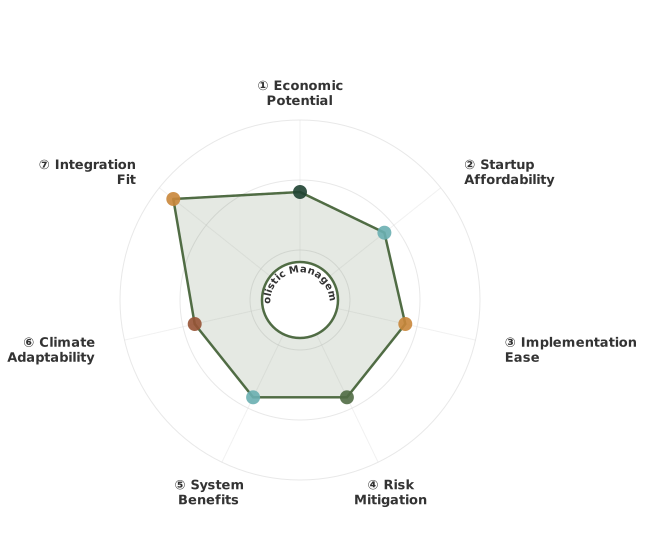
How These Traits Are Calculated
Trait dimensions are ordered clockwise starting from the top of the chart (12 o'clock position):
1. Economic Potential
Financial returns, annual value, and break-even timeline
WHAT: Evaluates financial viability by combining net annual value ($/ha from savings, income, and amortized harvests) with break-even timeline showing when practices pay for themselves.
WHY: Farmers need clear ROI understanding before committing resources. Fast payback (≤3 years) with strong returns (≥$300/ha) enables confident adoption, while long timelines (>10 years) restrict adoption to well-funded operations willing to wait for returns.
HOW: Calculated from net annual value in $/ha and break-even years. Exceptional (≥2.6): fast ROI ≤3 years + high value ≥$300/ha. Typical (1.8-2.5): moderate returns or longer timelines. Limited (<1.8): marginal economics or very long payback >10 years.
2. Startup Affordability
Initial investment costs and financial barrier to entry
WHAT: Measures financial barrier to entry through startup costs for equipment, infrastructure, consulting, and materials. Inverted scoring: lower costs = higher scores = more accessible adoption.
WHY: Affordability determines who can adopt. Low-cost practices (<$250/ha) enable widespread adoption across diverse scales, while high costs (>$2,500/ha) limit adoption to well-capitalized operations, creating barriers that slow regenerative transition.
HOW: Calculated from initial investment parsed from practice content. Inverted scoring: Exceptional (≥2.6): minimal investment <$250/ha. Typical (1.8-2.5): moderate costs $250-2,500/ha. Limited (<1.8): high barrier >$2,500/ha.
3. Implementation Ease
Learning curve and specialized knowledge required
WHAT: Measures how much learning, planning, and specialized knowledge a practice requires. Simpler practices with fewer steps score higher, while complex practices requiring extensive training or specialized resources score lower.
WHY: Complex practices create adoption barriers even when economically viable. Straightforward practices enable faster adoption and broader participation, while those requiring extensive training, timing precision, or specialized equipment limit who can succeed.
HOW: Evaluated by measuring documentation length and identifying complexity markers like location-specific requirements, seasonal timing windows, specialized skills, and dedicated equipment needs. Exceptional (≥2.6): straightforward practices with minimal prerequisites. Typical (1.8-2.5): moderate learning curve with some specialized needs. Limited (<1.8): steep learning curve requiring significant training or resources.
4. Risk Mitigation
Identified financial and ecological risk assessment
WHAT: Evaluates documented risks across financial (investment loss, market volatility) and ecological (crop failure, pest outbreaks) domains. Inverted scoring: fewer risks = higher scores.
WHY: Understanding risk exposure helps farmers make informed decisions. Low-risk practices allow confident implementation, while high-risk practices require careful planning and contingency resources. Risk transparency prevents costly failures.
HOW: Calculated from identified risks in practice content. Inverted scoring: Exceptional (≥2.6): ≤2 risks with manageable severity. Typical (1.8-2.5): 3-5 moderate risks. Limited (<1.8): 6+ risks or severe exposure.
5. System Benefits
How many ways the practice improves your land simultaneously
WHAT: Measures how many aspects of land health improve at once—carbon storage, soil quality, erosion control, water absorption, and biodiversity. Practices that improve multiple areas simultaneously create compounding benefits where each improvement reinforces the others.
WHY: The best practices solve multiple problems at once. For example, addressing erosion simultaneously builds carbon and improves water infiltration, creating a resilient system with positive feedback loops. Single-benefit approaches miss these compound transformation opportunities.
HOW: Evaluated across five key outcomes: carbon sequestration, soil organic matter increase, erosion reduction, water infiltration improvement, and biodiversity enhancement. Exceptional (≥2.6): high carbon storage (>8 t/ha/yr), improvements across 4-5 areas, transformative outcomes. Typical (1.8-2.5): moderate carbon (3-8 t/ha/yr), improvements across 2-3 areas. Limited (<1.8): modest impact (<3 t/ha/yr), single-area focus only.
6. Climate Adaptability
Geographic applicability across Köppen climate zones
WHAT: Evaluates geographic applicability by assessing how many Köppen climate zones successfully support a practice and what adaptation requirements are needed. Measures breadth of climates where farmers can implement with minimal to moderate modifications.
WHY: Universal practices working across diverse climates enable more farmers to adopt regenerative approaches. Practices limited to single climate types (only Mediterranean, only tropical) restrict adoption and slow global transition. Adaptability determines whether a practice serves niche regions or offers broad transformation.
HOW: LLM evaluation of regional success stories, Köppen zone coverage, and adaptation needs. Exceptional (≥2.6): 5+ zones or 4+ climate types, 3+ continents, minimal adaptation. Typical (1.8-2.5): 3-4 zones or 2-3 types, 2 continents, moderate adaptation. Limited (<1.8): 1-2 zones, single region, significant adaptation or highly specialized.
7. Integration Fit
How well this practice combines with others you're doing
WHAT: Measures how well a practice combines with other regenerative practices you might be doing. Some practices work as building blocks that make many other practices easier or more effective, while others work best on their own.
WHY: Practices that combine well with many others create more value on your farm. For example, cover cropping enables no-till, improves grazing, supports crop diversity, and helps water management—making all of them work better together. This helps you build a coherent system rather than juggling disconnected practices.
HOW: Evaluated by identifying which practices combine well and how strong those combinations are. 'Ideally Suited' means strong combinations where practices reinforce each other (practice A makes B easier, while B makes A more effective). 'Adequate' means complementary benefits that work well together. Exceptional (≥2.6): combines well with 6+ practices, serves as a building block. Typical (1.8-2.5): combines with 3-5 practices. Limited (<1.8): 1-2 practices or works best alone.
Going Deeper
1
WHY - The Benefits
Holistic Management offers a profound paradigm shift in how land managers approach their work. It moves from reactive, fragmented problem-solving to proactive, integrated vision fulfillment. The benefits are multidimensional, impacting soil health, economic viability,...
Holistic Management offers a profound paradigm shift in how land managers approach their work. It moves from reactive, fragmented problem-solving to proactive, integrated vision fulfillment. The benefits are multidimensional, impacting soil health, economic viability, water cycles, carbon sequestration, biodiversity, and social capital. Its strength lies in its ability to harmonize seemingly conflicting goals—increasing production while improving environment, enhancing profitability while supporting community well-being.
WHY - The Benefits
Holistic Management offers a profound paradigm shift in how land managers approach their work. It moves from reactive, fragmented problem-solving to proactive, integrated vision fulfillment. The benefits are multidimensional, impacting soil health, economic viability,...
Holistic Management offers a profound paradigm shift in how land managers approach their work. It moves from reactive, fragmented problem-solving to proactive, integrated vision fulfillment. The benefits are multidimensional, impacting soil health, economic viability, water cycles, carbon sequestration, biodiversity, and social capital. Its strength lies in its ability to harmonize seemingly conflicting goals—increasing production while improving environment, enhancing profitability while supporting community well-being.
Soil Health Benefits
Under Holistic Management, soil health is not an isolated objective but a natural consequence of holistic decision-making and tools like Holistic Planned Grazing. The continuous focus on keeping soil covered, maintaining living roots, and integrating livestock strategically leads to an increase in soil organic matter (SOM) between 0.5% and 2% over a decade, depending on starting conditions and climate. This increase in SOM enhances soil structure, improves water holding capacity by 40-70%, and provides a nutrient bank for plants, reducing reliance on synthetic inputs.
Earthworm populations, indicators of healthy soil, frequently increase by 2-5 times within 3-5 years of implementing Holistic Planned Grazing. Their burrowing action and manure deposition create vital macropores, improving aeration and infiltration and mitigating compaction. Diverse plant communities, favored by holistic decision-making, support a wider array of soil microbes and fungi, fostering a resilient and functional soil food web. Research and anecdotal evidence from countless farms show significant improvements in soil aggregate stability, reducing erosion and enhancing nutrient cycling.
Microbial biomass and activity see substantial increases, as the carbon provided by diverse, living plant communities fuels a thriving underground ecosystem. This allows ecosystems to process nutrients more efficiently, build soil structure, and detoxify contaminants. The holistic approach prioritizes long-term soil fertility and health not just for agricultural productivity, but for ecological resilience and the land's ability to support all life.
Economic Benefits
Holistic Management aims to drive economic prosperity by reducing costs and increasing revenue through better, integrated decision-making. By focusing on building profitable, healthy ecosystems, farmers and ranchers can reduce their reliance on external inputs like synthetic fertilizers, pesticides, and supplemental feed. These savings, combined with improved land productivity, can lead to a 10-25% increase in net profitability over 5-10 years.
Farmers often report improved livestock performance—better weight gains, higher fertility rates, and reduced mortality—due to better forage quality and reduced stress from living in a healthier environment. This translates directly into higher returns from animal enterprises. Many HM practitioners also develop diversified income streams, such as high-value livestock breeds, niche markets, or ecosystem service payments, all stemming from a holistic understanding of their land's potential and their community's needs.
The framework encourages disciplined financial planning that aligns with the holistic context, ensuring investments are directed towards goals that yield long-term, sustainable returns rather than short-term gains that might compromise ecological or social well-being. This leads to greater financial resilience, making operations less vulnerable to market fluctuations or extreme weather events. The long-term economic benefits also contribute to land appreciation over time, as healthy, productive land becomes more valuable.
Regenerative Systems Fit
Holistic Management is a foundational practice because its very essence is to foster regenerative outcomes through integrated decision-making. By constantly evaluating how decisions impact the ecological, social, and financial dimensions of a system, practitioners naturally lean towards practices that build long-term health and resilience.
Principle 1 (Minimize Soil Disturbance): HM decisions prioritize soil health. If a decision would lead to significant soil disturbance (tillage, severe compaction), it is rigorously evaluated against the Holistic Context. If the long-term ecological and financial benefits of avoiding disturbance align with the context, choices are made to minimize it. This can lead to transitions to no-till, reduced tillage, and improved grazing management that prevents compaction.
Principle 2 (Maximize Diversity): A core tenet of HM is that complex social and ecological systems are more resilient and productive. Decisions are made to increase diversity at all levels: plant species in pastures and cropping systems, animal breeds, income streams, and even social structures within a community. This naturally moves farms away from monoculture dependency.
Principle 3 (Keep Soil Covered): The Holistic Planned Grazing component of HM is specifically designed to ensure land is kept covered with living plants or mulch. Animal impact is managed to stimulate growth and distribute manure, and grazing periods are carefully planned to allow adequate recovery. This continuous living cover protects soil from erosion, conserves moisture, and feeds soil biology.
Principle 4 (Maintain Living Roots): HM emphasizes continuous plant growth. Decisions are made to ensure living roots are in the soil for as long as possible throughout the year. This is achieved through strategic grazing of perennial pastures and cover crops, extending the growing seasons, and selecting species with different growth cycles. The benefits of continuous root activity—nutrient cycling, soil structure improvement, carbon sequestration—are central to the holistic vision.
Principle 5 (Integrate Livestock): Livestock are viewed as an integral and essential component of regenerative systems within HM. They are not an isolated enterprise but a tool for managing land health. Holistic Planned Grazing uses animal impact to mimic natural grazing patterns, stimulating plant growth, breaking soil crusts, distributing fertility, and improving ecosystem function. The decisions about animal movement, density, and duration are all planned to optimize these ecological benefits while ensuring animal health and economic returns.
HM, therefore, serves as an overarching strategy that guides the implementation of many other regenerative practices. It provides the framework for ensuring these practices work synergistically and are aligned with the farm's specific vision. For farms new to regenerative agriculture, HM can provide a structured approach to understanding and implementing principles like cover cropping, rotational grazing, and reduced tillage by first establishing a clear vision and testing all decisions against it.
Sources behind this view
Videos & Podcasts
-
Holistic management and planned grazing are foundational for 100% grass-fed dairy, improving soil health, nutrient cycling, and economic viability by reducing feed costs. This regenerative approach be
-
Holistic planned grazing mimics natural herd behavior to regenerate grasslands, improve ecosystem function, and sequester carbon. It involves matching forage to livestock needs and monitoring grass re
-
Holistic planned grazing (HPG), also called adaptive multi-paddock grazing, significantly improves soil carbon (3 tons/ha/yr more than continuous grazing), water infiltration, and ecological function
-
Holistic management is a philosophy shifting from linear to holistic thinking. Key insights include the brittleness scale, the vital role of herbivores and predators in carbon cycling, and redefining
Community
-
Advocates for Soil Foodweb principles and Holistic Management, emphasizing land leasing and custom grazing/growing over labor-intensive methods. Focuses on soil restructuring for water availability an
Read more (opens in new window) permies.com -
Allan Savory explains holistic management prevents desertification by using livestock to mimic nature, replacing prescriptive grazing systems. Holistic Planned Grazing, with decisions guided by a holi
Read more (opens in new window) permies.com -
Adopts a holistic grazing management approach emphasizing diverse perennial pastures, higher residuals (4"), and longer rest periods (avg. 45 days) to build soil health, increase organic matter (3.4%
Read more (opens in new window) smallfarms.cornell.edu -
High-density planned grazing, part of Holistic Management, uses cattle timing and density to regenerate soil, enhance forage, and improve animal health. Key is leaving residual forage (40-70%) and mai
Read more (opens in new window) smallfarms.cornell.edu
Research
-
The effect of Holistic Planned Grazing™ on African rangelands: a case study from Zimbabwe (opens in new window)
This study found: Holistic Planned Grazing™ in Zimbabwe improved rangeland health, soil, and vegetation with higher animal density. Temporary animal enclosures also boosted crop yields, suggesting HPG enhances ecosyste
-
Managing Grazing to Restore Soil Health, Ecosystem Function, and Ecosystem Services (opens in new window)
This study found: Properly managed grazing animals can reverse environmental damage. Regenerative practices, like Adaptive Multi-Paddock (AMP) grazing, boost soil health, increase soil carbon, reduce erosion, and enhan
-
Impacts of holistic planned grazing with bison compared to continuous grazing with cattle in South Dakota shortgrass prairie (opens in new window)
This study found: Managed grazing with bison in South Dakota's shortgrass prairie significantly improved soil health, water infiltration, forage, and plant composition compared to continuous cattle grazing over a decad
-
Multi-paddock grazing on rangelands: why the perceptual dichotomy between research results and rancher experience? (opens in new window)
This study found: Ranchers often see benefits from multi-paddock grazing that scientific studies don't always confirm. This review explores the gap, highlighting rancher-led adaptive management principles and suggestin
From the Web
-
Holistic Management uses livestock in a planned grazing framework to regenerate grasslands, improving soil health, water retention, carbon sequestration, biodiversity, and animal welfare, while also b
-
Emphasizes setting clear goals and using Holistic Planned Grazing with adaptive management to navigate complexity, integrating production and conservation outcomes on working lands.
-
Holistic Management contrasts conventional continuous grazing with planned grazing periods and pasture recovery. This nature-based approach enhances photosynthesis, carbon cycling, and land productivi
-
Holistic Management for grazing emphasizes defining goals, understanding plant life cycles for recovery, and managing the plant-animal interaction. Practical advice includes timing for recovery, forag
2
WHERE - Regional Considerations
Holistic Management is remarkably adaptable, as its principles and decision-making tools are designed to work across diverse environments. The effectiveness of specific implementation strategies, however, varies significantly based on regional ecological and...
Holistic Management is remarkably adaptable, as its principles and decision-making tools are designed to work across diverse environments. The effectiveness of specific implementation strategies, however, varies significantly based on regional ecological and socio-economic factors. The core framework remains constant, but the application (e.g., species selection, grazing intensity, financial planning) must be tailored.
WHERE - Regional Considerations
Holistic Management is remarkably adaptable, as its principles and decision-making tools are designed to work across diverse environments. The effectiveness of specific implementation strategies, however, varies significantly based on regional ecological and...
Holistic Management is remarkably adaptable, as its principles and decision-making tools are designed to work across diverse environments. The effectiveness of specific implementation strategies, however, varies significantly based on regional ecological and socio-economic factors. The core framework remains constant, but the application (e.g., species selection, grazing intensity, financial planning) must be tailored.
Click Here to Look up your Region if you don't already know it
Humid Temperate Regions
Representative Locations: Southeastern United States, northern Europe (UK, Germany, Poland), eastern China, Japan, New Zealand
Climate Context: Warm to hot summers and cool to cold winters with moderate to high annual precipitation (75-150 cm or 30-60 inches) distributed relatively evenly. USDA Zones 6-8, Köppen Cfb/Cfa.
Considerations: Abundant rainfall and long growing seasons generally support robust plant growth. Holistic Planned Grazing can focus on optimizing pasture productivity and fertility cycling. Decisions might emphasize managing moisture for continuous growth, building soil organic matter to buffer against occasional dry spells (though less severe than in arid regions), and integrating livestock to manage weed pressure in pastures or agricultural lands. Economic decisions may involve leveraging high perennial forage production for intensive livestock operations or integrating trees into pastures (silvopasture). Socially, understanding local land use traditions and community values is key.
Mediterranean Regions
Representative Locations: California, Mediterranean basin (Spain, Italy, Greece), central Chile, southwestern Australia, Western Cape South Africa
Climate Context: Hot, dry summers and mild, wet winters. Annual precipitation 40-90 cm (15-35 inches), highly seasonal. USDA Zones 8-10, Köppen Csa/Csb.
Considerations: The distinct wet and dry seasons pose unique challenges for Holistic Management. Holistic Planned Grazing must carefully manage animal impact during the wet season to build soil cover and fertility, and then plan for carrying capacity limitations and potential supplemental feeding or destocking during the dry summer. Decisions often prioritize drought-tolerant species, water conservation, and building soil organic matter to enhance water infiltration and retention. Economic planning must account for potential variability in forage production year-to-year. Socially, understanding water rights and the impact on local ecosystems sensitive to drought is crucial.
Arid/Semi-Arid Regions
Representative Locations: Western USA, North Africa, Central Asia, Interior Australia
Climate Context: Low annual precipitation (<40 cm or 15 inches), high temperatures, short and often unpredictable growing season. USDA Zones 7-9, Köppen BSh/BSk.
Considerations: These environments demand extreme care in Holistic Management. The primary goal of Holistic Planned Grazing is often to prevent desertification and restore degraded rangelands through long rest periods and carefully timed, intense grazing. Decisions focus on maximizing water infiltration, building soil organic matter to retain what little moisture is available, and selecting drought-hardy, native species. Economic planning must be conservative, accounting for variable forage availability and potential production risks. Socially, working with indigenous land management practices and understanding community reliance on scarce resources is vital. Sustainability is paramount.
Cold Continental Regions
Representative Locations: Northern USA and Canada, Northern Europe, Northern Asia
Climate Context: Very short growing seasons, extreme summer heat, severe winter cold. USDA Zones 3-5, Köppen Dfa/Dfb.
Considerations: Holistic Management in these regions must contend with short grazing windows and long winters. Holistic Planned Grazing involves maximizing production during the brief summer, planning for winter feed sources (stored forages, rotational feeding), and managing livestock health and shelter during extreme cold. Decisions often involve selecting cold-hardy forage species, managing snow cover for soil protection, and integrating livestock into cropping systems to build fertility following harvest. Economic planning must consider higher winter feed costs and potentially shorter production seasons. Socially, community cooperation for shared resource management (e.g., communal grazing lands) can be important.
Subtropical Regions
Representative Locations: Southeastern USA, Southern China, Southern Brazil, Eastern Australia
Climate Context: Hot, humid summers and mild winters with generally ample rainfall. USDA Zones 9-11, Köppen Cfa/Cwa.
Considerations: Similar to humid temperate regions but with higher humidity and less distinct winter cool-down. Holistic Management decisions might focus on managing heat stress for livestock and forages, controlling tropical grasses and weeds, and optimizing nutrient cycling in systems with high biological activity. Economic planning can leverage long growing seasons for intensive livestock operations. Socially, integrating into diverse agricultural landscapes and respecting existing land use practices are important. Disease and pest management in tropical environments also require holistic consideration.
Tropical Regions
Representative Locations: Central America, Southeast Asia, East Africa, Northern Australia, Northern South America
Climate Context: High temperatures year-round, with distinct wet and dry seasons or consistent high rainfall. Köppen Af/Am/Aw.
Considerations: Tropical ecosystems present unique challenges and opportunities. Holistic Management's emphasis on biodiversity and ecosystem function is critical. Holistic Planned Grazing must contend with intense rainfall and erosion potential, often calling for slower, more deliberate grazing followed by extended rest, or integration with agroforestry systems. Decisions focus on native species, soil conservation during intense wet periods, and managing for heat and humidity. Economic planning might involve high-value tropical products or livestock. Socially, engaging with diverse cultural land management practices and understanding community needs is paramount.
3
HOW - Implementation Process
Implementing Holistic Management is a journey that begins with a commitment to a new way of thinking and making decisions. It's less about rigid techniques and more about a process of continuous learning and adaptation guided by a clear vision. The process generally...
Implementing Holistic Management is a journey that begins with a commitment to a new way of thinking and making decisions. It's less about rigid techniques and more about a process of continuous learning and adaptation guided by a clear vision. The process generally involves several interconnected phases, beginning with defining a personal philosophy and then moving into practical planning and implementation.
HOW - Implementation Process
Implementing Holistic Management is a journey that begins with a commitment to a new way of thinking and making decisions. It's less about rigid techniques and more about a process of continuous learning and adaptation guided by a clear vision. The process generally...
Implementing Holistic Management is a journey that begins with a commitment to a new way of thinking and making decisions. It's less about rigid techniques and more about a process of continuous learning and adaptation guided by a clear vision. The process generally involves several interconnected phases, beginning with defining a personal philosophy and then moving into practical planning and implementation.
Prerequisites: The Holistic Context
The absolute first step, and without which HM cannot be truly implemented, is to develop a Holistic Context. This is not optional. It's a written statement of your highest values, your desired future for yourself, your family, your land, and society, and your life plan. It should articulate what you want your land to look like, feel like, and provide.
- Personal Values: What is most important to you and your family? (e.g., freedom, community, health, adventure, legacy)
- Desired Future: What do you want your land to be producing in 10, 20, 50 years? What state should the environment be in? What kind of social interactions do you want to foster?
- Life Plan: How do you see yourself and your family living and working within this vision?
Without this context, decisions lack a unifying purpose and are prone to being reactive, unsustainable, or counterproductive. This step can take time—weeks or months—and often involves introspection, discussions with family, and sometimes facilitated sessions.
Phase 1: Understanding the Four Tools of Decision Making
Once a Holistic Context is defined, the next step is to learn and internalize the four tools that guide decisions within HM:
- The Holistic Context (HC): Already described, this is the foundation.
- The Planning Tool (Holistic Planned Grazing - HPG): This is the primary tool for managing livestock and land. It involves detailed planning of animal movements, grazing periods, and rest periods to achieve specific ecological and financial outcomes dictated by the HC. It is NOT a fixed rotation but a flexible plan responding to observed conditions.
- The Social Process: This tool ensures people work together effectively and harmoniously towards the Holistic Context. It involves clear communication, conflict resolution, and agreed-upon processes for decision-making within family or teams.
- The Financial Planning Process: This tool ensures financial decisions align with the Holistic Context and the outcomes of the other tools. It involves budgeting, analyzing profitability, and making investments that contribute to the overall vision.
Understanding these tools intellectually is the first step; internalizing them and applying them consistently is the ongoing practice.
Phase 2: Initial Land Planning and Monitoring
With a Holistic Context and tools understood, the next phase involves practical planning for your land. For livestock operations, this primarily means developing your first Holistic Planned Grazing schedule.
- Land Assessment: Understand your land's capacity—soil types, topography, water sources, existing vegetation, current ecological condition, and potential for different forages. This involves visual assessment, soil tests, and understanding grazing history.
-
Holistic Planned Grazing (HPG): Begin designing your grazing plan. This involves:
- Mapping your land: Divide your land into paddocks or recovery areas based on topography, water availability, and vegetation types.
- Determining livestock numbers: Based on your land's carrying capacity and your HC (e.g., a desire for a certain livestock type or quality).
- Planning animal movements: Decide when and where animals will graze and, critically, for how long they will rest. The length of rest is often more important than the length of grazing.
- Developing a sequence: Map out the sequence of grazing and rest periods throughout the year, considering seasonal forage growth, water availability, and expected weather patterns.
-
Monitoring: Establish baseline ecological monitoring (e.g., soil cover, plant diversity, water infiltration, soil organic matter) and begin regular observations. This is crucial for testing your decisions.
Phase 3: Implementation and Adaptive Management
This is where the planning meets reality. Implement your HPG plan, communicate with your team (if applicable), and start managing finances according to your HC.
- Execute the HPG plan: Move livestock according to your plan. Be observant of how the land and animals respond.
- Observe and Monitor: Regularly observe plant growth, animal health, soil conditions, and water cycles. Are the plants recovering after grazing? Are animals performing well? Is the soil improving?
-
Test Your Decisions: After a grazing period (or other management decision), ask:
- Did this decision move us toward our Holistic Context?
- Did it improve land health?
- Did it improve animal health/performance?
- Did it improve financial outcomes?
- Did it improve social harmony?
-
Adapt: If your observations and tests indicate a decision didn't move you toward your HC, or negatively impacted land health, adjust your plan. HM is a dynamic process; plans are living documents that are adapted based on feedback from the land and the system. This is the "adaptive" in adaptive management.
Transition Timeline & Phase-Out Strategy (If Applicable)
While HM isn't inherently a transition practice, many users transition from conventional, fragmented management to HM. If this involves phasing out non-regenerative inputs:
- Year 1-2: Define HC, learn the tools, develop initial HPG plan, begin observing land response. If moving away from synthetic inputs: begin gradual reduction (e.g., 10-20% cut in synthetic fertilizer/pesticides) while monitoring land's biological response and animal performance. Budget for potential temporary yield dips.
- Year 3-4: Implement HPG more strictly, refine plans based on monitoring. Continue reducing synthetics (another 20-30%). Focus on building soil biology through animal impact and cover crops. Financial planning should show increasing cost savings.
- Year 5+: Aim for elimination of synthetic inputs for current regenerative systems. If previously operating with synthetics, observe that soil biology is now largely self-sufficient in nutrient cycling and pest management. Land health indicators (SOM, water infiltration, biodiversity) should show marked improvement. Production may stabilize or increase without chemical reliance.
The key is that the HM framework supports the decision to phase out harmful inputs if it aligns with the HC and demonstrably improves the system's long-term health and profitability. Continuous monitoring provides the data to justify these shifts, while the HPG plan ensures the land can support these changes.
Sources behind this view
Videos & Podcasts
-
Holistic management and planned grazing are foundational for 100% grass-fed dairy, improving soil health, nutrient cycling, and economic viability by reducing feed costs. This regenerative approach be
-
True holistic planned grazing, guided by a 'holistic context,' differs from its many failed derivatives. It requires livestock in seasonal rainfall areas and proactive management, unlike hands-off app
-
Holistic planned grazing mimics natural herd behavior to regenerate grasslands, improve ecosystem function, and sequester carbon. It involves matching forage to livestock needs and monitoring grass re
-
Holistic management is a philosophy shifting from linear to holistic thinking. Key insights include the brittleness scale, the vital role of herbivores and predators in carbon cycling, and redefining
Community
-
Allan Savory explains holistic management prevents desertification by using livestock to mimic nature, replacing prescriptive grazing systems. Holistic Planned Grazing, with decisions guided by a holi
Read more (opens in new window) permies.com -
Advocates for Soil Foodweb principles and Holistic Management, emphasizing land leasing and custom grazing/growing over labor-intensive methods. Focuses on soil restructuring for water availability an
Read more (opens in new window) permies.com -
Adopts a holistic grazing management approach emphasizing diverse perennial pastures, higher residuals (4"), and longer rest periods (avg. 45 days) to build soil health, increase organic matter (3.4%
Read more (opens in new window) smallfarms.cornell.edu -
High-density planned grazing, part of Holistic Management, uses cattle timing and density to regenerate soil, enhance forage, and improve animal health. Key is leaving residual forage (40-70%) and mai
Read more (opens in new window) smallfarms.cornell.edu
Research
-
The effect of Holistic Planned Grazing™ on African rangelands: a case study from Zimbabwe (opens in new window)
This study found: Holistic Planned Grazing™ in Zimbabwe improved rangeland health, soil, and vegetation with higher animal density. Temporary animal enclosures also boosted crop yields, suggesting HPG enhances ecosyste
-
Holistic Management and Adaptive Grazing: A Trainers’ View (opens in new window)
This study found: HM trainers emphasize systems thinking, decision-making, and mindset shifts over specific grazing methods. HM is a flexible concept, making adoption rates hard to define.
-
Impacts of holistic planned grazing with bison compared to continuous grazing with cattle in South Dakota shortgrass prairie (opens in new window)
This study found: Managed grazing with bison in South Dakota's shortgrass prairie significantly improved soil health, water infiltration, forage, and plant composition compared to continuous cattle grazing over a decad
-
Managing Grazing to Restore Soil Health, Ecosystem Function, and Ecosystem Services (opens in new window)
This study found: Properly managed grazing animals can reverse environmental damage. Regenerative practices, like Adaptive Multi-Paddock (AMP) grazing, boost soil health, increase soil carbon, reduce erosion, and enhan
From the Web
-
Emphasizes setting clear goals and using Holistic Planned Grazing with adaptive management to navigate complexity, integrating production and conservation outcomes on working lands.
-
Holistic Management uses livestock in a planned grazing framework to regenerate grasslands, improving soil health, water retention, carbon sequestration, biodiversity, and animal welfare, while also b
-
In brittle environments prone to desertification, Holistic Planned Grazing (HPG) uses livestock to reverse land degradation and combat climate change. Developed from military planning, HPG mimics pred
-
A 10-step holistic management system for livestock operations emphasizes defining goals, optimizing time, analyzing enterprise profitability, maximizing solar collection through forage, and utilizing
4
Know the Debate
Holistic Management's effectiveness and timeline depend heavily on context. In humid regions with ample rainfall, rapid ecological improvements are...
Know the Debate
Holistic Management's effectiveness and timeline depend heavily on context. In humid regions with ample rainfall, rapid ecological improvements are...
Holistic Management's effectiveness and timeline depend heavily on context. In humid regions with ample rainfall, rapid ecological improvements are often observed within 3-5 years. However, in arid or semi-arid rangelands, the process is slower, requiring 5-7 years or more for significant soil health changes due to water limitations. Implementation costs vary significantly with scale: while small operations might invest $1,500-8,000 initially for training and basic tools, large-scale operations can see investments of $7,700-139,000+, particularly for infrastructure like advanced fencing and water systems. The ongoing labor commitment is consistent (1-2 hrs/day for moves), but the learning curve can initially demand substantial time, with expertise building over years of adaptive management.
How fast can Holistic Management regenerate land?
Rapid visible improvements possible (3-5 years)
Practitioners often report dramatic improvements in soil health, vegetation cover, and water infiltration within 3-5 years, especially in humid regions or where mimicking natural herd behavior is effectively implemented.
Sources behind this view
Sources behind this view
Videos & Podcasts
-
Holistic planned grazing mimics natural herd behavior to regenerate grasslands, improve ecosystem function, and sequester carbon. It involves matching forage to livestock needs and monitoring grass recovery, leading to healthier land and livelihoods.
-
Holistic planned grazing (HPG), also called adaptive multi-paddock grazing, significantly improves soil carbon (3 tons/ha/yr more than continuous grazing), water infiltration, and ecological function by managing for microbial activity, earthworms, and dung beetles. HPG contrasts with continuous grazing, which degrades soil, and requires short grazing periods with long recovery times.
From the Web
-
Holistic Management is a decision-making and grazing planning framework adaptable to various situations, aiming to balance ecological, financial, and social needs for regenerating grasslands.
Long-term recovery (decades) and context-dependent results
Academic research suggests that substantial, measurable soil health improvements take decades and that results are highly context-dependent, with specific methodologies and conditions influencing outcomes. Some studies show modest gains or lack of significant difference compared to other grazing methods.
Sources behind this view
Sources behind this view
Research
-
Who's afraid of Allan Savory? Scientometric polarization on Holistic Management as competing understandings (opens in new window)
This study found: Research on how to graze livestock sustainably, particularly using methods like Holistic Management (HM) developed by Allan Savory, is complex and often debated. A scientific analysis of studies related to HM shows that while the research is becoming more widespread geographically and across different scientific fields, there are distinct groups (factions) within the scientific community. These groups often align with their scientific discipline and their opinion on HM. Studies done on actual farms, especially in dry regions, are more likely to have positive findings about HM. The analysis suggests that different scientific disciplines sometimes struggle to work together, and there's a need for people with different viewpoints to collaborate and share their knowledge to make better decisions about grazing practices.
-
Multi-paddock grazing on rangelands: why the perceptual dichotomy between research results and rancher experience? (opens in new window)
This study found: There's a disconnect between what scientific studies often show and what experienced ranchers observe about multi-paddock grazing (also known as rotational or holistic grazing). While many ranchers report that carefully planned grazing improves pasture health, forage growth, and livestock production, many scientific reviews find little difference compared to continuous year-round grazing. This paper explores why this gap exists. It discusses how grazing ecosystems function, outlines key principles that successful ranchers use for adaptive management (adjusting practices based on observations), and suggests that much past research hasn't adequately captured the real-world goals and complexities faced by ranchers. The authors aim to provide a better framework for understanding how planned grazing can help manage rangelands effectively, especially as climate conditions change, and propose areas for future research.
From the Web
-
Holistic Management is a decision-making and grazing planning framework designed to balance ecological, financial, and social needs for regenerative outcomes, addressing grassland degradation.
Making Sense of the Differences
The 'speed' of land regeneration under Holistic Management varies by climate and starting land condition. Humid regions often see quicker improvements in 3-5 years, while arid areas require 5-7+ years for soil health changes. Academic research suggests long-term ecological processes and controlled measurements indicate slower, context-dependent progress, compared to practitioners' observations of visible changes. The interpretation of 'regeneration' and the evidence standards used by each group shape these differing timelines.
Does Holistic Management guarantee increased farm profitability?
Profitability can increase significantly (15-30%)
Positive economic outcomes are frequently reported, attributing profit uplifts to reduced costs, increased carrying capacity, and improved livestock performance within 5-7 years.
Sources behind this view
Sources behind this view
Videos & Podcasts
-
Holistic management can restore degraded cattle stations in monsoon climates, improving economics and production by addressing overgrazing and over-resting. Studies show holistic management adopters achieve significantly higher profitability (e.g., 300% average increase) compared to conventional farmers.
-
Holistic management and planned grazing are foundational for 100% grass-fed dairy, improving soil health, nutrient cycling, and economic viability by reducing feed costs. This regenerative approach benefits land, farmers, and consumers, with a growing network of farms adopting it.
From the Web
-
Holistic Management uses livestock in a planned grazing framework to regenerate grasslands, improving soil health, water retention, carbon sequestration, biodiversity, and animal welfare, while also boosting profitability.
Profitability gains are variable and context-dependent
Economic success depends on correct implementation, context-specific adaptation, managing transition risks, and aligning livestock production with the Holistic Context; results are not automatic.
Sources behind this view
Sources behind this view
Research
-
Multi-paddock grazing on rangelands: why the perceptual dichotomy between research results and rancher experience? (opens in new window)
This study found: There's a disconnect between what scientific studies often show and what experienced ranchers observe about multi-paddock grazing (also known as rotational or holistic grazing). While many ranchers report that carefully planned grazing improves pasture health, forage growth, and livestock production, many scientific reviews find little difference compared to continuous year-round grazing. This paper explores why this gap exists. It discusses how grazing ecosystems function, outlines key principles that successful ranchers use for adaptive management (adjusting practices based on observations), and suggests that much past research hasn't adequately captured the real-world goals and complexities faced by ranchers. The authors aim to provide a better framework for understanding how planned grazing can help manage rangelands effectively, especially as climate conditions change, and propose areas for future research.
-
Who's afraid of Allan Savory? Scientometric polarization on Holistic Management as competing understandings (opens in new window)
This study found: Research on how to graze livestock sustainably, particularly using methods like Holistic Management (HM) developed by Allan Savory, is complex and often debated. A scientific analysis of studies related to HM shows that while the research is becoming more widespread geographically and across different scientific fields, there are distinct groups (factions) within the scientific community. These groups often align with their scientific discipline and their opinion on HM. Studies done on actual farms, especially in dry regions, are more likely to have positive findings about HM. The analysis suggests that different scientific disciplines sometimes struggle to work together, and there's a need for people with different viewpoints to collaborate and share their knowledge to make better decisions about grazing practices.
From the Web
-
Holistic Planned Grazing is a dynamic livestock management system that integrates land regeneration, animal health, and profitability by carefully planning livestock movements based on ecological factors and desired outcomes. It involves subdividing land and creating detailed grazing plans to ensure animals are in the right place, at the right time, and with the right behavior, especially in complex or 'brittle' environments.
Making Sense of the Differences
While Holistic Management has the potential to significantly boost farm profitability through reduced costs and enhanced productivity, the economic outcomes are highly variable. Practitioners often report substantial profit increases within 5-7 years by focusing on reduced inputs and improved land carrying capacity. However, these gains are not guaranteed and depend heavily on correct implementation, adaptation to the specific farm context (climate, soil, markets), and successful management of the transition phase. Academic and observational analyses highlight that inconsistent results can arise from varying levels of expertise, different ecological starting points, and the challenges of rapid adaptation.
How does Holistic Management's ecological impact occur?
Mechanisms involve both plant growth and animal impact
Holistic Management's regenerative effect stems from a synergy between planned grazing that stimulates plant growth and direct animal actions like trampling, which improve soil conditions and initiate biological processes.
Sources behind this view
Sources behind this view
Videos & Podcasts
-
Holistic planned grazing mimics natural herd behavior to regenerate grasslands, improve ecosystem function, and sequester carbon. It involves matching forage to livestock needs and monitoring grass recovery, leading to healthier land and livelihoods.
-
Holistic planned grazing (HPG), also called adaptive multi-paddock grazing, significantly improves soil carbon (3 tons/ha/yr more than continuous grazing), water infiltration, and ecological function by managing for microbial activity, earthworms, and dung beetles. HPG contrasts with continuous grazing, which degrades soil, and requires short grazing periods with long recovery times.
-
Holistic planned grazing, adapted from other fields, is presented as the solution to desertification caused by livestock mismanagement. It integrates animals with land use and socio-economic factors, proving effective even with poor implementation.
Research
-
FORAGES AND PASTURES SYMPOSIUM: Improving soil health and productivity on grasslands using managed grazing of livestock. (opens in new window)
This study found: Managing livestock grazing on grasslands can offer multiple benefits beyond just producing meat or milk. By carefully planning grazing, farmers can encourage a wider variety of plants to grow. This diversity helps plants use sunlight, water, and nutrients more effectively, making the pasture more resilient to weather changes and less prone to weeds. Managed grazing also helps build soil organic matter, which means more carbon and nutrients are stored in the soil, and the soil can hold more water. While grazing can create soil compaction, the roots from diverse pasture plants can help reduce this. More research is needed on how different grazing and rest periods affect soil compaction. Keeping enough plants on the ground is key to helping water soak into the soil, even in wet areas. Diverse plant communities can also create better habitats for wildlife and pollinators. It's important to remember that how grasslands respond to grazing depends a lot on local climate, soil, and plant types. A single grazing plan might not be best for both animal production and all the ecological benefits, so farmers need to balance their goals.
Primary mechanism is plant response to planned grazing
Academic perspectives often highlight that the observed ecological benefits derive mainly from planned grazing stimulating plant growth and root exudates, which enhance soil biology over longer recovery periods.
Sources behind this view
Sources behind this view
Research
-
FORAGES AND PASTURES SYMPOSIUM: Improving soil health and productivity on grasslands using managed grazing of livestock. (opens in new window)
This study found: Managing livestock grazing on grasslands can offer multiple benefits beyond just producing meat or milk. By carefully planning grazing, farmers can encourage a wider variety of plants to grow. This diversity helps plants use sunlight, water, and nutrients more effectively, making the pasture more resilient to weather changes and less prone to weeds. Managed grazing also helps build soil organic matter, which means more carbon and nutrients are stored in the soil, and the soil can hold more water. While grazing can create soil compaction, the roots from diverse pasture plants can help reduce this. More research is needed on how different grazing and rest periods affect soil compaction. Keeping enough plants on the ground is key to helping water soak into the soil, even in wet areas. Diverse plant communities can also create better habitats for wildlife and pollinators. It's important to remember that how grasslands respond to grazing depends a lot on local climate, soil, and plant types. A single grazing plan might not be best for both animal production and all the ecological benefits, so farmers need to balance their goals.
-
Managing Grazing to Restore Soil Health, Ecosystem Function, and Ecosystem Services (opens in new window)
This study found: This article argues that grazing animals like cattle, when managed properly using regenerative farming methods, can actually help fix environmental problems caused by past mismanagement. Instead of harmful industrial farming, the focus should be on practices that boost nature's functions. Regenerative approaches, especially a method called Adaptive Multi-Paddock (AMP) grazing, are shown to be effective and cost-efficient for restoring healthy ecosystems. AMP grazing involves moving animals frequently to new pastures, allowing the plants ample time to recover. This management style leads to better ground cover, less soil erosion, and more carbon stored in the soil. Bringing livestock and forages into crop systems can also increase soil carbon, improve soil life, and cut down on the need for plowing, synthetic fertilizers, and pesticides. Ultimately, these practices enhance vital natural benefits like stable soil, better water absorption, carbon capture, nutrient cycling, and biodiversity, leading to more resilient farms and economies.
-
Multi-paddock grazing on rangelands: why the perceptual dichotomy between research results and rancher experience? (opens in new window)
This study found: There's a disconnect between what scientific studies often show and what experienced ranchers observe about multi-paddock grazing (also known as rotational or holistic grazing). While many ranchers report that carefully planned grazing improves pasture health, forage growth, and livestock production, many scientific reviews find little difference compared to continuous year-round grazing. This paper explores why this gap exists. It discusses how grazing ecosystems function, outlines key principles that successful ranchers use for adaptive management (adjusting practices based on observations), and suggests that much past research hasn't adequately captured the real-world goals and complexities faced by ranchers. The authors aim to provide a better framework for understanding how planned grazing can help manage rangelands effectively, especially as climate conditions change, and propose areas for future research.
Making Sense of the Differences
The exact mechanisms driving Holistic Management's regeneration are debated, with practitioners emphasizing the critical role of direct animal impact (hoof action, trampling) for stimulating soil biology and breaking crusts. Conversely, academic perspectives tend to highlight the importance of plant response – increased biomass and root exudates from planned grazing and rest periods – as the primary driver for soil carbon sequestration and improved ecosystem function. Both views likely hold relevance, with the synergy between managed animal impact and robust plant growth under planned grazing contributing to observed results, where their relative importance may vary by specific ecological context.
5
HOW MUCH - Costs & Investment
Note: Costs shown in USD; multiply by local labor and material cost indices for your region. Labor costs vary significantly internationally. Training and consulting are significant initial investments.
Note: Costs shown in USD; multiply by local labor and material cost indices for your region. Labor costs vary significantly internationally. Training and consulting are significant initial investments.
HOW MUCH - Costs & Investment
Note: Costs shown in USD; multiply by local labor and material cost indices for your region. Labor costs vary significantly internationally. Training and consulting are significant initial investments.
Note: Costs shown in USD; multiply by local labor and material cost indices for your region. Labor costs vary significantly internationally. Training and consulting are significant initial investments.
Note: All costs are based on recent US economic data (2024–2026) and may vary substantially by region based on local labor rates, material costs, and regulatory requirements.
Training and Education
Holistic Management requires a shift in decision-making psychology, which is primarily gained through certified training. For small operations (under 50 acres (20 ha)), introductory workshops typically cost $521–$2,605. Mid-size operations (50–500 acres (20–202 ha)) often seek more comprehensive multi-day courses, costing $1,042–$5,210. Large operations (500+ acres) may require team-wide training, scaling to $2,084–$10,420 or more depending on travel requirements for professional certification programs.
Professional Consulting and Facilitation
Developing a formal "Holistic Context" and long-term grazing plan often necessitates expert guidance. Small producers typically invest $1,042–$5,210 annually for periodic remote check-ins. Mid-size farms invest $2,084–$10,420 for professional site visits and setup of complex grazing charts. Large-scale operations face costs of $5,210–$26,050+ annually for integrated planning, which often includes complex financial monitoring and multi-enterprise coordination.
Planning Software and Tools
Basic planning can be performed using physical maps and spreadsheets with near-zero software costs. For advanced digital visualization and planning, small operations might spend $0–$208. Mid-size operations, requiring herd management and ecological trend plotting, typically spend $104–$521. Large operations using integrated GIS and livestock tracking software may spend $208–$1,042 to maintain high-resolution production maps.
Monitoring Equipment
Monitoring soil health and forage utilization is essential for objective decision-making. Small producers spend $52–$313 on basic soil probes and transect tools. Mid-size operations, often managing multiple pastures, spend $208–$1,042 on specialized monitoring kits and digital documentation tools. Large operations often invest $521–$3,126 in precision data loggers, advanced soil sensors, and drone aerial imagery to accurately assess ecosystem services and vegetation density at scale.
Grazing Infrastructure
Holistic Planned Grazing (HPG) is infrastructure-dependent, requiring the ability to move livestock frequently. Small farms with basic needs spend $0–$1,042 on temporary electric fencing and portable water points. Mid-size operations spend $1,042–$10,420 on perimeter fencing, interior division fencing, and pressurized water systems. Large operations face significant outlays of $10,420–$104,200 for permanent high-tensile fencing, extensive livestock watering networks, and laneways to bridge remote corners of the property.
Most Spend: Most agricultural operations fall within a moderate investment range: $3,126–$5,210 for small farms; $6,252–$12,504 for mid-size farms; and $20,840–$52,100 for large-scale operations. These figures represent the bulk of producers who invest in quality coaching and essential fencing infrastructure during their first three years.
Why the Range?: Cost variability is driven primarily by existing infrastructure and operator goals. A farm starting with existing cross-fencing and reliable water will sit at the bottom of the range, while an operation starting from a singular open-pasture set-up requires the maximum capital expenditure to establish effective grazing cells.
Sources behind this view
Videos & Podcasts
-
This cluster details ultra-high stock density grazing (UHSDG) and 'total grazing' for cattle, emphasizing intensive management, long pasture recovery, and increased stocking rates. The speaker advocat
-
Holistic management and planned grazing are foundational for 100% grass-fed dairy, improving soil health, nutrient cycling, and economic viability by reducing feed costs. This regenerative approach be
-
Laura Payne details how managed grazing enhances soil health, water quality, and wildlife habitat, citing research on reduced erosion, improved stream health, and support for grassland birds. Key prin
-
Critiques of holistic planned grazing (HPG) often stem from flawed research methodology, scale issues, and conflation with simple rotational grazing. HPG improves soil function, carbon sequestration (
Community
-
Adopts a holistic grazing management approach emphasizing diverse perennial pastures, higher residuals (4"), and longer rest periods (avg. 45 days) to build soil health, increase organic matter (3.4%
Read more (opens in new window) smallfarms.cornell.edu -
Allan Savory explains holistic management prevents desertification by using livestock to mimic nature, replacing prescriptive grazing systems. Holistic Planned Grazing, with decisions guided by a holi
Read more (opens in new window) permies.com -
Advocates for Soil Foodweb principles and Holistic Management, emphasizing land leasing and custom grazing/growing over labor-intensive methods. Focuses on soil restructuring for water availability an
Read more (opens in new window) permies.com -
Manage rotational grazing by setting recovery (15-40+ days, adapting to region/season) and grazing periods (2-3 days). Aim to 'take half, leave half' for livestock and soil microbes. High stocking den
Read more (opens in new window) smallfarms.cornell.edu
Research
-
The effect of Holistic Planned Grazing™ on African rangelands: a case study from Zimbabwe (opens in new window)
This study found: Holistic Planned Grazing™ in Zimbabwe improved rangeland health, soil, and vegetation with higher animal density. Temporary animal enclosures also boosted crop yields, suggesting HPG enhances ecosyste
-
Impacts of holistic planned grazing with bison compared to continuous grazing with cattle in South Dakota shortgrass prairie (opens in new window)
This study found: Managed grazing with bison in South Dakota's shortgrass prairie significantly improved soil health, water infiltration, forage, and plant composition compared to continuous cattle grazing over a decad
-
Managing Grazing to Restore Soil Health, Ecosystem Function, and Ecosystem Services (opens in new window)
This study found: Properly managed grazing animals can reverse environmental damage. Regenerative practices, like Adaptive Multi-Paddock (AMP) grazing, boost soil health, increase soil carbon, reduce erosion, and enhan
-
Regenerative Livestock Farming as a Socioeconomic Model for Sustainable Agribusiness in Latin America (opens in new window)
This study found: Regenerative livestock farming in Latin America improved soil carbon, biodiversity, and water quality, while boosting farmer income and quality of life. Government support is key for wider adoption.
From the Web
-
Regenerative grazing workshop recap highlights identifying 'weak links' in production (resource, conversion, marketing) to improve profitability. Key practices discussed include multi-species grazing,
-
Holistic Management is applied to a California pasture-based dairy to regenerate land and ensure profitability. Key challenges like water, soil quality, and feed production are addressed through inves
6
REWARDS AND RISKS - Economics & Risk Factors
Adopting Holistic Management involves a paradigm shift that can yield significant, long-term rewards, but also carries inherent risks, particularly during the learning and implementation phases. The economics are driven by ecological improvements, social cohesion, and...
Adopting Holistic Management involves a paradigm shift that can yield significant, long-term rewards, but also carries inherent risks, particularly during the learning and implementation phases. The economics are driven by ecological improvements, social cohesion, and better decision-making.
REWARDS AND RISKS - Economics & Risk Factors
Adopting Holistic Management involves a paradigm shift that can yield significant, long-term rewards, but also carries inherent risks, particularly during the learning and implementation phases. The economics are driven by ecological improvements, social cohesion, and...
Adopting Holistic Management involves a paradigm shift that can yield significant, long-term rewards, but also carries inherent risks, particularly during the learning and implementation phases. The economics are driven by ecological improvements, social cohesion, and better decision-making.
Holistic Management transforms abstract ecological goals into financial performance. In a Best Case Scenario, farms realize a 15–30% annual increase in profitability by reducing reliance on commercial fertilizers and supplemental feed. Increased forage efficiency can raise livestock carrying capacity by 25–50%, creating an additional $100–$500 per acre ($247–$1,236/ha) in net revenue through higher stocking densities and animal performance.
In a Typical Scenario, farms experience a 5–15% annual profit uplift. This is driven by lower variable costs and improved labor efficiency as management systems become more predictable. Soil health markers, such as organic matter and water infiltration rates, improve steadily, providing an inherent buffer against climate-related yield variance.
In a Worst Case Scenario, where implementation fails or the "Holistic Context" is poorly defined, farms see minimal to no economic gain. If grazing is improperly managed (e.g., poor recovery periods), producers may face a 10–20% decline in carrying capacity due to vegetation degradation. Without a clear plan, initial investments of $5,000–$25,000 in consulting and infrastructure can become stranded assets, yielding no return on investment.
Market Factors: Profitability is heavily influenced by the ability to link grazing outcomes to market premiums. Producers who verify their management practices can often capture an additional 10–20% market premium in direct-to-consumer or supply chain contracts.
Transition Period Risks (Years 1–5):
- Yield Dips: Switching from input-intensive systems can cause a temporary 5–15% drop in forage volume while soil biology recalibrates. Recovery typically accelerates by year three.
- Mitigation: Perform rigorous baseline soil and forage testing to adjust stocking rates before transitioning, preventing overgrazing.
- Cash Flow Management: Front-loading training costs can impact short-term liquidity. Tiering infrastructure upgrades over 36 months helps preserve working capital while the ecological base stabilizes.
Sources behind this view
Videos & Podcasts
-
Holistic management and planned grazing are foundational for 100% grass-fed dairy, improving soil health, nutrient cycling, and economic viability by reducing feed costs. This regenerative approach be
-
True holistic planned grazing, guided by a 'holistic context,' differs from its many failed derivatives. It requires livestock in seasonal rainfall areas and proactive management, unlike hands-off app
-
Holistic management is a philosophy shifting from linear to holistic thinking. Key insights include the brittleness scale, the vital role of herbivores and predators in carbon cycling, and redefining
-
Holistic planned grazing (HPG), also called adaptive multi-paddock grazing, significantly improves soil carbon (3 tons/ha/yr more than continuous grazing), water infiltration, and ecological function
Community
-
Allan Savory explains holistic management prevents desertification by using livestock to mimic nature, replacing prescriptive grazing systems. Holistic Planned Grazing, with decisions guided by a holi
Read more (opens in new window) permies.com -
Adopts a holistic grazing management approach emphasizing diverse perennial pastures, higher residuals (4"), and longer rest periods (avg. 45 days) to build soil health, increase organic matter (3.4%
Read more (opens in new window) smallfarms.cornell.edu -
Advocates for Soil Foodweb principles and Holistic Management, emphasizing land leasing and custom grazing/growing over labor-intensive methods. Focuses on soil restructuring for water availability an
Read more (opens in new window) permies.com -
High-density planned grazing, part of Holistic Management, uses cattle timing and density to regenerate soil, enhance forage, and improve animal health. Key is leaving residual forage (40-70%) and mai
Read more (opens in new window) smallfarms.cornell.edu
Research
-
The effect of Holistic Planned Grazing™ on African rangelands: a case study from Zimbabwe (opens in new window)
This study found: Holistic Planned Grazing™ in Zimbabwe improved rangeland health, soil, and vegetation with higher animal density. Temporary animal enclosures also boosted crop yields, suggesting HPG enhances ecosyste
-
Managing Grazing to Restore Soil Health, Ecosystem Function, and Ecosystem Services (opens in new window)
This study found: Properly managed grazing animals can reverse environmental damage. Regenerative practices, like Adaptive Multi-Paddock (AMP) grazing, boost soil health, increase soil carbon, reduce erosion, and enhan
-
Multi-paddock grazing on rangelands: why the perceptual dichotomy between research results and rancher experience? (opens in new window)
This study found: Ranchers often see benefits from multi-paddock grazing that scientific studies don't always confirm. This review explores the gap, highlighting rancher-led adaptive management principles and suggestin
-
Impacts of holistic planned grazing with bison compared to continuous grazing with cattle in South Dakota shortgrass prairie (opens in new window)
This study found: Managed grazing with bison in South Dakota's shortgrass prairie significantly improved soil health, water infiltration, forage, and plant composition compared to continuous cattle grazing over a decad
From the Web
-
Emphasizes setting clear goals and using Holistic Planned Grazing with adaptive management to navigate complexity, integrating production and conservation outcomes on working lands.
-
Holistic Management uses livestock in a planned grazing framework to regenerate grasslands, improving soil health, water retention, carbon sequestration, biodiversity, and animal welfare, while also b
-
In brittle environments prone to desertification, Holistic Planned Grazing (HPG) uses livestock to reverse land degradation and combat climate change. Developed from military planning, HPG mimics pred
-
A 10-step holistic management system for livestock operations emphasizes defining goals, optimizing time, analyzing enterprise profitability, maximizing solar collection through forage, and utilizing
7
REWARDS AND RISKS - Economics & Risk Factors
Holistic Management offers a powerful path to economic reward, but its application is not without financial and systemic risks. The rewards are often long-term and ecosystem-based, requiring a shift in perspective from short-term commodity-driven thinking to long-term,...
Holistic Management offers a powerful path to economic reward, but its application is not without financial and systemic risks. The rewards are often long-term and ecosystem-based, requiring a shift in perspective from short-term commodity-driven thinking to long-term, value-driven stewardship.
REWARDS AND RISKS - Economics & Risk Factors
Holistic Management offers a powerful path to economic reward, but its application is not without financial and systemic risks. The rewards are often long-term and ecosystem-based, requiring a shift in perspective from short-term commodity-driven thinking to long-term,...
Holistic Management offers a powerful path to economic reward, but its application is not without financial and systemic risks. The rewards are often long-term and ecosystem-based, requiring a shift in perspective from short-term commodity-driven thinking to long-term, value-driven stewardship.
Economic Scenarios (Long-Term, 5-10+ Years)
Best Case Scenario: Farm profitability increases by 15-30% annually due to improved land health, reduced input costs, and enhanced livestock performance. Carrying capacity increases by 25-50%, allowing for higher stocking rates or more resilient grazing in dry periods. New market opportunities may arise (e.g., premium pricing for regenerative products). The operation becomes a benchmark for ecological and economic sustainability, potentially attracting ecosystem service payments or investment. Resilience to drought, disease, and market volatility is significantly enhanced.
Typical Scenario: Profitability improves by 5-15% annually. Reduced input costs and slightly improved livestock performance contribute to this. Environmental improvements are robust, leading to increased water infiltration, better soil cover, and noticeable increases in soil organic matter. Farming operation becomes more predictable and less susceptible to external shocks. Labor efficiency may increase due to better land management. The farm demonstrates clear progress toward its Holistic Context.
Worst Case Scenario: Economic gains are minimal or non-existent. This occurs if:
- The Holistic Context is unclear or conflicting, leading to poor decisions.
- Holistic Planned Grazing is implemented incorrectly, leading to land degradation and reduced carrying capacity.
- Initial training was insufficient, leading to repeated mistakes.
- External factors (market collapse, severe drought, policy changes) were not adequately planned for.
- The farm fails to adapt to lessons learned from monitoring. In this scenario, the investment in training and time yields little financial return, and the farm may struggle to achieve its stated goals.
Transition Period Risks (Years 1-5)
Financial Risks:
- Training/Consulting Costs: Can be a significant upfront expense ($500 - $25,000+). This budget item is essential for effective implementation but needs careful financial planning.
- Infrastructure Investment: The need for more flexible fencing, reliable water points, or improved livestock handling facilities can incur costs ranging from $1,000 to $100,000+ depending on farm scale and existing infrastructure.
- Potential for Short-Term Production Dip: If grazing plans are not carefully matched to ecological capacity or if moving away from synthetics is done too abruptly, there can be temporary reductions in forage quality or livestock performance, impacting income. This risk is mitigated by careful planning, monitoring, and gradual transitions.
- Opportunity Cost: Time spent learning, planning, and monitoring is time not directly generating revenue. This is a significant intangible cost.
System Risks:
- Misinterpretation Leading to Degradation: Incorrectly applying grazing principles (like using fixed rotations or insufficient rest periods) can degrade land faster than planned, leading to soil erosion, loss of plant diversity, and reduced carrying capacity. This is a high risk if training is superficial or context is not clearly defined.
- Social Conflict and Resistance: Family members, employees, or community members may resist the shift in decision-making philosophy or the changes in management practices. This can create internal friction, slow progress, or lead to abandonment of the process.
- "Glossing Over" the Context: Treating the Holistic Context as a formality rather than a guiding force means decisions may not actually align with the desired future, leading to a lack of progress.
- Failure to Monitor and Adapt: Not observing the ecological and financial responses to decisions, or failing to adjust plans based on this feedback, means missing crucial learning opportunities and perpetuating mistakes.
- Burnout: The steep learning curve and the demands of integrated planning and management can lead to overwhelming stress and burnout if not managed with social processes and realistic expectations.
Financial Rewards (Long-Term, 5-10+ Years)
- Increased Profitability: 10-30% annual increase in net profit due to reduced input costs, improved land productivity, and enhanced livestock performance.
- Reduced Input Costs: 15-30% reduction in reliance on synthetic fertilizers, pesticides, and supplemental feed.
- Increased Land Value: Healthy, productive land is more valuable. Increased carrying capacity and ecological function contribute to capital appreciation.
- Enhanced Resilience: Greater ability to withstand drought, market volatility, and pest outbreaks due to improved soil health and ecosystem function.
- Diversified Income Streams: Potential for developing new enterprises aligned with the Holistic Context (e.g., niche markets, direct sales, agritourism, ecosystem service payments).
System Rewards (Long-Term, 5-10+ Years)
- Improved Land Health: Significant increases in soil organic matter, water infiltration, biodiversity, and reduced erosion. Land restoration and desertification reversal is possible.
- Enhanced Ecosystem Function: Natural nutrient cycling, water regulation, and pest control capabilities improve.
- Greater Predictability & Stability: Reduced reliance on external inputs and improved ecological resilience lead to more stable production and income.
- Social Cohesion: Shared vision and collaborative decision-making can improve family and community relationships.
- Personal Fulfillment: Living in alignment with one's values and vision can lead to greater job satisfaction and life purpose.
Sources behind this view
Videos & Podcasts
-
Holistic management and planned grazing are foundational for 100% grass-fed dairy, improving soil health, nutrient cycling, and economic viability by reducing feed costs. This regenerative approach be
-
True holistic planned grazing, guided by a 'holistic context,' differs from its many failed derivatives. It requires livestock in seasonal rainfall areas and proactive management, unlike hands-off app
-
Holistic management is a philosophy shifting from linear to holistic thinking. Key insights include the brittleness scale, the vital role of herbivores and predators in carbon cycling, and redefining
-
Holistic planned grazing (HPG), also called adaptive multi-paddock grazing, significantly improves soil carbon (3 tons/ha/yr more than continuous grazing), water infiltration, and ecological function
Community
-
Allan Savory explains holistic management prevents desertification by using livestock to mimic nature, replacing prescriptive grazing systems. Holistic Planned Grazing, with decisions guided by a holi
Read more (opens in new window) permies.com -
Adopts a holistic grazing management approach emphasizing diverse perennial pastures, higher residuals (4"), and longer rest periods (avg. 45 days) to build soil health, increase organic matter (3.4%
Read more (opens in new window) smallfarms.cornell.edu -
Advocates for Soil Foodweb principles and Holistic Management, emphasizing land leasing and custom grazing/growing over labor-intensive methods. Focuses on soil restructuring for water availability an
Read more (opens in new window) permies.com -
High-density planned grazing, part of Holistic Management, uses cattle timing and density to regenerate soil, enhance forage, and improve animal health. Key is leaving residual forage (40-70%) and mai
Read more (opens in new window) smallfarms.cornell.edu
Research
-
The effect of Holistic Planned Grazing™ on African rangelands: a case study from Zimbabwe (opens in new window)
This study found: Holistic Planned Grazing™ in Zimbabwe improved rangeland health, soil, and vegetation with higher animal density. Temporary animal enclosures also boosted crop yields, suggesting HPG enhances ecosyste
-
Managing Grazing to Restore Soil Health, Ecosystem Function, and Ecosystem Services (opens in new window)
This study found: Properly managed grazing animals can reverse environmental damage. Regenerative practices, like Adaptive Multi-Paddock (AMP) grazing, boost soil health, increase soil carbon, reduce erosion, and enhan
-
Multi-paddock grazing on rangelands: why the perceptual dichotomy between research results and rancher experience? (opens in new window)
This study found: Ranchers often see benefits from multi-paddock grazing that scientific studies don't always confirm. This review explores the gap, highlighting rancher-led adaptive management principles and suggestin
-
Impacts of holistic planned grazing with bison compared to continuous grazing with cattle in South Dakota shortgrass prairie (opens in new window)
This study found: Managed grazing with bison in South Dakota's shortgrass prairie significantly improved soil health, water infiltration, forage, and plant composition compared to continuous cattle grazing over a decad
From the Web
-
Emphasizes setting clear goals and using Holistic Planned Grazing with adaptive management to navigate complexity, integrating production and conservation outcomes on working lands.
-
Holistic Management uses livestock in a planned grazing framework to regenerate grasslands, improving soil health, water retention, carbon sequestration, biodiversity, and animal welfare, while also b
-
In brittle environments prone to desertification, Holistic Planned Grazing (HPG) uses livestock to reverse land degradation and combat climate change. Developed from military planning, HPG mimics pred
-
A 10-step holistic management system for livestock operations emphasizes defining goals, optimizing time, analyzing enterprise profitability, maximizing solar collection through forage, and utilizing
8
COMPATIBLE PRACTICES - Integration Opportunities
Holistic Management is a framework that enhances, and is enhanced by, many other regenerative agricultural and land management practices. Its strength lies in integrating these components into a unified system that works towards a common vision.
Holistic Management is a framework that enhances, and is enhanced by, many other regenerative agricultural and land management practices. Its strength lies in integrating these components into a unified system that works towards a common vision.
COMPATIBLE PRACTICES - Integration Opportunities
Holistic Management is a framework that enhances, and is enhanced by, many other regenerative agricultural and land management practices. Its strength lies in integrating these components into a unified system that works towards a common vision.
Holistic Management is a framework that enhances, and is enhanced by, many other regenerative agricultural and land management practices. Its strength lies in integrating these components into a unified system that works towards a common vision.
Holistic Planned Grazing (HPG)
- This is not a separate practice but rather the primary planning tool within Holistic Management for livestock and land. All other compatibility points are designed to support the outcomes of HPG and the Holistic Context.
Adaptive Multi-Paddock Grazing (AMP)
- HPG is the planning for how grazing is managed; AMP is a method of implementing grazing to achieve ecological goals. AMP involves high animal densities in small paddocks for short durations, followed by long rest periods, which is precisely what HPG plans for. The synergy is almost absolute.
Financial Planning Tools
- HM's dedicated Financial Planning Tool ensures that economic decisions support the Holistic Context and the outcomes of HPG and other land management plans. This is not a separate practice but an integrated part of the HM decision-making process.
Social Processes Tools
- The Social Process tool within HM ensures that communication, family/team dynamics, and community engagement are aligned with the Holistic Context, supporting the implementation of all other HM components.
Cover Cropping
- HPG plans often incorporate cover crops into pasture systems, providing high-quality forage during shoulder seasons or dry periods, or for specific ecological benefits (e.g., breaking compaction, fixing nitrogen). The decision to use cover crops is driven by the Holistic Context and guided by HPG to manage livestock impact.
Silvopasture
- Integrating trees into pastures is a decision that would stem from a Holistic Context valuing biodiversity, long-term income streams, and ecological services. HPG plans how livestock graze in silvopasture systems to manage manure, stimulate forage growth, and protect young trees, while ensuring the trees enhance the overall ecosystem function.
Keyline Design / Water Management
- Decisions to implement keyline design for water harvesting or contour farming would be guided by the Holistic Context and assessed using the HM decision-making tool. HPG then plans livestock movements in relation to these water harvesting structures and landscape contours to maximize their benefit and minimize erosion.
Soil Health Improvements (Compost, Biochar, etc.)
- Decisions to use amendments like compost or biochar would be evaluated using the HM framework. If they align with the Holistic Context and financial plan (e.g., reducing input costs, enhancing land productivity), they would be integrated. HPG would then manage livestock to optimize their interaction with these soil improvements (e.g., grazing compost-amended pastures).
Agroforestry
- Similar to silvopasture, decisions to implement broader agroforestry systems (e.g., windbreaks, alley cropping) would originate from the HC. HPG would then plan grazing to complement these systems, such as grazing cover crops between alley cropped trees.
The overarching principle here is that HM provides the why and the process for making decisions. Other practices are the tools or methods that are selected and implemented as part of that process, ensuring they work synergistically towards the defined Holistic Context, rather than being applied in isolation.
Sources behind this view
Videos & Podcasts
-
Holistic management and planned grazing are foundational for 100% grass-fed dairy, improving soil health, nutrient cycling, and economic viability by reducing feed costs. This regenerative approach be
-
True holistic planned grazing, guided by a 'holistic context,' differs from its many failed derivatives. It requires livestock in seasonal rainfall areas and proactive management, unlike hands-off app
-
Holistic planned grazing (HPG), also called adaptive multi-paddock grazing, significantly improves soil carbon (3 tons/ha/yr more than continuous grazing), water infiltration, and ecological function
-
Holistic planned grazing mimics natural herd behavior to regenerate grasslands, improve ecosystem function, and sequester carbon. It involves matching forage to livestock needs and monitoring grass re
Community
-
Advocates for Soil Foodweb principles and Holistic Management, emphasizing land leasing and custom grazing/growing over labor-intensive methods. Focuses on soil restructuring for water availability an
Read more (opens in new window) permies.com -
Allan Savory explains holistic management prevents desertification by using livestock to mimic nature, replacing prescriptive grazing systems. Holistic Planned Grazing, with decisions guided by a holi
Read more (opens in new window) permies.com -
Adopts a holistic grazing management approach emphasizing diverse perennial pastures, higher residuals (4"), and longer rest periods (avg. 45 days) to build soil health, increase organic matter (3.4%
Read more (opens in new window) smallfarms.cornell.edu -
High-density planned grazing, part of Holistic Management, uses cattle timing and density to regenerate soil, enhance forage, and improve animal health. Key is leaving residual forage (40-70%) and mai
Read more (opens in new window) smallfarms.cornell.edu
Research
-
The effect of Holistic Planned Grazing™ on African rangelands: a case study from Zimbabwe (opens in new window)
This study found: Holistic Planned Grazing™ in Zimbabwe improved rangeland health, soil, and vegetation with higher animal density. Temporary animal enclosures also boosted crop yields, suggesting HPG enhances ecosyste
-
Managing Grazing to Restore Soil Health, Ecosystem Function, and Ecosystem Services (opens in new window)
This study found: Properly managed grazing animals can reverse environmental damage. Regenerative practices, like Adaptive Multi-Paddock (AMP) grazing, boost soil health, increase soil carbon, reduce erosion, and enhan
-
Impacts of holistic planned grazing with bison compared to continuous grazing with cattle in South Dakota shortgrass prairie (opens in new window)
This study found: Managed grazing with bison in South Dakota's shortgrass prairie significantly improved soil health, water infiltration, forage, and plant composition compared to continuous cattle grazing over a decad
-
Multi-paddock grazing on rangelands: why the perceptual dichotomy between research results and rancher experience? (opens in new window)
This study found: Ranchers often see benefits from multi-paddock grazing that scientific studies don't always confirm. This review explores the gap, highlighting rancher-led adaptive management principles and suggestin
From the Web
-
Holistic Management uses livestock in a planned grazing framework to regenerate grasslands, improving soil health, water retention, carbon sequestration, biodiversity, and animal welfare, while also b
-
Emphasizes setting clear goals and using Holistic Planned Grazing with adaptive management to navigate complexity, integrating production and conservation outcomes on working lands.
-
Holistic Planned Grazing is a detailed planning process for livestock moves, using grazing charts to strategically manage animals for grassland regeneration by considering soil, plants, and animal beh
-
Holistic Management for grazing emphasizes defining goals, understanding plant life cycles for recovery, and managing the plant-animal interaction. Practical advice includes timing for recovery, forag
9
WHO - Labor & Expertise
Implementing Holistic Management requires a significant commitment in terms of both labor and expertise, particularly during the initial learning and adaptation phases. The emphasis on holistic thinking means that expertise is not just in the "how-to" of certain...
Implementing Holistic Management requires a significant commitment in terms of both labor and expertise, particularly during the initial learning and adaptation phases. The emphasis on holistic thinking means that expertise is not just in the "how-to" of certain practices, but in the "why" and the integrated decision-making.
WHO - Labor & Expertise
Implementing Holistic Management requires a significant commitment in terms of both labor and expertise, particularly during the initial learning and adaptation phases. The emphasis on holistic thinking means that expertise is not just in the "how-to" of certain...
Implementing Holistic Management requires a significant commitment in terms of both labor and expertise, particularly during the initial learning and adaptation phases. The emphasis on holistic thinking means that expertise is not just in the "how-to" of certain practices, but in the "why" and the integrated decision-making.
Expertise Requirements
-
Holistic Decision-Making Ability: This is the primary expertise. It involves:
- Context Development: Ability to articulate personal/family values, desired future, and life plan.
- Systems Thinking: Understanding the interconnectedness of ecological, social, and financial aspects of the farm/ranch.
- Observational Skills: Keen ability to notice changes in plants, animals, soil, and water.
- Analytical Skills: Ability to interpret observations, test decisions against the Holistic Context and ecological outcomes, and adapt plans accordingly.
- Social Skills: Effective communication, negotiation, and conflict resolution within family or farm teams.
-
Holistic Planned Grazing (HPG) Proficiency: This is the main land management tool. Expertise includes:
- Ecological Assessment: Understanding plant communities, soil types, topography, water sources, and ecological condition.
- Forage Management: Estimating carrying capacity, understanding plant growth cycles, and predicting forage availability under different weather conditions.
- Animal Husbandry: Understanding livestock nutrition, health, and performance in relation to forage quality and environmental conditions.
- Grazing Planning: Designing sequences of grazing and rest periods, calculating stocking densities and durations, and adapting plans based on real-time observations.
-
Financial Planning Acumen: Ability to develop budgets, analyze profitability drivers, and make investment decisions that align with the Holistic Context, rather than piecemeal accounting.
-
Basic Ecological Monitoring Skills: Proficiency in observing and documenting changes in soil health (e.g., cover, structure, infiltration), plant health (e.g., diversity, vigor, species composition), and animal health.
Labor Requirements
Initial Phase (Years 1-3):
- High Labor Input: Significant time investment is required for learning, context development, initial planning (especially HPG mapping), and intensive monitoring. This might be 10-20+ extra hours per week beyond normal farm duties, especially for the primary decision-maker.
- Teamwork: If multiple people are involved (family, farm staff), coordination and communication labor become critical.
- External Support: Time spent attending workshops, consulting with educators or facilitators.
Established Phase (Years 3+):
- Moderate Labor Input: Labor shifts from learning to consistent application and adaptation. HPG planning becomes more routine, though still requires careful observation and adjustment. Monitoring continues.
- Efficiency Gains: As HM principles become internalized, efficiency often increases because decisions are clearer and better aligned, reducing wasted efforts or counterproductive actions.
- Potential for Reduced Labor: For instance, improved soil health and reduced pest pressure might decrease the need for pesticide application. Healthier livestock may require less veterinary intervention.
Labor and Expertise in an International Context
- Cost Variation: Labor costs vary drastically by region. In North America and Europe, hiring consultants or extensive training programs represent significant investments. In parts of Africa, Asia, or Latin America, the cost might be lower, but access to formal training and experienced HM practitioners may be more limited.
- Cultural Adaptation: The manifestation of the Holistic Context and social processes will differ based on cultural norms. Expertise in facilitating cross-cultural dialogue and understanding local traditional ecological knowledge is valuable.
- Resource Availability: Access to information (internet, books), training opportunities, and peer networks varies. HM communities globally are developing to share knowledge, but access can be geographically challenging.
- DIY vs. Professional Support: Smaller operations or those in regions with high labor costs might aim for a "DIY" approach after initial training, while larger operations or those seeking rapid, robust implementation often invest in ongoing professional guidance. The economic justification for hiring expertise versus doing it yourself depends heavily on local wage rates and the financial capacity of the operation.
The key takeaway is that Holistic Management requires a dedicated individual or team willing to invest the time to learn and think holistically. Expertise is built through education, practice, rigorous observation, and a commitment to the decision-making framework.
Sources behind this view
Research
-
Holistic Management and Adaptive Grazing: A Trainers’ View (opens in new window)
This study found: HM trainers emphasize systems thinking, decision-making, and mindset shifts over specific grazing methods. HM is a flexible concept, making adoption rates hard to define.
-
Holistic Management: A New Framework for Decision Making (opens in new window)
This study found: Holistic Management offers a framework for decision-making, focusing on overall goals, ecosystem understanding, management tools, and feedback loops for integrated land management.
10
EQUIPMENT - Tools & Infrastructure
Holistic Management itself does not mandate specific new equipment; it's a decision-making framework. However, the implementation of its tools, particularly Holistic Planned Grazing (HPG), often necessitates or benefits greatly from certain types of infrastructure and...
Holistic Management itself does not mandate specific new equipment; it's a decision-making framework. However, the implementation of its tools, particularly Holistic Planned Grazing (HPG), often necessitates or benefits greatly from certain types of infrastructure and equipment that facilitate flexible animal management and land observation. The choice of equipment is always guided by the Holistic Context and the specific ecological and financial goals.
EQUIPMENT - Tools & Infrastructure
Holistic Management itself does not mandate specific new equipment; it's a decision-making framework. However, the implementation of its tools, particularly Holistic Planned Grazing (HPG), often necessitates or benefits greatly from certain types of infrastructure and...
Holistic Management itself does not mandate specific new equipment; it's a decision-making framework. However, the implementation of its tools, particularly Holistic Planned Grazing (HPG), often necessitates or benefits greatly from certain types of infrastructure and equipment that facilitate flexible animal management and land observation. The choice of equipment is always guided by the Holistic Context and the specific ecological and financial goals.
Essential Tools (For Most Livestock Operations)
-
Mapping & Planning Tools:
- Base Maps: Aerial photos, satellite imagery, or hand-drawn maps of the property showing topography, water sources, fences, and vegetation types.
- GPS Device / Smartphone App: For tracking animal movements, locating paddocks, and recording observations.
- Grazing Planning Software/Tools: Can range from simple spreadsheets and graph paper to dedicated digital planning platforms (e.g., PastureMap, AgMinder) for designing and tracking HPG.
- Cost: $0 (paper maps) - $1,000+ (advanced software/subscriptions) for large-scale integration.
-
Monitoring Tools:
- Soil Probes: For quick checks of soil moisture and structure.
- Camera: For documenting land condition, plant growth, and animal performance over time.
- Notebook/App: For recording observations daily or weekly.
- Cost: $50 - $500.
-
Fencing:
- High-Tensile Electric Fencing: Essential for creating flexible paddock divisions, moving animals efficiently, and managing intense grazing periods. Portable reels, poly wire/tape, and insulators are key components.
- Permanent Fencing: Established perimeter fences provide security. Internal permanent fences can define larger grazing zones.
- Cost: Varies greatly; portable poly wire setups can be $100-500 for a few paddocks. Dedicated grid fencing for intensive HPG can cost $10,000 - $50,000+ per 100 ha (250 ac).
-
Water Infrastructure:
- Reliable Water Sources: Troughs, tanks, natural springs, or wells.
- Water Distribution: Pipelines, hoses, or gravity-fed systems to move water to paddocks being grazed. This is critical for justifying high animal densities and short grazing times in concentrated areas.
- Cost: Simple water troughs can be $100-500 each. Extensive pipeline systems can cost $1,000 - $100,000+ depending on scale and terrain.
Facilitating Equipment (Highly Recommended)
-
Livestock Handling Facilities:
- Holding Pens/Corrals: For gathering animals before movement or for temporary confinement.
- Temporary or Permanent Loading Ramps: For moving animals off-farm or to different land blocks.
- Cost: $500 - $20,000+. Portable corrals offer flexibility for smaller operations.
-
Transport:
- Trailer or Truck: For moving portable fencing, water tanks, or animals.
- Cost: $2,000 - $50,000+.
-
ATV or Utility Vehicle:
- For quick movement across larger properties, transporting tools, checking fences and water points, and moving electric fence components.
- Cost: $5,000 - $15,000+.
Specialized Equipment (Optional, Depends on HC & Land Condition)
- Soil Testing Equipment: Penetrometers (to measure compaction), infiltration rings, soil sampling tools.
- Forage Testing Tools: Handheld equipment for estimating forage availability or quality.
- Record-Keeping Software: More advanced farm management software that integrates financial, ecological, and operational data.
International Considerations
- Availability: Infrastructure like extensive pipeline systems may be common and cost-effective in some regions (e.g., Australia, parts of US) but prohibitively expensive or unavailable in others.
- Cost: Material and labor costs for fencing, water systems, and specialized vehicles vary dramatically by country and region. A $10,000 pipeline system in one country might cost $50,000 in another.
- Local Innovations: Many regions have local solutions for fencing, water management, or animal handling that are more appropriate and cost-effective than imported technologies.
- DIY vs. Professional Installation: In regions with high labor costs, farmers may do more DIY installation. In regions with lower labor costs, hiring local expertise for installation is often more economical.
The core principle is to equip yourself with tools that facilitate flexible management and observation, allowing you to implement your Holistic Planned Grazing and adapt based on the land's feedback, all while staying financially aligned with your Holistic Context. Often, the most profound "equipment" is the sharpened eye of the land manager trained to observe and interpret plant and soil responses.
Sources behind this view
Videos & Podcasts
-
Essential tools for Grazing Lands include the Razor Grazer for fencing, Pasture Map for coordination, and water infrastructure for adaptive grazing, prioritizing modularity and team belief over rigid
11
COMPATIBLE PRACTICES - Integration Opportunities
Holistic Management is a framework for making decisions. Therefore, nearly any regenerative practice can be integrated if it aligns with a well-defined Holistic Context and demonstrates positive ecological and financial outcomes through the HM decision-making process....
Holistic Management is a framework for making decisions. Therefore, nearly any regenerative practice can be integrated if it aligns with a well-defined Holistic Context and demonstrates positive ecological and financial outcomes through the HM decision-making process. The compatibility rating reflects how directly and synergistically a practice supports HM's goals upon adoption.
COMPATIBLE PRACTICES - Integration Opportunities
Holistic Management is a framework for making decisions. Therefore, nearly any regenerative practice can be integrated if it aligns with a well-defined Holistic Context and demonstrates positive ecological and financial outcomes through the HM decision-making process....
Holistic Management is a framework for making decisions. Therefore, nearly any regenerative practice can be integrated if it aligns with a well-defined Holistic Context and demonstrates positive ecological and financial outcomes through the HM decision-making process. The compatibility rating reflects how directly and synergistically a practice supports HM's goals upon adoption.
Holistic Planned Grazing (HPG) (⭐⭐⭐⭐⭐ Essential):
- HPG is the operational tool of Holistic Management for livestock. All other compatible practices are assessed and integrated based on how they support the effective design and implementation of HPG and the Holistic Context.
Adaptive Multi-Paddock Grazing (AMP) (⭐⭐⭐⭐⭐ Essential):
- AMP is the methodology that HPG plans for. HPG defines the plan (when, where, how long), and AMP describes the rapid movement, high density, and long rest that achieve ecological goals. They are inseparable in practice.
Cover Cropping (⭐⭐⭐⭐ High Synergy):
- Integration: Cover crops are often integrated into HPG plans to extend the grazing season, provide high-quality forage during critical periods (dry seasons, winter), or prepare land for future grazing. HPG ensures livestock manage cover crops to maximize their ecological benefits without overgrazing.
- Synergy: Cover crops enhance forage availability and quality, supporting higher livestock performance, which aligns with financial goals. Their roots build soil structure, and in-place residue provides soil cover, directly supporting regenerative principles favored by HM.
Silvopasture (⭐⭐⭐⭐ High Synergy):
- Integration: Decisions to implement silvopasture originate from a Holistic Context valuing biodiversity, long-term income (timber/nuts), and land health. HPG plans livestock grazing within treed areas to manage manure, stimulate forage production, prevent tree damage during establishment, and optimize resource utilization across all three components (trees, forage, livestock).
- Synergy: Trees provide shade and reduce heat stress, improving animal welfare and performance. Leaf litter from trees builds soil organic matter, reduces erosion, and enhances water infiltration. Livestock manure fertilizes both trees and forage. This integration creates a more resilient, diverse, and productive system that strongly aligns with HM's goals.
Keyline Design / Water Management (⭐⭐⭐ Moderate Synergy):
- Integration: Decisions regarding keyline design for water harvesting or contour farming are evaluated within the HM framework based on their contribution to the Holistic Context (e.g., improving water availability, reducing erosion). HPG then plans livestock grazing in relation to these structures, ensuring they are utilized effectively and not damaged by concentrated animal impact.
- Synergy: Improved water management enhances forage production and drought resilience, supporting higher carrying capacity and more consistent livestock performance, which benefits economic goals. Reduced erosion and increased infiltration are direct ecological benefits aligned with HM.
Soil Health Amendments (Compost, Biochar, Mulching) (⭐⭐ Moderate Synergy):
- Integration: The decision to use soil amendments stems from a Holistic Context and financial plan that sees their value in improving land health and productivity. HM ensures these tools are applied thoughtfully, and HPG manages livestock to optimize their interaction with amended soils (e.g., grazing fertilized pastures).
- Synergy: These amendments directly improve soil structure, water retention, and nutrient availability, enhancing the effectiveness of grazing management within HM and accelerating the realization of ecological goals.
Agroforestry (⭐⭐⭐ Moderate Synergy):
- Integration: Similar to silvopasture, broader agroforestry systems that incorporate rows of trees for timber, nuts, or specialized products are evaluated through HM. HPG plans animal integration to complement these systems, potentially grazing between tree rows or utilizing cover crops grown in agricultural alleys.
- Synergy: Creates diversified income streams, enhances biodiversity, improves soil health, and can provide shelter for livestock, all of which are highly compatible with HM's holistic vision.
Complementary Regenerative Principles:
- Practices that support Minimize Soil Disturbance, Maximize Diversity, Keep Soil Covered, and Maintain Living Roots are all inherently compatible and often become natural choices as a Holistic Context emphasizing ecological health is developed. HM provides the decision-making structure to integrate these practices effectively into the whole farm system.
The synergy is highest when practices are viewed as interconnected components of a single, managed ecosystem under the guidance of the Holistic Management framework. The goal is not to implement practices in isolation but to ensure they work cooperatively towards a unified, regenerative vision.
Sources behind this view
Videos & Podcasts
-
Holistic management and planned grazing are foundational for 100% grass-fed dairy, improving soil health, nutrient cycling, and economic viability by reducing feed costs. This regenerative approach be
-
True holistic planned grazing, guided by a 'holistic context,' differs from its many failed derivatives. It requires livestock in seasonal rainfall areas and proactive management, unlike hands-off app
-
Holistic planned grazing (HPG), also called adaptive multi-paddock grazing, significantly improves soil carbon (3 tons/ha/yr more than continuous grazing), water infiltration, and ecological function
-
Holistic planned grazing mimics natural herd behavior to regenerate grasslands, improve ecosystem function, and sequester carbon. It involves matching forage to livestock needs and monitoring grass re
Community
-
Advocates for Soil Foodweb principles and Holistic Management, emphasizing land leasing and custom grazing/growing over labor-intensive methods. Focuses on soil restructuring for water availability an
Read more (opens in new window) permies.com -
Allan Savory explains holistic management prevents desertification by using livestock to mimic nature, replacing prescriptive grazing systems. Holistic Planned Grazing, with decisions guided by a holi
Read more (opens in new window) permies.com -
Adopts a holistic grazing management approach emphasizing diverse perennial pastures, higher residuals (4"), and longer rest periods (avg. 45 days) to build soil health, increase organic matter (3.4%
Read more (opens in new window) smallfarms.cornell.edu -
High-density planned grazing, part of Holistic Management, uses cattle timing and density to regenerate soil, enhance forage, and improve animal health. Key is leaving residual forage (40-70%) and mai
Read more (opens in new window) smallfarms.cornell.edu
Research
-
The effect of Holistic Planned Grazing™ on African rangelands: a case study from Zimbabwe (opens in new window)
This study found: Holistic Planned Grazing™ in Zimbabwe improved rangeland health, soil, and vegetation with higher animal density. Temporary animal enclosures also boosted crop yields, suggesting HPG enhances ecosyste
-
Managing Grazing to Restore Soil Health, Ecosystem Function, and Ecosystem Services (opens in new window)
This study found: Properly managed grazing animals can reverse environmental damage. Regenerative practices, like Adaptive Multi-Paddock (AMP) grazing, boost soil health, increase soil carbon, reduce erosion, and enhan
-
Impacts of holistic planned grazing with bison compared to continuous grazing with cattle in South Dakota shortgrass prairie (opens in new window)
This study found: Managed grazing with bison in South Dakota's shortgrass prairie significantly improved soil health, water infiltration, forage, and plant composition compared to continuous cattle grazing over a decad
-
Multi-paddock grazing on rangelands: why the perceptual dichotomy between research results and rancher experience? (opens in new window)
This study found: Ranchers often see benefits from multi-paddock grazing that scientific studies don't always confirm. This review explores the gap, highlighting rancher-led adaptive management principles and suggestin
From the Web
-
Holistic Management uses livestock in a planned grazing framework to regenerate grasslands, improving soil health, water retention, carbon sequestration, biodiversity, and animal welfare, while also b
-
Emphasizes setting clear goals and using Holistic Planned Grazing with adaptive management to navigate complexity, integrating production and conservation outcomes on working lands.
-
Holistic Planned Grazing is a detailed planning process for livestock moves, using grazing charts to strategically manage animals for grassland regeneration by considering soil, plants, and animal beh
-
Holistic Management for grazing emphasizes defining goals, understanding plant life cycles for recovery, and managing the plant-animal interaction. Practical advice includes timing for recovery, forag
12
HOW MUCH - Costs & Investment
Note: Costs shown in USD; multiply by local labor and material cost indices for your region. Labor costs vary significantly internationally. Training and consulting are significant initial investments.
Note: Costs shown in USD; multiply by local labor and material cost indices for your region. Labor costs vary significantly internationally. Training and consulting are significant initial investments.
HOW MUCH - Costs & Investment
Note: Costs shown in USD; multiply by local labor and material cost indices for your region. Labor costs vary significantly internationally. Training and consulting are significant initial investments.
Note: Costs shown in USD; multiply by local labor and material cost indices for your region. Labor costs vary significantly internationally. Training and consulting are significant initial investments.
Holistic Management Framework Adoption Costs
| Cost Category | Small Scale | Mid Scale | Large Scale |
|---|---|---|---|
| Training/Workshops | $500-2,500 | $1,000-5,000 | $2,000-10,000+ |
| Consulting/Facilitation | $1,000-5,000/year | $2,000-10,000/year | $5,000-25,000+/year |
| Planning Software/Tools | $0-200 (basic mapping) | $100-500 | $200-1,000+ |
| Monitoring Equipment | $50-300 (basic soil probes, cameras) | $200-1,000 | $500-3,000+ (drones, data loggers) |
| Infrastructure (Potential) | $0-1,000 (portable fencing, water points) | $1,000-10,000+ (grid fencing, more water) | $10,000-100,000+ (permanent infrastructure) |
| Total Initial Investment | $1,550-8,000 | $3,300-16,500+ | $7,700-139,000+ |
| Most Spend* | $3,000-5,000 | $6,000-12,000 | $20,000-50,000 |
*Most spend = middle 60% of range based on typical conditions
Scale Key:
- Small: <40 ha / <100 ac
- Mid: 40-200 ha / 100-500 ac
- Large: >200 ha / >500 ac
Why These Ranges?
Training/Workshops: Offered worldwide by organizations like Savory Institute, local HM networks. Costs vary by duration, location, and whether it's an introductory or in-depth course. Small-scale operators might attend a few key workshops, while large operations might invest in multiple team members attending advanced training.
Consulting/Facilitation: Highly recommended, especially for initial Context development and HPG planning. The cost depends on consultant experience, frequency of visits, and farm complexity. Facilitated sessions for families or farm teams are invaluable for aligning visions.
Planning Tools: HPG can be done with land maps, graph paper, and GPS trackers for free. Dedicated software offers more sophisticated visualization and planning capabilities.
Monitoring Equipment: Essential for testing decisions. Basic tools are inexpensive. Advanced monitoring yields more detailed data but requires higher investment and data analysis skills.
Infrastructure: HM itself doesn't mandate new infrastructure, but improved HPG often requires better fencing, water points, and potentially laneways to manage livestock movement effectively across larger areas. This is an indirect cost that might overlap with other regenerative practices.
Total Initial Investment: This represents the direct costs associated with learning and adopting the HM framework. The range is wide due to the variability in consulting needs and the scale of the operation.
Most Spend: The mid-range spending reflects a commitment to quality training and ongoing, though perhaps not constant, consulting support for several years to ensure proper implementation.
Sources behind this view
Videos & Podcasts
-
This cluster details ultra-high stock density grazing (UHSDG) and 'total grazing' for cattle, emphasizing intensive management, long pasture recovery, and increased stocking rates. The speaker advocat
-
Holistic management and planned grazing are foundational for 100% grass-fed dairy, improving soil health, nutrient cycling, and economic viability by reducing feed costs. This regenerative approach be
-
Laura Payne details how managed grazing enhances soil health, water quality, and wildlife habitat, citing research on reduced erosion, improved stream health, and support for grassland birds. Key prin
-
Critiques of holistic planned grazing (HPG) often stem from flawed research methodology, scale issues, and conflation with simple rotational grazing. HPG improves soil function, carbon sequestration (
Community
-
Adopts a holistic grazing management approach emphasizing diverse perennial pastures, higher residuals (4"), and longer rest periods (avg. 45 days) to build soil health, increase organic matter (3.4%
Read more (opens in new window) smallfarms.cornell.edu -
Allan Savory explains holistic management prevents desertification by using livestock to mimic nature, replacing prescriptive grazing systems. Holistic Planned Grazing, with decisions guided by a holi
Read more (opens in new window) permies.com -
Advocates for Soil Foodweb principles and Holistic Management, emphasizing land leasing and custom grazing/growing over labor-intensive methods. Focuses on soil restructuring for water availability an
Read more (opens in new window) permies.com -
Manage rotational grazing by setting recovery (15-40+ days, adapting to region/season) and grazing periods (2-3 days). Aim to 'take half, leave half' for livestock and soil microbes. High stocking den
Read more (opens in new window) smallfarms.cornell.edu
Research
-
The effect of Holistic Planned Grazing™ on African rangelands: a case study from Zimbabwe (opens in new window)
This study found: Holistic Planned Grazing™ in Zimbabwe improved rangeland health, soil, and vegetation with higher animal density. Temporary animal enclosures also boosted crop yields, suggesting HPG enhances ecosyste
-
Impacts of holistic planned grazing with bison compared to continuous grazing with cattle in South Dakota shortgrass prairie (opens in new window)
This study found: Managed grazing with bison in South Dakota's shortgrass prairie significantly improved soil health, water infiltration, forage, and plant composition compared to continuous cattle grazing over a decad
-
Managing Grazing to Restore Soil Health, Ecosystem Function, and Ecosystem Services (opens in new window)
This study found: Properly managed grazing animals can reverse environmental damage. Regenerative practices, like Adaptive Multi-Paddock (AMP) grazing, boost soil health, increase soil carbon, reduce erosion, and enhan
-
Regenerative Livestock Farming as a Socioeconomic Model for Sustainable Agribusiness in Latin America (opens in new window)
This study found: Regenerative livestock farming in Latin America improved soil carbon, biodiversity, and water quality, while boosting farmer income and quality of life. Government support is key for wider adoption.
From the Web
-
Regenerative grazing workshop recap highlights identifying 'weak links' in production (resource, conversion, marketing) to improve profitability. Key practices discussed include multi-species grazing,
-
Holistic Management is applied to a California pasture-based dairy to regenerate land and ensure profitability. Key challenges like water, soil quality, and feed production are addressed through inves
13
REWARDS AND RISKS - Economics & Risk Factors
Holistic Management offers a powerful path to economic reward, but its application is not without financial and systemic risks. The rewards are often long-term and ecosystem-based, requiring a shift in perspective from short-term commodity-driven thinking to long-term,...
Holistic Management offers a powerful path to economic reward, but its application is not without financial and systemic risks. The rewards are often long-term and ecosystem-based, requiring a shift in perspective from short-term commodity-driven thinking to long-term, value-driven stewardship.
REWARDS AND RISKS - Economics & Risk Factors
Holistic Management offers a powerful path to economic reward, but its application is not without financial and systemic risks. The rewards are often long-term and ecosystem-based, requiring a shift in perspective from short-term commodity-driven thinking to long-term,...
Holistic Management offers a powerful path to economic reward, but its application is not without financial and systemic risks. The rewards are often long-term and ecosystem-based, requiring a shift in perspective from short-term commodity-driven thinking to long-term, value-driven stewardship.
Economic Scenarios (Long-Term, 5-10+ Years)
Best Case Scenario: Farm profitability increases by 15-30% annually due to improved land health, reduced input costs, and enhanced livestock performance. Carrying capacity increases by 25-50%, allowing for higher stocking rates or more resilient grazing in dry periods. New market opportunities may arise (e.g., premium pricing for regenerative products). The operation becomes a benchmark for ecological and economic sustainability, potentially attracting ecosystem service payments or investment. Resilience to drought, disease, and market volatility is significantly enhanced.
Typical Scenario: Profitability improves by 5-15% annually. Reduced input costs and slightly improved livestock performance contribute to this. Environmental improvements are robust, leading to increased water infiltration, better soil cover, and noticeable increases in soil organic matter. Farming operation becomes more predictable and less susceptible to external shocks. Labor efficiency may increase due to better land management. The farm demonstrates clear progress toward its Holistic Context.
Worst Case Scenario: Economic gains are minimal or non-existent. This occurs if:
- The Holistic Context is unclear or conflicting, leading to poor decisions.
- Holistic Planned Grazing is implemented incorrectly, leading to land degradation and reduced carrying capacity.
- Initial training was insufficient, leading to repeated mistakes.
- External factors (market collapse, severe drought, policy changes) were not adequately planned for.
- The farm fails to adapt to lessons learned from monitoring. In this scenario, the investment in training and time yields little financial return, and the farm may struggle to achieve its stated goals.
Transition Period Risks (Years 1-5)
Financial Risks:
- Training and Consulting Costs: Significant upfront investment ($500 - $25,000+ depending on scale) without immediate guaranteed financial return. Can strain cash flow for smaller operations.
- Potential for Reduced Production (Short-Term): Improperly planned grazing or transitions away from inputs could temporarily reduce forage availability or livestock performance, impacting income. This is a risk if decisions are not aligned with ecological capacity or the Holistic Context.
- Infrastructure Investment: Adapting fencing, water systems, or handling facilities for better HPG can be costly ($1,000 - $100,000+).
- Opportunity Cost: Time spent on learning, planning, and monitoring is time away from other income-generating activities or rest.
System Risks:
- Misinterpretation Leading to Degradation: Incorrectly applying grazing principles (like using fixed rotations or insufficient rest periods) can degrade land faster than planned, leading to soil erosion, loss of plant diversity, and reduced carrying capacity. This is a high risk if training is superficial or context is not clearly defined.
- Social Conflict and Resistance: Family members, employees, or community members may resist the shift in decision-making philosophy or the changes in management practices. This can create internal friction, slow progress, or lead to abandonment of the process.
- "Glossing Over" the Context: Treating the Holistic Context as a formality rather than a guiding force means decisions may not actually align with the desired future, leading to a lack of progress.
- Failure to Monitor and Adapt: Not observing the ecological and financial responses to decisions, or failing to adjust plans based on this feedback, means missing crucial learning opportunities and perpetuating mistakes.
- Burnout: The steep learning curve and the demands of integrated planning and management can lead to overwhelming stress and burnout if not managed with social processes and realistic expectations.
Financial Rewards (Long-Term, 5-10+ Years)
- Increased Profitability: 10-30% annual increase in net profit due to reduced input costs, improved land productivity, and enhanced livestock performance.
- Reduced Input Costs: 15-30% reduction in reliance on synthetic fertilizers, pesticides, and supplemental feed.
- Increased Land Value: Healthy, productive land is more valuable. Increased carrying capacity and ecological function contribute to capital appreciation.
- Enhanced Resilience: Greater ability to withstand drought, market volatility, and pest outbreaks due to improved soil health and ecosystem function.
- Diversified Income Streams: Potential for developing new enterprises aligned with the Holistic Context (e.g., niche markets, direct sales, agritourism, ecosystem service payments).
System Rewards (Long-Term, 5-10+ Years)
- Improved Land Health: Significant increases in soil organic matter, water infiltration, biodiversity, and reduced erosion. Land restoration and desertification reversal is possible.
- Enhanced Ecosystem Function: Natural nutrient cycling, water regulation, and pest control capabilities improve.
- Greater Predictability & Stability: Reduced reliance on external inputs and improved ecological resilience lead to more stable production and income.
- Social Cohesion: Shared vision and collaborative decision-making can improve family and community relationships.
- Personal Fulfillment: Living in alignment with one's values and vision can lead to greater job satisfaction and life purpose.
Sources behind this view
Videos & Podcasts
-
Holistic management and planned grazing are foundational for 100% grass-fed dairy, improving soil health, nutrient cycling, and economic viability by reducing feed costs. This regenerative approach be
-
True holistic planned grazing, guided by a 'holistic context,' differs from its many failed derivatives. It requires livestock in seasonal rainfall areas and proactive management, unlike hands-off app
-
Holistic management is a philosophy shifting from linear to holistic thinking. Key insights include the brittleness scale, the vital role of herbivores and predators in carbon cycling, and redefining
-
Holistic planned grazing (HPG), also called adaptive multi-paddock grazing, significantly improves soil carbon (3 tons/ha/yr more than continuous grazing), water infiltration, and ecological function
Community
-
Allan Savory explains holistic management prevents desertification by using livestock to mimic nature, replacing prescriptive grazing systems. Holistic Planned Grazing, with decisions guided by a holi
Read more (opens in new window) permies.com -
Adopts a holistic grazing management approach emphasizing diverse perennial pastures, higher residuals (4"), and longer rest periods (avg. 45 days) to build soil health, increase organic matter (3.4%
Read more (opens in new window) smallfarms.cornell.edu -
Advocates for Soil Foodweb principles and Holistic Management, emphasizing land leasing and custom grazing/growing over labor-intensive methods. Focuses on soil restructuring for water availability an
Read more (opens in new window) permies.com -
High-density planned grazing, part of Holistic Management, uses cattle timing and density to regenerate soil, enhance forage, and improve animal health. Key is leaving residual forage (40-70%) and mai
Read more (opens in new window) smallfarms.cornell.edu
Research
-
The effect of Holistic Planned Grazing™ on African rangelands: a case study from Zimbabwe (opens in new window)
This study found: Holistic Planned Grazing™ in Zimbabwe improved rangeland health, soil, and vegetation with higher animal density. Temporary animal enclosures also boosted crop yields, suggesting HPG enhances ecosyste
-
Managing Grazing to Restore Soil Health, Ecosystem Function, and Ecosystem Services (opens in new window)
This study found: Properly managed grazing animals can reverse environmental damage. Regenerative practices, like Adaptive Multi-Paddock (AMP) grazing, boost soil health, increase soil carbon, reduce erosion, and enhan
-
Multi-paddock grazing on rangelands: why the perceptual dichotomy between research results and rancher experience? (opens in new window)
This study found: Ranchers often see benefits from multi-paddock grazing that scientific studies don't always confirm. This review explores the gap, highlighting rancher-led adaptive management principles and suggestin
-
Impacts of holistic planned grazing with bison compared to continuous grazing with cattle in South Dakota shortgrass prairie (opens in new window)
This study found: Managed grazing with bison in South Dakota's shortgrass prairie significantly improved soil health, water infiltration, forage, and plant composition compared to continuous cattle grazing over a decad
From the Web
-
Emphasizes setting clear goals and using Holistic Planned Grazing with adaptive management to navigate complexity, integrating production and conservation outcomes on working lands.
-
Holistic Management uses livestock in a planned grazing framework to regenerate grasslands, improving soil health, water retention, carbon sequestration, biodiversity, and animal welfare, while also b
-
In brittle environments prone to desertification, Holistic Planned Grazing (HPG) uses livestock to reverse land degradation and combat climate change. Developed from military planning, HPG mimics pred
-
A 10-step holistic management system for livestock operations emphasizes defining goals, optimizing time, analyzing enterprise profitability, maximizing solar collection through forage, and utilizing
14
COMPATIBLE PRACTICES - Integration Opportunities
Holistic Management is a framework for making decisions. Therefore, nearly any regenerative practice can be integrated if it aligns with a well-defined Holistic Context and demonstrates positive ecological and financial outcomes through the HM decision-making process....
Holistic Management is a framework for making decisions. Therefore, nearly any regenerative practice can be integrated if it aligns with a well-defined Holistic Context and demonstrates positive ecological and financial outcomes through the HM decision-making process. The compatibility rating reflects how directly and synergistically a practice supports HM's goals upon adoption.
COMPATIBLE PRACTICES - Integration Opportunities
Holistic Management is a framework for making decisions. Therefore, nearly any regenerative practice can be integrated if it aligns with a well-defined Holistic Context and demonstrates positive ecological and financial outcomes through the HM decision-making process....
Holistic Management is a framework for making decisions. Therefore, nearly any regenerative practice can be integrated if it aligns with a well-defined Holistic Context and demonstrates positive ecological and financial outcomes through the HM decision-making process. The compatibility rating reflects how directly and synergistically a practice supports HM's goals upon adoption.
Holistic Planned Grazing (HPG) (⭐⭐⭐⭐⭐ Essential):
- HPG is the operational tool of Holistic Management for livestock. All other compatible practices are assessed and integrated based on how they support the effective design and implementation of HPG and the Holistic Context.
Adaptive Multi-Paddock Grazing (AMP) (⭐⭐⭐⭐⭐ Essential):
- AMP is the methodology that HPG plans for. HPG defines the plan (when, where, how long), and AMP describes the rapid movement, high density, and long rest that achieve ecological goals. They are inseparable in practice.
Cover Cropping (⭐⭐⭐⭐ High Synergy):
- Integration: Cover crops are often integrated into HPG plans to extend the grazing season, provide high-quality forage during critical periods (dry seasons, winter), or prepare land for future grazing. HPG ensures livestock manage cover crops to maximize their ecological benefits without overgrazing.
- Synergy: Cover crops enhance forage availability and quality, supporting higher livestock performance, which aligns with financial goals. Their roots build soil structure, and in-place residue provides soil cover, directly supporting regenerative principles favored by HM.
Silvopasture (⭐⭐⭐⭐ High Synergy):
- Integration: Decisions to implement silvopasture originate from a Holistic Context valuing biodiversity, long-term income (timber/nuts), and land health. HPG plans livestock grazing within treed areas to manage manure, stimulate forage production, prevent tree damage during establishment, and optimize resource utilization across all three components (trees, forage, livestock).
- Synergy: Trees provide shade and reduce heat stress, improving animal welfare and performance. Leaf litter from trees builds soil organic matter, reduces erosion, and enhances water infiltration. Livestock manure fertilizes both trees and forage. This integration creates a more resilient, diverse, and productive system that strongly aligns with HM's goals.
Keyline Design / Water Management (⭐⭐⭐ Moderate Synergy):
- Integration: Decisions regarding keyline design for water harvesting or contour farming are evaluated within the HM framework based on their contribution to the Holistic Context (e.g., improving water availability, reducing erosion). HPG then plans livestock movements in relation to these water harvesting structures and landscape contours to maximize their benefit and minimize erosion.
- Synergy: Improved water management enhances forage production and drought resilience, supporting higher carrying capacity and more consistent livestock performance, which benefits economic goals. Reduced erosion and increased infiltration are direct ecological benefits aligned with HM.
Soil Health Amendments (Compost, Biochar, Mulching) (⭐⭐ Moderate Synergy):
- Integration: Decisions to use soil amendments stems from a Holistic Context and financial plan that sees their value in improving land health and productivity. HM ensures these tools are applied thoughtfully, and HPG manages livestock to optimize their interaction with amended soils (e.g., grazing fertilized pastures).
- Synergy: These amendments directly improve soil structure, water retention, and nutrient availability, enhancing the effectiveness of grazing management within HM and accelerating the realization of ecological goals.
Agroforestry (⭐⭐⭐ Moderate Synergy):
- Integration: Similar to silvopasture, broader agroforestry systems that incorporate rows of trees for timber, nuts, or specialized products are evaluated through HM. HPG plans animal integration to complement these systems, potentially grazing cover crops between alley cropped trees.
- Synergy: Creates diversified income streams, enhances biodiversity, improves soil health, and can provide shelter for livestock, all of which are highly compatible with HM's holistic vision.
Complementary Regenerative Principles:
- Practices that support Minimize Soil Disturbance, Maximize Diversity, Keep Soil Covered, and Maintain Living Roots are all inherently compatible and often become natural choices as a Holistic Context emphasizing ecological health is developed. HM provides the decision-making structure to integrate these practices effectively into the whole farm system.
The synergy is highest when practices are viewed as interconnected components of a single, managed ecosystem under the guidance of the Holistic Management framework. The goal is not to implement practices in isolation but to ensure they work cooperatively towards a unified, regenerative vision.
Sources behind this view
Videos & Podcasts
-
Holistic management and planned grazing are foundational for 100% grass-fed dairy, improving soil health, nutrient cycling, and economic viability by reducing feed costs. This regenerative approach be
-
True holistic planned grazing, guided by a 'holistic context,' differs from its many failed derivatives. It requires livestock in seasonal rainfall areas and proactive management, unlike hands-off app
-
Holistic planned grazing (HPG), also called adaptive multi-paddock grazing, significantly improves soil carbon (3 tons/ha/yr more than continuous grazing), water infiltration, and ecological function
-
Holistic planned grazing mimics natural herd behavior to regenerate grasslands, improve ecosystem function, and sequester carbon. It involves matching forage to livestock needs and monitoring grass re
Community
-
Advocates for Soil Foodweb principles and Holistic Management, emphasizing land leasing and custom grazing/growing over labor-intensive methods. Focuses on soil restructuring for water availability an
Read more (opens in new window) permies.com -
Allan Savory explains holistic management prevents desertification by using livestock to mimic nature, replacing prescriptive grazing systems. Holistic Planned Grazing, with decisions guided by a holi
Read more (opens in new window) permies.com -
Adopts a holistic grazing management approach emphasizing diverse perennial pastures, higher residuals (4"), and longer rest periods (avg. 45 days) to build soil health, increase organic matter (3.4%
Read more (opens in new window) smallfarms.cornell.edu -
High-density planned grazing, part of Holistic Management, uses cattle timing and density to regenerate soil, enhance forage, and improve animal health. Key is leaving residual forage (40-70%) and mai
Read more (opens in new window) smallfarms.cornell.edu
Research
-
The effect of Holistic Planned Grazing™ on African rangelands: a case study from Zimbabwe (opens in new window)
This study found: Holistic Planned Grazing™ in Zimbabwe improved rangeland health, soil, and vegetation with higher animal density. Temporary animal enclosures also boosted crop yields, suggesting HPG enhances ecosyste
-
Managing Grazing to Restore Soil Health, Ecosystem Function, and Ecosystem Services (opens in new window)
This study found: Properly managed grazing animals can reverse environmental damage. Regenerative practices, like Adaptive Multi-Paddock (AMP) grazing, boost soil health, increase soil carbon, reduce erosion, and enhan
-
Impacts of holistic planned grazing with bison compared to continuous grazing with cattle in South Dakota shortgrass prairie (opens in new window)
This study found: Managed grazing with bison in South Dakota's shortgrass prairie significantly improved soil health, water infiltration, forage, and plant composition compared to continuous cattle grazing over a decad
-
Multi-paddock grazing on rangelands: why the perceptual dichotomy between research results and rancher experience? (opens in new window)
This study found: Ranchers often see benefits from multi-paddock grazing that scientific studies don't always confirm. This review explores the gap, highlighting rancher-led adaptive management principles and suggestin
From the Web
-
Holistic Management uses livestock in a planned grazing framework to regenerate grasslands, improving soil health, water retention, carbon sequestration, biodiversity, and animal welfare, while also b
-
Emphasizes setting clear goals and using Holistic Planned Grazing with adaptive management to navigate complexity, integrating production and conservation outcomes on working lands.
-
Holistic Planned Grazing is a detailed planning process for livestock moves, using grazing charts to strategically manage animals for grassland regeneration by considering soil, plants, and animal beh
-
Holistic Management for grazing emphasizes defining goals, understanding plant life cycles for recovery, and managing the plant-animal interaction. Practical advice includes timing for recovery, forag