
Pasture Cropping
Pasture cropping is a system where you plant a cash grain crop directly into an established perennial pasture during the fall or winter. Livestock graze the pasture during its dormant season, and the cash crop then grows between the pasture plants in the spring and summer, often harvested before the pasture fully regains dominance in the fall. This allows for year-round plant cover and living roots, integrates livestock and grain production, and builds soil health without annual tillage.
Read More: Complete Description
Pasture cropping, also known as crop-and-pasture integration or intercropping with livestock, is a unique agricultural system designed to maximize land productivity and ecological health by co-locating a cash grain crop within a perennial pasture. The fundamental principle is to plant a crop like wheat, oats, or rye directly into an established, grazing-managed perennial pasture, typically during the fall or early winter in temperate climates. Livestock then graze the dormant pasture during its low-growth period—often through winter—acting as a natural weed controller and nutrient cycler, their manure fertilizing the soil for both the pasture and the emerging cash crop.
As spring arrives, the perennial pasture begins to regrow, reaching a moderate height and density. The cash crop, which was planted between the pasture species, also emerges and grows upwards. This creates a layered system where both the pasture and the cash crop are actively growing, utilizing different resources and occupying different vertical space. Strategically managed grazing can sometimes continue on the pasture component during early spring before the cash crop matures, or the livestock are moved to allow the cash crop to finish its lifecycle. The cash crop is then harvested, typically before the fall rains, at which point the perennial pasture can again regrow, ready for its dormant season grazing in the following winter.
This practice directly supports the core tenets of regenerative agriculture. Minimizing soil disturbance (Principle 1) is inherent, as planting occurs directly into the sod via no-till seeding, eliminating the need for tillage operations common in conventional grain production. This preserves soil structure, protects fungal networks, and prevents carbon loss. Maximizing crop diversity (Principle 2) is achieved through the co-existence of multiple perennial pasture species and the annual cash grain crop, creating a more complex and resilient below-ground root system and above-ground biomass than monocultures. Keeping soil covered (Principle 3) is a constant state, as the perennial pasture and crop residue always protect the soil surface, preventing erosion and maintaining moisture. Maintaining living roots (Principle 4) is paramount, as both pasture species and the cash crop have living roots in the soil for the majority of the year, continuously supporting soil biology and nutrient cycling. Finally, integrating livestock (Principle 5) is fundamental, with animals playing a crucial role in nutrient management, weed control, and providing economic returns during slower periods for grain production.
Pasture cropping originated from observing natural ecosystems where grazing animals and diverse plant life coexisted, and from traditional farming practices in various parts of the world where grain crops were sometimes grown in conjunction with rangelands. Modern pasture cropping adapts these observations with contemporary machinery and scientific understanding, particularly benefiting regions with distinct wet and dry seasons or warm and cold periods that allow for sequential crop and pasture growth. It is particularly suited to regions with temperate climates (e.g., USDA zones 5-8, Köppen Cfa/Cfb/Dfa) that experience cold winters or dry summers conducive to planting into dormant perennial vegetation.
The system requires careful planning and management. Accurate selection of drought-tolerant and shade-tolerant pasture species, along with cash crops suited to the local climate and competition from pasture, is vital. Grazing management must be adaptive, timed to benefit soil fertility and weed suppression without damaging the cash crop seedlings or the pasture's long-term health. Equipment for no-till seeding into tough sod is necessary, and farmers must understand how to manage the unique planting and harvesting windows this system presents. While it introduces complexity compared to monoculture farming, its regenerative benefits—enhanced soil health, diversified income streams, reduced input needs, and ecological resilience—make it an attractive option for farmers seeking to build long-term farm health and profitability.
Pasture cropping is not a transitional practice that violates regenerative principles temporarily. Instead, it is a foundational, context-dependent practice. It is regenerative when implemented with an emphasis on soil health, diversity, and strategic livestock integration. It can become extractive if the focus shifts solely to maximizing cash crop yield at the expense of pasture health or soil biology, if inappropriate crops are chosen, or if livestock management leads to overgrazing and soil degradation. However, when managed holistically, it offers a sophisticated pathway to intensifed ecological services and economic diversification.
Sources behind this view
Sources behind this view
 Videos & Podcasts
-
Pasture cropping is perennial cover cropping using zero tilling into living grasses, integrating livestock, and restoring soil/grassland ecosystems. It reduces chemical inputs, improves soil health, a
-
Pasture cropping is a zero-till method of planting cool-season grains into dormant warm-season native grasses, utilizing intensive grazing and selective herbicides for preparation, resulting in low-ri
-
Cole SI details his pasture cropping method, a zero-till technique for planting annual crops into dormant perennial grasslands. This approach, combined with grazing management, improves soil health, i

-
Pasture cropping involves sowing crops like oats and cereal rye into dormant grasslands, using sheep to mulch and fertilize. This method restores native grasses, boosts soil nutrients by an average of
 Community
-
Details a regenerative rotational cropping system using no-till, mulching, and integrated livestock (chicken tractors). Crops rotate through seedling, cover crop, legume, grain, and hay phases over su
Read more (opens in new window) permies.com -
Pasture cropping involves drilling cool-season cereals like oats and wheat directly into dormant warm-season pastures, particularly effective in climates like Australia's. UK regulations mandate cover
Read more (opens in new window) permies.com
 Research
-
Pasture cropping: a new approach to integrate crop and livestock farming systems (opens in new window)
This study found: Pasture cropping in Australia maintained perennial pastures and ground cover while producing profitable crops and grazing, with lower input costs and reduced profit volatility compared to conventional
-
Review: Redesigning Canadian prairie cropping systems for profitability, sustainability, and resilience (opens in new window)
This study found: Review of ecologically based practices for Canadian prairies to boost profitability, sustainability, and resilience, emphasizing mimicking natural systems and needing policy/research shifts.
-
Managing Grazing to Restore Soil Health, Ecosystem Function, and Ecosystem Services (opens in new window)
This study found: Properly managed grazing animals can reverse environmental damage. Regenerative practices, like Adaptive Multi-Paddock (AMP) grazing, boost soil health, increase soil carbon, reduce erosion, and enhan
-
Farming systems’ productivity and soil organic carbon stocks following fertilisers, no-tillage or legumes on a fertility-depleted soil in a semi-arid subtropical region (opens in new window)
This study found: A 12-year Australian study found chickpea-wheat rotations and no-till farming with nitrogen fertilizer boosted wheat yields on depleted soils. Legumes and N fertilizer provided long-term economic bene
 From the Web
-
Pasture cropping, pioneered by Colin Seis in Australia, involves planting cash crops into perennial pastures without tillage. This method enhances soil organic matter, fertility, and carbon sequestrat
-
Pasture cropping, a no-kill, no-till system developed in Australia by farmers like Colin Seis, involves planting cash crops directly into perennial pastures. This method enhances soil organic matter a
-
Pasture cropping, a no-kill, no-till system developed in Australia by farmers like Colin Seis, involves planting cash crops directly into perennial pastures. This method enhances soil organic matter,
Key Points
What It Is
- Cash grain crop planted into perennial pasture
- Livestock graze pasture during its dormant season
- Integrates grain, forage, and livestock production
- Year-round living roots and soil cover
Why Do It
- Builds soil organic matter & structure
- Diversifies farm income streams
- Reduces reliance on synthetic inputs
- Enhances ecosystem services
Know the Debate
- Establishment timelines range from 1-2 years to 3-5 years.
- Pasture quality is key: degraded land needs prior remediation.
- Integration of livestock and crops is fundamental.
- No-till seeding into sod is crucial for soil health.
Benefits - Financial
- Increased annual revenue by $150–$365 per acre ($371–$902 per hectare) via secondary livestock grazing.
- Synthetic fertilizer input costs reduced by 60–85% annually.
- Long-term land value appreciation via 0.5–1.5% soil organic matter increases.
Benefits - System
- Zero annual tillage (Principle 1)
- Diverse plants year-round (Principles 2, 4)
- Soil covered continuously (Principle 3)
- Livestock integration for nutrient cycling (Principle 5)
Risks - Financial
- Initial no-till equipment investment of $31,260–$156,300.
- Potential grain yield reduction of 10–20% during 3-year transition.
Risks - System
- Crop failure from drought or excessive weed pressure
- Damage to cash crop from livestock grazing mistakes
- Pasture degradation from poor grazing management
- Requires specialized niche markets for grain
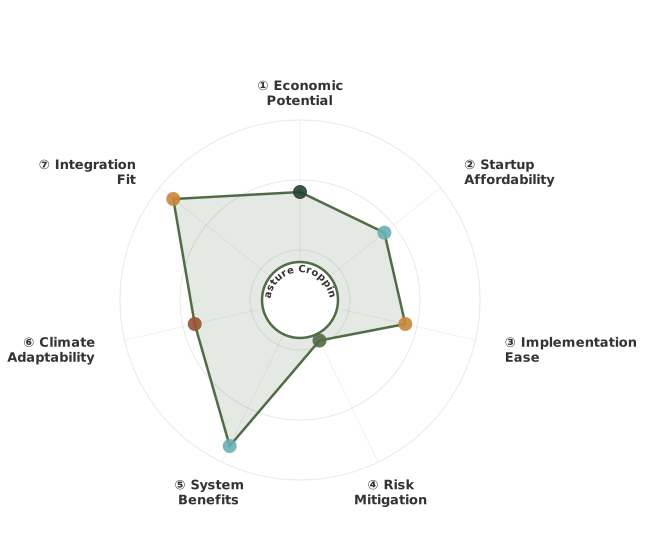
How These Traits Are Calculated
Trait dimensions are ordered clockwise starting from the top of the chart (12 o'clock position):
1. Economic Potential
Financial returns, annual value, and break-even timeline
WHAT: Evaluates financial viability by combining net annual value ($/ha from savings, income, and amortized harvests) with break-even timeline showing when practices pay for themselves.
WHY: Farmers need clear ROI understanding before committing resources. Fast payback (≤3 years) with strong returns (≥$300/ha) enables confident adoption, while long timelines (>10 years) restrict adoption to well-funded operations willing to wait for returns.
HOW: Calculated from net annual value in $/ha and break-even years. Exceptional (≥2.6): fast ROI ≤3 years + high value ≥$300/ha. Typical (1.8-2.5): moderate returns or longer timelines. Limited (<1.8): marginal economics or very long payback >10 years.
2. Startup Affordability
Initial investment costs and financial barrier to entry
WHAT: Measures financial barrier to entry through startup costs for equipment, infrastructure, consulting, and materials. Inverted scoring: lower costs = higher scores = more accessible adoption.
WHY: Affordability determines who can adopt. Low-cost practices (<$250/ha) enable widespread adoption across diverse scales, while high costs (>$2,500/ha) limit adoption to well-capitalized operations, creating barriers that slow regenerative transition.
HOW: Calculated from initial investment parsed from practice content. Inverted scoring: Exceptional (≥2.6): minimal investment <$250/ha. Typical (1.8-2.5): moderate costs $250-2,500/ha. Limited (<1.8): high barrier >$2,500/ha.
3. Implementation Ease
Learning curve and specialized knowledge required
WHAT: Measures how much learning, planning, and specialized knowledge a practice requires. Simpler practices with fewer steps score higher, while complex practices requiring extensive training or specialized resources score lower.
WHY: Complex practices create adoption barriers even when economically viable. Straightforward practices enable faster adoption and broader participation, while those requiring extensive training, timing precision, or specialized equipment limit who can succeed.
HOW: Evaluated by measuring documentation length and identifying complexity markers like location-specific requirements, seasonal timing windows, specialized skills, and dedicated equipment needs. Exceptional (≥2.6): straightforward practices with minimal prerequisites. Typical (1.8-2.5): moderate learning curve with some specialized needs. Limited (<1.8): steep learning curve requiring significant training or resources.
4. Risk Mitigation
Identified financial and ecological risk assessment
WHAT: Evaluates documented risks across financial (investment loss, market volatility) and ecological (crop failure, pest outbreaks) domains. Inverted scoring: fewer risks = higher scores.
WHY: Understanding risk exposure helps farmers make informed decisions. Low-risk practices allow confident implementation, while high-risk practices require careful planning and contingency resources. Risk transparency prevents costly failures.
HOW: Calculated from identified risks in practice content. Inverted scoring: Exceptional (≥2.6): ≤2 risks with manageable severity. Typical (1.8-2.5): 3-5 moderate risks. Limited (<1.8): 6+ risks or severe exposure.
5. System Benefits
How many ways the practice improves your land simultaneously
WHAT: Measures how many aspects of land health improve at once—carbon storage, soil quality, erosion control, water absorption, and biodiversity. Practices that improve multiple areas simultaneously create compounding benefits where each improvement reinforces the others.
WHY: The best practices solve multiple problems at once. For example, addressing erosion simultaneously builds carbon and improves water infiltration, creating a resilient system with positive feedback loops. Single-benefit approaches miss these compound transformation opportunities.
HOW: Evaluated across five key outcomes: carbon sequestration, soil organic matter increase, erosion reduction, water infiltration improvement, and biodiversity enhancement. Exceptional (≥2.6): high carbon storage (>8 t/ha/yr), improvements across 4-5 areas, transformative outcomes. Typical (1.8-2.5): moderate carbon (3-8 t/ha/yr), improvements across 2-3 areas. Limited (<1.8): modest impact (<3 t/ha/yr), single-area focus only.
6. Climate Adaptability
Geographic applicability across Köppen climate zones
WHAT: Evaluates geographic applicability by assessing how many Köppen climate zones successfully support a practice and what adaptation requirements are needed. Measures breadth of climates where farmers can implement with minimal to moderate modifications.
WHY: Universal practices working across diverse climates enable more farmers to adopt regenerative approaches. Practices limited to single climate types (only Mediterranean, only tropical) restrict adoption and slow global transition. Adaptability determines whether a practice serves niche regions or offers broad transformation.
HOW: LLM evaluation of regional success stories, Köppen zone coverage, and adaptation needs. Exceptional (≥2.6): 5+ zones or 4+ climate types, 3+ continents, minimal adaptation. Typical (1.8-2.5): 3-4 zones or 2-3 types, 2 continents, moderate adaptation. Limited (<1.8): 1-2 zones, single region, significant adaptation or highly specialized.
7. Integration Fit
How well this practice combines with others you're doing
WHAT: Measures how well a practice combines with other regenerative practices you might be doing. Some practices work as building blocks that make many other practices easier or more effective, while others work best on their own.
WHY: Practices that combine well with many others create more value on your farm. For example, cover cropping enables no-till, improves grazing, supports crop diversity, and helps water management—making all of them work better together. This helps you build a coherent system rather than juggling disconnected practices.
HOW: Evaluated by identifying which practices combine well and how strong those combinations are. 'Ideally Suited' means strong combinations where practices reinforce each other (practice A makes B easier, while B makes A more effective). 'Adequate' means complementary benefits that work well together. Exceptional (≥2.6): combines well with 6+ practices, serves as a building block. Typical (1.8-2.5): combines with 3-5 practices. Limited (<1.8): 1-2 practices or works best alone.
Going Deeper
1
WHY - The Benefits
Pasture cropping offers a synergistic approach that leverages the inherent strengths of perennial systems and livestock integration to create a more resilient and productive agricultural landscape. It provides benefits that ripple through soil health, economic...
Pasture cropping offers a synergistic approach that leverages the inherent strengths of perennial systems and livestock integration to create a more resilient and productive agricultural landscape. It provides benefits that ripple through soil health, economic...
WHY - The Benefits
Pasture cropping offers a synergistic approach that leverages the inherent strengths of perennial systems and livestock integration to create a more resilient and productive agricultural landscape. It provides benefits that ripple through soil health, economic...
Pasture cropping offers a synergistic approach that leverages the inherent strengths of perennial systems and livestock integration to create a more resilient and productive agricultural landscape. It provides benefits that ripple through soil health, economic...
Soil Health Benefits
The most significant benefit of pasture cropping is its profound positive impact on soil health. By eliminating annual tillage, it preserves soil structure, reducing erosion and preventing the loss of precious topsoil. The continuous presence of living roots from both the pasture species and the cash crop feeds soil microbes year-round, fostering a vibrant soil food web that is essential for nutrient cycling and disease suppression. Studies have shown that pasture cropping systems can increase soil organic matter by 0.5-1.5% over a decade, particularly in temperate or semi-arid systems where perennial root growth is the primary driver, leading to improved water-holding capacity and soil aggregation.
The diverse root systems of a mixed pasture and a cash crop create a complex network throughout the soil profile. This network enhances soil aeration, water infiltration, and nutrient availability. Earthworm populations and other beneficial soil organisms thrive in the undisturbed, biologically active soil, further improving soil structure and fertility through their burrowing and waste products. These improvements translate into more resilient crops and pastures, better able to withstand drought and heavy rainfall.
Economic Benefits
Pasture cropping offers a vital economic diversification strategy for farmers. It allows producers to generate income from two distinct enterprises—livestock grazing and cash grain sales—from the same land base without sacrificing the ecological benefits of perennial forages. This dual income stream can stabilize farm revenues, especially in volatile commodity markets. The grazing of livestock during the fall and winter, when pastures would otherwise be dormant and unproductive, extends the utilization of forage resources.
Moreover, pasture cropping often reduces input costs. The natural fertility provided by livestock manure can decrease the need for synthetic fertilizers. The presence of diverse plant communities and a healthy soil biology can suppress weeds and reduce the incidence of crop diseases, lowering the demand for pesticides and herbicides. While initial investment in no-till seeding equipment may be necessary, the long-term savings on fuel, labor, and inputs can be substantial. Some farmers also find niche markets for pasture-cropped grains, which are often perceived as higher quality due to their organic and sustainably produced nature.
Water Cycle Benefits
The continuous living cover and improved soil structure in pasture cropping systems dramatically enhance water infiltration and retention. Bare soil, common in conventional cropping for large parts of the year, leads to rapid water runoff, soil erosion, and reduced groundwater recharge. In pasture cropping, the dense root systems and high organic matter levels act like a sponge, absorbing and holding rainwater. This reduces surface runoff by 40-70%, thereby decreasing erosion and improving water quality in downstream ecosystems.
Extended periods of living roots ensure that soil moisture is utilized efficiently throughout the year, and improved infiltration means less water is lost to surface runoff, even during heavy rainfall events. This enhanced resilience to both drought and excessive moisture can lead to more stable yields and reduced risk for farmers, particularly in regions prone to unpredictable weather patterns.
Carbon Sequestration
By eliminating tillage and maintaining living roots and crop residue year-round, pasture cropping systems are highly effective at sequestering atmospheric carbon dioxide into the soil. The undecomposed organic matter from pasture species and cash crop residue, combined with the constant input of root exudates and microbial activity, builds soil organic carbon over time. Research suggests that regenerative systems like pasture cropping can sequester 2-5 tonnes of carbon per hectare per year, contributing to climate change mitigation efforts and building soil fertility simultaneously. This sequestration is a direct outcome of supporting soil biology and minimizing disturbance.
Biodiversity and Habitat
The integration of diverse perennial pasture species with an annual cash crop creates a richer and more complex habitat than monoculture systems. This structural and species diversity supports a wider array of beneficial insects, pollinators, earthworms, and other soil organisms. It also provides habitat and food sources for birds and other wildlife, particularly during periods when conventional fields are bare. This increased biodiversity contributes to ecosystem resilience, natural pest control, and overall ecological health on the farm.
Regenerative Systems Fit
Pasture cropping is intrinsically aligned with the five principles of regenerative agriculture:
- Principle 1 (Minimize Soil Disturbance): Achieved through no-till seeding directly into perennial sod, eliminating crop rotation tillage cycles and preserving soil structure and biology.
- Principle 2 (Maximize Crop Diversity): Integrates multiple species of perennial pasture grasses and legumes with a chosen annual cash grain crop, creating a highly diverse above-ground and below-ground plant community.
- Principle 3 (Keep Soil Covered): Ensures the soil surface is protected year-round by living plants (pasture and cash crop) and their residues, preventing erosion and conserving moisture.
- Principle 4 (Maintain Living Roots): Guarantees continuous activity of living roots throughout the soil profile for the majority of the year, feeding soil biology and cycling nutrients.
- Principle 5 (Integrate Livestock): Livestock play a key role in nutrient cycling, weed management, and extending the economic productivity of the land, managed strategically to enhance soil health.
Pasture cropping works synergistically with other regenerative practices, such as adaptive multi-paddock grazing, cover cropping (for pasture renovation or in alleyways), and contour farming for water management. It provides a robust framework for farms seeking to transition away from conventional systems by layering multiple ecological and economic benefits onto the same landbase.
Sources behind this view
Videos & Podcasts
-
Pasture cropping is perennial cover cropping using zero tilling into living grasses, integrating livestock, and restoring soil/grassland ecosystems. It reduces chemical inputs, improves soil health, a
-
Pasture cropping involves sowing crops like oats and cereal rye into dormant grasslands, using sheep to mulch and fertilize. This method restores native grasses, boosts soil nutrients by an average of
-
Cole SI details his pasture cropping method, a zero-till technique for planting annual crops into dormant perennial grasslands. This approach, combined with grazing management, improves soil health, i
-
Details the evolution to multispecies cropping and regenerative practices, leading to restored grasslands, reduced inputs (insecticides, fungicides, fertilizers), increased soil carbon (200%+), improv
Community
-
Details a regenerative rotational cropping system using no-till, mulching, and integrated livestock (chicken tractors). Crops rotate through seedling, cover crop, legume, grain, and hay phases over su
Read more (opens in new window) permies.com -
Build healthy pasture soils by minimizing tillage, maintaining living roots and species diversity, and implementing proper grazing management. Livestock are essential for nutrient cycling and stimulat
Read more (opens in new window) smallfarms.cornell.edu -
Explores pasture cropping and no-till grain planting, emphasizing drilling seed to preserve soil health, avoid nitrogen draw-down, and use mowed grass as mulch. Manual methods and no-till drill rental
Read more (opens in new window) permies.com -
Build healthy pasture soils by minimizing tillage, maintaining living roots and soil cover, increasing species diversity, managing grazing recovery periods, and utilizing animal impact. Key practices
Read more (opens in new window) smallfarms.cornell.edu
Research
-
Pasture cropping: a new approach to integrate crop and livestock farming systems (opens in new window)
This study found: Pasture cropping in Australia maintained perennial pastures and ground cover while producing profitable crops and grazing, with lower input costs and reduced profit volatility compared to conventional
-
Co-implementation of precision nutrient management in long-term conservation agriculture-based systems: A step towards sustainable energy-water-food nexus (opens in new window)
This study found: Conservation agriculture (permanent beds, no-till) with precision nutrient management significantly boosted corn-wheat-mungbean yields, water use, soil carbon, and profits in India, while reducing env
-
Farming systems’ productivity and soil organic carbon stocks following fertilisers, no-tillage or legumes on a fertility-depleted soil in a semi-arid subtropical region (opens in new window)
This study found: A 12-year Australian study found chickpea-wheat rotations and no-till farming with nitrogen fertilizer boosted wheat yields on depleted soils. Legumes and N fertilizer provided long-term economic bene
-
Regenerative Agriculture: Restoring Ecosystems¢ Resilience and Productivity: A Review (opens in new window)
This study found: Regenerative agriculture builds soil health and ecosystem services through practices like no-till, cover crops, and diverse rotations. It increases soil organic matter, improves water infiltration, bo
From the Web
-
Pasture cropping, pioneered by Colin Seis in Australia, involves planting cash crops into perennial pastures without tillage. This method enhances soil organic matter, fertility, and carbon sequestrat
-
Pasture cropping, a no-kill, no-till system developed in Australia by farmers like Colin Seis, involves planting cash crops directly into perennial pastures. This method enhances soil organic matter a
-
Australian ranchers like Colin Seis use 'pasture cropping' and regenerative planned grazing, integrating annual crops with perennial pastures and sheep, to boost biodiversity, fertility, and resilienc
-
Pasture cropping, a no-kill, no-till system developed in Australia by farmers like Colin Seis, involves planting cash crops directly into perennial pastures. This method enhances soil organic matter,
2
WHERE - Regional Considerations
Pasture cropping's success is heavily influenced by regional climate, soil types, and typical growing season patterns, requiring careful adaptation of species and management.
Pasture cropping's success is heavily influenced by regional climate, soil types, and typical growing season patterns, requiring careful adaptation of species and management.
WHERE - Regional Considerations
Pasture cropping's success is heavily influenced by regional climate, soil types, and typical growing season patterns, requiring careful adaptation of species and management.
Pasture cropping's success is heavily influenced by regional climate, soil types, and typical growing season patterns, requiring careful adaptation of species and management.
Click Here to Look up your Region if you don't already know it
Temperate Regions with Cold Winters
Representative Locations: Midwestern United States, Canada (Ontario, Quebec), Northern Europe (Germany, UK, Poland), Northern China, parts of Southern Australia. Climate Context: Warm to hot summers and cold winters; moderate to ample precipitation, often with distinct wet and dry periods. USDA Zones 4-7, Köppen Cfa/Cfb/Dfa/Dfb. Considerations: This is a prime region for pasture cropping. Fall-planted grains like winter wheat, winter rye, or triticale are well-suited. Pasture species must be winter-hardy, often including perennial ryegrass, fescues, clovers, or alfalfa. Livestock, typically cattle or sheep, can graze through winter, providing fertility. Harvest of the grain crop usually occurs before summer heat stress or drought impact, allowing the pasture to regain dominance.
Mediterranean Regions
Representative Locations: California (USA), Mediterranean Basin (Spain, Italy, Greece), Central Chile, Southwestern Australia, South Africa (Western Cape). Climate Context: Hot, dry summers and mild, wet winters. Precipitation is seasonal and can be erratic. USDA Zones 8-10, Köppen Csa/Csb. Considerations: Pasture cropping is highly compatible, leveraging the wet winter period for grain growth. Winter wheat, barley, and oats are common grain choices. Pasture species must tolerate summer drought; drought-tolerant grasses like fescues, and legumes like subclover are vital. Livestock grazing needs careful timing to allow grain establishment and recovery, focusing on the wet season when pasture vigour is highest. Summer remains challenging for dual-species growth, so the cash crop must be harvested relatively early.
Arid and Semi-Arid Regions
Representative Locations: Western USA (Great Plains), North Africa, Central Asia, Interior Australia. Climate Context: Low annual precipitation (<40 cm or 15 inches), high temperatures, and short, unpredictable growing seasons. USDA Zones 6-9, Köppen BSh/BSk. Considerations: Pasture cropping is challenging but possible with careful species selection and management. Focus is on drought-tolerant grains like barley, certain wheat varieties, or sorghum, planted into drought-resistant perennial grasses like western wheatgrass, blue grama, or buffelgrass. Livestock grazing must be extremely well-managed to avoid depleting precious forage reserves. Water management (e.g., using contouring or keyline design) becomes critical for success in these regions. Emphasis is placed on extending the grazing season and opportunistic grain production between the peak wet periods.
Humid Subtropical Regions
Representative Locations: Southeastern United States, Southern China, Eastern Australia, Southern Brazil. Climate Context: Hot, humid summers and mild winters with ample rainfall, though some regions experience dry spells. USDA Zones 9-11, Köppen Cfa/Cwa. Considerations: Pasture cropping can be highly productive. Winter grains are viable. Summer intercropping of heat-tolerant grains like sorghum or millet with warm-season pastures may also be considered. Managing for heat and humidity is key, both for the pasture species and the cash crop. Livestock grazing during warmer months of the year requires careful timing and rotational practices to ensure both pasture recovery and crop integrity. High fertility from livestock can support vigorous growth for both components.
Tropical Regions
Representative Locations: Southeast Asia, Central America, East Africa, Northern Australia. Climate Context: High temperatures year-round, with distinct wet and dry seasons or consistent high rainfall. Köppen Af/Am/Aw. Considerations: Pasture cropping can be adapted to different tropical cropping patterns. In regions with distinct wet/dry seasons, grains suited to the wet season can be intercropped with perennial tropical grasses and legumes. Management of livestock grazing will focus on the periods when the cash crop is not actively growing or is established in a way that livestock impact is minimal. Species selection for both pasture and cash crop must account for high temperatures, humidity, and potentially strong competition from tropical weeds and pasture species.
3
HOW - Implementation Process
Successfully implementing pasture cropping requires careful planning across several phases, from pasture establishment to harvest and ongoing management.
Successfully implementing pasture cropping requires careful planning across several phases, from pasture establishment to harvest and ongoing management.
HOW - Implementation Process
Successfully implementing pasture cropping requires careful planning across several phases, from pasture establishment to harvest and ongoing management.
Successfully implementing pasture cropping requires careful planning across several phases, from pasture establishment to harvest and ongoing management.
Prerequisites
Before initiating pasture cropping:
- Established Perennial Pasture: The pasture must be well-established, perennial, and healthy, typically 2-3 years old. It should be dominated by desirable, long-lived species (grasses, legumes, forbs) capable of withstanding grazing and competition. Species selection should favor those tolerant of grazing and moderate shade/competition.
- Grazing Management Plan: A robust rotational or adaptive grazing plan is essential for maintaining pasture health, controlling weeds, and ensuring adequate rest and recovery for both the pasture and the cash crop.
- Soil Health Assessment: Understand current soil organic matter, infiltration rates, and nutrient levels. Pasture cropping thrives on fertile soils but can also help rebuild degraded soils.
- Climate Appropriateness: Ensure your climate supports a distinct dormant or low-growth period for pasture that aligns with the planting window and growing season of a cash grain crop.
Phase 1: Pasture Preparation and Crop Selection
Pasture Species: Select hardy, well-established perennial species native to or adapted to your region and climate. Mixes are often preferred over monocultures for resilience and diversity. Examples:
- Temperate Cool-Season: Perennial Ryegrass, Fescues, Orchardgrass, Bromes, Timothy, White Clover, Red Clover, Alfalfa.
- Temperate Warm-Season: Eastern Gamagrass, Switchgrass, Big Bluestem (if managing for specific cattle breeds/periods).
- Tropical: Buffelgrass, Signalgrass, Rhodesgrass, various tropical legumes (e.g., Macroptilium atropurpureum). Consider species that offer natural weed suppression or nutrient cycling benefits.
Cash Crop Selection: Choose a grain crop suited to your climate, soil, and its ability to tolerate the competitive environment of a pasture.
- Fall Planting (Temperate): Winter wheat, winter rye, triticale, spelt, winter barley. These must be cold-hardy and able to establish in fall for harvest the following summer.
- Spring Planting (Temperate): Oats, spring wheat, certain millets, buckwheat (if a short-season crop is needed).
- Warm Season/Tropical: Sorghum, millet, certain cowpeas or other pulses as niche 'grain' income. Drought tolerance and shade tolerance are key considerations for the cash crop.
Site History: If the land has a history of severe compaction or nutrient deficiency, address these before or during pasture establishment. Pasture cropping will perform best on land already in relatively good ecological condition.
Phase 2: Seeding and Initial Management
Seeding: This is done using no-till seeding equipment. A specialized drill is required to slice through the sod and place the seed at the correct depth in the soil.
- Equipment: No-till drills equipped with coulters or disc openers that can penetrate established sod. Spacing of 15-25 cm (6-10 inches) between rows is common to allow for pasture regrowth and livestock access.
- Timing: Plant cash crop typically 4-6 weeks before your typical first killing frost for fall crops (e.g., September-October in Northern Hemisphere temperate zones), or in early spring for spring crops.
- Depth: Seed depth is crucial – deep enough to contact moisture but not so deep that emergence is hindered by pasture competition. Consult local extension services for optimal depths for your chosen crop and soil type.
- Cost: No-till drills can be purchased ($20,000-100,000+ USD equivalent) or rented/custom hired ($30-80/ha USD equivalent).
Initial Grazing Interval: After seeding the cash crop, the pasture may be grazed cautiously, but avoid grazing too heavily or too late into the establishment period of the cash crop. Some pasture rest may be needed before winter dormancy.
Phase 3: Dormant Season Grazing and Spring Growth
Winter Grazing: This is a critical phase for nutrient management. Livestock (cattle, sheep, goats) graze the dormant pasture species.
- Management: Use rotational grazing to ensure even distribution of manure and prevent overgrazing of emerging cash crop seedlings. High stocking densities for short durations are often employed. This period is key to breaking down plant residues and recycling nutrients.
- Nutrient Cycling: Animal manure adds vital nitrogen, phosphorus, and potassium, reducing the need for synthetic inputs.
Spring Transition: As temperatures rise and rainfall increases, both the pasture and the cash crop begin active growth.
- Grazing Adjustment: Livestock grazing intensity must be carefully managed. If cash crop seedlings are vulnerable, grazing may need to stop or be severely restricted. The goal is to allow the cash crop to gain sufficient height and root development to compete. Livestock may continue to graze the more robust pasture species between crop rows.
- Weed Management: Livestock can help manage early spring pasture growth that might otherwise compete excessively with the cash crop.
Phase 4: Cash Crop Maturation and Harvest
Crop Development: The cash crop matures in its niche between the pasture plants. Competition from the pasture is a key factor affecting yield.
- Yield Expectation: Understand that yields in pasture cropping are typically 5-15% lower than intensive monocultures, but this is offset by reduced input costs and the added value of the pasture system.
- Harvesting: Harvesting requires adapting standard combines. Row spacing and cash crop height must be suitable for combine headers. Adjustments may be needed for different crop heights and residue levels. Gleaning by livestock after harvest can recover dropped grain and further cycle nutrients.
Phase 5: Post-Harvest and Pasture Recovery
Immediate Post-Harvest: After the cash crop is harvested, the perennial pasture begins to regrow vigorously. Any remaining crop residue acts as mulch.
- Grazing Resumption: Livestock can typically return to full grazing of the recovered pasture shortly after harvest. This ensures continuous forage utilization and benefits the pasture's long-term health.
- Pasture Management: Continue the rotational grazing plan to promote healthy pasture growth, build soil organic matter, and prepare for the next cycle.
- Seed Bank Management: Allow some pasture species to go to seed occasionally to maintain pasture diversity and resilience.
Sources behind this view
Videos & Podcasts
-
Pasture cropping is perennial cover cropping using zero tilling into living grasses, integrating livestock, and restoring soil/grassland ecosystems. It reduces chemical inputs, improves soil health, a
-
Cole SI details his pasture cropping method, a zero-till technique for planting annual crops into dormant perennial grasslands. This approach, combined with grazing management, improves soil health, i
-
Pasture cropping is a zero-till method of planting cool-season grains into dormant warm-season native grasses, utilizing intensive grazing and selective herbicides for preparation, resulting in low-ri
-
Pasture cropping involves sowing crops like oats and cereal rye into dormant grasslands, using sheep to mulch and fertilize. This method restores native grasses, boosts soil nutrients by an average of
Community
-
Pasture cropping involves drilling cool-season cereals like oats and wheat directly into dormant warm-season pastures, particularly effective in climates like Australia's. UK regulations mandate cover
Read more (opens in new window) permies.com
Research
-
Pasture cropping: a new approach to integrate crop and livestock farming systems (opens in new window)
This study found: Pasture cropping in Australia maintained perennial pastures and ground cover while producing profitable crops and grazing, with lower input costs and reduced profit volatility compared to conventional
-
Farmer experience with perennial pastures in the mixed farming areas of southern New South Wales: on-farm participatory research investigating pasture establishment with cover-cropping (opens in new window)
This study found: Cover cropping to establish perennial pastures in southern NSW reduced pasture survival and productivity, especially with higher cover crop seeding rates, though lucerne showed resilience.
-
Time of sowing and the presence of a cover-crop determine the productivity and persistence of perennial pastures in mixed farming systems (opens in new window)
This study found: Autumn sowing of lucerne and chicory in NSW, Australia, improved perennial pasture establishment and yield over spring sowing. Cover crops reduced pasture success, especially in dry years.
From the Web
-
Pasture cropping, pioneered by Colin Seis in Australia, involves planting cash crops into perennial pastures without tillage. This method enhances soil organic matter, fertility, and carbon sequestrat
-
Pasture cropping, a no-kill, no-till system developed in Australia by farmers like Colin Seis, involves planting cash crops directly into perennial pastures. This method enhances soil organic matter a
-
Pasture cropping, a no-kill, no-till system developed in Australia by farmers like Colin Seis, involves planting cash crops directly into perennial pastures. This method enhances soil organic matter,
4
Know the Debate
Pasture cropping's success is highly context-dependent, varying significantly with climate, scale, and starting conditions. In temperate regions wi...
Know the Debate
Pasture cropping's success is highly context-dependent, varying significantly with climate, scale, and starting conditions. In temperate regions wi...
Pasture cropping's success is highly context-dependent, varying significantly with climate, scale, and starting conditions. In temperate regions with reliable rainfall and healthy existing pastures, benefits can be realized within 1-2 years. However, in semi-arid areas or when transitioning from degraded land, expect a 3-5 year timeline as soil health and forage stands are built. Initial capital investment for specialized no-till equipment can range from $5,000 to $70,000+, though custom hiring is an option. Daily labor for grazing management is essential at all scales.
How long does it take to establish pasture cropping?
Established in 1-2 years
Academic and institute sources suggest pasture cropping can become well-functioning within 1-2 years, often assuming a healthy existing perennial pasture and efficient management.
Sources behind this view
Sources behind this view
Research
-
Potential of Forages to Diversify Cropping Systems in the Northern Great Plains (opens in new window)
This study found: This review highlights how planting forage crops, like those used for hay or grazing, can significantly improve farming in the Northern Great Plains. Rotating these forages with grain crops can lead to higher grain yields for years afterward, change weed patterns, and boost soil health. Legume forages, such as alfalfa, naturally add nitrogen to the soil, reducing the need for synthetic fertilizers. While forages generally benefit the environment by storing carbon and providing wildlife habitat, they can sometimes use up too much soil moisture in dry areas, which might lower the next crop's yield. Farmers are increasingly using diverse forages and intensive grazing methods, including special types of alfalfa, which may also benefit animal and human health. More research is needed to best integrate these pastures into grain-based farming.
From the Web
-
Pasture cropping, a no-kill, no-till system developed in Australia by farmers like Colin Seis, involves planting cash crops directly into perennial pastures. This method enhances soil organic matter, increases soil fertility significantly, and offers substantial economic benefits through reduced costs and added grazing value.
-
Explains pasture cropping, a method of planting summer cover crops in cool-season perennial pastures to integrate crop production into grazing systems, enhancing soil health and yields.
Takes 3-5 years for full benefits
Field practitioners often report that realizing the full benefits, including optimal soil health and profitability, requires 3-5 years of dedicated management and system establishment.
Sources behind this view
Sources behind this view
Videos & Podcasts
-
Pasture cropping involves zero-tilling crops into dormant perennial grasslands, stimulating seed germination and restoring grasslands within approximately three years, with initial changes visible in the first year.
-
A self-paced pasture cropping course covers practical aspects like equipment (including conversions and Soil K system), transitioning from conventional methods, fertilizer reduction, and multi-species crops. It's applicable to various scales, with or without livestock, and offers ongoing support. The course is $349 USD with a 15% pre-sale discount.
-
A farmer in central New South Wales, Australia, explains their adoption of pasture cropping and holistic grazing management, detailing how annual crops are zero-tilled into dormant perennial grasslands to restore soil health and increase carbon.
Making Sense of the Differences
The timeline for realizing pasture cropping benefits varies by starting conditions and management intensity. Regions with pre-established healthy perennial pastures and timely adoption of no-till management see faster results (1-2 years). Farms transitioning from conventional annual cropping or dealing with degraded land often require 3-5 years to build adequate soil health, establish diverse forage stands, and optimize livestock integration for consistent profitability and yields.
What pasture quality is needed for successful pasture cropping?
Requires good perennial pasture
Academic and institute sources generally assume a functional perennial pasture base for pasture cropping, focusing on integrating crops and livestock into existing systems.
Sources behind this view
Sources behind this view
Research
-
Potential of Forages to Diversify Cropping Systems in the Northern Great Plains (opens in new window)
This study found: This review highlights how planting forage crops, like those used for hay or grazing, can significantly improve farming in the Northern Great Plains. Rotating these forages with grain crops can lead to higher grain yields for years afterward, change weed patterns, and boost soil health. Legume forages, such as alfalfa, naturally add nitrogen to the soil, reducing the need for synthetic fertilizers. While forages generally benefit the environment by storing carbon and providing wildlife habitat, they can sometimes use up too much soil moisture in dry areas, which might lower the next crop's yield. Farmers are increasingly using diverse forages and intensive grazing methods, including special types of alfalfa, which may also benefit animal and human health. More research is needed to best integrate these pastures into grain-based farming.
-
Integrated Crop–Livestock Systems in the Southeastern USA (opens in new window)
This study found: Combining crops and livestock farming in the southeastern US could offer significant benefits for both farm production and the environment, thanks to the region's mild climate. Researchers are exploring key practices like rotating crops with pastures (sod-based rotations), planting cover crops, intercropping, and using conservation tillage. Rotating crops with pasture is proven to help break pest cycles and rebuild soil organic matter, which is vital for healthy soil and plants. While cover crops have many advantages, farmers often hesitate due to upfront costs. However, allowing livestock to graze these cover crops could provide an immediate income stream. This approach, combined with conservation tillage, can help protect soil and water quality. Ongoing research in areas like the Coastal Plain and Piedmont regions suggests that better integration of crops and livestock can lead to higher yields, better profits, and less harm to natural resources.
From the Web
-
Pasture cropping, a no-kill, no-till system developed in Australia by farmers like Colin Seis, involves planting cash crops directly into perennial pastures. This method enhances soil organic matter, increases soil fertility significantly, and offers substantial economic benefits through reduced costs and added grazing value.
Degraded pastures need careful remediation
Field practitioners emphasize that severely degraded pastures or those with significant weed issues require prior remediation efforts to establish a suitable perennial stand before cash cropping.
Sources behind this view
Sources behind this view
Videos & Podcasts
-
Pasture cropping is perennial cover cropping using zero tilling into living grasses, integrating livestock, and restoring soil/grassland ecosystems. It reduces chemical inputs, improves soil health, and can be adapted for organic systems, with a focus on multi-species crops and careful machinery use during transition.
-
A farmer in central New South Wales, Australia, explains their adoption of pasture cropping and holistic grazing management, detailing how annual crops are zero-tilled into dormant perennial grasslands to restore soil health and increase carbon.
From the Web
-
PFI members advise converting cropland to pasture by consulting NRCS for grazing plans, using forages like reed canarygrass and kura clover, and employing cover crop mixes to build soil biology before establishing permanent pasture.
Making Sense of the Differences
Successful pasture cropping relies on a healthy perennial pasture base. While many descriptions assume an established stand, field experience highlights that degraded or weed-dominated pastures often necessitate dedicated efforts to build soil health and establish desirable perennial forage species before cash cropping can be effectively integrated. This preparatory phase ensures the pasture can support both grazing and compete appropriately with the cash crop.
5
HOW MUCH - Costs & Investment
Note: Costs are primarily for initial setup and the first few years. Ongoing costs are often lower than conventional systems. All costs are in USD equivalent; multiply by local labor and material indices for your region. Labor costs vary significantly internationally.
Note: Costs are primarily for initial setup and the first few years. Ongoing costs are often lower than conventional systems. All costs are in USD equivalent; multiply by local labor and material indices for your region. Labor costs vary significantly internationally.
HOW MUCH - Costs & Investment
Note: Costs are primarily for initial setup and the first few years. Ongoing costs are often lower than conventional systems. All costs are in USD equivalent; multiply by local labor and material indices for your region. Labor costs vary significantly internationally.
Note: Costs are primarily for initial setup and the first few years. Ongoing costs are often lower than conventional systems. All costs are in USD equivalent; multiply by local labor and material indices for your region. Labor costs vary significantly internationally.
Note: All costs are based on recent US economic data (2024–2026) and may vary substantially by region based on local labor rates, material costs, and regulatory requirements.
Machinery and Equipment
Capital requirements scale significantly with operational size. Small-scale operations (under 50 acres (20 ha)) typically rely on custom hire services to offset specialized equipment costs, ranging from $26 to $63 per acre ($64–$156/ha). Mid-size operations (50–500 acres (20–202 ha)) face equipment outlays of $31,260 to $72,940 for high-quality used or entry-level new no-till drills; these operators typically depreciate that capital at $8.34 to $18.76 per acre ($21–$46/ha) annually. Large-scale operations (500+ acres) invest in high-capacity, wide-width machinery costing $83,360 to $156,300 to effectively manage labor and operational windows. Renting equipment remains a common strategy for mid-size farms seeking to avoid maintenance overhead, though per-use costs are generally 15% higher than depreciation costs for owners.
Establishment and Planting
Seed costs fluctuate based on species diversity and purchasing volume. Small-scale farmers, typically purchasing in low volumes with limited distribution access, face costs of $63 to $156 per acre ($156–$385/ha). Mid-size producers manage input costs through cooperatives or bulk ordering, ranging from $47 to $115 per acre ($116–$284/ha). Large-scale producers leverage aggressive price negotiation, achieving seeding costs of $36 to $94 per acre ($89–$232/ha). Where pasture degradation necessitates corrective over-seeding or light soil amendments, producers must add a one-time periodic expense of $52 to $125 per acre ($128–$309/ha) for the first three years of establishment.
Annual Operational Maintenance
Operational expenditures are significantly lower than conventional intensive tillage systems. Total operational costs—encompassing labor, fuel, and equipment maintenance—generally fall between $146 and $292 per acre ($361–$722/ha). Specific input costs for synthetic fertilizers are largely minimized through biological cycling, provided by integrated livestock management, resulting in remaining annual costs of $0 to $42 per acre ($0–$104/ha) based on specific soil nitrogen needs. Labor demands represent the primary variable, as successful pasture cropping requires careful monitoring of livestock movement versus crop growth stages.
Most Spend: $180–$240 per acre ($445–$593/ha). This middle range represents the typical operational footprint for diversified mixed-commodity operations using a combination of owned entry-level machinery and bulk-purchased seed varieties.
Why the Range?: Factors driving costs higher include reliance on custom hire services without economies of scale, the density and species complexity of seed mixes, and the intensity of mechanical maintenance required for older equipment. Lower costs are typically achieved by farms with high soil health status—reducing nutrient input needs—and producers who perform in-house equipment maintenance.
Sources behind this view
Videos & Podcasts
-
Stock cropping integrates livestock into corn production, boosting corn yields with fewer inputs and generating significant livestock revenue ($12-15k/acre gross), improving soil health, and offering
-
Current regenerative practices include direct drilling multispecies mixes, reduced herbicide use, and strategic grazing. This has led to significant reductions in fertilizer costs (95% less P&K, 70% l
-
Details the evolution to multispecies cropping and regenerative practices, leading to restored grasslands, reduced inputs (insecticides, fungicides, fertilizers), increased soil carbon (200%+), improv
-
Perennial systems offer significantly better economics and lower risk than conventional row cropping in brittle environments, with a gross revenue of over $4/animal day grazing and minimal input costs
Research
-
Effects of input management and crop diversity on economic returns and riskiness of cropping systems in the semi-arid Canadian Prairie (opens in new window)
This study found: Organic farming in the Canadian Prairies was more profitable and less risky than conventional methods over 12 years, especially with a less diverse rotation, but relied on organic price premiums.
-
Farming systems’ productivity and soil organic carbon stocks following fertilisers, no-tillage or legumes on a fertility-depleted soil in a semi-arid subtropical region (opens in new window)
This study found: A 12-year Australian study found chickpea-wheat rotations and no-till farming with nitrogen fertilizer boosted wheat yields on depleted soils. Legumes and N fertilizer provided long-term economic bene
-
Pasture cropping: a new approach to integrate crop and livestock farming systems (opens in new window)
This study found: Pasture cropping in Australia maintained perennial pastures and ground cover while producing profitable crops and grazing, with lower input costs and reduced profit volatility compared to conventional
-
Co-implementation of precision nutrient management in long-term conservation agriculture-based systems: A step towards sustainable energy-water-food nexus (opens in new window)
This study found: Conservation agriculture (permanent beds, no-till) with precision nutrient management significantly boosted corn-wheat-mungbean yields, water use, soil carbon, and profits in India, while reducing env
6
REWARDS AND RISKS - Economics & Risk Factors
REWARDS AND RISKS - Economics & Risk Factors
Pasture cropping functions as a risk-dampening strategy by bifurcating revenue channels. In a Best Case scenario, optimal winter moisture and perfect timing result in grain yields hitting 90% of conventional benchmarks, generating $271 per acre ($670/ha) in grain sales, supplemented by $115 per acre ($284/ha) in intensive grazing returns, for a net annual return of $177 per acre ($437/ha). A Typical Case sees yields at 75% of conventional levels, producing $198 in grain revenue and $83 in grazing income. After accounting for $229 in operating costs, the net return is $52 per acre ($128/ha). Conversely, a Worst Case scenario involving severe drought or pest pressure may see revenue drop to $104 for grain and $63 for grazing. After accounting for input costs, this results in a net loss of $42 to $63 per acre ($104–$156/ha).
Profitability is heavily influenced by the spread between synthetic fertilizer prices and local grain market premiums. Producers who shift to direct-to-consumer markets for specialty grains like malt barley or spelt often secure 20–40% price premiums, effectively insulating their profit margins against commodity market volatility. Federal conservation stewardship programs provide a critical risk mitigation tool, often covering 50% of the cost of no-till equipment or regional-specific cover crop seed mixes.
Transition Period Risks: Translating perennial systems to grain often triggers a "transition dip" lasting 1 to 3 years as the biological cycle adapts to the disruption. Producers should anticipate a 15–20% reduction in grain yields compared to long-term projections. During these first 24 months, farmers should treat a 10% reduction in operating cash flow as a necessary research and development expense. Successful transition relies on starting on highly productive fields and utilizing grain varieties bred for competition with established perennial root systems. By year 3, increased soil organic matter—often rising by 0.5–1.0%—begins providing internal nitrogen cycling, which significantly lowers future synthetic dependency and narrows the performance gap relative to conventional tillage models.
Sources behind this view
Videos & Podcasts
-
Utilize multi-species cover crops based on specific 'resource concerns' to improve soil health, nitrogen fixation, and water retention. Integrate livestock for grazing, calving, and overwintering, enh
-
John Jeff integrates livestock grazing with dual-purpose crops (e.g., cereal rye, hairy vetch) sown in February at 850m elevation. Livestock recycle biomass, build soil fertility, and produce 400-600
-
Details the evolution to multispecies cropping and regenerative practices, leading to restored grasslands, reduced inputs (insecticides, fungicides, fertilizers), increased soil carbon (200%+), improv
-
Livestock impact, cover crops, and extended grazing are key to soil health and profitability, reducing tillage and hay feeding. Metrics include soil organic matter, infiltration, Brix levels, and stoc
Community
-
Explores pasture cropping and no-till grain planting, emphasizing drilling seed to preserve soil health, avoid nitrogen draw-down, and use mowed grass as mulch. Manual methods and no-till drill rental
Read more (opens in new window) permies.com -
Pasture cropping involves drilling cool-season cereals like oats and wheat directly into dormant warm-season pastures, particularly effective in climates like Australia's. UK regulations mandate cover
Read more (opens in new window) permies.com
Research
-
Farming systems’ productivity and soil organic carbon stocks following fertilisers, no-tillage or legumes on a fertility-depleted soil in a semi-arid subtropical region (opens in new window)
This study found: A 12-year Australian study found chickpea-wheat rotations and no-till farming with nitrogen fertilizer boosted wheat yields on depleted soils. Legumes and N fertilizer provided long-term economic bene
-
Potential of Forages to Diversify Cropping Systems in the Northern Great Plains (opens in new window)
This study found: Forage crops in the Northern Great Plains can boost grain yields, improve soil health, and add nitrogen. They also offer environmental benefits like carbon storage but can impact soil moisture. Innova
-
Pasture cropping: a new approach to integrate crop and livestock farming systems (opens in new window)
This study found: Pasture cropping in Australia maintained perennial pastures and ground cover while producing profitable crops and grazing, with lower input costs and reduced profit volatility compared to conventional
-
Effects of input management and crop diversity on economic returns and riskiness of cropping systems in the semi-arid Canadian Prairie (opens in new window)
This study found: Organic farming in the Canadian Prairies was more profitable and less risky than conventional methods over 12 years, especially with a less diverse rotation, but relied on organic price premiums.
7
COMPATIBLE PRACTICES - Integration Opportunities
Pasture cropping is a powerful integrative practice that thrives when combined with other regenerative management strategies.
Pasture cropping is a powerful integrative practice that thrives when combined with other regenerative management strategies.
COMPATIBLE PRACTICES - Integration Opportunities
Pasture cropping is a powerful integrative practice that thrives when combined with other regenerative management strategies.
Pasture cropping is a powerful integrative practice that thrives when combined with other regenerative management strategies.
Adaptive Multi-Paddock Grazing
- Integration: The cornerstone of successful pasture cropping. High-density, short-duration grazing with long rest periods for the pasture is vital for nutrient cycling, weed suppression, and pasture recovery.
- Synergy: Livestock manure fertilizes both pasture and crop. Strategic grazing clears pasture competition for cash crop establishment and growth. Pasture rest ensures long-term health and productivity.
No-Till (or Minimum Till) Seeding
- Integration: The method of planting the cash crop directly into the pasture sod.
- Synergy: Preserves soil structure, protects soil biology, conserves moisture, and prevents erosion – all core regenerative principles that pasture cropping aims to enhance.
Cover Cropping (for Pasture Renovation/Alleyways)
- Integration: Used to improve pasture health, fill in gaps, or provide supplemental forage. Can be planted in alleyways between crop rows during pasture establishment or in specific pasture renovation phases.
- Synergy: Adds plant diversity, feeds soil biology, improves soil structure, and provides additional grazing or nutrient cycling opportunities.
Contour Farming and Water Management
- Integration: Planting cash crop rows and managing livestock grazing along contours on sloping land. Techniques like keyline design can optimize water infiltration.
- Synergy: Reduces soil erosion from runoff, improves water distribution and retention in the soil, making the system more drought-resilient.
Diverse Perennial Pasture Mixes
- Integration: Selecting a variety of native or well-adapted perennial grasses, legumes, and forbs for the pasture base.
- Synergy: Maximizes plant diversity above and below ground, enhances soil health, provides varied forage quality for livestock, and increases ecosystem resilience.
Niche Grain Marketing
- Integration: Developing relationships with consumers or processors interested in sustainably produced, organically grown, or uniquely flavored grains.
- Synergy: Captures premium pricing for pasture-cropped grains, making the system more economically viable and rewarding the ecological services provided.
Integrated Pest and Weed Management
- Integration: Utilizing livestock grazing, diverse plant communities, and healthy soil biology to suppress weeds and pests, rather than relying solely on chemical solutions.
- Synergy: Reduces reliance on synthetic herbicides and pesticides, lowers input costs, and supports a healthier farm ecosystem.
Pasture cropping is not a standalone practice but a system that enhances other regenerative approaches. Its success is amplified when integrated with complementary strategies that build on its foundational ecological and economic benefits.
Sources behind this view
Videos & Podcasts
-
Pasture cropping is perennial cover cropping using zero tilling into living grasses, integrating livestock, and restoring soil/grassland ecosystems. It reduces chemical inputs, improves soil health, a
-
Utilize multi-species cover crops based on specific 'resource concerns' to improve soil health, nitrogen fixation, and water retention. Integrate livestock for grazing, calving, and overwintering, enh
-
Pasture cropping involves sowing crops like oats and cereal rye into dormant grasslands, using sheep to mulch and fertilize. This method restores native grasses, boosts soil nutrients by an average of
-
Farmers detail diverse cover cropping mixes (rye, vetch, oats, flax, sunflowers, peas, canola) and polyculture systems to boost soil health and reduce inputs. They emphasize continuous living roots, l
Community
-
Details a regenerative rotational cropping system using no-till, mulching, and integrated livestock (chicken tractors). Crops rotate through seedling, cover crop, legume, grain, and hay phases over su
Read more (opens in new window) permies.com -
Pasture cropping involves drilling cool-season cereals like oats and wheat directly into dormant warm-season pastures, particularly effective in climates like Australia's. UK regulations mandate cover
Read more (opens in new window) permies.com
Research
-
Farming with forages can reconnect crop and livestock operations to enhance circularity and foster ecosystem services (opens in new window)
This study found: Integrating crops and livestock with forages can boost sustainability by improving nutrient cycling, soil health, and biodiversity, reducing pollution and emissions. Practices like using cover crops f
-
Pasture cropping: a new approach to integrate crop and livestock farming systems (opens in new window)
This study found: Pasture cropping in Australia maintained perennial pastures and ground cover while producing profitable crops and grazing, with lower input costs and reduced profit volatility compared to conventional
-
Managing Grazing to Restore Soil Health, Ecosystem Function, and Ecosystem Services (opens in new window)
This study found: Properly managed grazing animals can reverse environmental damage. Regenerative practices, like Adaptive Multi-Paddock (AMP) grazing, boost soil health, increase soil carbon, reduce erosion, and enhan
-
Review: Redesigning Canadian prairie cropping systems for profitability, sustainability, and resilience (opens in new window)
This study found: Review of ecologically based practices for Canadian prairies to boost profitability, sustainability, and resilience, emphasizing mimicking natural systems and needing policy/research shifts.
From the Web
-
Pasture cropping, pioneered by Colin Seis in Australia, involves planting cash crops into perennial pastures without tillage. This method enhances soil organic matter, fertility, and carbon sequestrat
-
Pasture cropping, a no-kill, no-till system developed in Australia by farmers like Colin Seis, involves planting cash crops directly into perennial pastures. This method enhances soil organic matter a