
Stream Restoration
Stream restoration is the intentional process of rehabilitating degraded stream ecosystems to re-establish natural hydrological, ecological, and geomorphic functions. This commonly involves working with landowners and managers to repair eroded banks, improve water flow, enhance aquatic habitat, and reintroduce diverse riparian vegetation. The goal is to make streams more resilient, productive, and beneficial for both ecological health and agricultural operations.
Read More: Complete Description
Stream restoration is a multifaceted process aimed at reversing the degradation that often occurs in agricultural landscapes, where streams may be straightened, channelized, eroded, or disconnected from their floodplains. Such degradation leads to rapid water flow, increased erosion, poor water quality, loss of aquatic habitat, and reduced soil moisture in adjacent lands. Regenerative stream restoration seeks to address these issues by working with natural processes, rather than against them, to re-establish a stream's self-sustaining functions.
This practice is considered Context-Dependent in regenerative agriculture. While beneficial, its regenerative capacity hinges entirely on how it's implemented and its underlying goals. A restoration project that simply aims to move water faster downstream or prevent any perceived "loss" of land to water can be extractive. Conversely, a regenerative approach aims to slow water, increase infiltration, rebuild riparian ecosystems, and reconnect the stream to its floodplain, all of which build soil health, sequester carbon, and enhance biodiversity.
The core of regenerative stream restoration involves implementing techniques that mimic natural stream processes. This frequently includes bank stabilization using bioengineering methods (live stakes, fascines, brush layering) rather than hard armoring like concrete or Riprap, where possible; reconnecting the stream to its floodplain through setback levees or removal of artificial barriers; re-meandering straightened channels to increase length and reduce flow velocity; creating in-stream habitat features like root wads, log structures, or riffle-pool sequences; and re-establishing diverse native riparian vegetation. These actions collectively aim to lower stream energy, improve water retention, filter pollutants, and create habitat for a wide array of aquatic and terrestrial species.
From a regenerative perspective, stream restoration directly supports several principles when implemented regeneratively. It minimizes soil disturbance in the riparian zone by favoring biological and natural materials over heavy machinery where feasible. It maximizes biodiversity by establishing a complex web of native trees, shrubs, grasses, and forbs along the stream corridor, which in turn supports a more diverse soil microbial community and a wider array of insect, bird, and wildlife populations. By slowing water flow and creating wetland areas when streams are reconnected to floodplains, it keeps soil covered year-round with living plants and water. The riparian vegetation maintains living roots, contributing to soil structure and nutrient cycling. While direct livestock integration into the restored stream channel is undesirable, the healthy riparian zone can support managed grazing in adjacent pastures if properly fenced and managed, ensuring nutrient cycling benefits without degrading the stream itself.
The decision to undertake stream restoration often arises from observed problems: fields flooding unpredictably, loss of productive land to erosion, downstream sedimentation affecting water users, or loss of biodiversity. A regenerative approach views these problems not just as nuisances to be fixed, but as symptoms of a disconnected and degraded landscape. By restoring the stream corridor, you are not just "fixing" the water, but healing a critical interface between land and water that underpins ecological health and farm resilience. This might involve working with local conservation agencies, soil and water conservation districts, or experienced ecological restoration professionals. These partnerships can provide technical expertise, access to funding, and navigate regulatory processes.
The commitment to a regenerative approach to stream restoration is crucial. It means prioritizing practices that build soil, sequester carbon, enhance biodiversity, and improve water cycles over simply engineering a channel to behave in a preconceived manner. For example, instead of just placing large rocks to hold a bank, a regenerative approach would use live willow fascines and native grass plugs to create a living, self-repairing structure that also provides habitat and filters water. The key is to understand the stream as a dynamic ecosystem and work with its natural tendencies to create a system that is inherently more stable and productive over the long term.
Sources behind this view
Sources behind this view
 Videos & Podcasts
-
The Restorative Continuum details four stages: reducing impacts (stopping degradation), remediation (cleaning pollution), rehabilitation (agroecology, agroforestry, syntropic farming, wetlands), and e
 Research
-
Regenerative Agriculture: Restoring Ecosystems¢ Resilience and Productivity: A Review (opens in new window)
This study found: Regenerative agriculture builds soil health and ecosystem services through practices like no-till, cover crops, and diverse rotations. It increases soil organic matter, improves water infiltration, bo
-
Assessing stream channel restoration: the phased recovery framework (opens in new window)
This study found: Stream restoration in Montana improved stream shape but not aquatic life, especially in polluted areas. Fixing upstream pollution is key to successful recovery, which takes longer than typically monit
-
How maintenance and restoration measures mediate the response of riparian plant functional composition to environmental gradients on channel margins: Insights from a highly degraded large river. (opens in new window)
This study found: Managing riverbanks with plowing improved plant diversity on the degraded Rhône River, France, compared to other human interventions. Effective restoration needs varied flows, sediment transport, and
-
Attributes of an alluvial river and their relation to water policy and management (opens in new window)
This study found: Healthy rivers have key natural processes (attributes) often disrupted by dams. This review suggests recreating scaled-down versions of these processes can help restore river health and guide water ma
Key Points
What It Is
- Restoring natural stream functions and habitat
- Bioengineering over hard structures where possible
- Reconnecting streams to floodplains
- Establishing diverse native riparian vegetation
Why Do It
- Reduces erosion and land loss
- Improves water quality and infiltration
- Enhances biodiversity and wildlife habitat
- Builds healthier soil in riparian zones
Know the Debate
- Restoration costs range $6k-$480k+ based on scale, methods
- Gains accrue 5-15 yrs; break-even 5-12 yrs or faster
- Success depends on local climate, soil, and design
- Bioengineering preferred over hard structures for resilience
- Native plants crucial for long-term habitat and stability
Benefits - Financial
- Avoided land loss of $2,605–$10,420 per acre ($6,437–$25,748 per hectare) saved annually.
- Conservation subsidies offset 50–75% of total project installation costs.
- Property value appreciation of 15–30% for improved riparian tracts.
Benefits - System
- Carbon sequestration: 2-5 tonnes per hectare per year (Principles 2,3,4)
- Increased riparian biodiversity: up to 3x
- Improved water infiltration into riparian soils
- Enhanced soil health in floodplains
Risks - Financial
- Earthwork design failures requiring $31,260–$52,100 in secondary remediation costs.
- Initial setup capital requirements ranging from $6,252 to $500,100+ per project.
Risks - System
- Invasive species establishment in disturbed areas
- Poorly designed projects can worsen erosion
- Requires ongoing monitoring and adaptive management
- Livestock access can damage fragile restoration sites
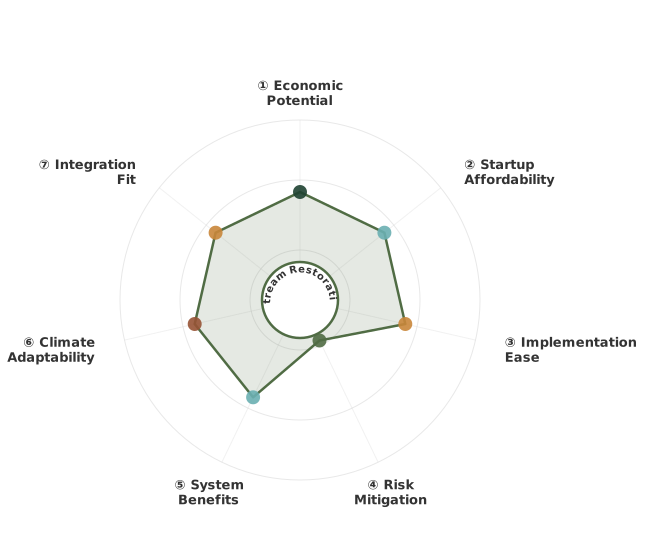
How These Traits Are Calculated
Trait dimensions are ordered clockwise starting from the top of the chart (12 o'clock position):
1. Economic Potential
Financial returns, annual value, and break-even timeline
WHAT: Evaluates financial viability by combining net annual value ($/ha from savings, income, and amortized harvests) with break-even timeline showing when practices pay for themselves.
WHY: Farmers need clear ROI understanding before committing resources. Fast payback (≤3 years) with strong returns (≥$300/ha) enables confident adoption, while long timelines (>10 years) restrict adoption to well-funded operations willing to wait for returns.
HOW: Calculated from net annual value in $/ha and break-even years. Exceptional (≥2.6): fast ROI ≤3 years + high value ≥$300/ha. Typical (1.8-2.5): moderate returns or longer timelines. Limited (<1.8): marginal economics or very long payback >10 years.
2. Startup Affordability
Initial investment costs and financial barrier to entry
WHAT: Measures financial barrier to entry through startup costs for equipment, infrastructure, consulting, and materials. Inverted scoring: lower costs = higher scores = more accessible adoption.
WHY: Affordability determines who can adopt. Low-cost practices (<$250/ha) enable widespread adoption across diverse scales, while high costs (>$2,500/ha) limit adoption to well-capitalized operations, creating barriers that slow regenerative transition.
HOW: Calculated from initial investment parsed from practice content. Inverted scoring: Exceptional (≥2.6): minimal investment <$250/ha. Typical (1.8-2.5): moderate costs $250-2,500/ha. Limited (<1.8): high barrier >$2,500/ha.
3. Implementation Ease
Learning curve and specialized knowledge required
WHAT: Measures how much learning, planning, and specialized knowledge a practice requires. Simpler practices with fewer steps score higher, while complex practices requiring extensive training or specialized resources score lower.
WHY: Complex practices create adoption barriers even when economically viable. Straightforward practices enable faster adoption and broader participation, while those requiring extensive training, timing precision, or specialized equipment limit who can succeed.
HOW: Evaluated by measuring documentation length and identifying complexity markers like location-specific requirements, seasonal timing windows, specialized skills, and dedicated equipment needs. Exceptional (≥2.6): straightforward practices with minimal prerequisites. Typical (1.8-2.5): moderate learning curve with some specialized needs. Limited (<1.8): steep learning curve requiring significant training or resources.
4. Risk Mitigation
Identified financial and ecological risk assessment
WHAT: Evaluates documented risks across financial (investment loss, market volatility) and ecological (crop failure, pest outbreaks) domains. Inverted scoring: fewer risks = higher scores.
WHY: Understanding risk exposure helps farmers make informed decisions. Low-risk practices allow confident implementation, while high-risk practices require careful planning and contingency resources. Risk transparency prevents costly failures.
HOW: Calculated from identified risks in practice content. Inverted scoring: Exceptional (≥2.6): ≤2 risks with manageable severity. Typical (1.8-2.5): 3-5 moderate risks. Limited (<1.8): 6+ risks or severe exposure.
5. System Benefits
How many ways the practice improves your land simultaneously
WHAT: Measures how many aspects of land health improve at once—carbon storage, soil quality, erosion control, water absorption, and biodiversity. Practices that improve multiple areas simultaneously create compounding benefits where each improvement reinforces the others.
WHY: The best practices solve multiple problems at once. For example, addressing erosion simultaneously builds carbon and improves water infiltration, creating a resilient system with positive feedback loops. Single-benefit approaches miss these compound transformation opportunities.
HOW: Evaluated across five key outcomes: carbon sequestration, soil organic matter increase, erosion reduction, water infiltration improvement, and biodiversity enhancement. Exceptional (≥2.6): high carbon storage (>8 t/ha/yr), improvements across 4-5 areas, transformative outcomes. Typical (1.8-2.5): moderate carbon (3-8 t/ha/yr), improvements across 2-3 areas. Limited (<1.8): modest impact (<3 t/ha/yr), single-area focus only.
6. Climate Adaptability
Geographic applicability across Köppen climate zones
WHAT: Evaluates geographic applicability by assessing how many Köppen climate zones successfully support a practice and what adaptation requirements are needed. Measures breadth of climates where farmers can implement with minimal to moderate modifications.
WHY: Universal practices working across diverse climates enable more farmers to adopt regenerative approaches. Practices limited to single climate types (only Mediterranean, only tropical) restrict adoption and slow global transition. Adaptability determines whether a practice serves niche regions or offers broad transformation.
HOW: LLM evaluation of regional success stories, Köppen zone coverage, and adaptation needs. Exceptional (≥2.6): 5+ zones or 4+ climate types, 3+ continents, minimal adaptation. Typical (1.8-2.5): 3-4 zones or 2-3 types, 2 continents, moderate adaptation. Limited (<1.8): 1-2 zones, single region, significant adaptation or highly specialized.
7. Integration Fit
How well this practice combines with others you're doing
WHAT: Measures how well a practice combines with other regenerative practices you might be doing. Some practices work as building blocks that make many other practices easier or more effective, while others work best on their own.
WHY: Practices that combine well with many others create more value on your farm. For example, cover cropping enables no-till, improves grazing, supports crop diversity, and helps water management—making all of them work better together. This helps you build a coherent system rather than juggling disconnected practices.
HOW: Evaluated by identifying which practices combine well and how strong those combinations are. 'Ideally Suited' means strong combinations where practices reinforce each other (practice A makes B easier, while B makes A more effective). 'Adequate' means complementary benefits that work well together. Exceptional (≥2.6): combines well with 6+ practices, serves as a building block. Typical (1.8-2.5): combines with 3-5 practices. Limited (<1.8): 1-2 practices or works best alone.
Going Deeper
1
WHY - The Benefits
Stream restoration, when approached regeneratively, serves as a critical intervention for healing degraded landscapes. It benefits soil health, economics, water cycles, carbon sequestration, and biodiversity, transforming a liability (a failing stream) into an asset that...
Stream restoration, when approached regeneratively, serves as a critical intervention for healing degraded landscapes. It benefits soil health, economics, water cycles, carbon sequestration, and biodiversity, transforming a liability (a failing stream) into an asset that...
WHY - The Benefits
Stream restoration, when approached regeneratively, serves as a critical intervention for healing degraded landscapes. It benefits soil health, economics, water cycles, carbon sequestration, and biodiversity, transforming a liability (a failing stream) into an asset that...
Stream restoration, when approached regeneratively, serves as a critical intervention for healing degraded landscapes. It benefits soil health, economics, water cycles, carbon sequestration, and biodiversity, transforming a liability (a failing stream) into an asset that...
Soil Health Benefits
Degraded streams often lead to soil health degradation in adjacent riparian zones and floodplains. Eroding banks lose valuable topsoil and nutrients, while entrenched streams reduce natural floodplain inundation, limiting organic matter deposition and soil moisture recharge. Regenerative restoration addresses this by stabilizing banks with living systems, which trap sediment and nutrients that would otherwise be lost. This trapped sediment is enriched with organic matter, slowly rebuilding floodplain soil depth and fertility.
The reintroduction of diverse native riparian vegetation creates year-round living root systems that enhance soil structure, aggregate stability, and water infiltration in the riparian zone. These roots bind soil particles, prevent erosion, and create pores for aeration and water movement. The continuous addition of organic matter from leaf litter, root exudates, and decomposition of dead plant material feeds soil microbes, earthworms, and other beneficial organisms, rebuilding a healthy, biologically active soil ecosystem. This creates a buffer that filters runoff, improving water quality before it reaches the stream and enhancing soil moisture availability for plants.
Economic Benefits
Economically, stream restoration can transform a source of ongoing cost and lost productivity into a source of value. Eroding stream banks can lead to the loss of productive agricultural land, requiring costly bank stabilization efforts or resulting in permanent land loss. Restored banks, particularly those stabilized with bioengineering, are often self-repairing and require less intensive maintenance over time than hard structures like concrete or riprap. Their initial investment can be significant, but the long-term reduction in maintenance costs and the recovery of lost land often provide a strong return.
Moreover, healthy riparian zones can improve the productivity of adjacent agricultural lands. Increased soil moisture due to better infiltration and reduced stream velocities can support better crop or pasture growth. Improved water quality downstream can reduce costs for downstream users (e.g., irrigation districts, municipal water providers) and may open opportunities for revenue from ecosystem services programs. Farms with restored streams also often achieve higher land values, as healthy ecosystems are increasingly recognized as valuable assets. Access to government conservation programs and grants specifically for stream restoration can also significantly offset project costs.
Carbon Sequestration
Healthy riparian ecosystems are remarkable carbon sinks. The dense vegetation, particularly trees and shrubs, sequesters atmospheric carbon dioxide through photosynthesis, storing it in biomass (trunks, branches, roots) and in the soil as organic matter. Unlike conventional agricultural soils which can oxidize carbon rapidly, the consistently moist and biologically active soils of riparian zones are prime locations for long-term carbon storage. Restored stream corridors can sequester 2-5 tonnes of carbon per hectare per year, contributing significantly to climate change mitigation efforts. This aligns with regenerative Principle 3 (Keep Soil Covered) and Principle 4 (Maintain Living Roots), as the continuous presence of living plants and organic matter locks away carbon.
Water Cycle Benefits
Stream restoration profoundly impacts local and regional water cycles. Degraded streams are typically fast-flowing channels that shed water quickly, leading to downstream flooding and reduced groundwater recharge. Regenerative restoration aims to slow water down. By re-meandering streams and reconnecting them to their floodplains, water spreads out, percolates into the soil, and recharges aquifers. This reduces peak flow rates downstream, mitigating flood risk, and maintains base flow during dry periods, ensuring water availability. The expanded riparian vegetation also plays a crucial role, with deep roots and fibrous networks enhancing soil infiltration rates, meaning more rainfall soaks into the ground rather than running off. This also serves to filter pollutants from agricultural runoff, improving water quality in the stream.
Biodiversity Enhancement
Degraded stream corridors often support limited biodiversity, with simplified habitats and poor water quality. Restoration projects, by reintroducing diverse native plant communities (trees, shrubs, forbs, grasses) and creating varied aquatic habitats (riffles, pools, undercut banks), dramatically increase habitat availability for a wide range of species. This includes insects, amphibians, fish, birds, and mammals. Healthy riparian zones become corridors for wildlife movement and essential refuges. The diversity of plant life supports a greater diversity of insect pollinators and herbivores, which in turn support bird and bat populations. This ecological complexity is a hallmark of regenerative systems, promoting resilience and natural pest control.
Regenerative Systems Fit
Stream restoration, when implemented regeneratively, acts as a foundational landscape-healing practice that directly supports and enables other regenerative principles.
Principle 1 (Minimize Soil Disturbance): While some disturbance is inherent in stream restoration (e.g., grading, minor excavation), regenerative practices prioritize bioengineering and natural materials over heavy machinery and hard structures. The goal is to disturb the soil as little as possible and to use live plant materials that quickly re-establish ground cover and soil structure. Minimizing disturbance allows native seed bank to germinate and prevents the introduction of invasive species that often thrive in heavily disturbed soils.
Principle 2 (Maximize Crop Diversity): This is perhaps the most directly supported principle. Restoration focuses on establishing a diverse suite of native riparian plant species adapted to the specific local climate and hydrology. This multi-species planting strategy builds a complex, resilient ecosystem that can withstand environmental stresses and support a wider range of associated flora and fauna than monocultures. This ecological complexity below ground translates to improved soil health and nutrient cycling.
Principle 3 (Keep Soil Covered): The very essence of riparian restoration is to keep the soil covered with living vegetation and organic mulch. Stabilized stream banks protected by live fascines and riparian plantings, and floodplains reconnected and reveled in seasonal inundation, ensure continuous soil cover. This prevents erosion, conserves moisture, and provides habitat for soil organisms, keeping the ecosystem functioning year-round.
Principle 4 (Maintain Living Roots): The establishment of diverse perennial native plants ensures that living roots are present throughout the soil profile for most, if not all, of the year. These roots are crucial for maintaining soil structure, facilitating water infiltration, and supporting the soil food web. The continuous biological activity contributes to long-term soil health and landscape resilience.
Principle 5 (Integrate Livestock): Direct livestock integration within the restored stream corridor is generally detrimental. However, healthy riparian zones function as high-quality, nutrient-rich forage areas that can support managed grazing in adjacent pastures. Properly fenced riparian buffers protect the restored stream while allowing the surrounding uplands to benefit from improved soil moisture and productivity, indirectly linking to livestock cycling. The improved health of the riparian zone can also reduce herd stress by providing cooler, shaded areas and cleaner water access points.
For farms transitioning to regenerative agriculture, stream restoration can be a crucial step in healing land that has been historically degraded by conventional practices. It often involves collaboration with conservation agencies that can provide technical and financial assistance. If a farm has a degraded stream running through it, addressing this issue regeneratively is often not just an environmental improvement, but an economic and ecological necessity for long-term resilience.
Sources behind this view
Videos & Podcasts
-
Regenerative agriculture awareness is growing. Restoring land and biodiversity, aided by livestock and soil organisms (beavers, earthworms), improves water cycles and creates habitat. Soil restoration

-
Regenerative agriculture benefits ecosystems by improving soil health, biodiversity, water quality, and wildlife habitats, while also enhancing farm worker conditions and community well-being.

-
Scaling regeneration requires building a 'culture of regeneration' through interconnected farms forming 'perennial transmission corridors.' This approach enhances ecosystem services, biodiversity, and

Research
-
Regenerative Agriculture: Restoring Ecosystems¢ Resilience and Productivity: A Review (opens in new window)
This study found: Regenerative agriculture builds soil health and ecosystem services through practices like no-till, cover crops, and diverse rotations. It increases soil organic matter, improves water infiltration, bo
-
How maintenance and restoration measures mediate the response of riparian plant functional composition to environmental gradients on channel margins: Insights from a highly degraded large river. (opens in new window)
This study found: Managing riverbanks with plowing improved plant diversity on the degraded Rhône River, France, compared to other human interventions. Effective restoration needs varied flows, sediment transport, and
-
The Revolutionary Impact of Regenerative Agriculture on Ecosystem Restoration and Land Vitality: A Review (opens in new window)
This study found: Regenerative agriculture in India enhances soil health, biodiversity, and carbon capture, offering solutions to degradation and climate change. Community and policy support are vital for its widesprea
-
Managing Grazing to Restore Soil Health, Ecosystem Function, and Ecosystem Services (opens in new window)
This study found: Properly managed grazing animals can reverse environmental damage. Regenerative practices, like Adaptive Multi-Paddock (AMP) grazing, boost soil health, increase soil carbon, reduce erosion, and enhan
2
WHERE - Regional Considerations
The success and most effective methods for stream restoration are highly dependent on local environmental conditions. Factors like climate, precipitation patterns, geology, soil types, and the existing landscape matrix profoundly influence stream behavior and the types...
The success and most effective methods for stream restoration are highly dependent on local environmental conditions. Factors like climate, precipitation patterns, geology, soil types, and the existing landscape matrix profoundly influence stream behavior and the types...
WHERE - Regional Considerations
The success and most effective methods for stream restoration are highly dependent on local environmental conditions. Factors like climate, precipitation patterns, geology, soil types, and the existing landscape matrix profoundly influence stream behavior and the types...
The success and most effective methods for stream restoration are highly dependent on local environmental conditions. Factors like climate, precipitation patterns, geology, soil types, and the existing landscape matrix profoundly influence stream behavior and the types...
Click Here to Look up your Region if you don't already know it
Humid Temperate Regions
Representative Locations: Northeastern United States, Western Europe (e.g., UK, France), Eastern China, Japan, Southeastern Australia.
Climate Context: Moderate temperatures with distinct seasons, generally ample and well-distributed rainfall (750-1500 mm or 30-60 inches annually). USDA Zones 4-7, Köppen Cfb/Cfa.
Considerations: These regions often face issues of channelization for agriculture or development, leading to entrenched streams and loss of floodplain connectivity. Erosion can be significant due to intense rainfall events. Restoration often focuses on reconnecting streams to floodplains, using bioengineering for bank stabilization, and re-establishing diverse deciduous and coniferous riparian forests. The high rainfall and moderate growing seasons allow for rapid establishment of vegetation, which is key to long-term success. Livestock managed in adjacent pastures must be carefully fenced to prevent damage to riparian areas.
Mediterranean Regions
Representative Locations: California (USA), Mediterranean Basin (e.g., Spain, Italy), parts of Chile, South Africa, Southwestern Australia.
Climate Context: Hot, dry summers and mild, wet winters. Rainfall is seasonal and can be intense during wet periods (400-900 mm or 15-35 inches annually). USDA Zones 8-10, Köppen Csa/Csb.
Considerations: Water scarcity and intense winter rains are key challenges. Restoration must focus on water conservation, slowing flow, and promoting infiltration. Native, drought-tolerant species are crucial for riparian plantings. Techniques that create microhabitats for water retention, such as swales, retention pools, and the use of coir logs and brush layering, are highly effective. Reconnecting streams to floodplains can be challenging due to steep gradients but is vital for recharging groundwater. Livestock grazing in adjacent areas must be carefully managed to prevent overgrazing and soil compaction, which exacerbate erosion during rainy periods.
Arid/Semi-Arid Regions
Representative Locations: Western USA, Middle East, Central Asia, Interior Australia.
Climate Context: Low and highly variable precipitation (<400 mm or 15 inches annually), high temperatures, and short, unpredictable growing seasons. USDA Zones 6-9, Köppen BSh/BSk.
Considerations: Water is the primary limiting factor. Restoration efforts focus heavily on maximizing water capture and infiltration. Techniques like creating grade stabilization structures (e.g., check dams), restoring beaver-dam analogs, and establishing drought-tolerant riparian species are paramount. The goal is to slow down ephemeral flows, spread water across the landscape, and encourage vegetation growth that can support soil building. Livestock management on adjacent arid rangelands is critical; overgrazing can undo restoration efforts by removing protective vegetation and leading to erosion. Regenerative rangeland management that defers grazing and promotes plant diversity is a natural synergy with arid stream restoration.
Cold Continental Regions
Representative Locations: Northern USA and Canada, Northern Europe, Siberia.
Climate Context: Very short growing seasons, extreme temperature fluctuations, with long periods of freezing. Precipitation can be moderate to high but often falls as snow (500-1000 mm or 20-40 inches annually). USDA Zones 2-5, Köppen Dfb/Dfc.
Considerations: Permafrost, frost heave, and extended periods of ice cover influence stream dynamics. Restoration must consider freeze-thaw cycles and spring snowmelt. Using cold-hardy native species, protecting stream banks from ice scour, and designing structures that can withstand freeze-thaw action are important. Bioengineering techniques such as live staking can be challenging if stakes freeze before rooting. Focusing on soil stabilization with woody debris and stone while planting hardy, deep-rooted species that can survive harsh winters is key. Reconnecting to floodplains is important for managing snowmelt and augmenting groundwater.
Tropical Regions
Representative Locations: Southeast Asia, Central Africa, Northern South America, Northern Australia.
Climate Context: High temperatures year-round, with distinct wet and dry seasons or consistent high rainfall. High humidity. Köppen Af/Am/Aw.
Considerations: High rainfall intensity and temperatures can lead to rapid erosion and nutrient cycling. Restoration requires rapid establishment of dense, multi-layered vegetation. Native tropical trees, shrubs, and groundcovers are ideal for stabilizing banks and creating riparian habitat. Invasive species can be a significant challenge in tropical climates due to rapid growth rates. Water management is critical—controlling high flows during the wet season while ensuring adequate soil moisture during the dry season. Livestock management in adjacent tropical agricultural systems needs to be strictly controlled to prevent stream degradation.
3
HOW - Implementation Process
Implementing stream restoration regeneratively requires a phased approach, prioritizing ecological function and long-term resilience. The process typically involves planning, design, implementation, and monitoring, with each phase informed by local context and...
Implementing stream restoration regeneratively requires a phased approach, prioritizing ecological function and long-term resilience. The process typically involves planning, design, implementation, and monitoring, with each phase informed by local context and...
HOW - Implementation Process
Implementing stream restoration regeneratively requires a phased approach, prioritizing ecological function and long-term resilience. The process typically involves planning, design, implementation, and monitoring, with each phase informed by local context and...
Implementing stream restoration regeneratively requires a phased approach, prioritizing ecological function and long-term resilience. The process typically involves planning, design, implementation, and monitoring, with each phase informed by local context and...
Prerequisites
Before embarking on stream restoration:
- Ecological assessment: Understand the current state of the stream, its watershed, and the riparian zone. Identify sources of degradation (e.g., historical channelization, overgrazing, urban runoff, erosion).
- Goals definition: Clearly define what "restored" means for your specific site. Is it improved water quality, reduced erosion, increased biodiversity, enhanced habitat, or a combination? For regenerative goals, prioritize slowing water, increasinginfiltration, and building soil health.
- Regulatory review: Identify necessary permits from local, regional, and national environmental agencies. This can be a complex and time-consuming step.
- Stakeholder engagement: Consult with neighbors, downstream users, and local conservation authorities. Collective understanding and buy-in are crucial for long-term success.
- Resource assessment: Determine available funding, labor, equipment, and expertise. Partnering with experienced restoration practitioners or conservation organizations is highly recommended.
- Site analysis: Understand soil types, hydrology, existing vegetation, and potential for invasive species.
Phase 1: Design and Planning
Conceptual Design: Based on assessment and goals, develop a conceptual plan. This may involve ideas like:
- Stream meandering: Increasing stream length to slow flow and reduce energy.
- Floodplain reconnection: Creating buffer zones and setback levees to allow water to spread out during high flows.
- Bank stabilization: Prioritizing bioengineering such as live staking willow and cottonwood, fascines, brush layering, and coir logs over hard structures.
- In-stream habitat enhancement: Adding root wads, log structures, or strategically placed boulders to create pools, riffles, and cover for aquatic life.
- Riparian vegetation plan: Selecting native, locally adapted species for different zones (wetland, bank, floodplain) to maximize biodiversity and ecological function. Consider species that are hardy, fast-growing, and provide multiple benefits (e.g., shade, pollinator support, soil stabilization).
Detailed Design: Translate the conceptual plan into precise engineering and ecological designs. This may involve:
- Topographic surveys: Mapping the existing stream and contours of the floodplain.
- Hydraulic modeling: Simulating water flow to predict how design changes will affect velocities and water levels.
- Geotechnical analysis: Understanding soil conditions for effective bank stabilization.
- Planting plans: Specifying species, densities, and planting methods for revegetation.
- Equipment and Material Plan: Identifying what machinery (e.g., excavators, specialized planters, hand tools) and materials (e.g., live stakes, logs, coir products, native seeds) will be needed. International sourcing for materials should be considered, prioritizing local and sustainable options where possible.
Phase 2: Site Preparation and Initial Construction
Site Access and Clearing: Establish safe access for equipment while minimizing disturbance to undisturbed areas. Remove invasive species if they dominate the site, but avoid over-clearing native vegetation.
Earthwork:
- Bank grading: Gently sloping banks to a stable angle (often 2:1 or 3:1, soil dependent) to reduce erosive forces.
- Floodplain reconnection: Removing or setting back artificial levees or berms to allow water access to the floodplain.
- Channel realignment/re-meandering: Excavating a new, longer channel path if needed.
- In-stream structure placement: Installing log jams, root wads, or boulders.
Bioengineering Installation:
- Live staking: Inserting cuttings of willow, cottonwood, or other fast-rooting species into banks. Can be done during dormancy (late fall to early spring).
- Fascines: Bundles of live branches tied together and laid along banks.
- Brush layering: Alternating layers of live branches and soil fill on slopes.
- Coir logs/products: Biodegradable erosion control logs made from coconut fiber, placed along bank toes.
Foundation for Revegetation: Prepare the site for planting by ensuring adequate soil moisture, some loosened soil if necessary (but avoiding deep tillage), and appropriate substrate for seed germination and seedling establishment.
Phase 3: Revegetation and Stabilization
Planting: Install native trees, shrubs, and herbaceous plants according to the plan. This is critical for long-term success. Use bare-root stock, containerized plants, or seed. Consider hydroseeding or other methods for large areas.
- Species Selection: Prioritize diverse, locally adapted native species. Mix deep-rooted species for soil stability with water-loving plants near the stream and drought-tolerant species higher on the banks.
- Planting Density: Ensure sufficient density to quickly cover the soil and provide habitat.
Erosion Control: Install temporary measures like erosion control blankets (biodegradable), straw mulch, or silt fences to protect newly planted areas from erosion during establishment, especially on steep slopes.
Watering and Maintenance (Initial Period): Provide supplemental watering if site is extremely dry, especially for newly planted trees and shrubs, for the first 1-2 growing seasons. Monitor for invasive species and remove them promptly.
Phase 4: Monitoring and Adaptive Management
Post-Implementation Monitoring (Years 1-5+):
- Vegetation survival and growth: Track the success of plantings and identify areas needing replanting.
- Erosion monitoring: Check for new signs of erosion or undercutting.
- Water quality: Measure turbidity, nutrient levels, and other indicators if baseline data exists.
- Habitat utilization: Observe increased use by wildlife, fish, and beneficial insects.
- Soil health indicators: Monitor soil moisture, organic matter, and aggregate stability in riparian areas.
Adaptive Management: Based on monitoring results, adjust management practices. If certain species are failing, investigate why and replant with alternatives. If minor erosion occurs, apply supplementary bioengineering or mulch. The goal is to guide the system towards a self-sustaining, resilient state.
Transition Timeline & Phase-Out Strategy (for regeneratively focused projects)
This practice IS regenerative when focused on ecological function, but it's key to note the transition from degraded states. The "phase-out" aspect here refers to phasing out the degraded state and the need for constant intervention.
Year 0-1 (Establishment): Minimal direct "phase-out" of non-regenerative inputs, as the focus is on installation. However, it's essential to phase out any practices that caused degradation (e.g., unrestricted livestock access, channelization).
- Goal: Secure plant establishment, achieve initial erosion control.
- Key Action: Implement temporary fencing to protect plantings from wildlife/livestock.
Year 1-3 (Stabilization & Early Growth): Begin monitoring and adapt management. Invasive species control is critical. As vegetation takes hold, the need for temporary erosion control materials diminishes.
- Goal: Plant survival >80%, minimal new erosion, initial signs of habitat use.
- Key Action: Remove temporary erosion controls as plants stabilize banks. Begin planning for long-term livestock management in adjacent pastures if applicable.
Year 3-5 (Self-Sufficiency & Long-Term Function): Vegetation becomes self-sustaining. Natural processes dominate erosion control and habitat creation. The stream begins functioning more ecologically.
- Goal: Fully established native riparian community, stable stream banks, visible signs of ecosystem recovery.
- Key Action: Phase out intensive monitoring and interventions, moving to a regular adaptive management schedule. Ensure long-term land management plans (e.g., grazing, development) do not re-introduce degradation.
Success Indicator: The restored stream corridor actively contributes to the farm's overall resilience, enhancing water availability, soil health on adjacent lands, biodiversity, and reducing costs associated with erosion and water management. The need for intensive intervention fades, replaced by observation and adaptive responses to natural changes.
Sources behind this view
Research
-
Application of science-based restoration planning to a desert river system. (opens in new window)
This study found: A science-based planning framework for restoring desert rivers, focusing on achievable goals, prioritizing sites, and adaptive management to aid biodiversity and natural river functions.
-
Assessing stream channel restoration: the phased recovery framework (opens in new window)
This study found: Stream restoration in Montana improved stream shape but not aquatic life, especially in polluted areas. Fixing upstream pollution is key to successful recovery, which takes longer than typically monit
-
Standards for ecologically successful river restoration (opens in new window)
This study found: Five standards for successful river restoration: aim for a healthy river vision, show measurable ecological improvement, increase self-sufficiency, avoid lasting harm, and share assessment data public
-
Attributes of an alluvial river and their relation to water policy and management (opens in new window)
This study found: Healthy rivers have key natural processes (attributes) often disrupted by dams. This review suggests recreating scaled-down versions of these processes can help restore river health and guide water ma
4
Know the Debate
Regenerative stream restoration success varies significantly by region, scale, and management. In humid climates, rapid vegetation growth supports ...
Know the Debate
Regenerative stream restoration success varies significantly by region, scale, and management. In humid climates, rapid vegetation growth supports ...
Regenerative stream restoration success varies significantly by region, scale, and management. In humid climates, rapid vegetation growth supports quicker erosion control, while arid regions demand meticulous water harvesting and drought-tolerant species. Projects range from small, landowner-led bioengineering efforts costing under $10,000 to large-scale river reconnect programs costing hundreds of thousands. Ongoing labor focuses on monitoring and adaptive management, transitioning from intensive establishment to light intervention over 3-5 years. While immediate erosion control is possible, substantial economic and ecological benefits often unfold over 5-15 years, with break-even achieved through avoided costs, increased land value, and program incentives.
How much does stream restoration cost?
Low-cost bioengineering ($6k-$26.5k small scale)
Small-scale projects leverage bioengineering, local materials, and volunteer labor for minimal upfront investment, focusing on targeted erosion control and habitat. DIY implementation is common.
Sources behind this view
Sources behind this view
Videos & Podcasts
-
Serge Koenig advises protecting stream banks by creating separate rotational grazing blocks and fortifying access points. He also warns against excessive livestock access to ponds due to phosphorus runoff, recommending alternative water sources.

-
Learn practical, human-scale water management techniques like 'water bars' and 'silt traps' to slow, spread, and sink water, preventing erosion and retaining soil. Use observation to guide incremental shovel work, creating S-curves in the landscape and enhancing soil fertility.
 From the Web
-
Simple, nature-based fixes like using sticks and stones are employed for river restoration and land healing in the western US, enhancing community resilience and water conservation.
Moderate cost ($25.5k-$108k medium scale)
Medium-scale projects involve more extensive design, permitting, earthwork, and planting, often requiring professional consultation and specialized equipment. Funding from conservation programs is common.
Sources behind this view
Sources behind this view
From the Web
-
Details stream restoration methods including streambank stabilization, floodplain restoration, and riparian buffers, emphasizing their role in improving water quality and managing erosion in Pennsylvania.
-
Induced meandering, detailed in 'Let the Water Do the Work' by Zeedyk and Clothier, is a practical stream restoration method that rebuilds floodplains by intentionally eroding banks to raise water tables. It complements planned grazing and shows dramatic results in six years.
-
Guidance on assessing stream health through visual indicators like bank cover and embeddedness, and restoration techniques including riparian buffers and live staking, with a focus on Pennsylvania waterways.
High cost ($97k-$480k+ large scale)
Large-scale endeavors require comprehensive planning, significant earthmoving, extensive native revegetation, and often involve multiple agencies and landowners, frequently funded by major grants or ecosystem service payments.
Sources behind this view
Sources behind this view
Videos & Podcasts
-
Restoring natural river-floodplain connections encourages diverse habitats (wetlands, grasslands, fen), increases species diversity, and enhances carbon sequestration in soils. This nature-based solution improves nutrient, sediment, and flood management, restoring river resilience.
-
Seattle's Thornton Creek restoration used historical ecology to revive the hyporheic zone, reducing flooding by 89x, improving water quality, and enabling salmon return. This approach highlights the importance of subsurface water flows in urban stream health.

Research
-
Repairing Damaged Wildlands (opens in new window)
This study found: This book offers a practical way to restore damaged natural areas by letting nature heal them, rather than relying on costly artificial inputs. It focuses on fixing water and nutrient flows and boosting how plants capture energy. This kickstarts natural self-repair systems, leading to healthier ecosystems. This approach is ideal for managing land with minimal intervention for goals like supporting wildlife, grazing livestock, growing timber, or providing essential ecosystem services. It's a valuable guide for anyone working to bring degraded lands back to life.
Making Sense of the Differences
Project costs depend heavily on scale and method. Small, landowner-led bioengineering projects can be cost-effective, while large-scale floodplain reconnection and complex design require significant capital. Accessing grants and conservation programs is crucial for most projects. The long-term economic benefits (avoided costs, land value) often outweigh initial investments over several years.
How long until stream restoration shows results?
Immediate bank stabilization & flow control
Visible erosion control and initial water flow improvements can occur within months of structural work and bioengineering installation. Quick establishment of hardy plants begins immediate soil binding.
Sources behind this view
Sources behind this view
Videos & Podcasts
-
Natural structures like contour banks, swales, and check dams are applied from headwaters to outlets to intercept water, halt erosion, increase infiltration, create wetlands, and enhance landscape resilience and water quality.

From the Web
-
Details stream restoration methods including streambank stabilization, floodplain restoration, and riparian buffers, emphasizing their role in improving water quality and managing erosion in Pennsylvania.
-
Simple, nature-based fixes like using sticks and stones are employed for river restoration and land healing in the western US, enhancing community resilience and water conservation.
Moderate improvement (1-5 years) to habitat and productivity
Within 1-5 years, plant communities establish, improving soil moisture, water quality, and providing recognizable habitat for wildlife. Adjacent land may show a modest yield increase.
Sources behind this view
Sources behind this view
Videos & Podcasts
-
Short-duration grazing in riparian zones restores creek beds by preventing erosion with grass sod, building carbon banks, and improving water retention, transforming dried-up areas into water sources.
Research
-
Quantitatively Estimating Carbon Sequestration Potential in Soil and Large Wood in the Context of River Restoration (opens in new window)
This study found: Restoring rivers and their floodplains can significantly increase the amount of carbon stored in the soil, fallen trees, and streamside plants. This research developed a way to estimate how much carbon can be stored by different river restoration projects. By studying restored, degraded, and natural stream areas in Oregon, USA, the scientists identified key factors that help maximize carbon storage. These include how well water can connect with the floodplain, the dynamics of the river channel itself, and the type of plants growing along the riverbanks. This framework can help managers choose restoration methods that best capture carbon.
From the Web
-
Induced meandering, detailed in 'Let the Water Do the Work' by Zeedyk and Clothier, is a practical stream restoration method that rebuilds floodplains by intentionally eroding banks to raise water tables. It complements planned grazing and shows dramatic results in six years.
Long-term ecological function (5-15+ years)
Full ecological maturity, substantial carbon sequestration, complex habitat development, and establishment of self-sustaining processes can take 5-15 years or more, especially for mature tree canopy and complex aquatic ecosystems.
Sources behind this view
Sources behind this view
Videos & Podcasts
-
Foster Creek stream restoration revitalized a waterway by reintroducing meanders and planting native species like willows and elderberries, enhancing biodiversity and water quality while creating food forests. The project also highlights the value of urban foraging and connecting with nature for health and a sustainable economy.

Research
-
Repairing Damaged Wildlands (opens in new window)
This study found: This book offers a practical way to restore damaged natural areas by letting nature heal them, rather than relying on costly artificial inputs. It focuses on fixing water and nutrient flows and boosting how plants capture energy. This kickstarts natural self-repair systems, leading to healthier ecosystems. This approach is ideal for managing land with minimal intervention for goals like supporting wildlife, grazing livestock, growing timber, or providing essential ecosystem services. It's a valuable guide for anyone working to bring degraded lands back to life.
-
Transforming ecosystems: When, where, and how to restore contaminated sites. (opens in new window)
This study found: This article offers advice for experts and land managers on how to fix ecosystems damaged by chemical pollution. It helps decide when to start restoration (considering if nature can heal itself and the cost), what to focus on (like bringing back diverse plants and animals, or restoring natural processes), and where to work, especially with climate change altering habitats. The review covers practical steps, including how to use financial incentives, manage restoration projects, involve local communities and stakeholders, and work with contractors. The goal is to improve teamwork between scientists who study pollution and those who restore ecosystems, creating a clear plan for cleaning up and revitalizing contaminated areas.
Making Sense of the Differences
Observable erosion control and initial riparian plant establishment can be seen within months to a few years. However, full ecological maturity, complex habitat development, and significant carbon sequestration typically require 5-15 years for native vegetation to establish and stabilize the system. Factors like climate, species selection, water availability, and initial site conditions influence the pace of recovery.
5
HOW MUCH - Costs & Investment
Note: All costs are indicative USD equivalents (2023-2025) and will vary significantly based on region, labor costs, material availability, scale of project, and regulatory requirements. International sourcing for materials and local labor rates must be factored in.
Note: All costs are indicative USD equivalents (2023-2025) and will vary significantly based on region, labor costs, material availability, scale of project, and regulatory requirements. International sourcing for materials and local labor rates must be factored in.
HOW MUCH - Costs & Investment
Note: All costs are indicative USD equivalents (2023-2025) and will vary significantly based on region, labor costs, material availability, scale of project, and regulatory requirements. International sourcing for materials and local labor rates must be factored in.
Note: All costs are indicative USD equivalents (2023-2025) and will vary significantly based on region, labor costs, material availability, scale of project, and regulatory requirements. International sourcing for materials and local labor rates must be factored in.
Note: All costs are based on recent US economic data (2024–2026) and may vary substantially by region based on local labor rates, material costs, and regulatory requirements.
Planning and Regulatory Compliance
Professional design, hydrological modeling, and federal or state permitting are the foundational costs of any stream restoration project. For small-scale projects under 50 acres (20 ha), planning fees range from $1,563–$6,773 as they often qualify for streamlined permit pathways. Mid-size projects covering 50–500 acres (20–202 ha) necessitate more granular site analysis and federal compliance, costing $7,294–$33,344. Large-scale restoration exceeding 500 acres (202 ha) requires comprehensive geotechnical surveys, in-depth environmental impact studies, and complex legal filings, with professional service fees ranging from $36,470–$145,880. These professional costs generally account for 15–25% of total project expenditure, acting as an insurance policy against future regulatory enforcement actions.
Earthwork, Engineering, and Materials
This phase represents the most capital-intensive component, involving the rental of heavy machinery and the acquisition of structural materials like boulders, woody debris, or erosion control blankets. Small-scale interventions require $4,689–$18,756 for localized bank grading and basic coir log installation. Mid-size operations, requiring excavators for significant channel realignment or floodplain benching, demand an investment of $36,470–$125,040. Large-scale ecological restoration, which involves major regrading of stream reaches and the installation of complex rock-vanes, can range from $114,620–$573,100. Accessibility remains a critical cost multiplier; remote or rugged terrain can increase fuel and equipment mobilization costs by 20–35% compared to roadside sites.
Revegetation and Long-term Monitoring
Post-construction stabilization is essential to ensure long-term structural viability. Small-scale projects utilize $1,876–$6,252 for native riparian stakes and initial inspections. Mid-size ventures require $7,815–$29,176 for dense, multi-year planting strategies and proactive invasive species management. Large-scale systems demand $31,260–$98,990 to cover extensive native seeding, mandatory deer exclusion fencing, and intensive 3–5 year monitoring programs. These costs fluctuate based on regional demand for native nurseries and the climate profiles that influence transplant survival rates.
Most Spend: Most landowners fall into the middle 60% of the cost ranges. Small projects: $12,510–$20,850. Mid-size projects: $46,890–$88,570. Large projects: $187,560–$364,700. These figures rely on standard site conditions where projects are managed proactively rather than as emergency flood recovery.
Why the Range?: The primary cost driver is the intensity of site-specific degradation; "head-cutting" or active vertical erosion requires 40–50% more mechanical stabilization than mild sediment accumulation. Additionally, project scope is determined by the length and connectivity of the stream corridor relative to the total acreage, as deep incisions exponentially increase the volume of earth moving required compared to shallow, wide-reach restoration.
6
REWARDS AND RISKS - Economics & Risk Factors
REWARDS AND RISKS - Economics & Risk Factors
In a Best Case Scenario, successfully stabilized banks prevent the loss of 2–5 acres (0.8–2.0 ha) of productive cropland over a decade, representing an avoided asset loss valued at $26,050–$62,520 based on prevailing land prices. Federal cost-share programs, such as EQIP or CRP, can effectively offset 50–75% of your total out-of-pocket installation expenses. A Typical Case scenario yields a structural break-even point in 9–13 years. In this timeframe, capital investments averaging $62,520 are recovered through the combination of retained acreage, documented property value appreciation of 15–20%, and reduced infrastructure maintenance expenses associated with culvert dredging or road washing.
Worst Case scenarios, often triggered by catastrophic failure due to extreme weather or poor initial design, occur within 24 months of installation. Such failures necessitate secondary remediation costing $31,260–$52,100, extending the payback period to 15+ years and creating a net negative ROI in the short term. Profitability is highly sensitive to the integration of Payments for Ecosystem Services (PES) or carbon credit markets; participation can generate an annual revenue stream of roughly $100–$300 per acre ($247–$741/ha), which is instrumental in shortening the return-on-investment timeline.
Landowners should mitigate financial risk through "phased implementation." By segmenting a large project into smaller reaches, a landowner can address the most unstable 50-acre (20 ha) zone with a $20,000–$40,000 initial investment, providing a low-stakes environment to test design performance before full-scale deployment. Retaining a certified ecological engineer for early consulting—costing $2,000–$8,000—reduces the statistical probability of engineering failure by approximately 40%.
Transition Period Risks: The most critical window is the initial 36 months following construction. During establishment, immature root systems remain vulnerable; a severe 2-inch rain event can easily wash away $5,210–$15,630 in new botanical assets. Incorporate "living" bioengineering, such as live willow stakes, alongside static structural armor to improve resiliency. Furthermore, farmers must account for potential temporary yield dips in adjacent fields due to water table rebalancing during the first three years. We recommend budgeting an additional 5–10% of total project costs to fund reactive replanting, which ensures long-term botanical health and protects the overall investment.
Sources behind this view
Research
-
The Relationship between Erosion and Precipitation and the Effects of Different Riparian Practices on Soil and Total-P Losses via Streambank Erosion in Small Streams in Iowa, USA (opens in new window)
This study found: Iowa study: Trees/grass along streams and fenced pastures significantly reduced soil and phosphorus loss compared to intensive grazing or row crops, with rainfall being the main driver of erosion.
-
Stochastic simulation of restoration outcomes for a dry afromontane forest landscape in northern Ethiopia (opens in new window)
This study found: Ethiopian forest restoration methods like assisted regeneration and exclosures have >77% chance of positive financial returns over 25 years, with recovery time being the main risk. Measuring exclosure
-
Assessing stream channel restoration: the phased recovery framework (opens in new window)
This study found: Stream restoration in Montana improved stream shape but not aquatic life, especially in polluted areas. Fixing upstream pollution is key to successful recovery, which takes longer than typically monit
7
WHO - Labor & Expertise
Stream restoration is an interdisciplinary practice that draws on a range of expertise and labor. Successful projects require collaboration between landowners, technical experts, and skilled labor. Landowners/Farm Managers:
Stream restoration is an interdisciplinary practice that draws on a range of expertise and labor. Successful projects require collaboration between landowners, technical experts, and skilled labor. Landowners/Farm Managers:
WHO - Labor & Expertise
Stream restoration is an interdisciplinary practice that draws on a range of expertise and labor. Successful projects require collaboration between landowners, technical experts, and skilled labor. Landowners/Farm Managers:
Stream restoration is an interdisciplinary practice that draws on a range of expertise and labor. Successful projects require collaboration between landowners, technical experts, and skilled labor. Landowners/Farm Managers:
Landowners/Farm Managers:
- Role: Project visionaries, primary decision-makers, provide site knowledge, often contribute labor or equipment, essential for long-term stewardship.
- Expertise Required: Understanding of farm operations, land management history, desire for long-term ecological health, willingness to engage with technical experts and regulatory bodies.
- Labor Contribution: Site preparation, planting, basic monitoring, potentially operating farm equipment for access or minor grading.
Ecological Consultants/Restoration Designers:
- Role: Assess site conditions, define restoration goals, design the restoration plan, navigate regulatory processes, oversee implementation.
- Expertise Required: Streambank geomorphology, hydrology, soil science, native plant ecology, fisheries biology, environmental regulations.
- Labor Contribution: Primarily professional services and oversight.
Environmental Engineers:
- Role: Provide hydraulic modeling, structural engineering for more complex designs (e.g., bridges, culverts), ensure structural integrity alongside ecological function.
- Expertise Required: Hydrology, fluid dynamics, civil/environmental engineering, understanding of fluvial geomorphology.
- Labor Contribution: Professional services, design calculations, site oversight.
Construction Contractors/Equipment Operators:
- Role: Operate heavy machinery (excavators, bulldozers, graders), implement earthwork, install structures, assist with planting.
- Expertise Required: Skill in operating heavy equipment safely and precisely, understanding of construction phasing, ability to work with bioengineering materials.
- Labor Contribution: Skilled manual labor and operation of heavy machinery. Projects often hire specialized ecological construction firms.
Nursery Personnel/Plant Suppliers:
- Role: Grow and supply native plant materials (live stakes, seeds, plugs, containerized plants).
- Expertise Required: Horticulture, native plant propagation, soil science for nursery media.
- Labor Contribution: Growing, harvesting, preparing materials for transport and planting.
Conservation Agency Staff:
- Role: Provide technical guidance, facilitate permitting, administer grants and cost-share programs, offer monitoring support.
- Expertise Required: Regulatory knowledge, program administration, regional restoration best practices.
- Labor Contribution: Technical assistance, program management.
Volunteers:
- Role: Assist with planting, invasive species removal, monitoring, and general site maintenance.
- Expertise Required: Willingness to learn and perform assigned tasks under supervision.
- Labor Contribution: Significant hands-on labor, particularly for planting and invasive removal. Community engagement events can leverage volunteer power effectively.
International Considerations: Specific roles and their availability will vary. In regions with well-developed conservation sectors, specialized ecological engineering firms may be common. In others, landowners may rely more heavily on governmental extension services and international NGOs. Sourcing locally adapted native plants and bioengineering materials is paramount, requiring local nursery partnerships. Labor costs for skilled operators and professional consultants differ vastly by country and region. Rigorous research into local expertise and resources is essential before project initiation.
8
EQUIPMENT - Tools & Infrastructure
Stream restoration projects, particularly those using bioengineering and ecological approaches, require a combination of specialized equipment and standard tools. The scale and complexity of the project heavily influence the machinery required.
Stream restoration projects, particularly those using bioengineering and ecological approaches, require a combination of specialized equipment and standard tools. The scale and complexity of the project heavily influence the machinery required.
EQUIPMENT - Tools & Infrastructure
Stream restoration projects, particularly those using bioengineering and ecological approaches, require a combination of specialized equipment and standard tools. The scale and complexity of the project heavily influence the machinery required.
Stream restoration projects, particularly those using bioengineering and ecological approaches, require a combination of specialized equipment and standard tools. The scale and complexity of the project heavily influence the machinery required.
Heavy Equipment (for larger projects or significant earthwork)
- Excavators: Crucial for grading banks, excavating new channels, placing large logs or root wads, and moving large volumes of soil and material. Mini-excavators are ideal for smaller, more sensitive sites.
- Bulldozers/Graders: Used for major earthmoving, creating floodplain benches, and shaping channel alignments on larger projects.
- Tractors with Front-End Loaders/Backhoes: Useful for moving smaller amounts of soil, lifting materials, and assisting with planting or transport.
- Skid-Steer Loaders: Versatile for tight access areas, moving plants and materials, and light grading.
- Dump Trucks/Gravel Trucks: For transporting soil, rock, mulch, or construction fill.
Specialized Bioengineering Tools
- Live Stake Cutters/Pruners: For harvesting and trimming cuttings from willows, cottonwoods, and other suitable woody species.
- Tamper Bars/Rebar: For driving live stakes into banks and compacting soil around them.
- Coir Log Rollers/Installers: Tools to help secure coir logs and other biodegradable erosion control products.
- Specialized Planting Augers/Tools: For creating holes for bare-root plants or plugs in difficult soil conditions.
Standard Tools & Infrastructure
- Shovels, Spades, and Hoes: Essential for digging holes, planting, soil preparation, and general site cleanup.
- Pruners and Loppers: For trimming live stakes, managing vegetation, and removing invasive species.
- Wheelbarrows and Carts: For moving soil, mulch, plants, and tools around the site.
- Measuring Tapes and Survey Equipment: For laying out designs, taking measurements, and monitoring.
- GPS Units/Drones: For site surveying, mapping, and monitoring progress.
- Temporary Fencing: Crucial for protecting the restoration site from livestock and excessive foot traffic during establishment. Available in various forms, from electric fencing to more robust temporary mesh.
- Watering Equipment: Hoses, portable pumps, or tanks for supplemental irrigation during establishment if rainfall is insufficient.
- Safety Equipment: Personal Protective Equipment (PPE) including hard hats, safety glasses, work gloves, steel-toed boots, and high-visibility vests.
Material Sourcing (International Considerations)
- Live Stakes/Plant Materials: For best success, source native species locally adapted to the specific climate and soil conditions. If local sources are scarce or unavailable, research reputable nurseries that specialize in native riparian plants and bioengineering materials. International sourcing might involve significant logistical and regulatory challenges (e.g., phytosanitary certificates, import/export restrictions).
- Bioengineering Materials: Coir logs, biodegradable erosion control blankets, and specialized anchoring pins may need to be sourced from international suppliers if not readily available locally.
- Stone/Rock: For more engineered structures, quarry stone may be required. Local availability and sourcing are typically most cost-effective.
- Wood: Fallen logs and root wads are excellent natural materials. For projects requiring specific types or quantities, milling operations or forestry salvage can be sources.
The selection of equipment should prioritize low-impact machinery where possible to minimize disturbance. Smaller, more agile equipment allows for greater precision and less damage to surrounding areas. For landowners, understanding the types of equipment and materials involved helps in planning budgets and identifying potential local resources or hire needs.
9
COMPATIBLE PRACTICES - Integration Opportunities
Regenerative stream restoration is not an isolated practice but a powerful component that enhances and is enhanced by other regenerative land management strategies. Its integration amplifies ecological benefits across the entire landscape.
Regenerative stream restoration is not an isolated practice but a powerful component that enhances and is enhanced by other regenerative land management strategies. Its integration amplifies ecological benefits across the entire landscape.
COMPATIBLE PRACTICES - Integration Opportunities
Regenerative stream restoration is not an isolated practice but a powerful component that enhances and is enhanced by other regenerative land management strategies. Its integration amplifies ecological benefits across the entire landscape.
Regenerative stream restoration is not an isolated practice but a powerful component that enhances and is enhanced by other regenerative land management strategies. Its integration amplifies ecological benefits across the entire landscape.
Adaptive Grazing Management
- Integration: While livestock must be excluded from the immediate stream corridor, managed grazing in adjacent pastures is vital. Rotational or multi-paddock grazing systems, with long rest periods for riparian pastures, prevent overgrazing and soil compaction that could re-initiate erosion.
- Synergy: Healthy riparian zones can provide shade and cooler conditions for livestock during summer months, improving animal welfare and productivity. Improved soil moisture in riparian pastures from better infiltration can extend the grazing season. Livestock manure, when managed properly in uplands, provides fertility to support pasture health, indirectly supporting the riparian ecosystem.
Native Plant Landscaping & Biodiversity Enhancement
- Integration: Using native plants throughout the farm landscape, not just in the riparian buffer, creates a connected network of habitats that supports pollinator and wildlife corridors.
- Synergy: A farm-wide commitment to native plants reinforces the riparian restoration's goal of increasing biodiversity. A functional ecosystem extends beyond the stream bank, creating a more resilient and interconnected landscape. Farmsteads and field borders planted with native species will naturally attract beneficial insects and pollinators that can also benefit adjacent crops and pastures.
Cover Cropping & Diverse Forages
- Integration: Implementing diverse cover crop mixes in adjacent agricultural fields, especially those closest to the stream, helps prevent soil erosion and filters runoff before it reaches the riparian zone.
- Synergy: Cover crops mimic the soil-health benefits of riparian vegetation by keeping soil covered and maintaining living roots. They reduce nutrient and sediment loads entering the stream, making the restoration effort more effective and sustainable. Increased soil organic matter from cover crops in upstream fields improves general water quality.
Agroforestry & Silvopasture
- Integration: Incorporating trees on slopes leading down to the riparian zone naturally extends the tree canopy and contributes to soil stabilization. Silvopasture systems can provide shade and extend grazing quality in nearby areas without direct stream impact.
- Synergy: Trees in agroforestry or silvopasture systems have extensive root systems that stabilize soils, similar to riparian trees. Tree leaf litter contributes to soil carbon sequestration and fertility. This creates a mosaic of interconnected healthy ecosystems.
Keyline Design & Water Harvesting
- Integration: Contour swales, ponds, or other water harvesting structures upslope of the stream can slow down and infiltrate runoff, reducing peak flow velocity and sediment load reaching the stream.
- Synergy: By retaining and infiltrating water higher up the landscape, these practices decrease the erosive forces on the stream banks and reduce the volume of water that needs to be managed by the restored stream corridor. This complements the stream's role in managing water flow and quality.
No-Till Farming
- Integration: Minimizing soil disturbance in fields upslope contributes to reduced runoff and sediment load reaching the stream.
- Synergy: While not directly linked to stream processes, no-till farming practices that improve soil structure and water infiltration upstream reduce the sediment and nutrient burden that the restored stream must process, making its job easier and its success more likely.
By integrating stream restoration with these regenerative practices, landowners create a holistic system where ecological functions are interconnected and mutually reinforcing, leading to a more resilient, productive, and biodiverse farm.
Sources behind this view
Videos & Podcasts
-
Regenerative agriculture benefits ecosystems by improving soil health, biodiversity, water quality, and wildlife habitats, while also enhancing farm worker conditions and community well-being.
-
Discusses how integrated water systems (ponds, swales, greywater) mimic natural sponges (beavers, forests) to increase stream flow, recharge aquifers, and support ecosystems like salmon. This approach

-
Scaling regeneration requires building a 'culture of regeneration' through interconnected farms forming 'perennial transmission corridors.' This approach enhances ecosystem services, biodiversity, and
Research
-
Regenerative Agriculture: Restoring Ecosystems¢ Resilience and Productivity: A Review (opens in new window)
This study found: Regenerative agriculture builds soil health and ecosystem services through practices like no-till, cover crops, and diverse rotations. It increases soil organic matter, improves water infiltration, bo
-
Managing Grazing to Restore Soil Health, Ecosystem Function, and Ecosystem Services (opens in new window)
This study found: Properly managed grazing animals can reverse environmental damage. Regenerative practices, like Adaptive Multi-Paddock (AMP) grazing, boost soil health, increase soil carbon, reduce erosion, and enhan
-
Estrategias de agricultura regenerativa para mejorar la salud del suelo (opens in new window)
This study found: Review of research shows cover crops, composting, and crop rotation significantly improve soil health, carbon capture, and erosion resistance in regenerative agriculture.
-
Building Soil Health and Fertility through Organic Amendments and Practices: A Review (opens in new window)
This study found: Review of organic amendments (manures, compost, cover crops) and regenerative practices (no-till, crop diversity, agroecology) shows they restore soil health by increasing organic matter and beneficia