
Transition Towns
Transition Towns are grassroots, community-led movements aiming to foster local resilience and sustainability, particularly in response to climate change and resource depletion. They focus on building local economies by encouraging shorter supply chains, skill-sharing, and community-based projects that reduce reliance on external and fossil fuel-based systems. While not an agricultural practice, they create a supportive context for regenerative agriculture by emphasizing local food systems and resource stewardship.
Read More: Complete Description
Transition Towns represent a global movement that empowers communities to build resilience in the face of environmental and economic challenges by reimagining their local systems. Initiated by local residents, these towns focus on developing local economies, fostering community connection, and reducing our dependency on finite global resources and fossil fuels. The core philosophy is to empower citizens to take collective action towards more sustainable and resilient ways of living, directly impacting food systems, energy, transport, housing, and local economies within their geographic area.
From a regenerative agriculture perspective, Transition Towns act as a vital enabling environment rather than a direct practice. They foster the conditions and networks necessary for regenerative farmers and land managers to thrive. By emphasizing local food production and consumption, shorter supply chains, and direct relationships between producers and consumers, Transition Towns create a natural market and social support structure for regenerative agriculture. This reduces the economic pressure for farmers to adopt unsustainable, high-input practices driven by long-distance, industrialized food systems.
The movement's emphasis on community resilience encourages local economies that prioritize resource stewardship and circularity. This aligns perfectly with regenerative agriculture's goal of building soil health, sequestering carbon, enhancing biodiversity, and creating closed-loop nutrient cycles. When communities actively support local, regenerative food producers through farmers' markets, community-supported agriculture (CSA) schemes, and local food procurement by institutions (schools, hospitals), it provides economic stability for farmers transitioning away from conventional methods. This economic security is crucial because regenerative transitions can involve upfront investment and a learning curve, and a supportive local market reduces the financial risk.
Principle 1 (Minimize Soil Disturbance): Transition Town initiatives often promote activities that reduce reliance on fossil fuels for transportation and energy, indirectly supporting reduced tillage in agriculture by lowering the cost and environmental impact of farm operations. Localized food systems also reduce the need for extensive processing and long-distance transport, which are energy-intensive.
Principle 2 (Maximize Crop Diversity): Transition Towns often champion heritage seeds, local varieties, and diverse crop planting through community gardens and local farms. This encourages farmers to grow a wider range of resilient, locally adapted crops rather than monocultures, supporting the principle of genetic and species diversity.
Principle 3 (Keep Soil Covered): Local food campaigns within Transition Towns can support perennial cropping systems and pasture-based livestock management by creating demand for these products, which naturally keep soil covered year-round.
Principle 4 (Maintain Living Roots): The focus on local food fosters demand for produce that is harvested and consumed locally, often implying shorter storage times and less reliance on preservative inputs, which can be indirectly linked to maintaining living systems. Community gardens and local farms also showcase the importance of living plants.
Principle 5 (Integrate Livestock): Some Transition Town initiatives may involve community livestock projects or support local farms that integrate animals, recognizing their role in nutrient cycling and soil building.
While Transition Towns are not a direct regenerative practice themselves, their ethos and practical outcomes strongly support the adoption and success of regenerative agriculture. They foster a culture of local stewardship, resourcefulness, and collective action that is essential for widespread ecological regeneration. By building stronger local economies and social networks, they create an environment where farmers and land managers are encouraged and supported to adopt practices that build rather than degrade natural capital. This community-level empowerment is a crucial, albeit indirect, pathway to achieving the broader goals of regenerative agriculture on a landscape scale.
Sources behind this view
Sources behind this view
 Videos & Podcasts
-
Key regenerative agriculture principles: minimal disturbance, permanent cover, biodiversity (including livestock), reduced agrochemicals, and context-specific design. Professional, financially literat
-
Transition Towns emerge in receptive communities by fostering local action, social connection, and a compassionate response to crises, driven by a spirit of collective experimentation and imagination.

 Research
-
Multi-Scale Theory of Change in Transition Design: A Case Study in Regenerative Agriculture (opens in new window)
This study found: A case study in Australia used 'Theory of Change' planning to link individual farm actions with regional and global systems, aiming to boost regenerative agriculture adoption and create more equitable
-
Why Regenerative Agriculture? (opens in new window)
This study found: Regenerative agriculture rebuilds soil health, boosts biodiversity, and protects water by emulating nature. It captures atmospheric carbon, offering a low-cost climate solution and producing nutritiou
-
Regenerative Agriculture: farmer motivation, environment and climate improvement (opens in new window)
This study found: Regenerative agriculture is an ecological farming movement emphasizing soil life and practices like no-till and intensive grazing. Farmer motivation is key, and supporting Regen ag offers a faster, le
Key Points
What It Is
- Community-led resilience initiatives
- Focus on local economies and sustainability
- Encourages shorter supply chains and resourcefulness
- Grassroots movements for systemic change
Why Do It
- Builds community resilience to external shocks
- Fosters local food security and sovereignty
- Supports local economies and employment
- Creates demand for regenerative practices
Benefits - Financial
- Redirects $52k–$208k in consumer spending into local regenerative economies.
- Boosts producer profit margins by 15–25% via direct market channels.
- Lowers local food procurement costs by 10% through shared logistics.
Benefits - System
- Indirectly supports all 5 regenerative principles
- Fosters local food system biodiversity
- Reduces transport footprint of food
- Promotes local resource stewardship
Risks - Financial
- Unsuccessful startup engagement may result in $2k–$10k capital loss.
- Volunteer burnout leads to 40–60% productivity losses annually.
- Market volatility may trigger 20–30% revenue dips during downturns.
Risks - System
- Can be slow to gain traction and momentum
- May lack formal governance structures
- Success requires broad community buy-in
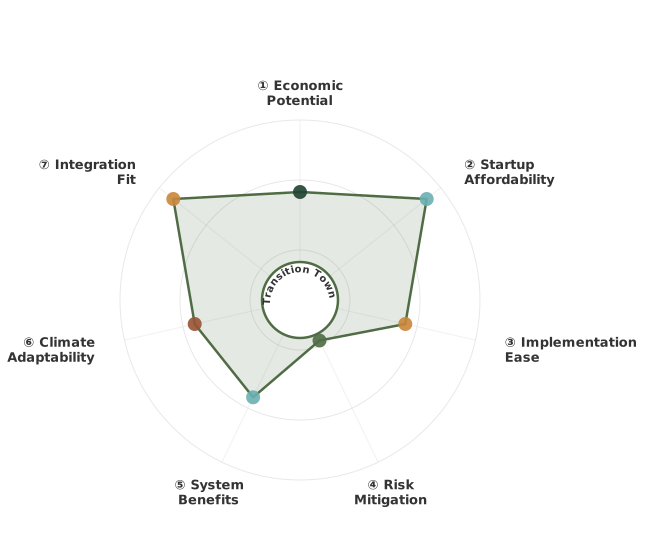
How These Traits Are Calculated
Trait dimensions are ordered clockwise starting from the top of the chart (12 o'clock position):
1. Economic Potential
Financial returns, annual value, and break-even timeline
WHAT: Evaluates financial viability by combining net annual value ($/ha from savings, income, and amortized harvests) with break-even timeline showing when practices pay for themselves.
WHY: Farmers need clear ROI understanding before committing resources. Fast payback (≤3 years) with strong returns (≥$300/ha) enables confident adoption, while long timelines (>10 years) restrict adoption to well-funded operations willing to wait for returns.
HOW: Calculated from net annual value in $/ha and break-even years. Exceptional (≥2.6): fast ROI ≤3 years + high value ≥$300/ha. Typical (1.8-2.5): moderate returns or longer timelines. Limited (<1.8): marginal economics or very long payback >10 years.
2. Startup Affordability
Initial investment costs and financial barrier to entry
WHAT: Measures financial barrier to entry through startup costs for equipment, infrastructure, consulting, and materials. Inverted scoring: lower costs = higher scores = more accessible adoption.
WHY: Affordability determines who can adopt. Low-cost practices (<$250/ha) enable widespread adoption across diverse scales, while high costs (>$2,500/ha) limit adoption to well-capitalized operations, creating barriers that slow regenerative transition.
HOW: Calculated from initial investment parsed from practice content. Inverted scoring: Exceptional (≥2.6): minimal investment <$250/ha. Typical (1.8-2.5): moderate costs $250-2,500/ha. Limited (<1.8): high barrier >$2,500/ha.
3. Implementation Ease
Learning curve and specialized knowledge required
WHAT: Measures how much learning, planning, and specialized knowledge a practice requires. Simpler practices with fewer steps score higher, while complex practices requiring extensive training or specialized resources score lower.
WHY: Complex practices create adoption barriers even when economically viable. Straightforward practices enable faster adoption and broader participation, while those requiring extensive training, timing precision, or specialized equipment limit who can succeed.
HOW: Evaluated by measuring documentation length and identifying complexity markers like location-specific requirements, seasonal timing windows, specialized skills, and dedicated equipment needs. Exceptional (≥2.6): straightforward practices with minimal prerequisites. Typical (1.8-2.5): moderate learning curve with some specialized needs. Limited (<1.8): steep learning curve requiring significant training or resources.
4. Risk Mitigation
Identified financial and ecological risk assessment
WHAT: Evaluates documented risks across financial (investment loss, market volatility) and ecological (crop failure, pest outbreaks) domains. Inverted scoring: fewer risks = higher scores.
WHY: Understanding risk exposure helps farmers make informed decisions. Low-risk practices allow confident implementation, while high-risk practices require careful planning and contingency resources. Risk transparency prevents costly failures.
HOW: Calculated from identified risks in practice content. Inverted scoring: Exceptional (≥2.6): ≤2 risks with manageable severity. Typical (1.8-2.5): 3-5 moderate risks. Limited (<1.8): 6+ risks or severe exposure.
5. System Benefits
How many ways the practice improves your land simultaneously
WHAT: Measures how many aspects of land health improve at once—carbon storage, soil quality, erosion control, water absorption, and biodiversity. Practices that improve multiple areas simultaneously create compounding benefits where each improvement reinforces the others.
WHY: The best practices solve multiple problems at once. For example, addressing erosion simultaneously builds carbon and improves water infiltration, creating a resilient system with positive feedback loops. Single-benefit approaches miss these compound transformation opportunities.
HOW: Evaluated across five key outcomes: carbon sequestration, soil organic matter increase, erosion reduction, water infiltration improvement, and biodiversity enhancement. Exceptional (≥2.6): high carbon storage (>8 t/ha/yr), improvements across 4-5 areas, transformative outcomes. Typical (1.8-2.5): moderate carbon (3-8 t/ha/yr), improvements across 2-3 areas. Limited (<1.8): modest impact (<3 t/ha/yr), single-area focus only.
6. Climate Adaptability
Geographic applicability across Köppen climate zones
WHAT: Evaluates geographic applicability by assessing how many Köppen climate zones successfully support a practice and what adaptation requirements are needed. Measures breadth of climates where farmers can implement with minimal to moderate modifications.
WHY: Universal practices working across diverse climates enable more farmers to adopt regenerative approaches. Practices limited to single climate types (only Mediterranean, only tropical) restrict adoption and slow global transition. Adaptability determines whether a practice serves niche regions or offers broad transformation.
HOW: LLM evaluation of regional success stories, Köppen zone coverage, and adaptation needs. Exceptional (≥2.6): 5+ zones or 4+ climate types, 3+ continents, minimal adaptation. Typical (1.8-2.5): 3-4 zones or 2-3 types, 2 continents, moderate adaptation. Limited (<1.8): 1-2 zones, single region, significant adaptation or highly specialized.
7. Integration Fit
How well this practice combines with others you're doing
WHAT: Measures how well a practice combines with other regenerative practices you might be doing. Some practices work as building blocks that make many other practices easier or more effective, while others work best on their own.
WHY: Practices that combine well with many others create more value on your farm. For example, cover cropping enables no-till, improves grazing, supports crop diversity, and helps water management—making all of them work better together. This helps you build a coherent system rather than juggling disconnected practices.
HOW: Evaluated by identifying which practices combine well and how strong those combinations are. 'Ideally Suited' means strong combinations where practices reinforce each other (practice A makes B easier, while B makes A more effective). 'Adequate' means complementary benefits that work well together. Exceptional (≥2.6): combines well with 6+ practices, serves as a building block. Typical (1.8-2.5): combines with 3-5 practices. Limited (<1.8): 1-2 practices or works best alone.
Going Deeper
1
WHY - The Benefits
Transition Towns are powerful catalysts for change, fostering community-level resilience and sustainability by empowering local action. While not an agricultural practice, their indirect effects significantly bolster the adoption and success of regenerative agriculture...
Transition Towns are powerful catalysts for change, fostering community-level resilience and sustainability by empowering local action. While not an agricultural practice, their indirect effects significantly bolster the adoption and success of regenerative agriculture...
WHY - The Benefits
Transition Towns are powerful catalysts for change, fostering community-level resilience and sustainability by empowering local action. While not an agricultural practice, their indirect effects significantly bolster the adoption and success of regenerative agriculture...
Transition Towns are powerful catalysts for change, fostering community-level resilience and sustainability by empowering local action. While not an agricultural practice, their indirect effects significantly bolster the adoption and success of regenerative agriculture...
Soil Health Benefits
The emphasis on local food systems within Transition Towns encourages practices that inherently benefit soil health. When communities prioritize locally grown produce, they often support smaller-scale farms that are more likely to be adopting diverse cropping systems, perennial plantings, and reduced tillage practices. This creates demand for products that are a direct result of healthy soils. By reducing the distance food travels, the energy-intensive processing and packaging associated with long-distance supply chains are minimized, indirectly lowering the overall environmental footprint of food consumption.
Economic Benefits
Transition Towns are fundamentally about building stronger, more resilient local economies. By encouraging local sourcing and production, they create economic multipliers within the community, keeping money circulating locally. This is crucial for regenerative farmers who can benefit from direct-to-consumer sales models like farmers' markets and Community Supported Agriculture (CSA) programs, which are often fostered by Transition Town initiatives. These models provide farmers with more stable and predictable income, reducing financial pressures that might otherwise force them towards conventional, high-input farming methods. The creation of local food hubs and cooperatives, often supported by Transition Towns, further enhances market access for regenerative producers.
Regenerative Systems Fit
Transition Towns indirectly support all five regenerative agriculture principles by fostering an environment conducive to their adoption.
Principle 1 (Minimize Soil Disturbance): By advocating for reduced reliance on fossil fuels and shorter supply chains, Transition Towns indirectly reduce the energy demands of agriculture. Local food systems often mean less processing and transportation, which are energy-intensive. This can lead to greater interest in less energy-intensive farming methods like no-till or minimum tillage, as the overall system becomes more aligned with conserving resources.
Principle 2 (Maximize Crop Diversity): Transition Towns frequently champion local food heritage, promoting heirloom varieties and diverse crop mixtures suitable for the local climate. This encourages farmers to grow a wider range of crops beyond standard monocultures, supporting biodiversity both above and below ground. Community gardens and local seed exchanges, common Transition Town activities, directly foster agricultural diversity.
Principle 3 (Keep Soil Covered): The promotion of local food systems can lead to increased demand for pasture-raised livestock and perennial crops, which naturally keep soil covered year-round. By fostering markets for these products, Transition Towns encourage land management strategies that prevent bare soil, thereby protecting against erosion and supporting soil biology.
Principle 4 (Maintain Living Roots): The emphasis on fresh, local produce implies shorter storage times and less reliance on preservation techniques that can diminish the vitality of food sources. While not a direct agricultural practice, the focus on local, seasonal eating aligns with the concept of maintaining living systems and appreciating the value of produce that retains its vital energy. Community gardens and urban farms often demonstrate the continuous cycle of planting and growth.
Principle 5 (Integrate Livestock): Some Transition Town projects may involve community farms or support local farmers who integrate livestock. By recognizing the role of animals in nutrient cycling, pest management, and soil fertility, these communities can become champions for integrated livestock systems that are a hallmark of regenerative agriculture. Their interest in local food systems can also extend to supporting pasture-based livestock operations.
The synergistic relationship means that communities actively working to become more self-reliant and sustainable are more likely to embrace and support regenerative agricultural practices. They create the social capital, market demand, and educational platforms necessary for regenerative farmers to succeed. The movement’s focus on local resource stewardship aligns seamlessly with the ecological stewardship principles of regenerative agriculture.
Water Cycle Benefits
By shortening supply chains, Transition Towns reduce the energy and infrastructure required for water-intensive irrigation, processing, and transportation of food. This indirectly supports water conservation efforts. Moreover, communities that prioritize local food are often more attuned to local water issues and can implement community-wide initiatives for water management and conservation that benefit agriculture.
Carbon Sequestration Benefits
The inherent drive of Transition Towns to reduce fossil fuel dependency aligns with carbon sequestration goals. Supporting local food means less transportation emissions. When these communities also champion local regenerative agriculture, they create demand for practices like cover cropping and perennial systems that actively draw down atmospheric carbon into the soil, effectively creating local carbon sinks.
Biodiversity Benefits
Promoting local food diversity inherently supports biodiversity. Local food systems often feature a wider array of crop varieties and animal breeds that are adapted to regional conditions, contrasting with the narrow genetic base of industrial agriculture. Transition Towns can also foster local initiatives for habitat restoration and conservation that create beneficial niches for pollinators and other wildlife essential for agricultural ecosystems.
Sources behind this view
Videos & Podcasts
-
Transition Towns emerge in receptive communities by fostering local action, social connection, and a compassionate response to crises, driven by a spirit of collective experimentation and imagination.
Research
-
Multi-Scale Theory of Change in Transition Design: A Case Study in Regenerative Agriculture (opens in new window)
This study found: A case study in Australia used 'Theory of Change' planning to link individual farm actions with regional and global systems, aiming to boost regenerative agriculture adoption and create more equitable
-
The Imperative for Regenerative Agriculture (opens in new window)
This study found: Regenerative agriculture is vital for food security, climate change mitigation, and soil health. It improves soil organic carbon, water retention, and reduces erosion. Localized and urban food product
2
WHERE - Regional Considerations
Transition Towns are inherently place-based initiatives and their success and specific focus vary greatly by region. Their impact on regenerative agriculture is contingent on the local context, including existing agricultural systems, climate, culture, and economic...
Transition Towns are inherently place-based initiatives and their success and specific focus vary greatly by region. Their impact on regenerative agriculture is contingent on the local context, including existing agricultural systems, climate, culture, and economic...
WHERE - Regional Considerations
Transition Towns are inherently place-based initiatives and their success and specific focus vary greatly by region. Their impact on regenerative agriculture is contingent on the local context, including existing agricultural systems, climate, culture, and economic...
Transition Towns are inherently place-based initiatives and their success and specific focus vary greatly by region. Their impact on regenerative agriculture is contingent on the local context, including existing agricultural systems, climate, culture, and economic...
Click Here to Look up your Region if you don't already know it
Temperate Regions (e.g., Western Europe, Eastern North America, Eastern Asia)
Climate Context: Moderate temperatures with distinct seasons, variable precipitation. USDA Zones 4-7, Köppen Cfb/Dfb. Impact on Regenerative Ag: These regions often have established farming communities and direct-to-consumer markets that Transition Towns can leverage. They can support a wide variety of crops and livestock, making diverse regenerative systems feasible. Local food initiatives can thrive through farmers' markets and CSAs, directly supporting regenerative producers by creating consistent demand for seasonally available products.
Mediterranean Regions (e.g., Mediterranean Basin, California, Central Chile)
Climate Context: Hot, dry summers and mild, wet winters. Seasonal precipitation patterns. USDA Zones 8-10, Köppen Csa/Csb. Impact on Regenerative Ag: Transition Towns in these areas can focus on water-wise regenerative practices, such as drought-tolerant crops, efficient irrigation for cover crops, and integrated livestock grazing that promotes soil cover and reduces erosion in dry periods. Local food movements can prioritize crops adapted to these conditions, supporting farmers in developing resilient systems.
Arid and Semi-Arid Regions (e.g., parts of Australia, US Southwest, North Africa)
Climate Context: Low rainfall, high temperatures, significant evaporation. Short and unpredictable growing seasons. USDA Zones 7-9, Köppen BSh/BSk. Impact on Regenerative Ag: Transition Towns here can be crucial for promoting water-efficient regenerative systems, including ancient grains, drought-tolerant perennials, and rotational grazing strategies that maximize soil moisture retention and minimize bare soil. Community efforts can focus on education regarding water harvesting and conservation on farms.
Tropical and Subtropical Regions (e.g., Southeast Asia, Central Africa, Brazil, Southern US)
Climate Context: High temperatures year-round, with distinct wet and dry seasons or consistent high rainfall. Köppen Af/Am/Aw/Cfa. Impact on Regenerative Ag: Transition Towns can champion agroforestry, permaculture, and integrated crop-livestock systems that are well-suited to these climates. They can support the production of diverse tropical fruits, vegetables, and staple crops while promoting practices that maintain soil fertility and prevent erosion in high rainfall areas. Local markets can create demand for these diverse, locally grown products, reducing reliance on imported foods often produced with high synthetic inputs.
Cold Continental Regions (e.g., Northern North America, Northern Europe, Siberia)
Climate Context: Very short growing seasons, extreme summer heat, severe winter cold. USDA Zones 3-5, Köppen Dfa/Dfb. Impact on Regenerative Ag: Transition Towns in these challenging climates can pioneer and promote resilient, season-extending regenerative practices. This includes season extension techniques in greenhouses, focus on hardy perennial crops and livestock breeds, and development of local food processing to preserve harvests for long winters. Community efforts can support research and dissemination of adaptive farming methods.
3
HOW - Implementation Process
Transition Towns are not a prescriptive agricultural practice but a community-driven framework. Their implementation process therefore focuses on community engagement, education, and collaborative action that indirectly supports regenerative agriculture.
Transition Towns are not a prescriptive agricultural practice but a community-driven framework. Their implementation process therefore focuses on community engagement, education, and collaborative action that indirectly supports regenerative agriculture.
HOW - Implementation Process
Transition Towns are not a prescriptive agricultural practice but a community-driven framework. Their implementation process therefore focuses on community engagement, education, and collaborative action that indirectly supports regenerative agriculture.
Transition Towns are not a prescriptive agricultural practice but a community-driven framework. Their implementation process therefore focuses on community engagement, education, and collaborative action that indirectly supports regenerative agriculture.
Prerequisites
- Community Interest: A core group of engaged individuals committed to building local resilience.
- Local Assessment: Understanding the community's resources, assets, challenges, and existing food systems.
- Connection to Land Use: Recognizing how land is currently used, particularly for agriculture, and identifying opportunities for change.
- Willingness to Collaborate: An openness to work with local farmers, businesses, government, and residents.
Phase 1: Visioning and Awareness Building (Months 1-6)
- Educate the Community: Host workshops, film screenings, and discussions about sustainability, climate change impacts, and the benefits of local resilience. Introduce concepts of regenerative agriculture through storytelling and practical examples from local regenerative farmers (if any exist).
- Identify Local Assets: Map existing local food producers, farmers' markets, food banks, community gardens, seed banks, and any land available for food production.
- Form a Core Group: Establish a steering committee or working group dedicated to the Transition Town initiative.
Phase 2: Strategy and Action Planning (Months 6-18)
- Develop a Local Food Strategy: This is where the direct link to regenerative agriculture is forged. The strategy should outline goals for increasing local food production, improving access, supporting local producers, and promoting sustainable land use.
- Focus on "Food, Farming, and Forests": Create working groups dedicated to these areas. The "Farming" group should actively engage with local farmers.
- Identify Support for Regenerative Farmers: Plan initiatives like:
- Enhanced Farmers' Markets: Increase frequency, duration, and promotion.
- Community Supported Agriculture (CSA) Development: Help establish new CSAs or expand existing ones.
- Local Food Hubs: Investigate creating aggregation and distribution points for local produce.
- Farm-to-Institution Programs: Connect local farms with schools, hospitals, and businesses for procurement.
- Skill-Sharing Workshops: Organize sessions on cover cropping, no-till, composting, and integrated livestock management, potentially led by local regenerative farmers.
- Plan for Land Access: Explore ways to make land available for new and transitioning farmers (e.g., land trusts, community farming projects).
Phase 3: Implementation and Project Initiation (Year 1-3+)
- Launch Pilot Projects: Start with achievable projects (e.g., a new farmers' market, a community garden, a school-procurement initiative).
- Support Regenerative Agriculture Education: Directly fund or partner with organizations offering regenerative agriculture training. Co-host field days on local regenerative farms.
- Promote Local Food: Launch public awareness campaigns that highlight the benefits of locally grown food, emphasizing environmental stewardship and soil health.
- Develop Local Infrastructure: Support the development of local infrastructure like seed banks, tool libraries, or community kitchens that support local food production and processing.
Phase 4: Expansion and Integration (Ongoing)
- Scale Up Successful Projects: Expand initiatives that have demonstrated success.
- Engage Local Government: Advocate for policies that support local food systems and sustainable land management (e.g., zoning for urban agriculture, tax incentives for regenerative farms).
- Foster Networks: Strengthen connections between consumers, farmers, researchers, and local government to create a robust and resilient local food ecosystem.
- Monitor and Adapt: Continuously evaluate progress, adapt strategies based on community feedback and evolving needs, and celebrate successes.
Transition Timeline & Phase-Out Strategy: Transition Towns are inherently about a long-term shift, not a rapid phase-out. They facilitate a gradual transition by building local capacity and demand. The "phase-out" applies to reliance on external, conventional systems, not a specific practice. This means:
- Phase-out of long-distance/industrial food reliance: Gradually increase local procurement and consumption.
- Phase-out of synthetic inputs: As local regenerative farms become economically viable and supported, consumer demand shifts away from conventionally grown products.
- Phase-out of outdated land use practices: Community education and advocacy encourage transitions to regenerative methods. The timeline is community-defined and project-dependent, often spanning years to decades for significant systemic change. Success is measured by increased local food self-reliance, improved community well-being, and enhanced ecological health.
Sources behind this view
Research
-
Multi-Scale Theory of Change in Transition Design: A Case Study in Regenerative Agriculture (opens in new window)
This study found: A case study in Australia used 'Theory of Change' planning to link individual farm actions with regional and global systems, aiming to boost regenerative agriculture adoption and create more equitable
4
HOW MUCH - Costs & Investment
Note: Transition Town initiatives are community-led and largely volunteer-driven, so direct financial costs can be low initially, scaling with project scope. Costs shown are indicative and will vary significantly by region based on local labor rates, material costs, and...
Note: Transition Town initiatives are community-led and largely volunteer-driven, so direct financial costs can be low initially, scaling with project scope. Costs shown are indicative and will vary significantly by region based on local labor rates, material costs, and...
HOW MUCH - Costs & Investment
Note: Transition Town initiatives are community-led and largely volunteer-driven, so direct financial costs can be low initially, scaling with project scope. Costs shown are indicative and will vary significantly by region based on local labor rates, material costs, and...
Note: Transition Town initiatives are community-led and largely volunteer-driven, so direct financial costs can be low initially, scaling with project scope. Costs shown are indicative and will vary significantly by region based on local labor rates, material costs, and...
Note: All costs are based on recent US economic data (2024–2026) and may vary substantially by region based on local labor rates, material costs, and regulatory requirements. Figures reflect a 4.2% inflation adjustment applied to standard base costs for community-led infrastructure.
Initial Organization and Administration
Establishing a formal governance structure for Transition Town initiatives requires varying levels of investment based on organizational scope and complexity. Small-scale initiatives, typically influencing under 50 acres (20 ha) of local food production, operate on lean budgets focused on community organizing. Initial setup, including legal entity formation, digital presence, and local outreach, ranges from $1,563 to $6,773. Mid-size initiatives managing between 50 and 500 acres (20–202 ha) require more sophisticated infrastructure, such as professional website hosting, dedicated marketing materials, and partial stipends for coordinating committees, totaling between $7,294 and $26,050. Large-scale initiatives, designed to influence over 500 acres (202 ha), necessitate formal incorporation and structural capacity, requiring an annual administrative budget of $31,260 to $125,040. This capital covers full-time administrative staff, grant writing services to leverage USDA regional food system grants, and complex compliance frameworks for municipal oversight.
Project-Specific Capital Expenditures
Initial project implementation centers on tangible assets that convert community interest into functional agricultural output. For small-scale projects, such as establishing localized community garden networks or tool-sharing libraries, initial seed capital ranges from $1,042 to $4,168. These funds are primarily allocated to soil amendments, basic hand tools, and small-scale site registration fees. Mid-size projects, which may involve developing town-wide farmers’ markets or coordinating farm-to-school procurement contracts, demand a higher capital injection of $5,210 to $20,840. This budget accounts for product liability insurance, cold-chain refrigeration units, and short-term facility rentals to ensure safety and regulatory adherence. Large-scale regional food hubs, functioning as the backbone for more than 500 acres (202 ha), require significant capital investment of $26,050 to $156,300. Expenditures at this scale cover refrigerated warehouse installation, proprietary inventory and distribution software, and professional logistics planning to synchronize diverse, scattered producers into a cohesive, market-ready supply chain.
Ongoing Operational Support
Sustainable community initiatives require ongoing maintenance to ensure long-term viability beyond initial launch funding. Small-scale initiatives require annual operating budgets of $521 to $2,084, covering essential digital subscriptions, liability insurance, and basic promotional costs. Mid-size initiatives typically allocate $4,168 to $12,504 per year; this budget is prioritized for event coordination, educational workshops on regenerative practices, and modest bookkeeping services to maintain organizational transparency. Large-scale initiatives, due to their oversight of multi-stakeholder food systems, require an annual investment of $20,840 to $83,360. This covers permanent staff salaries, recurring commercial facility leases, and the management of rigorous regulatory reporting required for large-scale distribution operations. These operational costs are critical to preventing system stalls and maintaining the trust of participating local producers.
Most Spend: $4,689–$12,504 is the typical investment range for the majority of community-led initiatives. This range represents a sweet spot for groups that rely heavily on collaborative volunteer efforts while maintaining sufficient funds for professional-grade marketing, community event staging, and minimal administrative overhead.
Why the Range?: Cost variation is driven primarily by the transition from volunteer-labor models to compensated professional management. Higher costs reflect the integration of permanent facility leases and advanced logistics software, whereas lower costs identify groups that leverage public spaces and non-remunerated, skill-sharing labor to minimize overhead.
5
REWARDS AND RISKS - Economics & Risk Factors
REWARDS AND RISKS - Economics & Risk Factors
Economic Scenarios
The economic health of a Transition Town initiative relies on moving consumer spending toward local procurement rather than external retailers. In a best-case scenario, effective aggregation of local demand creates a vital, consistent market for area producers. This shift enables $52,100 to $208,400 in redirected annual consumer spending, fundamentally bolstering the local economy. Participating producers typically see a 15–25% increase in profitability due to the removal of distribution middlemen and enhanced price discovery. Communities benefit from a localized growth in tax revenue and a measurable 10–15% increase in food security.
In a typical case scenario, the initiative experiences steady, moderate traction, facilitating $15,630 to $52,100 in annual direct-to-consumer sales. Existing farmers’ markets report a 10–20% increase in average weekly foot traffic, providing producers with a reliable ancillary income stream. Although these initiatives may not fully replace commercial supply chains, they successfully provide a platform for new producers to enter the market, fostering the establishment of 2–5 new small-plot regenerative operations annually.
In a worst-case scenario, community interest fails to coalesce around the proposed infrastructure, resulting in $2,084 to $10,420 of lost startup capital. This typically occurs when decentralized or fragmented leadership prevents the completion of the first harvest cycle. Such failures lead to local disillusionment, potentially imposing financial losses on early-adopter farmers who prepared inventory for empty supply chains.
Transition Period Risks
Transitioning toward a local, community-led food economy involves significant structural hazards. Volunteer Fatigue constitutes a primary risk, as reliance on unpaid labor often leads to a 40–60% loss in project productivity during the first two years. Mitigation requires the allocation of 5–10% of the initial budget for micro-stipends to retain key administrative talent. Infrastructure Mismatch also threatens early growth; small-scale producers frequently struggle to provide the volume necessary to meet consistent market contracts during the first 12–24 months. Mitigating this risk requires limiting initial scope to smaller CSA-style subscriptions before attempting to fulfill large-scale institutional contracts. Market Price Sensitivity remains a constant threat, as inflationary pressures may drive local consumers toward cheaper industrial retailers. Protecting against 20–30% revenue drops requires intentional diversification of the customer base across multiple neighborhood demographics, providing a hedge against localized economic shocks.
Sources behind this view
Videos & Podcasts
-
Transitioning to regenerative agriculture is a human/psychological process requiring trials to reduce risk and build trust. Increased consumer awareness of ecology and health would drive demand for re

-
A strategy to scale regenerative agriculture involves paying pioneer farmers to coach others, developing farm-specific business cases for regenerative organic practices and direct sales. This creates

-
Nicolas Fraser (Soil Capital) states financial barriers are key to regenerative transition. He advises optimizing agrochemical/external input use (10-40% savings possible) to generate internal funds f

-
Adopting regenerative agriculture requires convincing farmers through risk mitigation, mindset change, and demonstrating results via trials and monitoring. Benefits include reduced costs, improved soi
 Community
-
Key takeaways for scaling regenerative agriculture include consistent certification standards, secure data sharing, long-term investment and financing, supply chain transparency, and collaborative eff
Read more (opens in new window) ucanr.edu
Research
-
Motivations behind regenerative agriculture: A systematic literature review (opens in new window)
This study found: Studies show environmental reasons are key for regenerative agriculture adoption, supported by economic/social factors. Challenges include transition, incentives, and policy gaps, requiring better far
-
Systematic review of regenerative farming: Addressing agricultural sustainability challenges (opens in new window)
This study found: Systematic review of 31 studies shows regenerative farming improves soil health, biodiversity, and carbon capture, aiding sustainability. Technology is key for adoption, but policy, farmer understandi
-
Regenerative Livestock Farming as a Socioeconomic Model for Sustainable Agribusiness in Latin America (opens in new window)
This study found: Regenerative livestock farming in Latin America improved soil carbon, biodiversity, and water quality, while boosting farmer income and quality of life. Government support is key for wider adoption.
-
Regenerative Agriculture in the 21st Century: A Systematic Review of Environmental, Agronomic, and Socio-Economic Outcomes (opens in new window)
This study found: Systematic review finds Regenerative Agriculture boosts environment but faces yield gaps (16-21%) and socio-economic barriers. Advocates for resilience over maximum yields, needing financial support a
 From the Web
-
To finance regenerative agriculture, create documented pilot cases (3-5 years) to define risks/returns, drawing lessons from renewable energy's scaling. This will attract mainstream investors by showc
-
Profitability in regenerative agriculture is also driven by growing consumer demand for sustainably produced goods and willingness to pay premiums. However, adoption is hindered by cultural shifts, la
-
Regenerative agriculture improves soil health, forage, and resilience, but adoption faces practical, political, and personal barriers, requiring education, adaptation, and a mindset shift.
6
COMPATIBLE PRACTICES - Integration Opportunities
Transition Towns, by their nature, foster integration. They are about connecting different sectors and stakeholders within a community to build a more resilient whole. Their compatibility with regenerative agriculture is therefore inherent.
Transition Towns, by their nature, foster integration. They are about connecting different sectors and stakeholders within a community to build a more resilient whole. Their compatibility with regenerative agriculture is therefore inherent.
COMPATIBLE PRACTICES - Integration Opportunities
Transition Towns, by their nature, foster integration. They are about connecting different sectors and stakeholders within a community to build a more resilient whole. Their compatibility with regenerative agriculture is therefore inherent.
Transition Towns, by their nature, foster integration. They are about connecting different sectors and stakeholders within a community to build a more resilient whole. Their compatibility with regenerative agriculture is therefore inherent.
Community-Supported Agriculture (CSA)
- Transition Towns actively promote and often help establish CSA programs.
- Benefit: Provides farmers with stable upfront income, consumer connection, and demand for diverse, seasonal produce. Supports Principle 2 (Crop Diversity).
Farmers' Markets
- Often a primary focus for Transition Town food initiatives.
- Benefit: Creates direct market access for farmers, allows for premium pricing, educates consumers, and fosters producer-consumer relationships. Supports Principles 1, 2, 3, 4, 5 through direct interaction and demand creation.
Skill-Sharing & Education Initiatives
- Workshops on cover cropping, composting, no-till, integrated pest management, etc.
- Benefit: Empowers farmers and community members with practical knowledge for adopting regenerative practices. Directly supports Principles 1-5 through education.
Local Food Hubs & Aggregation Centers
- Facilitates distribution for multiple small producers.
- Benefit: Connects smaller regenerative farms to larger buyers (institutions, restaurants), overcomes logistical challenges, and expands market reach. Supports farmer viability.
Farm-to-Institution Programs (e.g., schools, hospitals)
- Connects local farms directly with institutional food service.
- Benefit: Creates consistent, large-volume demand for local produce, often with specifications that align with regenerative practices. Influences institutional procurement towards sustainability.
Community Gardens & Urban Farms
- Develops local food production capacity within urban/suburban areas.
- Benefit: Educates general public about food growing and soil health, provides hands-on experience with regenerative principles (composting, diverse planting), and can supply local food networks. Supports Principles 2, 3, 4.
Local Seed Banks & Heritage Varieties
- Promotes the use of locally adapted and diverse crop varieties.
- Benefit: Supports on-farm biodiversity, resilience to pests/diseases, and reduces reliance on a narrow genetic base. Directly supports Principle 2 (Crop Diversity).
Advocacy for Supportive Land Use Policies
- Encouraging local government to support urban agriculture, protect farmland, and incentivize sustainable practices.
- Benefit: Creates a favorable policy landscape for regenerative farmers regarding land access, infrastructure, and market development.
Transition Towns act as a platform that connects consumers, farmers, educators, and policymakers, creating a holistic approach to building a resilient and regenerative local food system. Their success amplifies the viability and adoption of regenerative agriculture.
Sources behind this view
Videos & Podcasts
-
Transitioning to regenerative agriculture is a human/psychological process requiring trials to reduce risk and build trust. Increased consumer awareness of ecology and health would drive demand for re
-
Regenerative agriculture provides solutions for climate change, human health, and soil degradation, contrasting with industrial agriculture's harmful impacts, including glyphosate use. Practices like

-
Adopts regenerative agriculture principles: minimize disturbance, keep living roots, use soil armor, integrate animals (livestock grazing, multi-species), and increase biodiversity. These practices bu

Community
-
Key takeaways for scaling regenerative agriculture include consistent certification standards, secure data sharing, long-term investment and financing, supply chain transparency, and collaborative eff
Read more (opens in new window) ucanr.edu
Research
-
The Indigenous Roots of Regenerative Agriculture (opens in new window)
This study found: Modern regenerative agriculture practices are rooted in millennia of Indigenous land stewardship, offering profound knowledge and a crucial value system of respect and reciprocity for true transformat
-
Systematic review of regenerative farming: Addressing agricultural sustainability challenges (opens in new window)
This study found: Systematic review of 31 studies shows regenerative farming improves soil health, biodiversity, and carbon capture, aiding sustainability. Technology is key for adoption, but policy, farmer understandi
-
Multi-Scale Theory of Change in Transition Design: A Case Study in Regenerative Agriculture (opens in new window)
This study found: A case study in Australia used 'Theory of Change' planning to link individual farm actions with regional and global systems, aiming to boost regenerative agriculture adoption and create more equitable
-
Regenerative Agriculture: Insights and Challenges in Farmer Adoption (opens in new window)
This study found: Review of 7 regenerative agriculture practices (no-till, crop rotation, cover crops, etc.) highlights benefits and key adoption challenges like cost, farm size, and institutional barriers for scalable
From the Web
-
Transitioning to regenerative agriculture requires a paradigm shift beyond technical practices, driven by values, emotions, and worldviews. Farmers' experiences reveal 'zones of friction and traction'