The pathway to pastured pork requires a structured approach, prioritizing learning and risk mitigation. The single most valuable investment you can make, by a wide margin according to most practitioners, is education before infrastructure investment. Attending workshops, taking online courses, and visiting established farms can save you 12-18 months of costly trial-and-error learning. These educational opportunities often highlight the nuances of pig behavior, nutrition needs on pasture, fencing principles, and predator management that are critical for success.
A practical entry point for many is to start with a small number of animals rather than disrupting your entire operation. If you have underutilized pasture or crop residues available, begin by piloting pastured pork on a small scale, perhaps with 10-20 feeder pigs. This low-risk approach allows you to learn the management skills, observe the direct-market demand, and understand the infrastructure needs without jeopardizing your core business. You can use portable electric fencing and temporary shelters to manage these animals, minimizing upfront capital.
The typical sequence unfolds over several phases:
Phase 1: Education & Planning (0-6 months)
Attend workshops, read extensively, and visit farms. Develop a clear understanding of pig genetics suitable for pasture (e.g., dual-purpose breeds known for foraging ability and mothering instincts), nutritional requirements, and common health challenges in outdoor settings. Create a detailed business plan that includes realistic financial projections, marketing strategies, and an infrastructure development roadmap. Identify potential market channels and begin building relationships.
Phase 2: Pilot Program (6-18 months)
Acquire your first group of feeder pigs (or start with weaners if you have experience with farrowing). Implement your learned management techniques using minimal infrastructure: portable electric fencing, temporary shelters (e.g., Arks, Hoop shelters), and basic waterers. Focus on learning essential skills: daily observation, fence management, predator deterrence, and understanding pig behavior in a pasture setting. Simultaneously, begin developing your direct-market channels. This pilot phase is critical for testing your assumptions, refining your techniques, and confirming market demand.
Phase 3: Infrastructure Development & Expansion (1.5 - 3 years)
Based on the success of your pilot, begin investing in more durable infrastructure. This might involve installing sub-surface water lines, more robust permanent or semi-permanent fencing systems, and higher-quality portable shelters. You can gradually increase your herd size, perhaps by adding a breeding program or purchasing more feeder pigs. Continue to refine your marketing strategies to handle increased volume. If integrating into silvopasture, begin planting trees or renovating pasture areas during this phase.
Phase 4: System Integration & Maturation (3-5+ years)
Your operation is now established with most of the necessary infrastructure. Focus shifts to optimizing profitability, improving genetics, refining pasture and woodland management techniques, and potentially expanding value-added processing. If you started with woodland/silvopasture integration, the trees will be maturing, providing significant mast crops and shade for the pigs, and the land will show tangible ecological benefits. Your marketing efforts will be well-established, and you will have a reliable customer base.
Sequencing will vary based on your starting point. A diversified farmer might integrate pastured pigs as a new enterprise, using existing land and infrastructure as a base. An existing confinement operator will face a more radical shift, likely needing to divest or repurpose buildings and re-educate themselves on entirely new management paradigms. Always prioritize learning and starting small.
At different scales:
200-5,000 acres: Your sequence can accommodate more substantial infrastructure investment earlier, as the economics are more favorable for amortizing costs. You can afford to experiment with more varieties of fencing and shelter systems. Educational efforts should focus on supply chain logistics, herd health at scale, and potentially incorporating diverse feed sources beyond just pasture (e.g., cover crops, crop residues). Marketing will be a mix of direct sales and potentially regional distribution.
5,000+ acres: The sequence for large-scale operations, especially those integrating pigs into broader land management, involves careful zoning and phased implementation. Infrastructure may be geared towards managing large numbers of animals efficiently across extensive areas. Education should focus on systems-level integration, financial modeling for large enterprises, and potentially managing teams of workers. Marketing might involve establishing private label brands or supplying processors with specific quality specifications. This scale necessitates a highly strategic approach to infrastructure and market development.
Small (under 50 sows): Begin with 10-20 feeder pigs, utilizing portable electric fencing systems (e.g., Gallagher, Premier) costing $200-500 per paddock and temporary shelters like goat arks or hoop structures. Focus on mastering daily observation and the basic management of 1-2 paddocks, which will require about 0.5 acres (0.2 ha) per 10 head.
Mid-size (50–200 sows): Plan for a phased infrastructure build-out, potentially starting with a dedicated 5-10 acre (2-4 ha) pasture for your pilot group of 30-50 feeder pigs. Invest in more robust portable shelters that can house 15-20 animals and explore semi-permanent fencing solutions like woven wire with electric offsets for higher-traffic areas.
Large (200+ sows): Transitioning a portion of your operation, perhaps 100-200 sows, to pasture makes strategic sense. This could involve adapting existing paddocks or investing in a multi-strand electric fence system with a dedicated controller, costing $1,000-3,000 to secure a 20-acre (8 ha) area, and ensuring water systems can support rotational grazing across multiple sites.
Sources behind this view
-
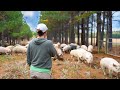
Provides a step-by-step guide for moving pastured pigs, detailing fence setup, equipment relocation (feeders, waterers, shelters), and low-stress handling techniques for pigs of all ages. Emphasizes safety and securing the new paddock.
-
Pastured pork operation uses feeder pigs rotated every 7-14 days in an apple orchard with hot wire training. Challenges include terrain and occasional escapes, but the operation is generally successful and enjoyable.

-
Pastured pork management focuses on providing shade, soil disturbance for regenerative benefits, and efficient watering systems using hot wire to secure troughs. They partner for farrowing and focus on finishing, using portable feed wagons and training pigs to hotwire fences.
![Thumbnail for LIVE Tour: Seven Sons Farms [Regenerative Agriculture]](/static/thumbnails/FAVk44qpGQU.jpg)
-
Regenerative pig farming on forested, sloped land involves sustainable logging for pasture creation, planting diverse forages (grasses, legumes, brassicas), and using robust electric fencing with high-tensile wire. Supplementing with homegrown produce and by-products is key.
-
Walter Jeffries of Sugar Mountain Farm in Vermont details developing cold-hardy, pasture-adapted pig genetics through managed rotational grazing and diverse diets, using heritage and crossbred lines, emphasizing breeder selection and long-term genetic improvement.
-
Identifying challenges to manage body weight variation in pig farms implementing all-in-all-out management practices and their possible implications for animal health: a case study (opens in new window)
A pig farm's attempts to manage weight variation using delayed weaning and re-grading pens disrupted their 'all-in, all-out' system and increased disease incidence in slower-growing pigs.
-
Regenerative Livestock Farming as a Socioeconomic Model for Sustainable Agribusiness in Latin America (opens in new window)
Regenerative livestock farming in Latin America improved soil carbon, biodiversity, and water quality, while boosting farmer income and quality of life. Government support is key for wider adoption.
-
Review: Precision Livestock Farming technologies in pasture-based livestock systems. (opens in new window)
Smart farming tech (GPS, drones, virtual fencing) can improve livestock management on pasture for cattle, sheep, goats, pigs, and poultry, despite challenges like battery life and cost.
-
Raising pigs in silvopasture involves rotational grazing every 3-7 days with portable electric fencing, 30-90 day paddock rest, and stocking 10-20 pigs/acre. Protect trees with guards and avoid grazing wet soils. Observe land daily for adaptability and cooperation.
-
Silvopasture management for pigs involves rotational grazing with portable electric fencing, moving pigs every 3-7 days. Key practices include 30-90 day paddock rest, stocking 10-20 pigs/acre, protecting young trees, and timing moves to avoid wet soil. Balanced feeding and attentive observation are crucial for soil health and animal welfare.