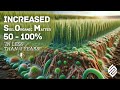
The destination you're moving towards is a farm that actively functions as a thriving ecosystem, producing food and fiber while improving its own capacity for productivity and resilience year after year. This transition is not just about avoiding problems; it's about cultivating abundance through ecological processes. You'll see tangible improvements in your farm's biological engine – the soil. Soil organic matter increases will become measurable, often in the range of 0.2-0.5 percentage points per year in well-managed systems, leading to enhanced water-holding capacity, improved aeration, and better nutrient availability. Expect infiltration rates to improve by 20-50% as soil structure aggregates more effectively.
Production metrics will begin to stabilize and, in many cases, increase, but the nature of those gains shifts. Instead of relying on external inputs, you'll increasingly leverage on-farm resources. Yields might not always dramatically outpace your best organic years initially, but they will likely become more consistent, showing less year-to-year variability due to weather extremes. This stability is a significant economic and operational benefit. You’ll notice a reduction in pest and disease pressure, as a more balanced ecosystem fosters beneficial insects and a more robust plant immune system, lessening the need for interventions.
Economic outcomes are projected to improve as you reduce reliance on purchased amendments and potentially synthetic inputs (even organic ones can be costly). Over time, the trend is towards lower input costs and greater profitability margins. Studies from various regions indicate that regenerative systems can achieve yield parity or modest gains with significantly lower input expenditures. However, it's crucial to acknowledge that economic outcomes vary by region. US and Australian studies generally show positive returns, but research from other contexts has documented higher costs and lower profitability, suggesting local conditions significantly influence viability.
Beyond production and financial metrics, practitioners document reduced stress from managing fewer external inputs and a more robust system. There's an improved mental health state derived from spending more time observing and working with the land's natural processes, rather than fighting against perceived limitations. In some cases, practitioners report reduced medical costs. Wildlife and biodiversity indicators often improve measurably within 2-3 years as forage structure and diversity increase, providing both an ecological measure and a quality-of-life enhancement through increased bird populations and beneficial insect activity. The improved ecosystem function also translates to better water quality leaving your farm.
Many well-executed operations exhibit bimodal outcome distributions. Gains range from 10-15% in modestly improved systems to 40-120% in well-executed operations. This suggests outcomes are highly sensitive to management quality and local conditions, emphasizing the importance of continuous learning and adaptation.
At different scales:
200-5,000 acres: You’ll observe increasing soil organic matter and improved water infiltration on your cover-cropped acres. Reduced expenditure on amendments and an increase in nitrogen fixation from clover-type cover crops will begin to offset the costs of new seed and potentially new equipment. Livestock integration, even on a small scale, will demonstrate its nutrient cycling benefits across pasture and croplands, leading to more resilient crop yields and improved forage quality for grazing animals.
5,000+ acres: Initial changes will be most pronounced in pilot areas where you are experimenting with no-till drilling, cover crops, and livestock integration. You’ll see lower soil organic matter losses due to reduced tillage. The economic benefits will manifest as stabilized yields alongside a projected reduction in amendment costs over time. Observing the resilience of cover-cropped fields during challenging weather will be a key indicator that the system is building long-term capacity, even if widespread adoption takes longer.
Small (under 100 acres/40 ha): Visible improvements in water infiltration, perhaps from 0.5 to 1 inch per hour (12-25 mm/hr), will quickly demonstrate the value of increased soil organic matter, potentially reducing runoff and erosion on a smaller, more intensely managed footprint.
Mid-size (100–500 acres/40–200 ha): Gains in soil organic matter of 0.2-0.4% per year across larger areas can lead to substantial increases in water-holding capacity, potentially reducing irrigation needs by 15-30% and improving drought resilience across diverse crop rotations.
Large (500+ acres/200+ ha): Systematic monitoring of soil health indicators across vast acreages will reveal significant improvements in infiltration rates, with potential gains of 1-2 inches per hour (25-50 mm/hr) over 5-10 years, meaning less water lost to runoff and better groundwater recharge.
Sources behind this view
-
A 5-year case study in Mississippi transformed a degraded farm using adaptive grazing, bale grazing, and plant diversity. Soil organic matter, water infiltration, and forage species increased dramatically, while stocking rates improved significantly, demonstrating the power of regenerative practices.

-
Regenerative trials show dramatic improvements in soil aggregate depth (up to 15 inches in 4 years), increased microbial and plant diversity (123% in pastures without new seed), enhanced water infiltration, and better animal health. Regenerative farms are also 4x more powerful GHG sinks and support 3x more grassland birds.
-
Advocates for Soil Foodweb principles and Holistic Management, emphasizing land leasing and custom grazing/growing over labor-intensive methods. Focuses on soil restructuring for water availability and fertility through animal inputs and diverse pasture mixes.
-
Key takeaways for scaling regenerative agriculture include consistent certification standards, secure data sharing, long-term investment and financing, supply chain transparency, and collaborative efforts involving farmers, institutions, and communities.
-
Regenerative Livestock Farming as a Socioeconomic Model for Sustainable Agribusiness in Latin America (opens in new window)
Regenerative livestock farming in Latin America improved soil carbon, biodiversity, and water quality, while boosting farmer income and quality of life. Government support is key for wider adoption.
-
Regenerative Almond Production Systems Improve Soil Health, Biodiversity, and Profit (opens in new window)
Regenerative almond farms in California doubled profits and improved soil health and biodiversity by combining practices like cover crops, compost, and reduced synthetic inputs, with no yield loss.
-
Regenerative Agriculture: Restoring Ecosystems¢ Resilience and Productivity: A Review (opens in new window)
Regenerative agriculture builds soil health and ecosystem services through practices like no-till, cover crops, and diverse rotations. It increases soil organic matter, improves water infiltration, boosts soil life, and captures carbon, leading to lower input costs and greater long-term farm stability.
-
Organic farming and rotational grazing are presented as solutions, enhancing soil health, sequestering carbon, and preventing erosion. Managed grazing boosts plant roots, improving soil fertility and water retention, potentially mitigating agriculture's carbon footprint.
-
Key regenerative agriculture methods include no-till farming, cover cropping, agroforestry, perennial crops, planned rotational grazing (Holistic Management), and compost application, all aimed at improving soil health and sequestering carbon.