
What is regenerative agriculture?
Regenerative agriculture is an approach to farming and land management focused on restoring and enhancing the health of the ecosystem, rather than merely sustaining it. It prioritizes building soil organic matter, increasing biodiversity, improving water cycles, and fostering resilient biological systems. Practices like cover cropping, no-till farming, and integrating livestock are central to this philosophy, aiming to create a net positive impact on the environment, improve farm profitability, and produce nutrient-dense food.
Read More: Complete Description
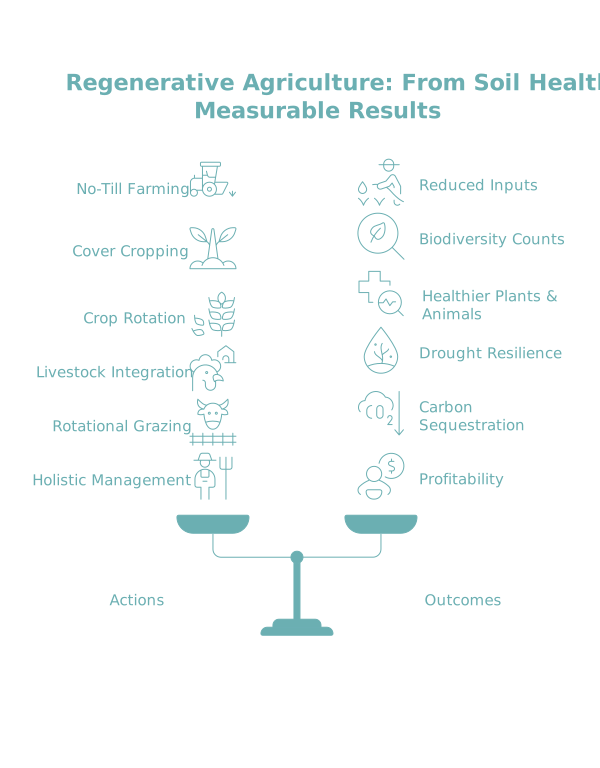
Regenerative agriculture is a holistic philosophy and a set of practices focused on rebuilding and improving the ecological health of agricultural landscapes. Unlike conventional approaches that often deplete soil and biodiversity, regenerative systems aim to increase these vital resources over time. The core objective is to create farms and ranches that function more like natural ecosystems, enhancing their ability to sequester carbon, retain water, improve soil fertility naturally, and support a greater diversity of life both above and below ground.
At its heart, regenerative agriculture is about building soil health. Healthy soil is a living ecosystem teeming with microbial life. These microorganisms are crucial for nutrient cycling, water infiltration, and plant growth. By minimizing soil disturbance (e.g., through no-till or reduced tillage), maximizing plant diversity (e.g., diverse cover crops and cash crops), keeping the soil covered year-round, and properly integrating livestock, regenerative farmers nurture this hidden ecosystem. This not only reduces the need for external inputs like synthetic fertilizers but also makes crops more resilient to drought and disease.
Farmers are increasingly adopting regenerative principles because they recognize the inherent limitations and environmental impacts of some conventional practices. These principles are applicable across a vast spectrum of agricultural systems, from large-scale grain farms in the North American prairies to smallholder fruit orchards in Southeast Asia, and from cattle ranches in the Australian Outback to coffee plantations in Colombia. The emphasis is on working with nature's processes, creating a virtuous cycle of ecological improvement. For instance, on a 100-hectare (247-acre) mixed farm in France, adopting a 5-year rotation including legumes and brassica cover crops under a no-till system led to a 0.5% annual increase in soil organic matter within three years, reducing synthetic nitrogen fertilizer needs by 20% ($40-60/ha or $16-24/acre reduction), an example of an early-stage benefit on the path toward greater reductions.
The foundational principles of regenerative agriculture can be summarized as: keeping the soil covered, maximizing plant diversity, maintaining living roots in the soil for as long as possible, and integrating livestock. These principles are not rigid rules but guiding concepts that inform practice. For a rancher in the Masai Mara region of Kenya, managing grazing through rotational patterns – moving cattle every 2-3 days over pastures and allowing 60-90 days of rest – has been observed to increase grass biomass by 30-50% and improve water infiltration into the soil within two grazing seasons, supporting better livestock health and reducing erosion.
This approach represents a paradigm shift, moving from a focus on discrete practices to an understanding of farming as an interconnected system. It acknowledges that farms are part of a larger biome and that their management choices can either degrade or regenerate that biome. For a family farm in the San Luis Obispo area of California, transitioning from annual vegetable production with extensive tillage to incorporating perennial cover crops and silvopasture (integrating trees, forage, and livestock) over a period of 5-7 years has resulted in a 15% improvement in soil water-holding capacity, allowing for reduced irrigation needs during dry spells.
Measuring the outcomes of regenerative agriculture involves more than just yield. While yields often remain stable or increase over time, the focus is also on soil organic carbon levels, water quality and infiltration rates, on-farm biodiversity (measured by insect and bird populations), and reduced reliance on external inputs. A study on a 500-hectare (1,235-acre) wheat and soy farm in Saskatchewan, Canada, demonstrated that over 10 years of no-till and diverse cover cropping, soil aggregation improved, leading to a 25% increase in the soil's ability to absorb heavy rainfall events without significant runoff.
Sources behind this view
Sources behind this view
 Videos & Podcasts
-
Regenerative agriculture regenerates the environment through animal integration, building soil, biodiversity, and resilience, while promoting local food systems and a less perfectionist, more connecte
-
Adopts regenerative agriculture principles: minimize disturbance, keep living roots, use soil armor, integrate animals (livestock grazing, multi-species), and increase biodiversity. These practices bu

-
Regenerative agriculture benefits ecosystems by improving soil health, biodiversity, water quality, and wildlife habitats, while also enhancing farm worker conditions and community well-being.

 Community
-
Regenerative agriculture rebuilds soil organic matter and biodiversity through practices like cover cropping, reduced tillage, minimal artificial fertilizers, and regenerative grazing, ultimately impr
Read more (pp. 8-9) (opens PDF, pp. 8-9) permies.com -
Regenerative agriculture reverses soil harm by sequestering carbon through cover crops, no-till, compost, and crop rotation, improving soil health and resilience for both farms and home gardens.
Read more (opens in new window) ucanr.edu
 Research
-
Regenerative Agriculture: Restoring Ecosystems¢ Resilience and Productivity: A Review (opens in new window)
This study found: Regenerative agriculture builds soil health and ecosystem services through practices like no-till, cover crops, and diverse rotations. It increases soil organic matter, improves water infiltration, bo
-
Why Regenerative Agriculture? (opens in new window)
This study found: Regenerative agriculture rebuilds soil health, boosts biodiversity, and protects water by emulating nature. It captures atmospheric carbon, offering a low-cost climate solution and producing nutritiou
-
Regenerative agriculture for sustainable crop productivity: A comprehensive review (opens in new window)
This study found: Regenerative Agriculture revitalizes soil by minimizing disturbance, maximizing living roots, fostering diversity, and reducing synthetic inputs. It improves soil health, carbon sequestration, and cro
-
Restoration Through Regeneration: a Scientific and Political Lens into Regenerative Agriculture in the United States (opens in new window)
This study found: Regenerative agriculture builds soil health and resilience using practices like no-till and cover crops, contrasting with industrial farming. Current U.S. policies hinder its adoption, requiring refor
 From the Web
-
Regenerative agriculture regenerates topsoil, increases biodiversity, and improves carbon/water cycles through methods like minimal tillage, soil cover, diversity, and animal integration, boosting pro
-
Regenerative agriculture, rooted in agroecology and the Four Principles of Organic Agriculture (Health, Ecology, Fairness, Care), aims to improve systems by increasing soil organic matter through prac
-
Regenerative agriculture restores soil health through practices like cover cropping and crop rotation, leading to carbon sequestration, increased resiliency, and reduced reliance on off-farm inputs, b
-
Regenerative agriculture builds ecological and economic resilience through practices like soil carbon sequestration, perennial farming, and climate-friendly livestock management, offering a pathway to
Key Points
Where Applies
- All soil types and climates.
- From smallholdings to large ranches.
- Cereal crops, livestock, specialty crops.
- Temperate, tropical, and arid regions.
- Arable land and grazing systems.
Why Essential
- Restores degraded ecosystems.
- Sequester carbon from the atmosphere.
- Boosts biodiversity above and below ground.
- Enhances water cycles and availability.
- Creates more resilient farms.
Starts With Soil
- Builds soil organic matter and structure.
- Enhances soil biology and microbial activity.
- Improves water infiltration and retention.
- Increases nutrient cycling naturally.
- Creates resilient and fertile topsoil.
Management Actions
- Minimize soil disturbance (no-till/low-till).
- Maximize plant diversity (cover crops, rotations).
- Keep soil covered year-round.
- Integrate livestock grazing thoughtfully.
- Focus on building soil ecosystem health.
Know the Debate
- Livestock: Essential ecosystem component vs. optional/substitutable
- Definition debated: Outcome-based vs. practice-based vs. relationship-based
- Scalability: Works for all sizes vs. limited by context/management
Going Deeper
1
Why This Matters: The Ecological Mandate
Regenerative agriculture is fundamentally about shifting from an extractive model to a restorative one. For decades, many conventional farming practices have treated soil as an inert medium, relying on synthetic inputs to provide nutrients and manage pests. This has led...
Why This Matters: The Ecological Mandate
Regenerative agriculture is fundamentally about shifting from an extractive model to a restorative one. For decades, many conventional farming practices have treated soil as an inert medium, relying on synthetic inputs to provide nutrients and manage pests. This has led...
Regenerative agriculture is fundamentally about shifting from an extractive model to a restorative one. For decades, many conventional farming practices have treated soil as an inert medium, relying on synthetic inputs to provide nutrients and manage pests. This has led to widespread soil degradation, erosion, reduced biodiversity, and increased greenhouse gas emissions from agriculture. Regenerative agriculture, conversely, views the farm as an ecosystem. By focusing on processes such as carbon sequestration, water retention, and nutrient cycling, it addresses multiple ecological challenges simultaneously.
For example, soil organic matter is a key indicator of soil health, and increasing it by just 0.5% annually can lead to significant improvements. A farmer in the Western Cape of South Africa implementing cover cropping and reduced tillage on 50 hectares (123 acres) of vineyards has observed a 0.3-0.6% increase in soil organic matter over 5 years, along with a measurable reduction in erosion by approximately 20 tonnes per hectare per year during intense rainfall events. This improved soil structure also means that for every 2.5 cm (1 in) of rainfall, the soil can absorb up to 2.5 cm (1 in) more water compared to degraded soil, crucial in regions facing increasing drought stress. Furthermore, healthy soils support a vibrant community of microorganisms, which can suppress plant pathogens, reducing the need for synthetic fungicides.
Sources behind this view
Sources behind this view
Videos & Podcasts
-
Regenerative agriculture provides solutions for climate change, human health, and soil degradation, contrasting with industrial agriculture's harmful impacts, including glyphosate use. Practices like
-
Regenerative agriculture is crucial for environmental resilience. It focuses on understanding soil microbiology, carbon and water cycles, and building aggregate structure. Healthy soil acts like a spo

-
Adopts regenerative agriculture principles: minimize disturbance, keep living roots, use soil armor, integrate animals (livestock grazing, multi-species), and increase biodiversity. These practices bu
-
Regenerative farming, using no-till, cover crops, and diverse rotations, rapidly rebuilds soil organic matter and soil life. Examples from Ohio and Ghana show these practices increase profitability by

Community
-
Conservation agriculture, specifically no-tillage and cover crops, significantly improves soil health by increasing biodiversity, water infiltration, and soil carbon, while reducing water and fertiliz
Read more (opens in new window) ucanr.edu -
Regenerative agriculture rebuilds soil organic matter and biodiversity through practices like cover cropping, reduced tillage, minimal artificial fertilizers, and regenerative grazing, ultimately impr
Read more (pp. 8-9) (opens PDF, pp. 8-9) permies.com -
Regenerative agriculture reverses soil harm by sequestering carbon through cover crops, no-till, compost, and crop rotation, improving soil health and resilience for both farms and home gardens.
Read more (opens in new window) ucanr.edu
Research
-
Regenerative Agriculture: Restoring Ecosystems¢ Resilience and Productivity: A Review (opens in new window)
This study found: Regenerative agriculture builds soil health and ecosystem services through practices like no-till, cover crops, and diverse rotations. It increases soil organic matter, improves water infiltration, bo
-
The Indigenous Roots of Regenerative Agriculture (opens in new window)
This study found: Modern regenerative agriculture practices are rooted in millennia of Indigenous land stewardship, offering profound knowledge and a crucial value system of respect and reciprocity for true transformat
-
A Review of Soil Organic Carbon Dynamics under Regenerative Agricultural Practices (opens in new window)
This study found: Regenerative agriculture practices like cover crops and reduced tillage significantly increase soil organic carbon (0.2-1.5 Mg C ha⁻¹ yr⁻¹), improving soil health and resilience. Challenges include co
-
Systematic review of regenerative farming: Addressing agricultural sustainability challenges (opens in new window)
This study found: Systematic review of 31 studies shows regenerative farming improves soil health, biodiversity, and carbon capture, aiding sustainability. Technology is key for adoption, but policy, farmer understandi
From the Web
-
Regenerative agriculture restores degraded soils using ecological principles, improving soil health, biodiversity, and resilience while reducing chemical inputs and capturing carbon.
-
Regenerative agriculture is vital for combating soil degradation, biodiversity loss, and climate change by improving land and soil health, producing nutrient-dense food, and increasing topsoil.
2
How It Works: The Biological Engine
The "how" of regenerative agriculture is powered by biology. Healthy soil is a complex ecosystem where billions of microorganisms—bacteria, fungi, protozoa, and nematodes—work in concert. These organisms decompose organic matter, making nutrients available to plants in a...
How It Works: The Biological Engine
The "how" of regenerative agriculture is powered by biology. Healthy soil is a complex ecosystem where billions of microorganisms—bacteria, fungi, protozoa, and nematodes—work in concert. These organisms decompose organic matter, making nutrients available to plants in a...
The "how" of regenerative agriculture is powered by biology. Healthy soil is a complex ecosystem where billions of microorganisms—bacteria, fungi, protozoa, and nematodes—work in concert. These organisms decompose organic matter, making nutrients available to plants in a form they can absorb. They also form symbiotic relationships with plant roots, such as mycorrhizal fungi, which extend the plant's root system, enhancing its ability to access water and nutrients.
When farmers minimize soil disturbance, they protect this delicate web of life. Tillage, especially deep tillage, breaks apart fungal hyphae, disrupts soil structure, and releases stored carbon into the atmosphere as CO2. Keeping the soil covered with living plants or organic mulch shields it from erosion, insulates it from temperature extremes, and provides a continuous food source for soil organisms. Diversity is another key driver; a variety of plant species, including those with different root structures and nutrient needs, supports a more diverse and robust soil food web. Integrating livestock mimics historic grazing patterns, where animals cycle nutrients, stimulate plant growth through grazing, and add manure, which feeds soil microbes. For a 200-hectare (494-acre) mixed farm in Argentina, introducing a 3-year rotation that includes maize, soy, and a multi-species cover crop sown with livestock grazing for 30-60 days has shown a 15% increase in soil aggregation and a 10% improvement in water infiltration rates over 4 years, leading to a decreased need for irrigation by 10-15% during dry spells.
Sources behind this view
Sources behind this view
Videos & Podcasts
-
Regenerative agriculture's hallmark is soil habitat management ('build it and they will come') fostering microbial abundance through minimal disturbance, cover crops, and grazing. Liquid biological am
-
Biological farming eliminates synthetic toxins, relying on microbial translocation for natural fertilization. Plants feed microbes sugar, and microbes provide nutrients. This system is vulnerable to c

-
Regenerative crop transition involves leaving root structures intact, removing above-ground biomass, adding compost, and transplanting new crops quickly, all without disturbing the soil to support soi

-
Details regenerative practices for soil health, including using herbal ferments to manage cover crop decomposition, specific shallow incorporation techniques for improved soil structure, and the shift

Community
-
Build healthy pasture soils by minimizing tillage, maintaining living roots and species diversity, and implementing proper grazing management. Livestock are essential for nutrient cycling and stimulat
Read more (opens in new window) smallfarms.cornell.edu
Research
-
Regenerative Agriculture: Restoring Ecosystems¢ Resilience and Productivity: A Review (opens in new window)
This study found: Regenerative agriculture builds soil health and ecosystem services through practices like no-till, cover crops, and diverse rotations. It increases soil organic matter, improves water infiltration, bo
-
Regenerative agriculture improves soil functioning and the complexity of soil food webs after a short transition period (opens in new window)
This study found: Five years of regenerative farming in horticultural systems boosted soil moisture, organic matter, and beneficial soil enzymes. Soil animal life shifted from mites/worms to larger invertebrates, indic
-
Building Soil Health and Fertility through Organic Amendments and Practices: A Review (opens in new window)
This study found: Review of organic amendments (manures, compost, cover crops) and regenerative practices (no-till, crop diversity, agroecology) shows they restore soil health by increasing organic matter and beneficia
-
Sustainable Agriculture and Soil Health: A Comprehensive Review of Bio-Inputs (opens in new window)
This study found: Sustainable farming with natural biological inputs (biofertilizers, compost) is key to restoring soil health, reducing chemical use, and increasing soil carbon. These inputs improve nutrient uptake an
From the Web
-
Regenerative practices like no-till, cover crops, crop rotations, compost, and well-managed grazing build soil fertility and biodiversity, enhance carbon sequestration, and improve ecosystem health, c
-
Biological farming integrates science and nature to reduce inputs and boost profits by focusing on soil health, microbial diversity, and balanced nutrient management through practices like cover cropp
3
Common Misconceptions
One prevalent misunderstanding is that regenerative agriculture is solely about "organic" farming or a single practice like "no-till." While organic farming often aligns with regenerative goals by avoiding synthetics, regenerative agriculture is more holistic. It can...
Common Misconceptions
One prevalent misunderstanding is that regenerative agriculture is solely about "organic" farming or a single practice like "no-till." While organic farming often aligns with regenerative goals by avoiding synthetics, regenerative agriculture is more holistic. It can...
One prevalent misunderstanding is that regenerative agriculture is solely about "organic" farming or a single practice like "no-till." While organic farming often aligns with regenerative goals by avoiding synthetics, regenerative agriculture is more holistic. It can incorporate practices that might not be certified organic by all standards but are designed to improve ecosystem function. Similarly, no-till is a powerful tool, but it's one among many. A truly regenerative system integrates multiple strategies, such as cover cropping, crop rotation, compost integration, and often livestock, to build a robust and resilient farm ecosystem.
Another misconception is that regenerative agriculture means drastically reduced yields or prohibitively high costs. While there can be a transition period where adaptation occurs, many regenerative farmers report stable or improving yields over time due to enhanced soil fertility and plant resilience. For example, a mixed vegetable farm in New Zealand that transitioned to minimal tillage and diverse rotations over 7 years, including cover crops and poultry integration for pest and fertility management, saw a 5-10% increase in marketable yield for key crops and a 20% reduction in water usage. The upfront investment in things like diverse seed mixes for cover crops ($100-300/ha or $40-120/acre) is often offset by reduced costs for synthetic inputs and improved long-term productivity and resilience.
Sources behind this view
Sources behind this view
Videos & Podcasts
-
Regenerative farming, using no-till, cover crops, and diverse rotations, rapidly rebuilds soil organic matter and soil life. Examples from Ohio and Ghana show these practices increase profitability by
-
Case studies of farmers like Duane Beck, Kofi Boa, David Brandt, and Gabe Brown demonstrate that regenerative agriculture (no-till, cover crops, diverse rotations) significantly increases soil health,

-
Adopting regenerative practices should start small and incrementally, focusing on soil health over short-term yields. Collaboration, strategic nutrient sourcing, and leveraging resources like Continuu
-
Regenerative agriculture provides solutions for climate change, human health, and soil degradation, contrasting with industrial agriculture's harmful impacts, including glyphosate use. Practices like
Community
-
Adopting no-till farming and non-GMO seeds improves soil health, reduces input costs (fuel, fertilizer, herbicides), and increases yields and profitability, leading to farmer adoption within 4-5 years
Read more (opens in new window) permies.com -
Regenerative agriculture rebuilds soil organic matter and biodiversity through practices like cover cropping, reduced tillage, minimal artificial fertilizers, and regenerative grazing, ultimately impr
Read more (pp. 8-9) (opens PDF, pp. 8-9) permies.com -
Regenerative agriculture reverses soil harm by sequestering carbon through cover crops, no-till, compost, and crop rotation, improving soil health and resilience for both farms and home gardens.
Read more (opens in new window) ucanr.edu
Research
-
Regenerative Agriculture: Restoring Ecosystems¢ Resilience and Productivity: A Review (opens in new window)
This study found: Regenerative agriculture builds soil health and ecosystem services through practices like no-till, cover crops, and diverse rotations. It increases soil organic matter, improves water infiltration, bo
-
The Indigenous Roots of Regenerative Agriculture (opens in new window)
This study found: Modern regenerative agriculture practices are rooted in millennia of Indigenous land stewardship, offering profound knowledge and a crucial value system of respect and reciprocity for true transformat
-
Restoration Through Regeneration: a Scientific and Political Lens into Regenerative Agriculture in the United States (opens in new window)
This study found: Regenerative agriculture builds soil health and resilience using practices like no-till and cover crops, contrasting with industrial farming. Current U.S. policies hinder its adoption, requiring refor
-
Regenerative Agriculture: Insights and Challenges in Farmer Adoption (opens in new window)
This study found: Review of 7 regenerative agriculture practices (no-till, crop rotation, cover crops, etc.) highlights benefits and key adoption challenges like cost, farm size, and institutional barriers for scalable
From the Web
-
Regenerative farming combines no-till, cover crops, and complex rotations, often with livestock grazing, to boost profitability by reducing input costs and increasing soil organic matter. Studies show
-
Key regenerative agriculture methods include no-till farming, cover cropping, agroforestry, perennial crops, planned rotational grazing (Holistic Management), and compost application, all aimed at imp
-
Regenerative agriculture, combining minimal disturbance, cover cropping, and diversified rotations, rebuilds soil fertility, significantly reduces input costs (fertilizers, pesticides, diesel), and ma
-
Regenerative agriculture restores soil health through practices like cover cropping and crop rotation, leading to carbon sequestration, increased resiliency, and reduced reliance on off-farm inputs, b
4
Regional Considerations
Regenerative agriculture principles are universal, but their application varies significantly by climate, soil type, market demands, and existing farming systems. In the arid and semi-arid regions of Australia, for instance, practices like deep-rooted perennial cover...
Regional Considerations
Regenerative agriculture principles are universal, but their application varies significantly by climate, soil type, market demands, and existing farming systems. In the arid and semi-arid regions of Australia, for instance, practices like deep-rooted perennial cover...
Regenerative agriculture principles are universal, but their application varies significantly by climate, soil type, market demands, and existing farming systems. In the arid and semi-arid regions of Australia, for instance, practices like deep-rooted perennial cover crops and strategic grazing are prioritized to improve water infiltration and prevent wind erosion. A 1,000-hectare (2,470-acre) cattle station in Queensland has used planned rotational grazing (moving herds every 7-14 days and allowing 6-12 months of pasture rest) to increase ground cover by 40% and seedling regeneration of native grasses by 25% within three years, improving the resilience of their operation to drought cycles.
Conversely, in the humid tropics of Brazil, focus might be on building soil structure to prevent nutrient leaching and erosion exacerbated by heavy rainfall. This often involves incorporating fast-growing legumes for nitrogen fixation, using intercropping strategies with diverse species, and employing agroforestry or silvopasture systems. A smallholder cocoa farm in Bahia, Brazil, integrating nitrogen-fixing trees like Erythrina into their perennial crop system and using a mulch layer of biomass from pruning has seen a 10% increase in cocoa yield and a significant reduction in the need for chemical fertilizers over 5 years, along with improved soil moisture retention of about 15%. These examples highlight how core regenerative principles are adapted to local ecological and economic realities.
Sources behind this view
Sources behind this view
Videos & Podcasts
-
Australian farmer Colin Seis transformed his 2,000-acre property using regenerative agriculture, holistic grazing, and pasture cropping. These methods restored native grasslands, eliminated pesticide/
-
Holistic management with cattle is key to improving soil health, water cycles, and carbon sequestration. Maximize animal impact (hooves, dung, urine) for diversity and plant growth, while breeding cat
-
Key regenerative agriculture principles include: keeping soil covered, limiting disturbance (no-plow), building diversity (microbes, plants, animals), maintaining a living root in the soil, and integr

-
Regenerative agriculture encompasses holistic grazing and pasture cropping, where edible cereals and canola are drilled into native grasslands and grazed to stimulate soil ecology. This method, often

Community
-
Regenerative agriculture principles, including pasture-based systems, cover cropping, and livestock integration, are discussed for improving soil health and water infiltration in arid African climates
Read more (opens in new window) permies.com -
Planned Holistic Grazing by Allan Savory is recommended for large, dry farms to regenerate land and improve stocking rates. Key practices include using swales and ditches for water infiltration, adapt
Read more (opens in new window) permies.com -
Regenerative agriculture rebuilds soil organic matter and biodiversity through practices like cover cropping, reduced tillage, minimal artificial fertilizers, and regenerative grazing, ultimately impr
Read more (pp. 8-9) (opens PDF, pp. 8-9) permies.com
Research
-
The Indigenous Roots of Regenerative Agriculture (opens in new window)
This study found: Modern regenerative agriculture practices are rooted in millennia of Indigenous land stewardship, offering profound knowledge and a crucial value system of respect and reciprocity for true transformat
-
Regenerative Agriculture: Restoring Ecosystems¢ Resilience and Productivity: A Review (opens in new window)
This study found: Regenerative agriculture builds soil health and ecosystem services through practices like no-till, cover crops, and diverse rotations. It increases soil organic matter, improves water infiltration, bo
-
Regenerative Livestock Farming as a Socioeconomic Model for Sustainable Agribusiness in Latin America (opens in new window)
This study found: Regenerative livestock farming in Latin America improved soil carbon, biodiversity, and water quality, while boosting farmer income and quality of life. Government support is key for wider adoption.
-
Potential regenerative agricultural practices for different ecosystems to rebuild soil health and ensure food security: A comprehensive review (opens in new window)
This study found: Regenerative agriculture practices boost soil health, increase crop yields by up to 18%, and cut greenhouse gas emissions by up to 5% across tropical and temperate regions, with specific strategies ne
From the Web
-
Key regenerative agriculture methods include no-till farming, cover cropping, agroforestry, perennial crops, planned rotational grazing (Holistic Management), and compost application, all aimed at imp
-
Regenerative agriculture in the Gran Chaco involves planting native species between soybean crops to improve soil and biodiversity, and grazing cattle in forests to fertilize ecosystems. Traceability
-
Regenerative agriculture in Gran Chaco involves intercropping native plants for soil health and grazing cattle in forests for ecosystem fertilization. Traceability is also gaining importance for susta
-
Regenerative agriculture restores degraded soils by building organic matter and biodiversity, enhancing drought/flood resilience and capturing carbon. Key principles include covering soil, minimizing
5
Historical Context
The roots of regenerative agriculture extend back far beyond the modern movement. Indigenous farming practices around the world, such as the integrated maize, bean, and squash systems of Mesoamerica or the floodplain agriculture of ancient river valleys, intrinsically...
Historical Context
The roots of regenerative agriculture extend back far beyond the modern movement. Indigenous farming practices around the world, such as the integrated maize, bean, and squash systems of Mesoamerica or the floodplain agriculture of ancient river valleys, intrinsically...
The roots of regenerative agriculture extend back far beyond the modern movement. Indigenous farming practices around the world, such as the integrated maize, bean, and squash systems of Mesoamerica or the floodplain agriculture of ancient river valleys, intrinsically embodied principles of working with natural cycles to build fertility and resilience. They relied on biodiversity, crop rotation, animal integration, and minimal disturbance to maintain soil health over millennia. For example, the "Three Sisters" companion planting method has been used for centuries by Native American peoples, where corn provides a stalk for beans to climb, beans fix nitrogen in the soil, and squash shades the ground, suppressing weeds and retaining moisture.
The development of modern soil science in the late 19th and early 20th centuries, particularly the work of Sir Albert Howard in India, further laid scientific groundwork for understanding soil as a living entity. Howard's research on composting and the connection between soil health and plant vitality significantly influenced later thinkers. The concept has evolved through contributions from figures like J.I. Rodale, who popularized organic farming, and later, researchers like Dr. William Albrecht and Dr. Elaine Ingham, who deepened our understanding of soil biology and its critical role in agroecosystems. Today, this historical understanding informs the contemporary movement, which seeks to scale these principles globally.
Sources behind this view
Sources behind this view
Videos & Podcasts
-
Regenerative agriculture provides solutions for climate change, human health, and soil degradation, contrasting with industrial agriculture's harmful impacts, including glyphosate use. Practices like
-
Advocates for a gradual transition to regenerative practices, emphasizing soil health, diverse crop rotations, livestock integration, and smart nutrient management. Stresses the need for farmers to 'e

-
Adopts regenerative agriculture principles: minimize disturbance, keep living roots, use soil armor, integrate animals (livestock grazing, multi-species), and increase biodiversity. These practices bu
-
Regenerative agriculture is built on four ecosystem processes and six soil health principles (context, minimal disturbance, soil armor, diversity, long roots, animal integration) and three rules (disr

Community
-
California organic farmers are pioneering a natural systems agriculture with year-round soil cover, reduced tillage, and integrated grazing, leading to improved soil health, carbon storage, and nutrie
Read more (opens in new window) ucanr.edu
Research
-
The Indigenous Roots of Regenerative Agriculture (opens in new window)
This study found: Modern regenerative agriculture practices are rooted in millennia of Indigenous land stewardship, offering profound knowledge and a crucial value system of respect and reciprocity for true transformat
-
Building Soil Health and Fertility through Organic Amendments and Practices: A Review (opens in new window)
This study found: Review of organic amendments (manures, compost, cover crops) and regenerative practices (no-till, crop diversity, agroecology) shows they restore soil health by increasing organic matter and beneficia
-
Regenerative Agriculture: Restoring Ecosystems¢ Resilience and Productivity: A Review (opens in new window)
This study found: Regenerative agriculture builds soil health and ecosystem services through practices like no-till, cover crops, and diverse rotations. It increases soil organic matter, improves water infiltration, bo
-
Sustainable Agriculture and Soil Health: A Comprehensive Review of Bio-Inputs (opens in new window)
This study found: Sustainable farming with natural biological inputs (biofertilizers, compost) is key to restoring soil health, reducing chemical use, and increasing soil carbon. These inputs improve nutrient uptake an
From the Web
-
Regenerative agriculture, guided by Health, Ecology, Fairness, and Care principles, aims to improve systems by increasing soil organic matter through practices like cover crops and longer rotations. T
-
Driven by organic farming's neglect of soil health and high certification costs, regenerative agriculture, emphasizing soil organic matter and carbon sequestration, is presented as a farmer-centric, n
-
Regenerative agriculture's roots are in indigenous and communities of color, predating the Green Revolution's high-input model. Agroecology emerged from indigenous resistance, emphasizing ecological a
6
Connections to Other Concepts
Regenerative agriculture is deeply interconnected with other sustainability and ecological concepts. Agroecology provides the scientific framework, studying the ecological principles behind farming systems, and regenerative agriculture is a practical application of these...
Connections to Other Concepts
Regenerative agriculture is deeply interconnected with other sustainability and ecological concepts. Agroecology provides the scientific framework, studying the ecological principles behind farming systems, and regenerative agriculture is a practical application of these...
Regenerative agriculture is deeply interconnected with other sustainability and ecological concepts. Agroecology provides the scientific framework, studying the ecological principles behind farming systems, and regenerative agriculture is a practical application of these principles. Permaculture, with its emphasis on designing human settlements and agricultural systems that mimic natural ecosystems, shares many of regenerative agriculture's goals, particularly in its focus on closed-loop systems, biodiversity, and soil health through perennial planting.
Furthermore, regenerative agriculture directly contributes to climate change mitigation by sequestering atmospheric carbon into soils and biomass and reducing greenhouse gas emissions from fertilizer production and soil disturbance. It also plays a crucial role in water conservation and quality, as healthy soil with high organic matter can absorb and filter water more effectively, reducing runoff and pollution. For a 300-hectare (740-acre) farm in the UK transition to diverse rotations and reduced tillage for 7 years, water runoff events during heavy rains reduced by an estimated 30%, and the farm became a local biodiversity hotspot, with a noted increase in beneficial insects.
Sources behind this view
Sources behind this view
Videos & Podcasts
-
Regenerative agriculture provides solutions for climate change, human health, and soil degradation, contrasting with industrial agriculture's harmful impacts, including glyphosate use. Practices like
-
Adopts regenerative agriculture principles: minimize disturbance, keep living roots, use soil armor, integrate animals (livestock grazing, multi-species), and increase biodiversity. These practices bu
-
Regenerative agriculture increases diversity and reduces disturbance through practices like no-till, cover crops, and integrated animals. This fosters biodiversity, which replaces costly agrochemicals

-
Regenerative agriculture regenerates the environment through animal integration, building soil, biodiversity, and resilience, while promoting local food systems and a less perfectionist, more connecte
Community
-
Regenerative agriculture rebuilds soil organic matter and biodiversity through practices like cover cropping, reduced tillage, minimal artificial fertilizers, and regenerative grazing, ultimately impr
Read more (pp. 8-9) (opens PDF, pp. 8-9) permies.com -
Regenerative agriculture reverses soil harm by sequestering carbon through cover crops, no-till, compost, and crop rotation, improving soil health and resilience for both farms and home gardens.
Read more (opens in new window) ucanr.edu
Research
-
Regenerative Agriculture: Restoring Ecosystems¢ Resilience and Productivity: A Review (opens in new window)
This study found: Regenerative agriculture builds soil health and ecosystem services through practices like no-till, cover crops, and diverse rotations. It increases soil organic matter, improves water infiltration, bo
-
The Indigenous Roots of Regenerative Agriculture (opens in new window)
This study found: Modern regenerative agriculture practices are rooted in millennia of Indigenous land stewardship, offering profound knowledge and a crucial value system of respect and reciprocity for true transformat
-
Regenerative agriculture for sustainable crop productivity: A comprehensive review (opens in new window)
This study found: Regenerative Agriculture revitalizes soil by minimizing disturbance, maximizing living roots, fostering diversity, and reducing synthetic inputs. It improves soil health, carbon sequestration, and cro
-
Systematic review of regenerative farming: Addressing agricultural sustainability challenges (opens in new window)
This study found: Systematic review of 31 studies shows regenerative farming improves soil health, biodiversity, and carbon capture, aiding sustainability. Technology is key for adoption, but policy, farmer understandi
From the Web
-
Regenerative agriculture, rooted in agroecology and the Four Principles of Organic Agriculture (Health, Ecology, Fairness, Care), aims to improve systems by increasing soil organic matter through prac
-
Regenerative agriculture restores soil health through practices like cover cropping and crop rotation, leading to carbon sequestration, increased resiliency, and reduced reliance on off-farm inputs, b
-
Regenerative agriculture, based on agroecology, focuses on improving soil organic matter (SOM) through practices like cover crops and compost. Increasing SOM enhances soil health, fertility, and water
-
Methods like Holistic Planned Grazing and permaculture (food forests) are used in regenerative agriculture to build soil carbon, which moderates water cycles, sequesters atmospheric carbon, and bolste
7
Measuring and Monitoring
Measuring the progress of regenerative agriculture is essential for understanding its impact and refining practices. Key metrics include soil organic matter (SOM) content, which is ideally increased by 0.2-1.0% annually in degraded soils, soil aggregation (how well soil...
Measuring and Monitoring
Measuring the progress of regenerative agriculture is essential for understanding its impact and refining practices. Key metrics include soil organic matter (SOM) content, which is ideally increased by 0.2-1.0% annually in degraded soils, soil aggregation (how well soil...
Measuring the progress of regenerative agriculture is essential for understanding its impact and refining practices. Key metrics include soil organic matter (SOM) content, which is ideally increased by 0.2-1.0% annually in degraded soils, soil aggregation (how well soil particles clump together, indicating structure), and water infiltration rates. On a 150-hectare (370-acre) grain farm in eastern Germany, implementing diverse cover crops and minimal tillage led to a 0.5% annual increase in SOM over 6 years, along with a doubling of water infiltration capacity tested during controlled field trials.
Beyond soil health, farmers monitor on-farm biodiversity using indicators like insect populations (e.g., pollinators, beneficial predators), bird counts, and the presence of earthworms, which are excellent bioindicators. Reduced input costs, particularly for synthetic fertilizers and pesticides, can be a significant economic indicator, often showing savings of $100-400/ha ($40-160/acre) per year after a transition period of 3-7 years. For example, a dairy farm in Ireland integrated rotational grazing and reduced tillage on its pastures, leading to a 15% increase in pasture productivity and a 25% reduction in nitrogen fertilizer costs within 5 years, while also observing an increase in bird species diversity on the farm.
Sources behind this view
Sources behind this view
Videos & Podcasts
-
Case studies of farmers like Duane Beck, Kofi Boa, David Brandt, and Gabe Brown demonstrate that regenerative agriculture (no-till, cover crops, diverse rotations) significantly increases soil health,
-
Regenerative practices lead to exponential soil health improvements (e.g., 15-inch aggregate depth in 4 years) and significant ecological benefits (4x GHG sink, 3x birds, 2.3x water infiltration) comp

-
Regenerative trials show dramatic improvements in soil aggregate depth (up to 15 inches in 4 years), increased microbial and plant diversity (123% in pastures without new seed), enhanced water infiltr
Research
-
Regenerative Agriculture: Restoring Ecosystems¢ Resilience and Productivity: A Review (opens in new window)
This study found: Regenerative agriculture builds soil health and ecosystem services through practices like no-till, cover crops, and diverse rotations. It increases soil organic matter, improves water infiltration, bo
-
Substantial and Rapid Increase in Soil Health across Crops with Conversion from Conventional to Regenerative Practices (opens in new window)
This study found: Switching to regenerative practices like cover cropping and compost rapidly improved soil organic matter, soil structure, and beneficial soil microbes on a working farm over nine years.
-
Soil Microbial Dynamics in Regenerative Agriculture Systems: A Data-Driven Synthesis for Soil Health, Pest Suppression, and Yield Sustainability in the Western Canadian Prairies (opens in new window)
This study found: Regenerative farming in Western Canada boosts soil microbes (up to 86%), fungi (up to 60%), and carbon, improving soil health and water retention. This leads to more stable yields and reduced syntheti
-
Regenerative Almond Production Systems Improve Soil Health, Biodiversity, and Profit (opens in new window)
This study found: Regenerative almond farms in California doubled profits and improved soil health and biodiversity by combining practices like cover crops, compost, and reduced synthetic inputs, with no yield loss.
From the Web
-
Provides a practical guide to measuring soil health using field indicators and lab tests, emphasizing consistency, context-specific interpretation, and tracking functional improvements over time. Link
-
Regenerative agriculture improves soil health, biodiversity, and farm profitability by working with nature. Success is measured by outcomes like nutrient-dense food, resilient ecosystems, and carbon s
8
Current Research
Current research in regenerative agriculture is rapidly expanding our understanding of its mechanisms and benefits. Studies are increasingly focusing on optimizing cover crop mixtures for specific soil health outcomes, such as increasing microbial biomass and improving...
Current Research
Current research in regenerative agriculture is rapidly expanding our understanding of its mechanisms and benefits. Studies are increasingly focusing on optimizing cover crop mixtures for specific soil health outcomes, such as increasing microbial biomass and improving...
Current research in regenerative agriculture is rapidly expanding our understanding of its mechanisms and benefits. Studies are increasingly focusing on optimizing cover crop mixtures for specific soil health outcomes, such as increasing microbial biomass and improving nutrient availability in various climates. For instance, research in India is exploring the synergistic effects of various legume and grass cover crops under different rice-wheat cropping systems to enhance soil organic carbon and reduce reliance on nitrogen fertilizers. Trials indicate that specific multi-species cover crops can increase available soil phosphorus by 10-20% within one growing season.
There's also a growing body of work on the role of fungi, particularly arbuscular mycorrhizal fungi (AMF), in regenerative systems. Research consistently shows that practices like no-till and cover cropping significantly increase AMF colonization rates on plant roots, often by 50-100%, which enhances nutrient uptake, water use efficiency, and plant disease resistance. Scientists are also investigating the long-term carbon sequestration potential of different regenerative practices across diverse biomes. While estimates vary, many studies suggest that widespread adoption could sequester billions of tonnes of carbon globally. Field trials in the Midwestern United States, for example, have documented an average annual soil carbon sequestration rate of 0.5-1.0 tonnes of carbon per hectare (0.2-0.4 tonnes of carbon per acre) in well-managed regenerative systems.
Sources behind this view
Sources behind this view
Videos & Podcasts
-
Cover cropping is the gateway to regenerative agriculture, improving soil health, nitrogen management, and drainage while reducing tillage and input costs. It offers a significant return on investment

-
Regenerative agriculture provides solutions for climate change, human health, and soil degradation, contrasting with industrial agriculture's harmful impacts, including glyphosate use. Practices like
-
Case studies of farmers like Duane Beck, Kofi Boa, David Brandt, and Gabe Brown demonstrate that regenerative agriculture (no-till, cover crops, diverse rotations) significantly increases soil health,
-
Regenerative farming, using no-till, cover crops, and diverse rotations, rapidly rebuilds soil organic matter and soil life. Examples from Ohio and Ghana show these practices increase profitability by
Community
-
Multi-species cover crop success hinges on soil type, species, and goals, with regenerative practices like grazing and manure spreading building soil health. Gabe Brown's methods differ from a New Eng
Read more (opens in new window) permies.com -
A 20-year study in California found that no-till and cover cropping significantly improved soil health, soil carbon, and water dynamics after an initial eight-year period, demonstrating the long-term
Read more (opens in new window) ucanr.edu -
Conservation agriculture, specifically no-tillage and cover crops, significantly improves soil health by increasing biodiversity, water infiltration, and soil carbon, while reducing water and fertiliz
Read more (opens in new window) ucanr.edu -
Gabe Brown's regenerative practices emphasize no-till, polyculture (ideally 7-20 species), and minimizing bare soil to build soil health and organic matter. These methods reduce water needs, increase
Read more (opens in new window) permies.com
Research
-
Soil Microbial Dynamics in Regenerative Agriculture Systems: A Data-Driven Synthesis for Soil Health, Pest Suppression, and Yield Sustainability in the Western Canadian Prairies (opens in new window)
This study found: Regenerative farming in Western Canada boosts soil microbes (up to 86%), fungi (up to 60%), and carbon, improving soil health and water retention. This leads to more stable yields and reduced syntheti
-
Regenerative Agriculture: Restoring Ecosystems¢ Resilience and Productivity: A Review (opens in new window)
This study found: Regenerative agriculture builds soil health and ecosystem services through practices like no-till, cover crops, and diverse rotations. It increases soil organic matter, improves water infiltration, bo
-
Systematic review of regenerative farming: Addressing agricultural sustainability challenges (opens in new window)
This study found: Systematic review of 31 studies shows regenerative farming improves soil health, biodiversity, and carbon capture, aiding sustainability. Technology is key for adoption, but policy, farmer understandi
-
Assessing the Role of Regenerative Practices in Enhancing Soil Carbon Sequestration in Farmlands: A Review (opens in new window)
This study found: Regenerative farming practices like cover crops, reduced tillage, and agroforestry effectively store soil carbon (0.2-2.5 Mg C ha⁻¹ yr⁻¹), improving soil health and reducing emissions, especially in t
From the Web
-
Regenerative farming combines no-till, cover crops, and complex rotations, often with livestock grazing, to boost profitability by reducing input costs and increasing soil organic matter. Studies show
-
Key regenerative agriculture methods include no-till farming, cover cropping, agroforestry, perennial crops, planned rotational grazing (Holistic Management), and compost application, all aimed at imp
-
Regenerative agriculture restores soil health through practices like cover cropping and crop rotation, leading to carbon sequestration, increased resiliency, and reduced reliance on off-farm inputs, b
-
Regenerative Agriculture uses holistic land management and photosynthesis to build soil health, increase biodiversity, and sequester carbon. Key practices include no-till, cover crops, compost, polyse
9
Know the Debate
Regenerative agriculture's effectiveness and broad application are strongly influenced by context. While its principles apply universally across al...
Know the Debate
Regenerative agriculture's effectiveness and broad application are strongly influenced by context. While its principles apply universally across al...
Regenerative agriculture's effectiveness and broad application are strongly influenced by context. While its principles apply universally across all soil types, climates, and scales, the specific outcomes and challenges encountered can vary dramatically. Factors like the necessity of livestock integration, the precise definition and measurement of regeneration, and the ability to scale practices from small plots to vast commodity farms are subject to ongoing discussion and research.
Is livestock integration essential for regenerative agriculture?
Animals essential for complete system
Practitioners in holistic management argue animals are vital for nutrient cycling, stimulating plant growth, and achieving true ecosystem regeneration. They believe essential functions cannot be replicated without fauna.
Animals optional or substitutable
Plant-only systems using compost, cover crops, and mechanical management can achieve regeneration. Focus should be on measurable soil health and ecological indicators, not mandating livestock.
Context-dependent necessity
The necessity of animals depends on the ecosystem type (e.g., grassland requires grazing) and specific management goals. Not all regenerative systems require livestock, but their role can be pivotal in certain contexts.
Making Sense of the Differences
The debate on livestock necessity hinges on whether regenerative agriculture is a prescriptive set of practices or a holistic philosophy adapted to context. Grassland ecosystems evolved with grazing, suggesting animals are critical for their mimicry. However, crop-centric farms can build soil health through plant-based inputs, supporting the argument that animals are optional. The optimal approach likely depends on the specific land type, management goals, and resource availability.
How should regenerative agriculture be defined and standardized?
Outcome-based verification
Focus on measurable ecological outcomes like soil organic matter, biodiversity, and reduced synthetic inputs. This approach incentivizes real gains and allows for innovation in practice.
Resist standardization and formal definitions
Formal definitions and certifications risk commodifying regenerative agriculture, leading to rote compliance and undermining its adaptive, context-specific nature. Direct relationships and transparency are preferred.
Context-specific, adaptive approach
Regenerative approaches must be tailored to local conditions. Formal definitions often fail to account for regional variations in climate, soil, and ecological potential.
Making Sense of the Differences
The debate over defining and standardizing regenerative agriculture highlights a core tension: balancing the need for clear, verifiable metrics with the practice's inherent context-dependency and adaptive nature. Outcome-based approaches promise robust environmental gains but face measurement challenges, while practice-based methods offer accessibility but risk becoming compliance-focused. Ultimately, the value of any standard will depend on its ability to promote genuine ecological improvement without stifling innovation or excluding farmers.
Can regenerative principles scale to commodity agriculture?
Scalable by design
Regenerative principles are adaptable to large-scale operations through technology and skilled management. Scaling up is considered essential for significant environmental and economic impact.
Scale compromises true regeneration
Commodity-scale agriculture often necessitates simplified practices and reduces the possibility of deep observation and adaptation. True regeneration requires a more intimate relationship with the land.
Practice-specific scalability
Some regenerative practices (cover cropping, reduced tillage) scale well, while others (intensive rotational grazing, diverse crop rotations) are more challenging. Large operations can achieve improvements but may not reach the same systemic depth as smaller, more adaptive systems.
Making Sense of the Differences
The scalability of regenerative agriculture is debated, with proponents arguing for its necessity and feasibility at commodity scale through technology. Critics counter that large operations inherently sacrifice the adaptive management and deep observation central to regeneration. Evidence suggests certain practices like cover cropping and reduced tillage are highly scalable, while others, like intensive rotational grazing, face significant logistical hurdles at large scales. This implies a spectrum of 'regenerativeness' may exist, where large farms achieve significant improvements without necessarily reaching the same systemic depth as smaller, highly adaptive operations.