
Can regenerative agriculture help address food insecurity?
Yes, regenerative agriculture offers a powerful, multi-faceted approach to addressing food insecurity by enhancing the resilience and productivity of farming systems globally. By focusing on rebuilding soil health, increasing biodiversity, and integrating ecological principles, regenerative practices lead to more stable yields, improved water management, and healthier food production. This approach not only increases the quantity of nutritious food available but also strengthens local economies and empowers communities, creating more sustainable and equitable access to food for all.
Read More: Complete Description
Sources behind this view
Sources behind this view
 Videos & Podcasts
-
Regenerative agriculture provides solutions for climate change, human health, and soil degradation, contrasting with industrial agriculture's harmful impacts, including glyphosate use. Practices like

-
Regenerative agriculture benefits ecosystems by improving soil health, biodiversity, water quality, and wildlife habitats, while also enhancing farm worker conditions and community well-being.

 Research
-
Systematic review of regenerative farming: Addressing agricultural sustainability challenges (opens in new window)
This study found: Systematic review of 31 studies shows regenerative farming improves soil health, biodiversity, and carbon capture, aiding sustainability. Technology is key for adoption, but policy, farmer understandi
-
The Imperative for Regenerative Agriculture (opens in new window)
This study found: Regenerative agriculture is vital for food security, addressing soil erosion and fossil fuel dependence. It improves soil health, increases soil organic carbon, and helps mitigate climate change, floo
-
The Imperative for Regenerative Agriculture (opens in new window)
This study found: Regenerative agriculture is vital for food security, climate change mitigation, and soil health. It improves soil organic carbon, water retention, and reduces erosion. Localized and urban food product
-
Restoration Through Regeneration: a Scientific and Political Lens into Regenerative Agriculture in the United States (opens in new window)
This study found: Regenerative agriculture builds soil health and resilience using practices like no-till and cover crops, contrasting with industrial farming. Current U.S. policies hinder its adoption, requiring refor
 From the Web
-
Regenerative agriculture enhances water retention, nutrient density, resilience to climate change, and provides significant economic and social benefits, empowering local communities and small farmers
-
Regenerative agriculture is vital for combating soil degradation, biodiversity loss, and climate change by improving land and soil health, producing nutrient-dense food, and increasing topsoil.
-
Regenerative agriculture enhances water retention, nutrient density, and resilience, while also providing social and economic benefits by empowering local communities and small farmers.
-
Regenerative agriculture, through soil regeneration and biodiversity enhancement, is a global solution for restoring degraded lands, improving livelihoods, and strengthening food security.
Key Points
Community & Social
- Supports local economies and smallholder farmers.
- Increases access to nutritious, locally grown food.
- Empowers farmers with knowledge and resilient practices.
- Strengthens community food security networks.
- Improves public health through better food quality.
Ecosystem Services
- Improves water cycles, reducing drought and flood impacts.
- Enhances pollination through diverse floral resources.
- Provides habitat for wildlife and beneficial microorganisms.
- Filters water naturally, reducing pollution runoff.
- Builds soil fertility, reducing need for external amendments.
Systemic Resilience
- Stabilizes yields during extreme weather events.
- Diversifies food sources, reducing vulnerability to single crops.
- Reduces dependence on volatile global supply chains.
- Enhances farm profitability through reduced input costs.
- Creates adaptive systems for evolving environmental conditions.
Environmental Impact
- Builds soil organic matter by 0.2-1.0% annually.
- Increases soil water infiltration rates by 20-30% over 3-5 years.
- Enhances biodiversity, supporting 50-100% more beneficial insects.
- Reduces reliance on synthetic inputs by 50-80% within 7 years.
- Sequester carbon, improving soil health and mitigating climate change.
Know the Debate
- Immediate stability vs. long-term systemic resilience timelines
- Scaling regenerative principles vs. context-specific adaptation
Going Deeper
1
Environmental Impact: Rebuilding the Foundation
Regenerative agriculture's primary contribution to addressing food insecurity lies in its profound positive impact on the environment, particularly upon degraded soils. Conventional agricultural practices often lead to soil erosion, loss of organic matter, and diminished...
Environmental Impact: Rebuilding the Foundation
Regenerative agriculture's primary contribution to addressing food insecurity lies in its profound positive impact on the environment, particularly upon degraded soils. Conventional agricultural practices often lead to soil erosion, loss of organic matter, and diminished...
Regenerative agriculture's primary contribution to addressing food insecurity lies in its profound positive impact on the environment, particularly upon degraded soils. Conventional agricultural practices often lead to soil erosion, loss of organic matter, and diminished microbial life, severely limiting productive capacity. Regenerative methods, conversely, actively build soil. Practices like no-till or reduced tillage protect soil structure and prevent the loss of carbon and nutrients. Cover cropping, using diverse plant species to blanket fields outside the main growing season, adds organic matter, suppresses weeds, and prevents erosion. For example, farmers in the Midwestern United States have documented an increase in soil organic matter content by 0.2-0.5% per year within 3-5 years of adopting comprehensive cover cropping regimes, leading to soils that are significantly more fertile and resilient.
Integrating livestock, when managed properly through rotational grazing, plays a critical role. Animal manure acts as a natural fertilizer, providing essential nutrients and stimulating microbial activity. The movement of livestock prevents overgrazing and allows pastures to recover, improving soil aeration and water infiltration. In Australia, ranchers in the semi-arid regions have shown that well-managed grazing systems can increase the water-holding capacity of soils by up to 30% over a decade, a crucial benefit in areas prone to drought. This enhanced soil health translates directly into more stable crop yields and healthier pasture for livestock, forming a virtuous cycle that underpins consistent food production. Biodiversity is another key beneficiary. By encouraging a wider variety of crops, planting hedgerows, and creating habitat corridors, regenerative farms support a richer ecosystem of beneficial insects, pollinators, and soil organisms. This biological complexity acts as a natural pest control system and enhances nutrient cycling, reducing the need for synthetic interventions and ensuring more robust food production.
Sources behind this view
Sources behind this view
Videos & Podcasts
-
Regenerative agriculture provides solutions for climate change, human health, and soil degradation, contrasting with industrial agriculture's harmful impacts, including glyphosate use. Practices like
-
Adopts regenerative agriculture principles: minimize disturbance, keep living roots, use soil armor, integrate animals (livestock grazing, multi-species), and increase biodiversity. These practices bu

-
Regenerative agriculture increases diversity and reduces disturbance through practices like no-till, cover crops, and integrated animals. This fosters biodiversity, which replaces costly agrochemicals

-
Case studies of farmers like Duane Beck, Kofi Boa, David Brandt, and Gabe Brown demonstrate that regenerative agriculture (no-till, cover crops, diverse rotations) significantly increases soil health,

 Community
-
Regenerative agriculture rebuilds soil organic matter and biodiversity through practices like cover cropping, reduced tillage, minimal artificial fertilizers, and regenerative grazing, ultimately impr
Read more (pp. 8-9) (opens PDF, pp. 8-9) permies.com -
Conservation agriculture, specifically no-tillage and cover crops, significantly improves soil health by increasing biodiversity, water infiltration, and soil carbon, while reducing water and fertiliz
Read more (opens in new window) ucanr.edu -
Jon from Wild Roots Farm in Vermont advocates for regenerative practices like limited tillage, crop rotations, and rotational grazing to build resilience in food systems. He explains how these methods
Read more (opens in new window) smallfarms.cornell.edu -
Regenerative gardening principles include minimizing soil disruption (avoiding excessive tilling), keeping soil covered with plants or organic matter, promoting plant diversity through crop rotation a
Read more (opens in new window) ucanr.edu
Research
-
Regenerative Agriculture: Restoring Ecosystems¢ Resilience and Productivity: A Review (opens in new window)
This study found: Regenerative agriculture builds soil health and ecosystem services through practices like no-till, cover crops, and diverse rotations. It increases soil organic matter, improves water infiltration, bo
-
Systematic review of regenerative farming: Addressing agricultural sustainability challenges (opens in new window)
This study found: Systematic review of 31 studies shows regenerative farming improves soil health, biodiversity, and carbon capture, aiding sustainability. Technology is key for adoption, but policy, farmer understandi
-
The Indigenous Roots of Regenerative Agriculture (opens in new window)
This study found: Modern regenerative agriculture practices are rooted in millennia of Indigenous land stewardship, offering profound knowledge and a crucial value system of respect and reciprocity for true transformat
-
Managing Grazing to Restore Soil Health, Ecosystem Function, and Ecosystem Services (opens in new window)
This study found: Properly managed grazing animals can reverse environmental damage. Regenerative practices, like Adaptive Multi-Paddock (AMP) grazing, boost soil health, increase soil carbon, reduce erosion, and enhan
From the Web
-
Regenerative agriculture regenerates topsoil, increases biodiversity, and improves carbon/water cycles through methods like minimal tillage, soil cover, diversity, and animal integration, boosting pro
-
Regenerative farming combines no-till, cover crops, and complex rotations, often with livestock grazing, to boost profitability by reducing input costs and increasing soil organic matter. Studies show
-
Key regenerative agriculture methods include no-till farming, cover cropping, agroforestry, perennial crops, planned rotational grazing (Holistic Management), and compost application, all aimed at imp
-
Regenerative agriculture restores soil health through practices like cover cropping and crop rotation, leading to carbon sequestration, increased resiliency, and reduced reliance on off-farm inputs, b
2
Ecosystem Services: The Gifts of Healthy Land
The environmental benefits of regenerative agriculture translate directly into invaluable ecosystem services that bolster food security. Healthy, living soils act like sponges, significantly improving water infiltration and retention. This is critical for both drought...
Ecosystem Services: The Gifts of Healthy Land
The environmental benefits of regenerative agriculture translate directly into invaluable ecosystem services that bolster food security. Healthy, living soils act like sponges, significantly improving water infiltration and retention. This is critical for both drought...
The environmental benefits of regenerative agriculture translate directly into invaluable ecosystem services that bolster food security. Healthy, living soils act like sponges, significantly improving water infiltration and retention. This is critical for both drought resilience and flood mitigation. In regions like the Mediterranean basin, where water scarcity is a growing concern, farms implementing practices like contour farming, terracing, and dense cover cropping have demonstrated an ability to retain 20-40% more water in the soil profile during rainfall events compared to conventionally managed fields, ensuring water availability for crops through drier periods. This improved water cycle means more consistent harvests and reduced crop losses due to water stress.
Beyond water, regenerative systems foster robust pollination networks. Diverse plantings and the preservation of natural habitats provide continuous food sources for bees, butterflies, and other pollinators, which are essential for the production of many fruits, vegetables, and seeds. Field trials in Western Europe have shown that farms with higher on-farm biodiversity, including flowering hedgerows and multi-species cover crops, experience a 15-25% increase in fruit and seed set for key crops like apples and oilseeds compared to monoculture systems. This directly impacts crop yields and the availability of nutrient-rich foods.
Furthermore, the carbon sequestration capacity of regenerative agriculture is a vital global ecosystem service. By increasing soil organic matter, farms act as carbon sinks, drawing down atmospheric CO2. While specific sequestration rates vary widely (typically 0.5 to 2.0 metric tons of CO2 equivalent per hectare annually), this process not only aids in climate change mitigation but also fundamentally improves soil fertility and structure, making land more productive for food generation over the long term. This dual benefit of climate action and enhanced food production makes regenerative agriculture a cornerstone for future food security.
Sources behind this view
Sources behind this view
Videos & Podcasts
-
Regenerative agriculture provides solutions for climate change, human health, and soil degradation, contrasting with industrial agriculture's harmful impacts, including glyphosate use. Practices like
-
Regenerative agriculture benefits ecosystems by improving soil health, biodiversity, water quality, and wildlife habitats, while also enhancing farm worker conditions and community well-being.
-
Advocates for regenerative practices to restore ecosystem connections, providing essential services like nutrient supply, pest control, pollination, and weather protection. Enhancing biodiversity abov

-
Dr. Sorab Dos explains the vital role of soil health for ecosystem services, highlighting soil's carbon sequestration potential and the severe impacts of soil degradation. He outlines key regenerative

Community
-
Carbon farming builds soil organic matter, increasing water retention by 25,000 gallons/hectare per 1% increase, enhancing drought resilience and flood prevention, while also boosting biodiversity and
Read more (opens in new window) sustainableagriculture.net
Research
-
Regenerative Agriculture: Restoring Ecosystems¢ Resilience and Productivity: A Review (opens in new window)
This study found: Regenerative agriculture builds soil health and ecosystem services through practices like no-till, cover crops, and diverse rotations. It increases soil organic matter, improves water infiltration, bo
-
The Imperative for Regenerative Agriculture (opens in new window)
This study found: Regenerative agriculture is vital for food security, climate change mitigation, and soil health. It improves soil organic carbon, water retention, and reduces erosion. Localized and urban food product
-
Systematic review of regenerative farming: Addressing agricultural sustainability challenges (opens in new window)
This study found: Systematic review of 31 studies shows regenerative farming improves soil health, biodiversity, and carbon capture, aiding sustainability. Technology is key for adoption, but policy, farmer understandi
-
The Imperative for Regenerative Agriculture (opens in new window)
This study found: Regenerative agriculture is vital for food security, addressing soil erosion and fossil fuel dependence. It improves soil health, increases soil organic carbon, and helps mitigate climate change, floo
From the Web
-
Regenerative agriculture enhances water retention, nutrient density, resilience to climate change, and provides significant economic and social benefits, empowering local communities and small farmers
-
Regenerative agriculture enhances water retention, nutrient density, and resilience, while also providing social and economic benefits by empowering local communities and small farmers.
3
Community & Social Dimensions: Empowering People
Regenerative agriculture's impact extends far beyond the farm gate, profoundly influencing the social fabric of communities and enhancing food security at the human level. By prioritizing local food systems and economic viability for farmers, it helps to keep rural...
Community & Social Dimensions: Empowering People
Regenerative agriculture's impact extends far beyond the farm gate, profoundly influencing the social fabric of communities and enhancing food security at the human level. By prioritizing local food systems and economic viability for farmers, it helps to keep rural...
Regenerative agriculture's impact extends far beyond the farm gate, profoundly influencing the social fabric of communities and enhancing food security at the human level. By prioritizing local food systems and economic viability for farmers, it helps to keep rural communities vibrant and prevents the out-migration that often accompanies agricultural decline. When farmers can achieve stable incomes through regenerative practices, they invest in their local communities, supporting local businesses and services. For instance, farmers in regions of East Africa adopting intercropping and small livestock integration have reported increased household incomes by 20-30% over 3-5 years, allowing them to better support their families and invest in local infrastructure.
Crucially, regenerative agriculture promotes equitable access to nutritious food. Many regenerative approaches, such as those employed in urban agriculture or permaculture design, focus on producing food locally and distributing it through accessible channels like farmers' markets, community-supported agriculture (CSA) programs, or direct sales to local institutions. This is particularly impactful in areas designated as "food deserts," where traditional retail access to fresh produce is limited. A project in the arid outskirts of Cape Town, South Africa, established community food forests and market gardens that, within 4-6 years, provided an average of 100-150 families per project with weekly access to diverse, affordable fresh vegetables and fruits, significantly improving dietary diversity.
Moreover, regenerative agriculture fosters a sense of connection to the land and food production. Education and outreach programs associated with regenerative farms often engage community members, providing opportunities to learn about sustainable food systems and healthy eating. This not only builds a stronger consumer base for regeneratively grown food but also cultivates a deeper appreciation for the role of agriculture in societal well-being. The emphasis on building soil health and producing nutrient-dense food also directly contributes to public health by providing healthier dietary options, helping to combat malnutrition and diet-related diseases, which are significant aspects of food insecurity globally.
Sources behind this view
Sources behind this view
Videos & Podcasts
-
Regenerative agriculture provides solutions for climate change, human health, and soil degradation, contrasting with industrial agriculture's harmful impacts, including glyphosate use. Practices like
-
Farmers are advised to join regenerative farming communities, engage with impact investors, and focus on value-adding and regional food systems. Food and agriculture are presented as key solutions to

-
Regenerative agriculture benefits ecosystems by improving soil health, biodiversity, water quality, and wildlife habitats, while also enhancing farm worker conditions and community well-being.
-
Regenerative agriculture boosts profitability, revitalizes rural communities by supporting multiple families per farm, and enables farm succession. Robust supply chains are key to realizing these bene

Community
-
Permaculture and regenerative agriculture offer an alternative to conventional farming's negative environmental and climate impacts, promoting food production in harmony with nature to increase biodiv
Read more (opens in new window) www.permaculture.org.uk
Research
-
The Indigenous Roots of Regenerative Agriculture (opens in new window)
This study found: Modern regenerative agriculture practices are rooted in millennia of Indigenous land stewardship, offering profound knowledge and a crucial value system of respect and reciprocity for true transformat
-
Systematic review of regenerative farming: Addressing agricultural sustainability challenges (opens in new window)
This study found: Systematic review of 31 studies shows regenerative farming improves soil health, biodiversity, and carbon capture, aiding sustainability. Technology is key for adoption, but policy, farmer understandi
-
The Revolutionary Impact of Regenerative Agriculture on Ecosystem Restoration and Land Vitality: A Review (opens in new window)
This study found: Regenerative agriculture in India enhances soil health, biodiversity, and carbon capture, offering solutions to degradation and climate change. Community and policy support are vital for its widesprea
-
Regenerative Agriculture: Restoring Ecosystems¢ Resilience and Productivity: A Review (opens in new window)
This study found: Regenerative agriculture builds soil health and ecosystem services through practices like no-till, cover crops, and diverse rotations. It increases soil organic matter, improves water infiltration, bo
From the Web
-
Regenerative agriculture empowers farmers through increased sovereignty and community rebuilding by fostering farmer-to-farmer relationships and reducing reliance on external inputs, creating a health
-
Regenerative agriculture's benefits extend beyond ecosystem processes to include profitable farms, healthy soils, clean water, nutritious food, and thriving rural communities. Understanding Ag offers
-
Regenerative agriculture improves water quality/quantity, farm profitability, and human health by sequestering carbon and enhancing ecosystem function. It calls for collective action from farmers, bus
4
Food System Resilience: Weathering the Storms
Regenerative agriculture is fundamentally about building resilience into our food systems, making them less vulnerable to the shocks and stresses that are increasing in frequency and intensity due to climate change and global economic instability. By diversifying crops,...
Food System Resilience: Weathering the Storms
Regenerative agriculture is fundamentally about building resilience into our food systems, making them less vulnerable to the shocks and stresses that are increasing in frequency and intensity due to climate change and global economic instability. By diversifying crops,...
Regenerative agriculture is fundamentally about building resilience into our food systems, making them less vulnerable to the shocks and stresses that are increasing in frequency and intensity due to climate change and global economic instability. By diversifying crops, integrating livestock, and enhancing soil health, regenerative farms become more adaptable and less prone to catastrophic failure. For example, farms that plant multiple crop varieties, including drought-tolerant native species or legumes that fix nitrogen, are far more likely to achieve at least some harvest even during extreme weather events, unlike monocultures that can be wiped out by a single pest, disease, or weather anomaly. In regions experiencing increased rainfall variability, diversified farms have shown yield stability, maintaining 70-80% of average yields in challenging years, compared to 40-50% in less diverse systems.
The reduced reliance on synthetic inputs, a hallmark of regenerative agriculture, further enhances systemic resilience. The production and transport of synthetic fertilizers, pesticides, and herbicides are energy-intensive and subject to volatile global markets and geopolitical disruptions. When farmers transition to building soil fertility through compost, cover crops, and livestock manure, they become less dependent on these external, often imported, inputs. This localized approach to fertility management not only lowers costs but also insulates farmers from price hikes and supply chain disruptions, ensuring continuity of production. Farmers in Europe who have phased out synthetic nitrogen fertilizers over 5-7 years, relying instead on legume cover crops and manure, report consistent crop yields and are less affected by fluctuations in natural gas prices that impact fertilizer production.
Furthermore, the emphasis on soil health and biodiversity in regenerative systems creates natural buffers against environmental challenges. Healthy soils with high organic matter content can absorb and release water more effectively, reducing the impact of both droughts and floods. Likewise, a diverse range of plants and animals on the farm creates a more balanced ecosystem, where natural predators can keep pest populations in check, and a variety of plant species can outcompete problematic weeds. This intrinsic ecological balance means that regenerative farms are less likely to experience pest outbreaks or weed infestations that require costly and disruptive interventions, ensuring a more stable and predictable food supply chain over the long term and contributing to enhanced national and global food security.
Sources behind this view
Sources behind this view
Videos & Podcasts
-
Regenerative agriculture provides solutions for climate change, human health, and soil degradation, contrasting with industrial agriculture's harmful impacts, including glyphosate use. Practices like
-
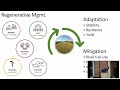
Regenerative Agriculture practices like minimizing tillage, maximizing crop and species diversity, keeping soil covered, and maintaining living roots build system stability and resilience, supported b
-
Regenerative agriculture increases diversity and reduces disturbance through practices like no-till, cover crops, and integrated animals. This fosters biodiversity, which replaces costly agrochemicals
-
Increasing crop diversity (aiming for ~20 species) and incorporating practices like double cropping, biofumigation (Sudan sorghum hybrid), and integrating animals builds farm resilience against climat

Community
-
Jon from Wild Roots Farm in Vermont advocates for regenerative practices like limited tillage, crop rotations, and rotational grazing to build resilience in food systems. He explains how these methods
Read more (opens in new window) smallfarms.cornell.edu -
Farmers must build resilience to intensifying climate change by using information tools for planning planting, irrigation, and harvesting, and by implementing management strategies to enhance soil hea
Read more (opens in new window) smallfarms.cornell.edu
Research
-
Systematic review of regenerative farming: Addressing agricultural sustainability challenges (opens in new window)
This study found: Systematic review of 31 studies shows regenerative farming improves soil health, biodiversity, and carbon capture, aiding sustainability. Technology is key for adoption, but policy, farmer understandi
-
The Imperative for Regenerative Agriculture (opens in new window)
This study found: Regenerative agriculture is vital for food security, climate change mitigation, and soil health. It improves soil organic carbon, water retention, and reduces erosion. Localized and urban food product
-
Regenerative Agriculture: Restoring Ecosystems¢ Resilience and Productivity: A Review (opens in new window)
This study found: Regenerative agriculture builds soil health and ecosystem services through practices like no-till, cover crops, and diverse rotations. It increases soil organic matter, improves water infiltration, bo
-
Regenerative Agriculture and Sustainable Plant Protection: Enhancing Resilience Through Natural Strategies (opens in new window)
This study found: Regenerative agriculture enhances crop protection and farm resilience by restoring ecosystems, reducing artificial inputs, and adopting agro-ecological pest control methods, promoting sustainability.
From the Web
-
Regenerative organic agriculture enhances crop resilience to extreme weather, yielding up to 40% higher during drought or flood, by prioritizing soil health and a thriving microbiome.
-
Regenerative agriculture enhances water retention, nutrient density, resilience to climate change, and provides significant economic and social benefits, empowering local communities and small farmers
-
Regenerative agriculture enhances water retention, nutrient density, and resilience, while also providing social and economic benefits by empowering local communities and small farmers.
5
The Evidence Base: What the Science and Practice Show
The understanding of how regenerative agriculture addresses food insecurity is built on a growing body of scientific research and decades of practical experience from farmers worldwide. Field trials and long-term farm studies consistently demonstrate improvements in key...
The Evidence Base: What the Science and Practice Show
The understanding of how regenerative agriculture addresses food insecurity is built on a growing body of scientific research and decades of practical experience from farmers worldwide. Field trials and long-term farm studies consistently demonstrate improvements in key...
The understanding of how regenerative agriculture addresses food insecurity is built on a growing body of scientific research and decades of practical experience from farmers worldwide. Field trials and long-term farm studies consistently demonstrate improvements in key agricultural indicators. For instance, research from the Rodale Institute and other agricultural research centers has shown that regenerative organic systems can build soil organic matter by 0.4-1.0% annually, leading to increased water infiltration rates and reduced erosion. These soil improvements are directly linked to higher and more stable crop yields, particularly in marginal or degraded land. A meta-analysis of over 100 studies indicated that organic and regenerative farming systems often match or even exceed conventional yields for certain crops, especially in average or dry years, suggesting a higher intrinsic resilience.
Specific on-farm data from North America, Europe, and Australia highlights tangible outcomes. In the Canadian Prairies, farmers practicing no-till farming with diverse cover crops have reported increases in soil water storage capacity by 15-25% over a decade, leading to improved drought resilience. In France, farmers participating in conservation agriculture programs have documented reductions in synthetic nitrogen fertilizer use by up to 30% within 5 years, achieved through thoughtful crop rotation including legumes and effective use of compost and manure, while maintaining comparable or improved yields for crops like wheat and maize. In Western Australia, the adoption of stubble retention and reduced tillage has been shown to increase soil organic carbon levels by 0.2-0.4% per year in many systems, contributing to better soil health and water retention.
While the broad benefits are clear, the precise impact on food security can vary significantly based on local agroecological conditions, socio-economic contexts, and the specific regenerative practices adopted. For example, the rate at which soil carbon increases or yields stabilize can differ based on climate, soil type, and farmer management across continents. However, the overarching trend is toward systems that are more resource-efficient, ecologically sound, and economically viable. This evidence base is continuously expanding, with ongoing research investigating the nutritional quality of food produced regeneratively, the long-term socio-economic impacts on farming communities, and the scalability of these practices across diverse global agricultural landscapes. The commitment to building soil health and biodiversity remains the consistent underlying principle driving these positive outcomes.
Sources behind this view
Sources behind this view
Videos & Podcasts
-
Regenerative agriculture provides solutions for climate change, human health, and soil degradation, contrasting with industrial agriculture's harmful impacts, including glyphosate use. Practices like
-
Case studies of farmers like Duane Beck, Kofi Boa, David Brandt, and Gabe Brown demonstrate that regenerative agriculture (no-till, cover crops, diverse rotations) significantly increases soil health,
-
Regenerative trials show dramatic improvements in soil aggregate depth (up to 15 inches in 4 years), increased microbial and plant diversity (123% in pastures without new seed), enhanced water infiltr
-
Regenerative farming, using no-till, cover crops, and diverse rotations, rapidly rebuilds soil organic matter and soil life. Examples from Ohio and Ghana show these practices increase profitability by

Community
-
Adopting no-till farming and non-GMO seeds improves soil health, reduces input costs (fuel, fertilizer, herbicides), and increases yields and profitability, leading to farmer adoption within 4-5 years
Read more (opens in new window) permies.com
Research
-
Systematic review of regenerative farming: Addressing agricultural sustainability challenges (opens in new window)
This study found: Systematic review of 31 studies shows regenerative farming improves soil health, biodiversity, and carbon capture, aiding sustainability. Technology is key for adoption, but policy, farmer understandi
-
Soil Microbial Dynamics in Regenerative Agriculture Systems: A Data-Driven Synthesis for Soil Health, Pest Suppression, and Yield Sustainability in the Western Canadian Prairies (opens in new window)
This study found: Regenerative farming in Western Canada boosts soil microbes (up to 86%), fungi (up to 60%), and carbon, improving soil health and water retention. This leads to more stable yields and reduced syntheti
-
Regenerative Agriculture: Restoring Ecosystems¢ Resilience and Productivity: A Review (opens in new window)
This study found: Regenerative agriculture builds soil health and ecosystem services through practices like no-till, cover crops, and diverse rotations. It increases soil organic matter, improves water infiltration, bo
-
Regenerative Agriculture in the 21st Century: A Systematic Review of Environmental, Agronomic, and Socio-Economic Outcomes (opens in new window)
This study found: Systematic review finds Regenerative Agriculture boosts environment but faces yield gaps (16-21%) and socio-economic barriers. Advocates for resilience over maximum yields, needing financial support a
From the Web
-
Regenerative and organic agriculture, based on agroecology, achieves higher yields and profitability than industrial methods by increasing soil organic matter through practices like cover crops and or
-
Regenerative and organic agriculture, based on agroecology, yields equal or higher crops than industrial methods, especially in droughts. Practices like cover crops, SRI, and regenerative grazing impr
-
A 7-year study of 78 European regenerative farms showed they outperform conventional farms in yields, reduce NPK fertilizer use by >75%, and significantly cut pesticides, while improving photosynthesi
-
Regenerative and adaptive grazing principles demonstrably improve soil health, sequester carbon, and rehabilitate ecosystems, leading to healthier food, profitable farms, and increased biodiversity, a
6
Know the Debate
Regenerative agriculture's potential to address food insecurity is multifaceted, operating on principles that enhance environmental health, ecosyst...
Know the Debate
Regenerative agriculture's potential to address food insecurity is multifaceted, operating on principles that enhance environmental health, ecosyst...
Regenerative agriculture's potential to address food insecurity is multifaceted, operating on principles that enhance environmental health, ecosystem services, social equity, and systemic resilience. While its ability to mitigate climate impacts and reduce input costs offers immediate benefits to farmers and local communities, the timeline for these improvements to translate into global food security varies significantly. Furthermore, the question of how effectively these practices can be scaled to impact commodity food systems remains a key point of discussion.
Food security benefits: Immediate gains vs. long-term realization
Immediate & Medium-Term Gains (2-5 years)
Regenerative practices enhance soil moisture and nutrient cycling, stabilizing yields and improving local food access within 2-5 years. Reduced input costs also bolster economic stability for farmers.
Long-Term Systemic Resilience (7-15 years)
Full realization of regenerative agriculture's benefits, including systemic resilience and input independence, requires 7-15 years of dedicated soil building. Short-term yield dips can initially challenge food security.
Making Sense of the Differences
The timeline for achieving meaningful food security benefits from regenerative agriculture varies. Farms can expect improvements in local food availability and on-farm stability within 2-5 years through practices like improved water management and reduced input costs. However, the broader systemic resilience, input independence, and widespread mitigation of food insecurity that rely on significant soil regeneration typically require a commitment of 7-15 years. This highlights the need for patience and strategic planning, recognizing that immediate gains complement the longer-term goal of robust and equitable food systems.
Scaling regenerative agriculture for global food security
Scalable to Commodity Levels
Regenerative principles like cover cropping and reduced tillage can be scaled to commodity operations, leveraging technology to enhance yields and resilience for global food security.
Context-Specific, Smaller Scales for True Regeneration
True regenerative agriculture requires localized observation and adaptive management, which is challenging at commodity scales; focus on smaller, context-specific systems for maximum impact on local food security.
Making Sense of the Differences
The scalability of regenerative agriculture for global food security is debated. Commodity-scale operations can adopt beneficial practices like cover cropping and reduced tillage to improve yields and reduce inputs, contributing incrementally to food availability more broadly. However, regenerative purists argue that true, systemic regeneration—characterized by deep soil health, biodiversity, and adaptive management—is best achieved at smaller, context-specific scales. These smaller systems often foster stronger local food security and community resilience. Balancing these approaches is key: leveraging scalable practices in large systems while nurturing context-driven regeneration in smaller ones.