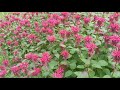
Bee Balm
Scarlet bee balm (*Monarda didyma*) offers several potential benefits within regenerative agriculture systems, though our current knowledge base coverage is limited. Its primary use appears to be as a valuable **pollinator support** plant, attracting hummingbirds and bumblebees, which is crucial for ecosystem health and crop pollination. Excerpt notes its attractiveness to these beneficial insects and its flowering period. While not explicitly a cover crop or nitrogen fixer in the excerpts, its inclusion in perennial gardens, alongside practices like deadheading to extend bloom, suggests its role in **polyculture layers** that enhance biodiversity. The plant's aromatic properties are mentioned for culinary uses, hinting at potential integration into intercropping or companion planting schemes. Farmer experience highlights its **vigorous spread** once established, indicating its potential for ground cover and soil building over time, though careful management might be needed. Ethical harvesting considerations are also noted, emphasizing sustainable wildcrafting practices.
For a full botanical description see: Wikipedia(opens in new window) (external link)
Regenerative Quick Profile
All recommendations assume integrated, regenerative practices—not conventional inputs.
Climate & Soil Fit
Climate: Tropical Rainforest, Tropical Monsoon, Tropical Savanna, Hot Semi-Arid (Steppe), Cold Semi-Arid (Steppe), Hot Desert, Cold Desert, Humid Subtropical, Oceanic (Maritime Temperate), Hot-Summer Mediterranean, Warm-Summer Mediterranean, Monsoon-Influenced Humid Subtropical, Subtropical Highland, Hot-Summer Continental, Warm-Summer Continental, Subarctic, Monsoon-Influenced Hot-Summer Continental, Tundra
Zones: USDA 4-9, Australian Zones 3-5
Optimal Soil: Loam Soil
System Role & Functions
Primary: Pollinator Support
Secondary: Cash Crop With Services, Cover Crop System
Key Benefits: Multi-benefit value
Management Level
Experience: Beginner-Friendly
Maintenance: Moderate maintenance - Thrives with ongoing soil moisture management and good air circulation to foster healthy plant communities. Division contributes to plant vigor and the overall cycling of organic matter within the system.
Value Streams
- Diversifies farm income
- Enhances biodiversity
4
System Role & Multi-Benefit Value
Functional roles, integration strategies, and stacked benefits
System Role & Multi-Benefit Value
Functional roles, integration strategies, and stacked benefits
Functional Role
Total System Value
Bee balm's primary contribution to whole-farm resilience lies in its exceptional pollinator support. By attracting bees and hummingbirds, it directly enhances the reproductive success of many agricultural crops, a crucial ecosystem service. Its aromatic properties and nectar production make it a valuable component of insectary plantings, supporting beneficial insect populations that can aid in pest control. While direct harvest value exists for culinary and medicinal uses (teas, spices), its most significant impact is through ecosystem services. It contributes to biodiversity by providing a food source for pollinators and can indirectly support wildlife. Its dense growth habit offers some potential for erosion control on slopes. Risk diversification is achieved by increasing the farm's ecological stability; a robust pollinator community is less susceptible to fluctuations and supports more consistent crop yields, reducing reliance on external inputs. Its value as a non-tree component diversifies the plant base beyond woody perennials.
Integration Characteristics
Multi-Benefit Value: Ideally Suited - A keystone species for supporting diverse pollinator populations, particularly bees and hummingbirds, while contributing to soil health and offering traditional medicinal uses as a native perennial.
Sources behind this view
 Research
-
Maximizing arthropod‐mediated ecosystem services in agricultural landscapes: the role of native plants (opens in new window)
Native plants can boost beneficial insects on farms, providing pollination and pest control services worth billions. They offer crucial food sources and habitat, especially in moderately complex lands
7
Learn More
Why farmers use this plant and additional resources
Learn More
Why farmers use this plant and additional resources
Why Regenerative Farmers Use This Plant
Monarda didyma, commonly known as Bee Balm or Scarlet Monarda, is a highly valuable perennial for regenerative agriculture systems, primarily for its exceptional ecological contributions. Its vibrant, nectar-rich flowers are a powerful attractant for a wide array of pollinators, including native bees, bumblebees, butterflies, and hummingbirds, often supporting peak bloom during mid-summer when other floral resources may be scarce. A single plant can attract hundreds of pollinator visits daily, and a well-established patch can support an estimated 50-100 pollinator visits per hour during peak bloom, contributing to the overall health and productivity of surrounding agricultural landscapes by enhancing pollination services for nearby crops. Studies on similar native bee-attracting plants indicate that a well-established patch can support a significant increase in local pollinator populations, with observed increases in bee diversity and abundance by 15-25%.
Beyond its direct pollinator support, Monarda didyma contributes to soil health through its fibrous root system, which helps to bind soil particles, reduce erosion on slopes and in garden beds, and improve soil structure and water infiltration. Its deep fibrous root system can reach 1-2 feet (30-60 cm) in depth. While not a nitrogen fixer, its decomposition contributes organic matter to the soil, enhancing microbial activity and nutrient cycling over time. The dense foliage contributes to soil health by adding organic matter annually, estimated at 1-2 tons per acre (2.2-4.5 metric tons/ha) of above-ground biomass, which decomposes to enrich the soil. Improved soil structure from its root activity can enhance water infiltration rates by 10-15% in its immediate vicinity, making the landscape more resilient to drought. In systems where it is allowed to naturalize, it can form robust ground cover, suppressing weeds and reducing the need for mechanical or chemical weed management.
The aromatic foliage also possesses antimicrobial properties and contains compounds that can deter certain pests and diseases, offering a degree of natural pest resistance to nearby plants and contributing to a more resilient farm ecosystem. Its presence can attract beneficial insects that prey on common agricultural pests, potentially reducing the need for interventions by up to 20-30% in adjacent crops. In some regions, the leaves and flowers have traditional medicinal uses, offering potential for a small-scale specialty market or value-added products.
Monarda didyma has found success in diverse regenerative systems globally. In the United States, it is commonly integrated into pollinator strips and hedgerows on organic farms in the Midwest and Northeast, supporting bee populations in corn and soybean rotations. In the Pacific Northwest, it is often incorporated into pollinator strips alongside organic berry farms, supporting the bees essential for fruit set. In Europe, it is utilized in wildflower meadows and ecological landscaping projects across the UK and Germany, enhancing biodiversity in agricultural margins. European farmers have integrated it into wildflower meadows and hedgerows to bolster populations of wild bees crucial for crop pollination. Australian farmers are increasingly incorporating native and naturalized flowering plants like Monarda into their pasture systems and riparian buffer zones to support native pollinators and improve ecosystem function in dryland farming regions. Australian farmers in temperate regions are exploring its use in native plant gardens and conservation areas to support local insect populations and enhance landscape aesthetics. In Brazilian coffee plantations, it can be used as an understory plant in shaded areas, providing pollinator support and ground cover.
Sources behind this view
 Videos & Podcasts
-
Bee balm (Monarda didyma) is an easy-to-propagate plant, spreading via rhizomes. Small root pieces can yield thousands of plants, and it attracts hummingbirds and bumblebees, flowering for 3-4 weeks.