
How does regenerative farming affect farmer wellbeing?
Regenerative farming fundamentally shifts the farmer's relationship with their land and livelihood, fostering enhanced physical and mental wellbeing. By intensifying biological processes and diversifying income streams, regenerative systems often reduce reliance on high-cost external inputs, leading to greater financial stability and less risk. This approach encourages a more holistic connection to the farm, promoting autonomy, community engagement, and a profound sense of purpose derived from ecological stewardship.
Read More: Complete Description
Sources behind this view
Sources behind this view
 Videos & Podcasts
-
Regenerative grazing boosts farmer well-being by cutting medical costs (by ~10%) and operating expenses through better animal health, reduced pest cycles, and less reliance on hay production. The work

-
Regenerative practices boost profitability by 76% (Dr. Jonathan Lundgren), significantly reducing financial stress and improving mental health for farmers and ranchers, making agriculture more attract

-
Regenerative farming revitalizes soil life and health through organic matter and microbiology, enabling carbon cycling and combating climate change, while fostering a deep spiritual connection to natu
-
Regenerative agriculture benefits ecosystems by improving soil health, biodiversity, water quality, and wildlife habitats, while also enhancing farm worker conditions and community well-being.

 Research
-
Regenerative Agriculture: Restoring Ecosystems¢ Resilience and Productivity: A Review (opens in new window)
This study found: Regenerative agriculture builds soil health and ecosystem services through practices like no-till, cover crops, and diverse rotations. It increases soil organic matter, improves water infiltration, bo
-
Systematic review of regenerative farming: Addressing agricultural sustainability challenges (opens in new window)
This study found: Systematic review of 31 studies shows regenerative farming improves soil health, biodiversity, and carbon capture, aiding sustainability. Technology is key for adoption, but policy, farmer understandi
-
Understanding the phases and tensions of regenerative agriculture for better health outcomes for farmers (opens in new window)
This study found: Switching to regenerative farming has distinct stages and challenges impacting farmer mental health, requiring tailored support during transitions.
-
Why Regenerative Agriculture? (opens in new window)
This study found: Regenerative agriculture rebuilds soil health, boosts biodiversity, and protects water by emulating nature. It captures atmospheric carbon, offering a low-cost climate solution and producing nutritiou
Key Points
Rural Vitality
- Reduced financial stress through lower input costs.
- Increased farm autonomy and decision-making power.
- Stronger community ties through knowledge sharing networks.
- Renewed sense of purpose and connection to land.
Environmental Impact
- Reduced exposure to hazardous synthetic inputs.
- Improved physical health from less toxic work environment.
- Stewardship fosters connection and reduces ecological anxiety.
- Observing ecological recovery enhances psychological wellbeing.
Food System Resilience
- More predictable farm income due to ecological stability.
- Greater capacity to adapt to climate shocks.
- Diversified enterprises reducing reliance on single markets.
- Enhanced farm resilience benefits local food security.
Know the Debate
- Regenerative farming can boost wellbeing, but transition stress is real.
- Economic benefits improve stability and reduce financial pressure.
- Connection to land and community fosters purpose and autonomy.
Going Deeper
1
Economic Stability and Reduced Financial Risk
The economic benefits of regenerative agriculture are a cornerstone of improved farmer wellbeing. A significant aspect is the reduction in reliance on expensive external inputs. For many farmers globally, the cost of synthetic fertilizers, pesticides, and herbicides...
Economic Stability and Reduced Financial Risk
The economic benefits of regenerative agriculture are a cornerstone of improved farmer wellbeing. A significant aspect is the reduction in reliance on expensive external inputs. For many farmers globally, the cost of synthetic fertilizers, pesticides, and herbicides...
The economic benefits of regenerative agriculture are a cornerstone of improved farmer wellbeing. A significant aspect is the reduction in reliance on expensive external inputs. For many farmers globally, the cost of synthetic fertilizers, pesticides, and herbicides represents a substantial portion of their operating expenses. By transitioning to practices that leverage biological fertility, pest regulation, and weed suppression, farmers can significantly decrease this financial burden. For example, a dairy farm in Central California implementing rotational grazing and cover cropping saw a reduction in their annual feed and fertility costs by approximately $75/cow/year ($185/cow/year) over a 5-year transition period, reinvesting those savings into their operation and personal finances.
This reduced input cost directly translates into greater profit margins and improved cash flow. Furthermore, regenerative systems are inherently more resilient to market volatility. With diversified income streams from multiple crops, livestock, and potentially ecosystem services payments (e.g., carbon credits), farmers are less vulnerable to price collapses in single commodities. In the Canadian Prairies, farmers integrating livestock into grain operations have reported that the combined enterprises offer a more stable income than grain alone, averaging a 10-20% increase in net income predictability over 3-7 years. This economic security lessens the constant pressure of financial uncertainty, a major source of stress for farmers worldwide.
Sources behind this view
Sources behind this view
Videos & Podcasts
-
Case studies of farmers like Duane Beck, Kofi Boa, David Brandt, and Gabe Brown demonstrate that regenerative agriculture (no-till, cover crops, diverse rotations) significantly increases soil health,

-
A North Dakota farmer achieved significant economic success through regenerative agriculture, reducing fertilizer (40-60%), eliminating seed treatments, fungicides, and crop burndown, and cutting herb

-
Regenerative agriculture provides solutions for climate change, human health, and soil degradation, contrasting with industrial agriculture's harmful impacts, including glyphosate use. Practices like

-
Nicolas Fraser (Soil Capital) states financial barriers are key to regenerative transition. He advises optimizing agrochemical/external input use (10-40% savings possible) to generate internal funds f

 Community
-
Adopting no-till farming and non-GMO seeds improves soil health, reduces input costs (fuel, fertilizer, herbicides), and increases yields and profitability, leading to farmer adoption within 4-5 years
Read more (opens in new window) permies.com
Research
-
Regenerative Agriculture: Restoring Ecosystems¢ Resilience and Productivity: A Review (opens in new window)
This study found: Regenerative agriculture builds soil health and ecosystem services through practices like no-till, cover crops, and diverse rotations. It increases soil organic matter, improves water infiltration, bo
-
Soil Microbial Dynamics in Regenerative Agriculture Systems: A Data-Driven Synthesis for Soil Health, Pest Suppression, and Yield Sustainability in the Western Canadian Prairies (opens in new window)
This study found: Regenerative farming in Western Canada boosts soil microbes (up to 86%), fungi (up to 60%), and carbon, improving soil health and water retention. This leads to more stable yields and reduced syntheti
-
Regenerative Livestock Farming as a Socioeconomic Model for Sustainable Agribusiness in Latin America (opens in new window)
This study found: Regenerative livestock farming in Latin America improved soil carbon, biodiversity, and water quality, while boosting farmer income and quality of life. Government support is key for wider adoption.
-
Regenerative Almond Production Systems Improve Soil Health, Biodiversity, and Profit (opens in new window)
This study found: Regenerative almond farms in California doubled profits and improved soil health and biodiversity by combining practices like cover crops, compost, and reduced synthetic inputs, with no yield loss.
 From the Web
-
Regenerative farming combines no-till, cover crops, and complex rotations, often with livestock grazing, to boost profitability by reducing input costs and increasing soil organic matter. Studies show
-
Regenerative ranching benefits include increased soil organic matter, reduced erosion, improved water retention, enhanced profitability, carbon sequestration, and increased wildlife habitat, achieved
-
Regenerative agriculture, combining minimal disturbance, cover cropping, and diversified rotations, rebuilds soil fertility, significantly reduces input costs (fertilizers, pesticides, diesel), and ma
-
Regenerative agriculture aligns environmental and financial goals by improving soil health, leading to cost savings and better plant nutrition. This approach demonstrates economic viability, encouragi
2
Enhanced Autonomy and Decision-Making Power
Regenerative agriculture empowers farmers by returning control over their production systems. Conventional agriculture often necessitates adherence to prescribed chemical application schedules and crop rotations dictated by input manufacturers or tightly regulated market...
Enhanced Autonomy and Decision-Making Power
Regenerative agriculture empowers farmers by returning control over their production systems. Conventional agriculture often necessitates adherence to prescribed chemical application schedules and crop rotations dictated by input manufacturers or tightly regulated market...
Regenerative agriculture empowers farmers by returning control over their production systems. Conventional agriculture often necessitates adherence to prescribed chemical application schedules and crop rotations dictated by input manufacturers or tightly regulated market demands. Regenerative approaches, conversely, emphasize observation, adaptation, and context-specific solutions. Farmers become diagnosticians and system designers rather than mere operators of prescribed technologies. This shift fosters a sense of agency and autonomy.
Consider the experience of farmers in the European Union adopting agroecological practices, often supported by national policies that encourage ecological farming. They report feeling more in tune with their land and less beholden to external directives. The ability to make informed decisions based on the biological indicators of their farm, rather than defaulting to a generic product recommendation, can be psychologically liberating. This increased autonomy can reduce feelings of powerlessness and enhance job satisfaction, contributing to a more positive mental state and a stronger sense of professional identity.
Sources behind this view
Sources behind this view
Videos & Podcasts
-
Matt Haggetty returned to the family farm due to regenerative agriculture's dynamic decision-making, diversification opportunities, and reduced workload/costs. This approach fosters business resilienc

-
Regenerative agriculture offers a solution to soil degradation by combining minimal disturbance, cover crops, and diversified rotations. This approach reduces input costs (fertilizer, pesticides, dies
-
Regenerative farming re-cultivates farmers' observation skills, enabling them to tune into nature, understand plant/soil responses, and recognize ecosystem benefits like microbial life and beneficial

-
Regenerative agriculture necessitates holistic management, shifting from reductionist decision-making (meeting needs/desires/problems) to a proactive approach within a holistic context that integrates

Research
-
Regenerative Agriculture: Restoring Ecosystems¢ Resilience and Productivity: A Review (opens in new window)
This study found: Regenerative agriculture builds soil health and ecosystem services through practices like no-till, cover crops, and diverse rotations. It increases soil organic matter, improves water infiltration, bo
-
Regenerative agriculture for sustainable crop productivity: A comprehensive review (opens in new window)
This study found: Regenerative Agriculture revitalizes soil by minimizing disturbance, maximizing living roots, fostering diversity, and reducing synthetic inputs. It improves soil health, carbon sequestration, and cro
-
Regenerative Agriculture and Sustainable Plant Protection: Enhancing Resilience Through Natural Strategies (opens in new window)
This study found: Regenerative agriculture enhances crop protection and farm resilience by restoring ecosystems, reducing artificial inputs, and adopting agro-ecological pest control methods, promoting sustainability.
-
Healthy people, soils, and ecosystems: uncovering primary drivers in the adoption of regenerative agriculture by US farmers and ranchers (opens in new window)
This study found: US farmers and ranchers adopt regenerative agriculture primarily to improve human, soil, and ecosystem health, driven by relational values and a rejection of industrial farming, with economic factors
3
Improved Physical Health and Reduced Occupational Hazards
The shift away from synthetic pesticides and herbicides in regenerative farming has a direct, positive impact on the physical health of farmers and farm workers. Exposure to these chemicals has been linked to a range of health issues, including neurological disorders,...
Improved Physical Health and Reduced Occupational Hazards
The shift away from synthetic pesticides and herbicides in regenerative farming has a direct, positive impact on the physical health of farmers and farm workers. Exposure to these chemicals has been linked to a range of health issues, including neurological disorders,...
The shift away from synthetic pesticides and herbicides in regenerative farming has a direct, positive impact on the physical health of farmers and farm workers. Exposure to these chemicals has been linked to a range of health issues, including neurological disorders, respiratory problems, and certain types of cancer. By phasing out these inputs, regenerative systems create a safer working environment. A farmer in the Indian state of Gujarat, who transitioned from synthetic to bio-dynamic farming 8 years ago, reports a significant improvement in their chronic respiratory issues and a general increase in energy levels, attributable to the absence of chemical sprays.
Furthermore, regenerative practices can lead to a more balanced workload. While regenerative farming can be intensive, the focus shifts from reactive crisis management (e.g., spraying for an emerging pest infestation) to proactive, observational, and ecological building. This can allow for better planning of labor distribution throughout the year, reducing the extreme peaks of physical demand that often lead to burnout. For instance, integrating cover crops and no-till methods in South America reduces the need for heavy pre-planting tillage operations, redistributing labor across a broader season. This improved work-life balance contributes to better physical health and reduces the risk of injury and overuse syndromes.
Sources behind this view
Sources behind this view
Videos & Podcasts
-
Regenerative agriculture provides solutions for climate change, human health, and soil degradation, contrasting with industrial agriculture's harmful impacts, including glyphosate use. Practices like
-
Regenerative grazing boosts farmer well-being by cutting medical costs (by ~10%) and operating expenses through better animal health, reduced pest cycles, and less reliance on hay production. The work
-
Regenerative farming reduces synthetic fertilizer and pesticide costs (30-50% and up to 75% respectively, per USDA) by building soil organic matter, improving soil chemistry, and enhancing microbial d
-
Regenerative agriculture enhances human health by increasing food nutrient density and supporting the gut microbiome. It also reduces reliance on fossil fuels and off-farm inputs like phosphate rock b

Research
-
Regenerative Agriculture: Restoring Ecosystems¢ Resilience and Productivity: A Review (opens in new window)
This study found: Regenerative agriculture builds soil health and ecosystem services through practices like no-till, cover crops, and diverse rotations. It increases soil organic matter, improves water infiltration, bo
-
Systematic review of regenerative farming: Addressing agricultural sustainability challenges (opens in new window)
This study found: Systematic review of 31 studies shows regenerative farming improves soil health, biodiversity, and carbon capture, aiding sustainability. Technology is key for adoption, but policy, farmer understandi
-
Regenerative Agriculture and Sustainable Plant Protection: Enhancing Resilience Through Natural Strategies (opens in new window)
This study found: Regenerative agriculture enhances crop protection and farm resilience by restoring ecosystems, reducing artificial inputs, and adopting agro-ecological pest control methods, promoting sustainability.
-
Regenerative agriculture: merging farming and natural resource conservation profitably (opens in new window)
This study found: Regenerative corn farming in the Northern Plains yielded 78% higher profits than conventional methods, despite lower grain production, due to improved soil health and reduced pest issues.
4
Stronger Community Connections and Knowledge Exchange
Regenerative agriculture fosters vibrant, supportive community networks. As farmers transition, they often seek out peers and mentors who are further along in their regenerative journey. This leads to the formation of farmer-to-farmer learning circles, collaborative...
Stronger Community Connections and Knowledge Exchange
Regenerative agriculture fosters vibrant, supportive community networks. As farmers transition, they often seek out peers and mentors who are further along in their regenerative journey. This leads to the formation of farmer-to-farmer learning circles, collaborative...
Regenerative agriculture fosters vibrant, supportive community networks. As farmers transition, they often seek out peers and mentors who are further along in their regenerative journey. This leads to the formation of farmer-to-farmer learning circles, collaborative research projects, and knowledge-sharing platforms. These networks go beyond mere technical advice; they provide emotional support, reduce feelings of isolation, and build collective efficacy. In New Zealand, farmer groups focused on regenerative dairy farming are actively sharing data on soil carbon sequestration rates and pasture productivity improvements, demonstrating a high level of transparency and mutual support.
These communities often address challenges not just on individual farms but at a landscape or regional level. This collaborative spirit extends to engaging with local consumers, policymakers, and other stakeholders. The shared goal of building a more sustainable and resilient food system creates strong social bonds. For example, community-supported agriculture (CSA) initiatives rooted in regenerative principles often involve farmers directly interacting with their customers, fostering a sense of shared investment in the farm's success and its ecological mission. This interconnectedness combats the isolation that can plague agricultural professions and builds a powerful sense of belonging.
Sources behind this view
Sources behind this view
Videos & Podcasts
-
Farmers are advised to join regenerative farming communities, engage with impact investors, and focus on value-adding and regional food systems. Food and agriculture are presented as key solutions to

-
Farmers are encouraged to collaborate and form cooperatives, similar to historical Australian models, to build local brands, become price-makers, and achieve economic resilience within the regenerativ
-
Regenerative agriculture thrives on community, continuous learning, and mindset shifts, drawing from indigenous wisdom and fostering empathy. Practical advice includes joining networks, asking 'why' a

-
Regenerative agriculture boosts profitability, revitalizes rural communities by supporting multiple families per farm, and enables farm succession. Robust supply chains are key to realizing these bene

Research
-
Regenerative Agriculture: Restoring Ecosystems¢ Resilience and Productivity: A Review (opens in new window)
This study found: Regenerative agriculture builds soil health and ecosystem services through practices like no-till, cover crops, and diverse rotations. It increases soil organic matter, improves water infiltration, bo
-
Motivations behind regenerative agriculture: A systematic literature review (opens in new window)
This study found: Studies show environmental reasons are key for regenerative agriculture adoption, supported by economic/social factors. Challenges include transition, incentives, and policy gaps, requiring better far
-
Beyond the buzz: analyzing actors promoting regenerative agriculture in Europe (opens in new window)
This study found: European study shows regenerative agriculture, initially farmer-led, is now heavily promoted by non-farming groups, with a focus on soil health and biodiversity. Cover cropping and crop diversificatio
-
Regenerative agriculture and a more-than-human ethic of care: a relational approach to understanding transformation (opens in new window)
This study found: Regenerative agriculture involves a mindset shift and caring for nature, leading to holistic views of farm ecosystems. This relational approach is key to transforming food systems, as shown by farmer
From the Web
-
Community and mentorship, both local and online, are crucial for adopting regenerative practices. Networks like Practical Farmers of Iowa and resources like YouTube and podcasts facilitate knowledge s
5
Renewed Sense of Purpose and Ecological Connection
Perhaps one of the most profound impacts of regenerative agriculture on farmer wellbeing is the cultivation of a renewed sense of purpose and a deeper connection to the natural world. Stewardship of the land becomes not just a job but a calling. Witnessing tangible...
Renewed Sense of Purpose and Ecological Connection
Perhaps one of the most profound impacts of regenerative agriculture on farmer wellbeing is the cultivation of a renewed sense of purpose and a deeper connection to the natural world. Stewardship of the land becomes not just a job but a calling. Witnessing tangible...
Perhaps one of the most profound impacts of regenerative agriculture on farmer wellbeing is the cultivation of a renewed sense of purpose and a deeper connection to the natural world. Stewardship of the land becomes not just a job but a calling. Witnessing tangible improvements in soil health, the return of beneficial insects, the clarity of water, and the overall vitality of the ecosystem provides a profound sense of accomplishment. Farmers become active participants in ecological restoration, seeing their land flourish under their care.
Farmers who have adopted regenerative practices often describe a feeling of being "in sync" with nature, rather than fighting against it. This holistic perspective can reduce feelings of stress and anxiety often associated with the pressures of modern agriculture. For example, a farmer in Ireland utilizing holistically managed grazing and establishing buffer strips along waterways reports that observing the increased birdlife and insect populations on their land provides daily moments of joy and deep satisfaction, reinforcing their commitment to ecological stewardship. This connection to nature can foster a more positive outlook and a greater appreciation for life's fundamental processes.
Sources behind this view
Sources behind this view
Videos & Podcasts
-
Key benefits of regenerative farming include increased yields and profitability, enhanced nutrient density in products linked to soil health and gut biome, and working in harmony with natural biologic

-
Regenerative agriculture resolves the farmer's internal conflict between stewardship and the 'warfare' of conventional pest control, restoring joy, hope, and soul satisfaction by fostering life instea

-
Regenerative agriculture benefits ecosystems by improving soil health, biodiversity, water quality, and wildlife habitats, while also enhancing farm worker conditions and community well-being.
-
Regenerative farming re-cultivates farmers' observation skills, enabling them to tune into nature, understand plant/soil responses, and recognize ecosystem benefits like microbial life and beneficial
Research
-
Regenerative Agriculture: Restoring Ecosystems¢ Resilience and Productivity: A Review (opens in new window)
This study found: Regenerative agriculture builds soil health and ecosystem services through practices like no-till, cover crops, and diverse rotations. It increases soil organic matter, improves water infiltration, bo
-
Healthy people, soils, and ecosystems: uncovering primary drivers in the adoption of regenerative agriculture by US farmers and ranchers (opens in new window)
This study found: US farmers and ranchers adopt regenerative agriculture primarily to improve human, soil, and ecosystem health, driven by relational values and a rejection of industrial farming, with economic factors
-
Understanding the phases and tensions of regenerative agriculture for better health outcomes for farmers (opens in new window)
This study found: Switching to regenerative farming has distinct stages and challenges impacting farmer mental health, requiring tailored support during transitions.
-
Importance of regenerative agriculture: climate, soil health, biodiversity and its socioecological impact (opens in new window)
This study found: Regenerative agriculture is a vital solution for sustainability, improving soil health, biodiversity, and mitigating climate change without sacrificing yields or profits. It's gaining attention for it
6
Resilience in the Face of Climate Change
Regenerative practices build inherent resilience into farm systems, which is crucial for farmer wellbeing in an era of increasing climate volatility. By improving soil structure, increasing soil organic matter, and enhancing ground cover, regenerative farms are better...
Resilience in the Face of Climate Change
Regenerative practices build inherent resilience into farm systems, which is crucial for farmer wellbeing in an era of increasing climate volatility. By improving soil structure, increasing soil organic matter, and enhancing ground cover, regenerative farms are better...
Regenerative practices build inherent resilience into farm systems, which is crucial for farmer wellbeing in an era of increasing climate volatility. By improving soil structure, increasing soil organic matter, and enhancing ground cover, regenerative farms are better equipped to handle extreme weather events. Improved water infiltration means better drought resistance, while increased soil aggregation and reduced disturbance can mitigate erosion during heavy rainfall and floods. This resilience reduces the risk of catastrophic crop failure and the associated financial and emotional devastation.
For instance, farmers in Southern India have found that integrating crop diversification and on-farm water harvesting techniques significantly reduces their vulnerability to the erratic monsoon patterns. When one crop suffers from drought or excessive rain, others may still thrive, providing a more stable harvest. This buffer against unpredictable events allows farmers to maintain their livelihoods with less anxiety. The knowledge that their farm is physically more robust and adaptable to changing environmental conditions provides a significant psychological comfort, boosting confidence and reducing stress associated with climate uncertainty.
Sources behind this view
Sources behind this view
Videos & Podcasts
-
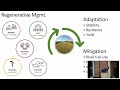
Regenerative Agriculture practices like minimizing tillage, maximizing crop and species diversity, keeping soil covered, and maintaining living roots build system stability and resilience, supported b
-
Increasing crop diversity (aiming for ~20 species) and incorporating practices like double cropping, biofumigation (Sudan sorghum hybrid), and integrating animals builds farm resilience against climat

-
Building resilience involves enhancing soil resilience through integrated farming systems that promote nutrient and water cycling, climate regulation, and carbon sequestration by diversifying from mon

-
Gradual transition to regenerative systems is advised, prioritizing knowledge sharing. Increased soil organic matter (0.1% increase = 16,000 L/ha water holding) builds resilience against drought and w
Community
-
Farmers can modify microclimates and build resilience through practices like agroforestry, no-till, and cover crops, which improve soil health, water availability, and crop resistance to climate chall
Read more (opens in new window) smallfarms.cornell.edu -
A Central Iowa farm built climate resilience through no-till planting, rigorous cover cropping, infrastructure improvements, and diversified systems, preventing damage from extreme weather events.
Read more (opens in new window) smallfarms.cornell.edu -
Organic farmers can build climate resilience by assessing climate risk and using ecosystem-based adaptive management tools, learning from successful strategies for managing weather variability and ext
Read more (opens in new window) permies.com -
Farmers must build resilience to intensifying climate change by using information tools for planning planting, irrigation, and harvesting, and by implementing management strategies to enhance soil hea
Read more (opens in new window) smallfarms.cornell.edu
Research
-
Spotlight on agroecological cropping practices to improve the resilience of farming systems: a qualitative review of meta-analytic studies (opens in new window)
This study found: Agroecological practices like crop diversification and ecological soil management are key to farm resilience. Cover crops, no-till, and organic matter addition are vital. Outcomes are site-specific, r
-
Managing soil health for climate resilience and crop productivity in a changing environment. (opens in new window)
This study found: Climate change and poor farming degrade soil, reducing yields and resilience. Improving soil health through diverse practices like conservation agriculture and beneficial microbes, tailored to local c
-
Assessing the Resilience of Regenerative Agricultural Systems to Climate Change: A Scenario-Based Systemic Analysis Framework (opens in new window)
This study found: Regenerative farming practices alone aren't enough for climate resilience. Farms need systems to track and prove environmental benefits to access financial support and withstand climate shocks.
-
FORAGES AND PASTURES SYMPOSIUM: COVER CROPS IN LIVESTOCK PRODUCTION: WHOLE-SYSTEM APPROACH: Managing grazing to restore soil health and farm livelihoods1 (opens in new window)
This study found: Regenerative grazing management is key to sustainable, climate-resilient farms. It restores soil health, enhances ecosystem services like carbon capture and water infiltration, and improves farm profi
From the Web
-
Regenerative organic agriculture enhances crop resilience to extreme weather, yielding up to 40% higher during drought or flood, by prioritizing soil health and a thriving microbiome.
-
Regenerative agriculture enhances water retention, nutrient density, resilience to climate change, and provides significant economic and social benefits, empowering local communities and small farmers
-
Farm resilience is built through environmental health (soil health, cover crops, diverse cropping, rotational grazing), financial diversity (multiple markets/products), and social connections (communi
-
Climate change impacts agriculture with extreme weather and new pests; solutions include agroforestry and perennial pastures to build resilience and reduce greenhouse gas emissions.
7
Know the Debate
Regenerative agriculture's impact on farmer wellbeing extends beyond soil health to encompass economic, social, and psychological dimensions. While...
Know the Debate
Regenerative agriculture's impact on farmer wellbeing extends beyond soil health to encompass economic, social, and psychological dimensions. While...
Regenerative agriculture's impact on farmer wellbeing extends beyond soil health to encompass economic, social, and psychological dimensions. While it promises greater financial stability through reduced inputs and enhanced resilience, and fosters a deeper connection to the land through ecological stewardship, the transition period can introduce significant stress. The journey involves navigating new practices, potential economic uncertainty, and varying levels of community support. Understanding these nuances is crucial for appreciating the full spectrum of wellbeing outcomes.
Does regenerative farming boost farmer wellbeing?
Enhanced Wellbeing through Systemic Change
Regenerative practices fundamentally improve farmer wellbeing by reducing financial anxiety through lower input costs, increasing farm autonomy, and fostering a deep connection to land and community. This systemic shift leads to greater purpose and resilience.
Transition Stress Outweighs Long-Term Gains (Initially)
The learning curve, potential yield dips, and financial risks during transition create significant stress. Achieving wellbeing benefits often requires weathering this challenging period and depends heavily on external support systems and prior financial stability.
Making Sense of the Differences
The path to improved wellbeing through regenerative farming is often non-linear. While established practitioners report profound increases in purpose, reduced financial anxiety, and stronger community bonds, the transition period can introduce considerable stress. This often stems from learning curves, potential yield dips, climate volatility impacting new systems, and dealing with skepticism. Farmer experience varies significantly based on local support networks, institutional policies (subsidies, advice), and pre-existing financial and mental health.